


Pseudonymization of confidential accounting data is defined by Article 4(5) of the GDPR as the processing that replaces identifying information with codes or pseudonyms while retaining the possibility of re-identification under strict control. This technique is fundamentally distinct from anonymization, which irreversibly removes all links to the individual. For finance and accounting professionals, mastering this distinction is not optional. The GDPR, national commercial codes, and recent case law from the Court of Justice of the European Union (CJEU) impose precise obligations on the protection and retention of sensitive data.
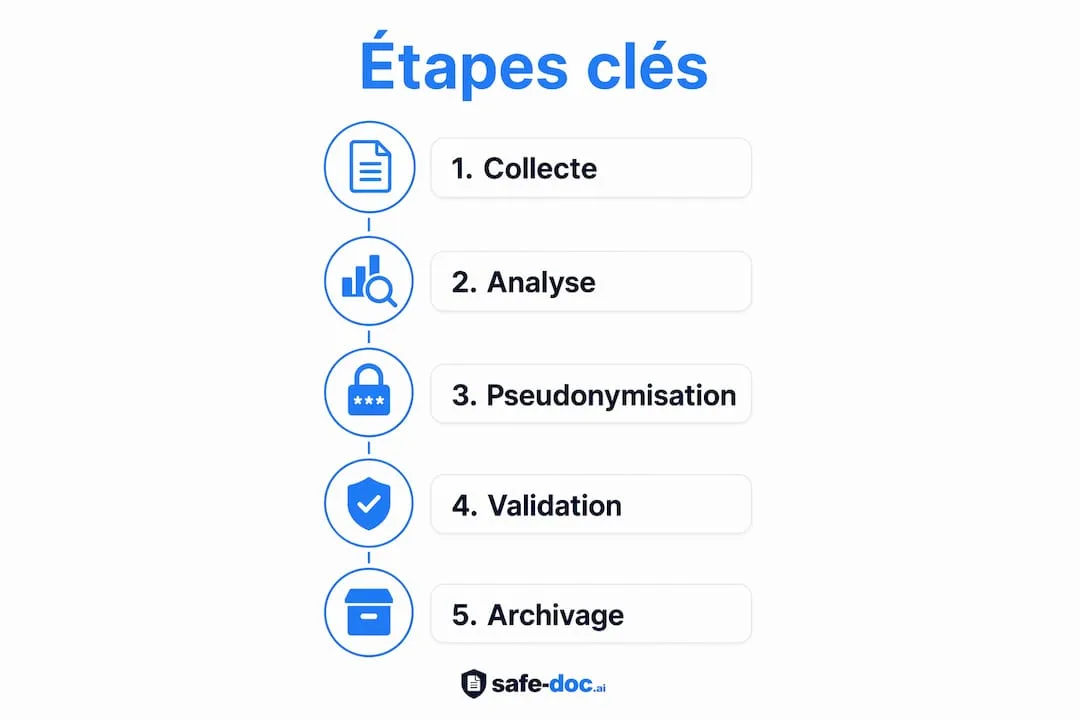
Table of contents
- What are the legal obligations to protect sensitive accounting data?
- What tools and methods effectively pseudonymize accounting data?
- How to integrate pseudonymization into accounting and audit processes
- What are the real benefits and limits of accounting pseudonymization?
- Key points
- What practice has taught me about accounting pseudonymization
- Safe-doc: pseudonymize your accounting data without changing your tools
- Frequently asked questions
What are the legal obligations to protect sensitive accounting data?
Accounting documents must be retained for 10 years after the close of the financial year, in accordance with article L123-22 of the French Commercial Code. This legal retention period does not exempt compliance with the GDPR for all personal data contained in these documents. Beyond this period, personal data must be deleted or irreversibly anonymized.
The GDPR applies to all personal data processed in an accounting context: customer names, supplier contact details, IBAN numbers, and employee references. This information appears in invoices, accounting journals, and Accounting Entry Files (FEC). Their presence in long-term documents creates an obligation for active protection throughout the retention period.
The CJEU judgment of 4 September 2025 significantly strengthened these requirements. According to this decision, the obligation of transparency regarding recipients of pseudonymized data falls to the data controller, even if those recipients cannot re-identify individuals. This means accounting firms must document precisely who receives pseudonymized data, in what context, and for what duration.
The main obligations to respect are:
- Secure retention: personal data in accounting documents must be protected throughout the legal retention period.
- Deletion or anonymization: beyond 10 years, personal data must be erased or made irreversibly anonymous.
- Documented transparency: since the 2025 CJEU ruling, any flow of pseudonymized data to a third party must be recorded in the processing register.
- Up-to-date GDPR register: pseudonymization processing, retention periods, and access control measures must be explicitly documented.
Remember: Pseudonymization remains subject to the GDPR. It reduces risk but does not eliminate legal obligations related to personal data.
What tools and methods effectively pseudonymize accounting data?
Pseudonymization relies on three main families of techniques. Each has characteristics suited to different contexts.

Tokens, hashes and generic codes
Tokenization replaces a sensitive value (an IBAN, a company registration number) with a random identifier stored in a secure correspondence table. Cryptographic hashing (SHA-256, for example) transforms data into a non-reversible digital fingerprint without the key. Generic codes assign neutral labels like CLIENT_001 or SUPPLIER_042 to each entity. Using consistent pseudonyms maintains the traceability necessary for auditing while protecting real identities.
Local automation versus cloud processing
| Criterion | Local processing | External cloud processing |
|---|---|---|
| Data sovereignty | Total: data never leaves the system | Partial or none depending on contract |
| GDPR Compliance | Facilitated: no transfer outside perimeter | Requires specific contractual guarantees |
| Leakage risk | Minimal | High in case of provider breach |
| AI Integration | Possible with local tools or prior pseudonymization | Risk of exposure if data not pseudonymized before sending |
Local automation is recommended to preserve data sovereignty and facilitate the use of artificial intelligence tools within firms. Local processing avoids exposing sensitive data to external cloud platforms, which constitutes the primary risk vector in financial environments.
Pseudonymization of the Accounting Entry File
The FEC is a regulatory file that concentrates all accounting entries for a financial year. Its pseudonymization requires neutralizing not only names but also sensitive references such as invoice numbers, IBANs, and tax identifiers. A pseudonymized FEC retains full analytical value for auditing or AI processing without exposing third-party personal data.
Pro tip: Before submitting an FEC to an external AI tool, systematically apply local pseudonymization. Replace each IBAN with a code like IBAN_001, each company name with SOCIETE_001. Store the correspondence table in an encrypted environment accessible only to the data controller.
How to integrate pseudonymization into accounting and audit processes
Effective pseudonymization follows a five-step protocol. Each step determines the compliance of the entire process.
1. Identify sensitive data: inventory all categories of personal data present in your accounting documents. Customer names, supplier contacts, salaries, IBANs, and tax identification numbers constitute priority categories.
2. Define the replacement method: choose between tokenization, hashing, or generic codes depending on the required level of reversibility. For internal audits, generic codes suffice. For transfer to an external provider, tokenization with an encrypted correspondence table is preferable.
3. Secure re-identification keys: re-identification keys must be kept under strict control, separately from pseudonymized data. Access must be limited to a restricted number of specifically designated individuals.
4. Configure internal workflows: integrate the pseudonymization step into existing processes, particularly before any transmission to an external auditor, AI provider, or third-party firm.
5. Document and trace: record each pseudonymization operation in the GDPR register. Specify the date, type of data processed, method used, and recipients of pseudonymized data.
The most common mistakes in finance teams are well documented. Unsecured storage of sensitive data, access to keys by too many staff members, and use of unprotected files directly compromise compliance. These errors expose firms to sanctions from data protection authorities and potentially costly data breaches.
Pro tip: Designate a single person responsible for managing re-identification keys. This person validates each access request and maintains a consultation log. This log constitutes proof of compliance in case of inspection.
Points of vigilance specific to accounting firms include:
- Never send a non-pseudonymized accounting document to an online AI tool, even for one-time use.
- Verify that accounting software permits native export of pseudonymized data or via a dedicated module.
- Update the processing register after each evolution of pseudonymization processes.
What are the real benefits and limits of accounting pseudonymization?
Pseudonymization concretely reduces the risk of data breaches. In case of unauthorized access to a pseudonymized file, an attacker cannot exploit the data without the correspondence key. This risk reduction is recognized by Article 32 of the GDPR, which explicitly cites pseudonymization as an appropriate security measure.
Pseudonymization also maintains the analytical value of data. It preserves data consistency while protecting identities through generic codes and neutralized labels. A firm can thus submit a set of pseudonymized data to an AI tool to detect accounting anomalies without exposing client names.
The limits are real and must be clearly understood:
- Pseudonymization is not anonymization. Pseudonymized data remains personal data under the GDPR. All legal obligations continue to apply.
- Reversibility is a risk. If the correspondence table is compromised, all pseudonymized data becomes identifiable again. System security depends entirely on key protection.
- Case law evolves. The 2025 CJEU ruling clarified that pseudonymization does not exempt from the obligation to inform data subjects or document all data flows.
- True anonymization is rare. It requires total technical irreversibility, difficult to achieve in an accounting context where traceability remains necessary.
"Pseudonymization is a security measure, not an exemption. True anonymization is technically complex and rarely applicable to accounting data."
Finance teams often underestimate the scope of these limits. Many believe that a pseudonymized file falls outside the GDPR's scope. This is incorrect. This misconception exposes firms to non-compliance risks that could have been avoided with proper training.
Key points
Pseudonymization of confidential accounting data reduces breach risk while maintaining GDPR compliance, provided re-identification keys are secured and each processing operation is documented.
| Point | Details |
|---|---|
| Pseudonymization ≠ anonymization | Pseudonymized data remains personal data subject to the GDPR. |
| 10-year legal retention | Beyond that, personal data must be deleted or irreversibly anonymized. |
| Secure re-identification keys | Store separately from data, with restricted access and consultation log. |
| 2025 CJEU ruling | Any flow of pseudonymized data to a third party must be documented in the GDPR register. |
| Local processing recommended | Local automation avoids exposing sensitive data on external platforms. |
What practice has taught me about accounting pseudonymization
After several years supporting accounting firms with their GDPR obligations, the finding is always the same: confusion between pseudonymization and anonymization is the source of the costliest errors. Entire teams believe they have "anonymized" their data because they replaced names with codes. Yet they continue sending these files to online AI tools without realizing the data remains legally personal.
The September 2025 CJEU ruling changed the landscape on a specific point: transparency toward data subjects can no longer be ignored on grounds that recipients cannot re-identify the data. This evolution requires firms to review their privacy policies and processing registers, often drafted before this case law.
What I systematically recommend: industrialize pseudonymization locally, before any external processing. A manual process, even well-intentioned, generates oversights. One non-pseudonymized invoice reference, one IBAN left in plaintext in a footnote, and the entire system loses its value. Tools that process data locally without storing or transmitting them are today the only credible answer to reconciling AI tool productivity with accounting data sovereignty.
Pseudonymization is not an administrative constraint. It is a work discipline that protects your clients, your firm, and your personal liability as a professional.
- Jacques
Safe-doc: pseudonymize your accounting data without changing your tools
Accounting professionals who use AI tools like ChatGPT or Claude to analyze financial documents face real risk if those documents contain non-pseudonymized personal data. Safe-doc solves this problem by adding automatic pseudonymization before each AI submission, without storing any documents.
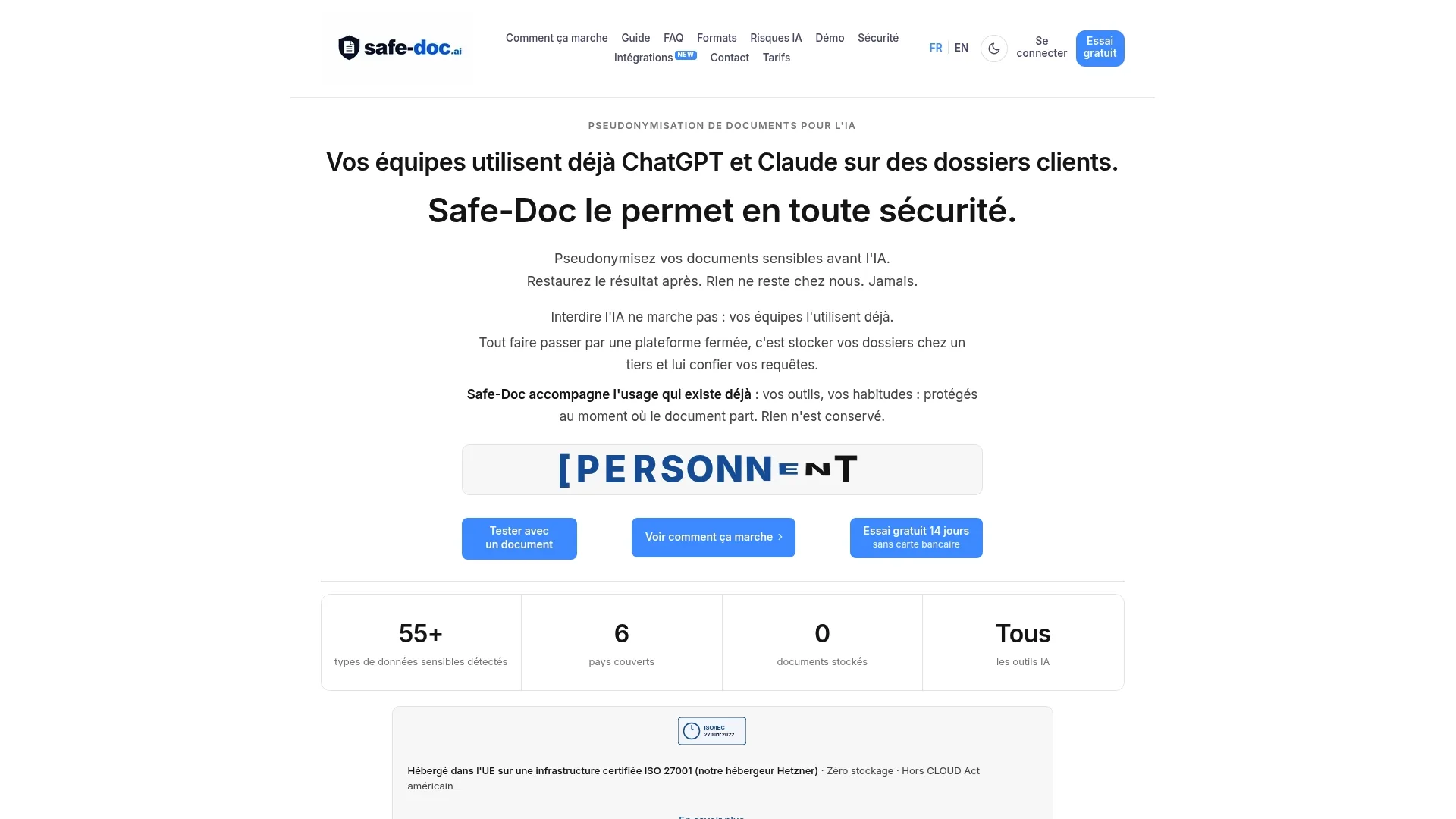
Safe-doc processes data locally in real time, ensuring no sensitive information leaves your environment. The solution is designed for accountants and their teams, with immediate onboarding and integrated GDPR compliance. For DPOs and compliance officers, the dedicated pseudonymization and audit page details the traceability and access management features available in Safe-doc.
Frequently asked questions
What is pseudonymization of accounting data?
Pseudonymization of accounting data consists of replacing identifying information (names, IBANs, company registration numbers) with codes or pseudonyms, in accordance with Article 4(5) of the GDPR. Data remains usable for analysis or auditing, but real identities are protected.
Is pseudonymization sufficient to comply with the GDPR?
Pseudonymization is a security measure recommended by Article 32 of the GDPR, but it does not remove the status of personal data. All GDPR obligations continue to apply to pseudonymized data.
How long must accounting data be retained?
Accounting documents must be retained for 10 years after the close of the financial year according to article L123-22 of the French Commercial Code. Beyond this period, the personal data they contain must be deleted or irreversibly anonymized.
How to pseudonymize an Accounting Entry File (FEC)?
Pseudonymization of an FEC requires replacing names, IBANs, invoice numbers, and tax identifiers with consistent generic codes (CLIENT_001, IBAN_001). The correspondence table must be stored separately in an encrypted environment with restricted access.
What are the consequences of the 4 September 2025 CJEU ruling for accounting firms?
The ruling imposes an obligation of transparency regarding all recipients of pseudonymized data, even if those recipients cannot re-identify individuals. Firms must document each flow of pseudonymized data in their GDPR register and update their privacy policies accordingly.