

For a data room to be GDPR-compliant, demand three proofs upfront: robust document encryption, a signed Data Processing Agreement (DPA) compliant with Article 28, and evidence of data minimization or pseudonymization of uploaded files. If the provider cannot produce all three within the hour, treat the solution as non-compliant. A Data Protection Impact Assessment (DPIA) becomes mandatory whenever processing involves high volumes or sensitive data categories.
In brief:
- A GDPR-compliant data room requires proof of robust encryption, a signed DPA compliant with Article 28, and evidence of pseudonymization.
- Security must cover the entire data lifecycle with strong authentication, granular access controls, and immutable logs-anything less is non-compliant.
- Key management must prevent extraction by the subprocessor or foreign hosting, particularly through secure technical architecture.
- A data processing agreement must include clauses on breach notification, audit rights, data deletion, and data return to limit controller liability.
- Pseudonymization preserves the ability to restore data while limiting breach risk, especially in transfers or large-scale, sensitive processing.
Table of contents
- Operational security checklist: 8 essential criteria
- Encryption, key management and sovereignty: what to verify technically
- What must the DPA (Article 28) contain?
- Minimize and pseudonymize before uploading your documents
- When is a DPIA required for a data room?
- How to audit a vendor before signing
- What real due diligence reveals
- Reduce residual risk with a pseudonymization layer
- Sources
Operational security checklist: 8 essential criteria
A GDPR-compliant data room is never just secure storage. It must demonstrate, point by point, that it protects personal data at every stage of the document lifecycle. Here are eight criteria to verify before signing any contract.
- Encryption: AES-256 (or equivalent) at rest, TLS in transit-no exceptions for "low-sensitivity" documents.
- Strong authentication: Mandatory MFA and SSO via SAML or OIDC for all users, including external parties.
- Granular access control: Least-privilege principle, with permissions adjustable by folder, role, and duration.
- Audit logs: Exportable, timestamped, and ideally immutable logs to reconstruct who accessed what and when.
- Data residency: Hosting in the EU or France, with documented backup policy.
- Certifications: ISO 27001 and SOC 2 Type II as standard; HDS certification if the folder contains health data.
- Anti-leak controls: Configurable download restrictions, dynamic personal watermarks on every viewed page.
- Access lifecycle: Automatic expiration, immediate revocation, and "clean team" procedures for ultra-sensitive data.
Most industry guides also stress the availability of responsive support capable of urgent replies to supervisory authority requests. A vendor that takes days to produce ISO or SOC certificates often reveals broader gaps in preparedness.
Pro tip: Always request a real log export before signing-not a screenshot of the interface. The difference between a consultable log and one actually usable in litigation is immediately obvious.
Encryption, key management and sovereignty: what to verify technically
Server-side encryption protects against physical disk theft but leaves the provider technically able to read your documents. Client-side encryption prevents even the host from accessing files in plaintext, which fundamentally changes the equation in the event of foreign legal requisitions.
Three points to verify before any commitment:
- Key management policy: who holds them, where are they stored, is there a key escrow mechanism?
- Safeguards against extraterritoriality, notably the U.S. Cloud Act, via architecture designed for European hosting and keys isolated from the subprocessor.
- Technical architecture evidence: network segmentation diagrams, key management logs, and if applicable, a roadmap toward post-quantum encryption standards.
A serious provider documents these elements in writing-no detours, no marketing fluff.
What must the DPA (Article 28) contain?
The data processing agreement is not a formality: it's the document that legally binds the vendor. It must specify processing purposes, duration, security measures, and conditions for using sub-processors.
- Data breach notification within 72 hours, with support for your own obligations toward the CNIL.
- Contractual audit rights, with effective access to logs and third-party certification reports.
- Guaranteed data deletion clauses at contract end, and return procedures before erasure.
Without these clauses, your liability as data controller remains fully exposed in the event of an incident.
Minimize and pseudonymize before uploading your documents
The CNIL recommends prioritizing pseudonymization whenever direct identification is unnecessary for the intended processing. Concretely, before uploading to a data room, follow this sequence:
1. Identify sensitive fields (names, bank details, health data) in each document type.
2. Apply consistent substitution rules, with mapping stored separately to allow controlled restoration if needed.
3. Automate this processing via API rather than manual review, which introduces errors and delays.
Pro tip: Pseudonymizing rather than anonymizing keeps the door open to legitimate restoration if an acquirer or auditor makes a contractual request-something irreversible anonymization no longer permits.
When is a DPIA required for a data room?
A Data Protection Impact Assessment becomes mandatory whenever processing volume is large, sensitive categories appear (health, banking, detailed HR data), or the purpose poses high risk to data subjects, as recalled in the CNIL's practical guide.
- Precise description of processing and its necessity for the operation (due diligence, sale, audit).
- Risk assessment for data subjects in the event of a leak or unauthorized access.
- Documented mitigation measures: reinforced encryption, role-based access restrictions, systematic pseudonymization of high-risk fields.
- Explicit link between identified risks and chosen measures-not a wish list disconnected from the real context.
How to audit a vendor before signing
A rigorous audit unfolds in four stages, with concrete evidence at each step.
1. Request documentation: Signed DPA, ISO 27001 and SOC 2 certificates, network architecture diagram.
2. Test under real conditions: Effective log export, test access revocation, verification that MFA actually blocks login without a second factor.
3. Incorporate these criteria into your RFP with a standardized response template to compare vendors on identical bases.
4. Draft an internal audit report recording test results, dated and signed by the compliance officer.
| Stage | Expected proof | Warning signal |
|---|---|---|
| Documentation | DPA + current certificates | Outdated or missing documents |
| Technical test | Functional log export | Incomplete or non-timestamped logs |
| Access test | Immediate revocation confirmed | Delay of several hours |
| Restitution | Signed audit report | No written record of testing |
What real due diligence reveals
In practice, workarounds almost always stem from excessive complexity: when a data room imposes too many steps, some team members copy excerpts into a consumer AI tool to save time, without recognizing the leak risk. This isn't a matter of bad intent-it's a problem of poorly anticipated user experience.
Pseudonymization changes this equation. It lets teams continue using the tools they already know, while removing personally identifiable data before it leaves the secure perimeter. In my view, this is the only realistic compromise between strict compliance and effective use of modern tools by time-pressed teams.
- Jacques
Reduce residual risk with a pseudonymization layer
A well-configured data room secures storage and access, but it doesn't protect what comes out once an employee copies a contract excerpt into an AI tool for summarization. Safe-doc fills precisely this gap: the platform detects many types of personal and confidential data, pseudonymizes it in real time without durably storing the document, then provides a mapping export to restore data if necessary.
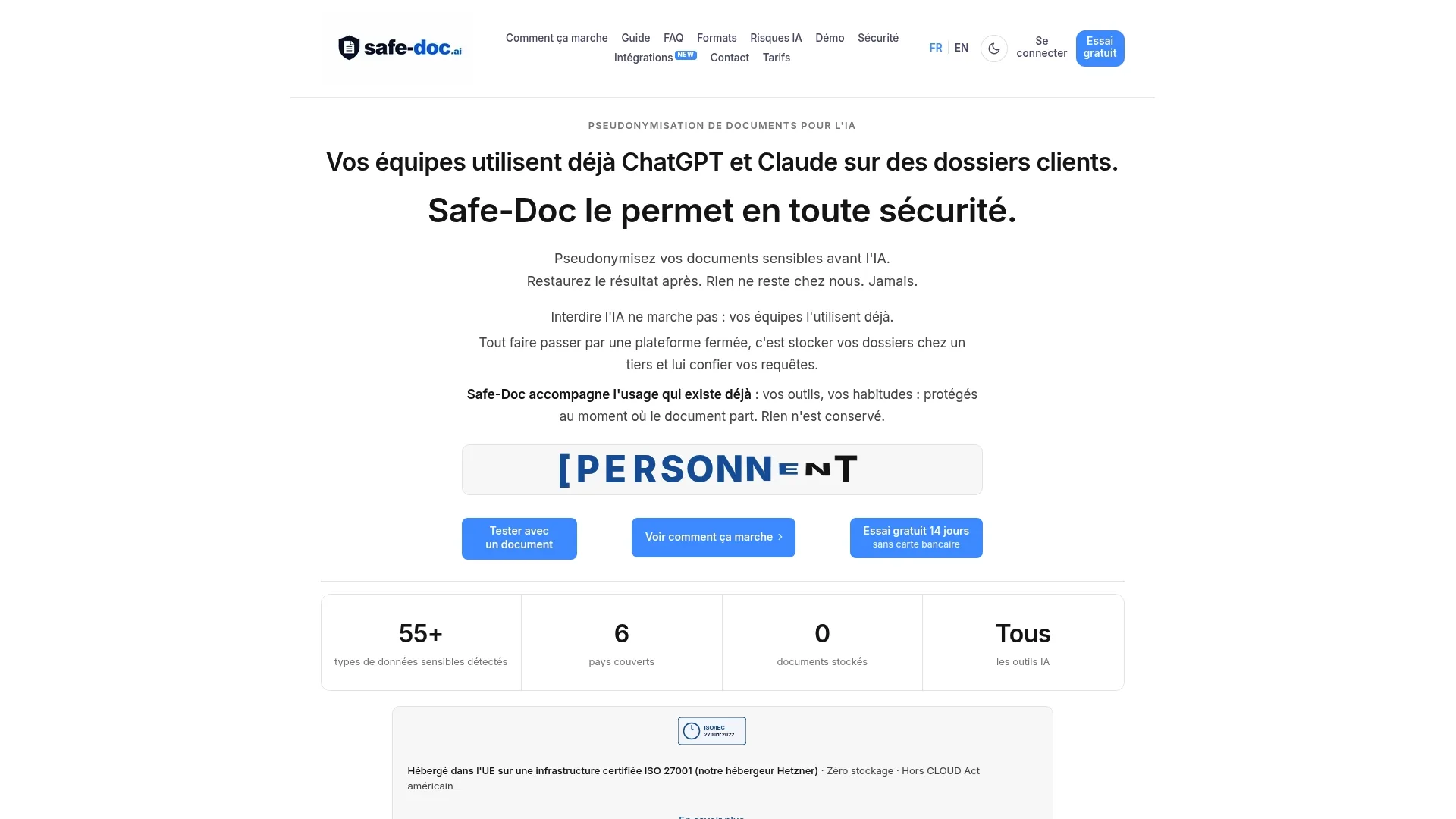
Concretely, in M&A due diligence or HR audits, your teams retain use of ChatGPT or Claude, but sensitive data never leaves the perimeter in identifiable form-essential to successfully selling your business in compliance with GDPR obligations. The processing integrates via REST API or MCP directly into your existing data room workflows, with residual risk analysis after each treatment. For DPOs and CISOs who must demonstrate active rather than declarative compliance, the compliance teams page details technical integration and trial arrangements.