

Before sharing any documents in an M&A transaction, the absolute priority is to centralize files in an encrypted data room, after pseudonymizing personal and financial data, with NDAs signed by every stakeholder. Three checks are immediately required: Are confidentiality agreements in place? Have documents been pseudonymized before upload? Are access logs exportable to prove compliance? France's CNIL, the GDPR (notably Article 4(5) on pseudonymization), and the National Commission's practical guides set out these obligations. For the pseudonymization workflow, Safe-doc offers a compliant, stateless, and audited SaaS option.
- Signed NDAs before any access, even partial, to the data room.
- Pseudonymization upstream: no document containing identifiable personal data may be uploaded raw.
- Exportable logging: access logs must be available in PDF or CSV for any CNIL audit.
Pseudonymization before upload reduces the attack surface and facilitates compliance by minimizing personal data exposed during the audit.
Table of contents
- What operational checklist should you follow before and during due diligence?
- What are the GDPR obligations specific to due diligence in France?
- What technical controls should be implemented to secure the data room?
- How do you effectively pseudonymize financial documents?
- Who should be involved, and what contractual clauses should you include?
- What risk scenarios should you anticipate, and how do you mitigate them?
- Operational checklist to copy before opening a data room
- Key points
- Data protection in M&A: an underestimated negotiation lever
- Safe-doc: stateless pseudonymization for your M&A operations
- Useful sources and regulatory references to keep in your file
What operational checklist should you follow before and during due diligence?
Well-protected financial due diligence is prepared in advance, not at the last minute. Here is the sequence to follow.
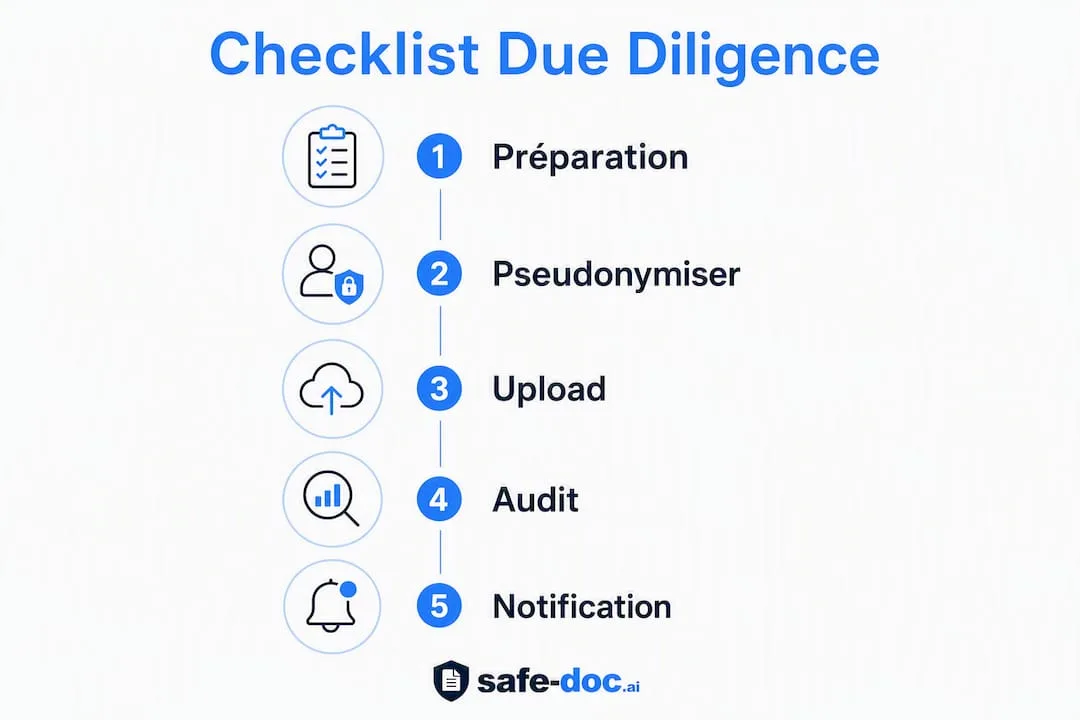
1. Scoping (D-21 to D-14): define which documents enter the data room, identify the categories of personal data concerned, and enter the processing activity in the register of processing operations. Involve the DPO from this stage.
2. NDA signatures (D-14): no access without a signed confidentiality agreement, including for external advisors.
3. Document pseudonymization (D-14 to D-7): process each PDF, DOCX, or spreadsheet file before upload. Store the re-identification mapping in a separate vault (HSM or secrets manager).
4. PII inventory and residual risk analysis (D-7): list types of residual data, assess whether a DPIA is necessary (large-scale or high-risk processing).
5. Data room upload and configuration (D-7 to D-3): role-based access controls (RBAC), multi-factor authentication (MFA), automatic access expiration, secure Q&A, monitoring activation.
6. Log export and verification (D-1): generate an initial audit report before opening, verify log integrity.
7. Continuous monitoring during due diligence: real-time alerts, weekly access reviews, immediate rights deletion upon closing.
Preparation takes time, which varies depending on document volume. Expected costs include DPO/CISO hours for scoping and review, pseudonymization tool licenses (charged per seat and per page volume), and any additional page packs.
Pro tip: Pseudonymize in batch before upload rather than file by file. This reduces the attack surface, accelerates preparation, and generates a consolidated mapping that is easier to export for compliance evidence.
What are the GDPR obligations specific to due diligence in France?
The CNIL reminds us that any processing of personal data must be based on a legal basis, respect the principle of minimization, and be subject to proportionate technical measures. In the M&A context, this translates into several concrete obligations.
- Register of processing activities: document the purpose (due diligence), data categories, recipients, and retention periods.
- Minimization: share only data strictly necessary for the financial evaluation.
- Information to data subjects: wherever possible, inform individuals whose data is processed, unless this compromises the transaction (exception provided by the GDPR).
- Rights of access, rectification, and erasure: establish a procedure to respond to requests within one month.
- Retention period: define an access expiration date and a data deletion schedule after closing.
A DPIA (Data Protection Impact Assessment) is mandatory when processing presents a high risk: massive volumes of personal financial data, cross-referencing of files, or processing of special categories. The CNIL 2023 practical guide details the stages of mapping, analysis, and risk treatment, as well as the need for regular audits.
"Any processing of personal data should be lawful and fair [...]. The principle of transparency requires that any information and communication relating to the processing of those personal data be easily accessible and easy to understand, and that clear and plain language be used." - GDPR, Recital 39
In the event of a data breach, notification to the CNIL is mandatory within 72 hours. Require a robust Data Processing Agreement (DPA) from each subprocessor, with guarantees on encryption, logging, and-where relevant-proof of non-storage.
What technical controls should be implemented to secure the data room?
Defense in depth-multiple layers of simultaneous controls-is preferable to any single solution. Here is the minimum benchmark.
- Encryption: AES-256 at rest, TLS 1.3 in transit, key management via HSM.
- Access control: RBAC (minimum roles and privileges), mandatory MFA, automatic session expiration.
- Logging: time-stamped and immutable logs, exportable in PDF/CSV for proof of compliance.
- Monitoring: SIEM or IDS to detect abnormal behavior, real-time alerts.
- Shadow AI: explicit usage policy for external AI models, blocking unauthorized uploads to third-party services, filtering API integrations.
- Backups and testing: encrypted backups, regular restoration tests, CNIL notification runbook (72 hours).
| Control | Minimum requirement | Priority |
|---|---|---|
| Encryption at rest | AES-256 | Critical |
| Encryption in transit | TLS 1.3 | Critical |
| Authentication | MFA + RBAC | Critical |
| Logging | Exportable time-stamped logs | High |
| AI monitoring | Shadow AI policy + API filtering | High |
Automated audit reports generated before each data room opening reassure auditors and serve as evidence in the event of a CNIL inspection.

Pro tip: Favor stateless processing: no data should be stored server-side after processing, limiting exposure. Coupled with upstream pseudonymization, this mode drastically limits cloud exposure.
How do you effectively pseudonymize financial documents?
Pseudonymization and anonymization are not interchangeable. In due diligence, pseudonymization is generally preferable: it preserves the analytical usefulness of documents while reducing the risk of identification, and it remains reversible for post-deal restoration.
| Criterion | Pseudonymization | Anonymization |
|---|---|---|
| Reversibility | Yes (via secure mapping) | No |
| Usefulness for analysis | Preserved | Reduced |
| GDPR status | Personal data (art. 4(5)) | Outside GDPR scope |
| Recommended use in M&A | Yes | Very limited cases |
Practical methods include token substitution, salted hashing for identifiers, and contextual replacement for names and references. For unstructured documents (PDFs, emails, annexes), OCR combined with automatic detection of 90+ types of PII reduces human errors that manual preparation cannot avoid. The re-identification mapping must be stored separately in an HSM or encrypted vault, never in the data room itself.
- Define the level of granularity according to the usefulness required for financial analysis.
- Assess the residual risk after pseudonymization and document it.
- Export the mapping securely to enable post-deal restoration.
Pro tip: For [confidential accounting data](https://safe-doc.ai/blog/pseudonymiser-donnees-comptables-confidentielles-guide-2026.html), pseudonymize customer references and IBANs before any sharing, even internal.
Who should be involved, and what contractual clauses should you include?
Clear governance avoids blind spots. The roles to mobilize from the scoping stage are the DPO (compliance pilot), the CISO/CIO (technical controls), the transaction lawyer (NDA, DPA, non-disclosure clauses), the finance team (identification of sensitive documents), and a dedicated contact for external auditors. Involving the DPO and CISO from scoping improves operational resilience and compliance, particularly with regard to DORA and NIS2.
- NDAs: cover all stakeholders, including advisors and technical service providers.
- DPA: require guarantees from each subprocessor on encryption, logging, and data non-retention.
- Audit clauses: right of verification and obligation to notify an incident within 24 hours (ahead of the CNIL 72-hour deadline).
- Decision log: track all access approvals and temporary delegations.
Pro tip: Update the register of processing activities with each new access opening. A static register does not reflect operational reality and weakens proof of compliance.
What risk scenarios should you anticipate, and how do you mitigate them?
Four scenarios account for the majority of financial due diligence incidents.
- Leak by an internal user: separation of environments, granular logging, alerts on mass downloads.
- Unauthorized sharing outside the data room: watermarking of exported documents, multi-level approval for all exports, deletion SLA in the event of a stakeholder's departure.
- Exfiltration via AI integration (Shadow AI): block uploads to unapproved AI services, pseudonymize before any use of an external model, audit API integrations regularly. Concrete examples of violations illustrate the scale of regulatory consequences.
- Document preparation error: double human verification on pseudonymized batches, manual rules for sensitive annexes, quality assurance before upload.
In the event of an incident, the runbook must provide for:
1. Immediate isolation of the compromised account or document.
2. Internal notification (DPO, CISO, management) within one hour.
3. CNIL notification within 72 hours if personal data is affected.
4. Communication to transaction stakeholders according to contractual clauses.
Operational checklist to copy before opening a data room
Copy or print this list and check each point before opening access.
- [ ] NDAs signed by all stakeholders (internal and external)
- [ ] Processing activity entered in the register of processing (purpose, categories, recipients, duration)
- [ ] DPIA performed if high-risk processing or large volumes of PII
- [ ] Documents pseudonymized in batch before upload (mapping kept separately)
- [ ] AES-256 encryption at rest and TLS 1.3 in transit enabled
- [ ] Authorizations configured by role (RBAC), MFA enabled for all accounts
- [ ] Automatic access expiration configured
- [ ] Exportable logs generated and verified (initial audit PDF report)
- [ ] Shadow AI policy communicated to all stakeholders
- [ ] Incident notification test performed (72-hour CNIL runbook validated)
- [ ] Remediation deadlines defined: minor corrections within 30 days, major within 60 days, structural within 90 days
Key points
Data protection in financial due diligence rests on three inseparable pillars: pseudonymization before upload, encrypted data room with exportable logging, and documented governance (register, DPIA, NDA, DPA).
| Point | Details |
|---|---|
| Pseudonymization before upload | Processing all documents before upload reduces the attack surface and facilitates compliance exports. |
| Encrypted and audited data room | AES-256, TLS 1.3, MFA, and exportable logs are the minimum technical baseline before any access opening. |
| Register and DPIA | Enter the processing in the register and perform a DPIA if the volume or sensitivity of PII justifies it. |
| Contractual governance | NDAs and DPAs signed by all stakeholders, with audit clauses and incident notification obligation. |
| Safe-doc for pseudonymization | Safe-doc offers stateless pseudonymization with detection of 90+ types of PII, reversible mapping, and PDF audit report. |
Data protection in M&A: an underestimated negotiation lever
GDPR compliance is often perceived as an administrative constraint. This is a framing error. Well-protected due diligence reduces uncertainty for the acquirer, protects the value of the deal, and can even accelerate closing. A seller capable of producing clean access logs, an up-to-date register, and a documented DPIA sends a strong signal: the organization controls its risks. Conversely, a poorly configured data room or non-pseudonymized documents expose the seller to questions about the company's overall governance, well beyond GDPR compliance alone.
The most common mistake I observe in M&A transactions is treating data protection as a last-minute step, entrusted to a lawyer alone, without the CISO or the DPO. Yet it is precisely the early involvement of these two functions that transforms compliance into a transactional advantage: they identify residual risks before the acquirer discovers them, and they produce the documentary evidence that reassures auditors. Well-managed compliance does not slow down a transaction. It secures it.
Safe-doc: stateless pseudonymization for your M&A operations
Preparing a compliant data room without slowing down the transaction is exactly what Safe-doc enables. The platform automatically detects more than 90 types of personal and financial data in your PDFs and DOCX files, pseudonymizes them in real time without durably storing the documents, and generates a reversible mapping kept separately for post-deal restoration. Each session produces an exportable PDF audit report, ready for a CNIL inspection or acquirer review.
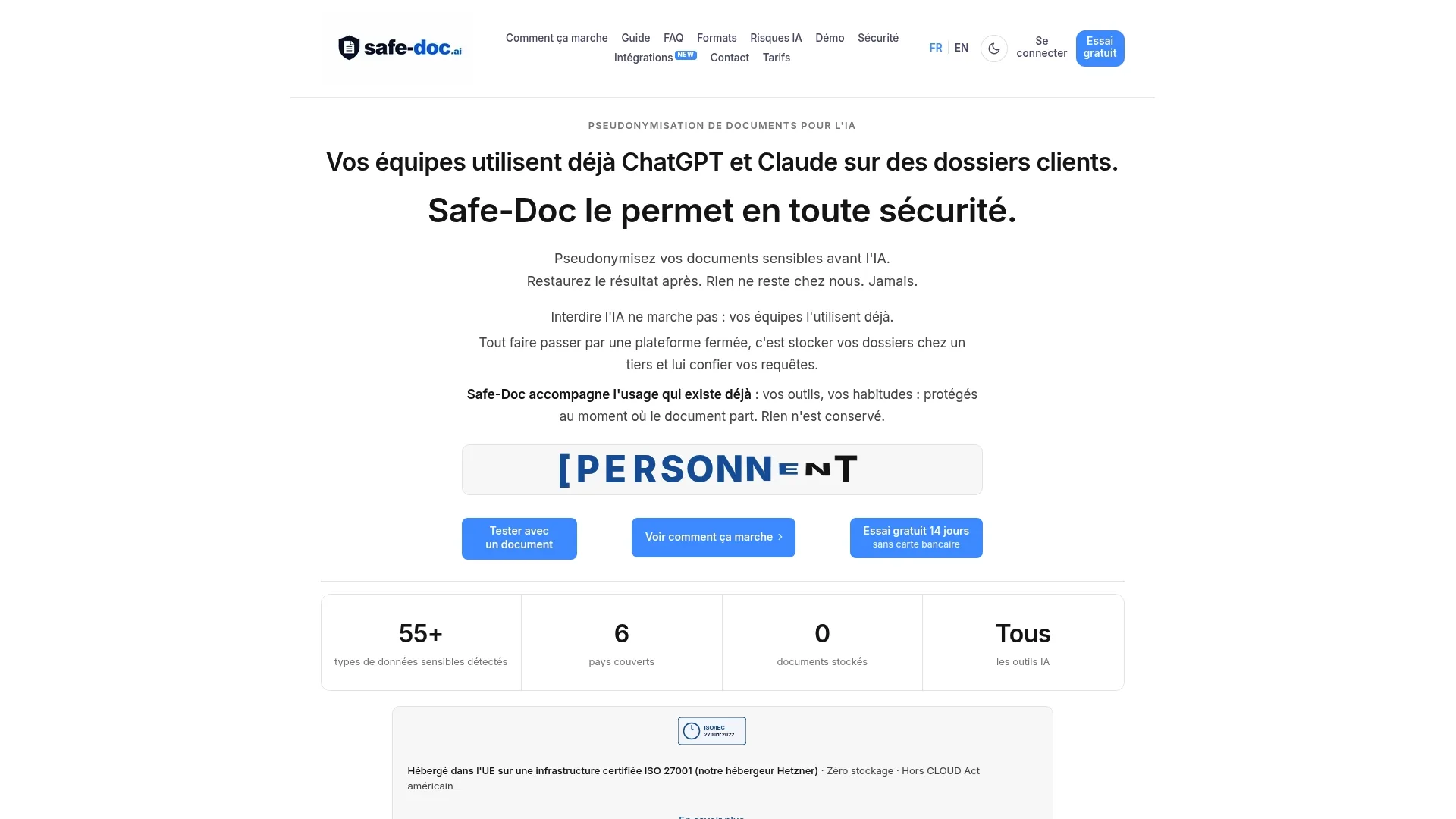
For DPOs and CISOs seeking an immediate operational solution, Safe-doc's pseudonymization and compliance offering covers M&A needs: stateless mode, REST and MCP API integrations, data room support, and integrated audit reports. Request a demo or test the platform directly at safe-doc.ai.
Useful sources and regulatory references to keep in your file
Keep these references in the transaction compliance file: they serve as a documentary basis in the event of an inspection or acquirer question.
- GDPR - official text (EUR-Lex): reference text for legal bases, pseudonymization (art. 4(5)), data subject rights, and notification obligations.
- CNIL - GDPR page: register obligations, DPIA, transparency, and notification within 72 hours.
- CNIL 2023 practical guide - personal data security: DPIA templates, risk mapping, technical controls checklist (encryption, logs, MFA).
- Financial due diligence - M&A processes and tools: data room best practices, NDA, pseudonymization, and auditability in a transactional context.
- Legal due diligence and GDPR compliance: pseudonymization methods before upload and management of reversible mapping.
- Financial data security compliance: CIA approach (confidentiality, integrity, availability) and sector best practices for encryption and logging.
- Data confidentiality in financial audit: additional guide on data room preparation and recommended technical controls.
This article is general information for practical purposes. For your specific situation, consult your DPO, CISO, or qualified legal counsel, and verify current requirements with the CNIL.