


An HR data breach is defined by Article 4.12 of the GDPR as any security incident resulting in the destruction, loss, alteration, or unauthorized disclosure of employees' personal data. The most common HR data breach examples under the GDPR involve particularly sensitive information: payslips, social security numbers (NIR in France), health data, or disciplinary records. The CNIL actively monitors such violations, and GDPR penalties for companies can reach 4% of worldwide annual turnover. Understanding these concrete cases is the first step toward strengthening your compliance posture.
1. HR Data Breach Examples: Poorly Secured Server Migration
A server migration carried out without first deleting existing data constitutes a sanctionable GDPR breach. A 2026 ruling confirmed that accidental access by a colleague to payslips exposed during a poorly secured migration was sufficient to establish a violation. This type of incident occurs when IT teams transfer data without verifying that old servers have been properly wiped and disconnected.
Failure to delete HR data on obsolete servers increases the attack surface and exposes the organization to litigation years after the fact. Payslips, contracts, and performance reviews remain accessible long after their active use if no formalized purge procedure is in place.

Pro tip: Before any migration, compile a complete inventory of stored HR data and validate permanent deletion on each source medium with a formal record signed by the CISO.
2. Unauthorized Access to Employee Files
Unauthorized access occurs when a manager or colleague views HR data without proper authorization. This is common in organizations where access rights are not segmented by role. HR access management requires that sensitive data be isolated and that unauthorized managers cannot access it.
The risk is compounded when access logs are not retained or analyzed. Without audit trails, the organization can neither detect the incident nor demonstrate good faith to the CNIL.
3. Sending Payslips to the Wrong Recipient
Sending a payslip via unsecured email to the wrong recipient is one of the most common human resources GDPR violations. This type of human error directly exposes the social security number, gross salary, and bank details of the affected employee. Unsecured email transmission is a documented risk: simple password encryption often remains inadequate.
Using a compliant digital vault is the recommended method for transmitting electronic payslips. This solution ensures that only the relevant employee can access their document via personal authentication.
4. Excessive Retention of Former Employees' Data
Indefinite or excessive retention of former employees' data is the most common trap in GDPR non-compliance. According to the CNIL, retention periods are strictly regulated: badge logs must be deleted after 3 months, while payslips may be retained for 50 years. Other data, such as unsuccessful job applications or performance reviews, must be erased once applicable legal retention periods have expired.
Many organizations retain all HR files by default without an automated purge procedure. This inertia constitutes an ongoing violation, exposed to any CNIL audit.
5. Processing Without a Valid Legal Basis
Processing HR data without a valid legal basis is a direct GDPR violation. Employee consent is often deemed invalid by the CNIL because the inherent power imbalance between employer and employee vitiates true consent. The correct legal basis in HR is typically the performance of the employment contract or compliance with a legal obligation.
This pitfall particularly affects processing related to employee monitoring, internal investigations, or the collection of health data. Basing such processing on consent exposes the organization to immediate reclassification during an audit.
6. Failure to Respond After Detecting a Vulnerability
The absence of corrective measures after detecting a vulnerability significantly aggravates potential penalties. The CNIL made this principle a central message in 2026: failing to respond to a known vulnerability is considered a separate fault from the initial breach. This position means that an organization that detects an incident and fails to act faces a double sanction.
Legal procedure requires notification to the CNIL within a maximum of 72 hours. If the data concerned is sensitive, such as social security numbers or health data, the affected employees must also be informed directly.
7. Exposure of Sensitive Data: Health, Disability, Social Security Number
Health data, disability data, and social security numbers belong to the special categories under Article 9 of the GDPR. Their exposure constitutes a personal data breach of heightened severity, triggering reinforced notification obligations under Article 34 of the GDPR. Breaches involving health data require direct communication to affected employees, in addition to notifying the CNIL.
Such data frequently appears in HR files: sick leave certificates, disability declarations, and benefit attestations. Processing it requires a specific legal basis and enhanced security measures, such as GDPR pseudonymization.
8. What Are the GDPR Penalties for Companies?
Financial penalties for GDPR breaches can reach 4% of worldwide annual turnover. The average cost of a breach is estimated at 4.4 million euros in 2025, with average fines of 2.1 million euros for security failures. These figures illustrate that HR non-compliance is not a theoretical risk.
Beyond fines, organizations face employment tribunal litigation. An employee whose data has been exposed can file a claim to obtain compensation for harm suffered. Reputational risks complete the picture: a public CNIL sanction has a lasting impact on the employer brand.
"When a vulnerability is known, the absence of immediate corrective measures significantly aggravates potential penalties." - CNIL, 2026
Key Takeaways
HR data breaches expose organizations to fines of up to 4% of worldwide annual turnover and to employee litigation, making GDPR compliance non-negotiable for any HR department.
| Point | Details |
|---|---|
| - | - |
| Server migration | Permanently delete HR data before any migration to avoid residual access. |
| Retention periods | Apply CNIL deadlines: 3 months for badge logs, 50 years for payslips. |
| Legal basis in HR | Use contract performance or legal obligation, never employee consent. |
| Notification within 72 hours | Notify the CNIL within 72 hours and inform employees directly if the data is sensitive. |
| Pseudonymization | Apply pseudonymization to sensitive data to reduce the impact of a potential breach. |
What I See in the Field in 2026
Most of the HR data breaches I encounter are not the result of sophisticated attacks. They stem from a botched migration, an email sent too hastily, or a file forgotten on a decommissioned server. This reality should radically change how HR teams approach compliance.
Human risk is trivialized. HR managers know their employees' data is sensitive, but they underestimate the likelihood of an ordinary incident. A colleague accidentally accessing a payslip during a migration: that alone is enough to trigger a CNIL procedure and employment tribunal litigation.
What concerns me more is the acceleration of Shadow AI within HR departments. Staff members use unsecured artificial intelligence tools to process employee files, performance reviews, or health data. These practices create silent breaches, invisible in the logs, yet entirely real. Protecting HR data with AI is a topic DPOs must put on the agenda right now, not in six months.
My concrete recommendation: organize a quarterly audit of access to sensitive HR data and formalize a response procedure of under 24 hours. The CNIL does not only penalize the breach. It penalizes inaction.
- Jacques
Safe-doc for HR Compliance
HR teams that process employee files with AI tools expose themselves to silent breaches if no protective layer is in place. Safe-doc addresses this risk precisely by pseudonymizing sensitive documents before any AI processing, without durably storing the files.
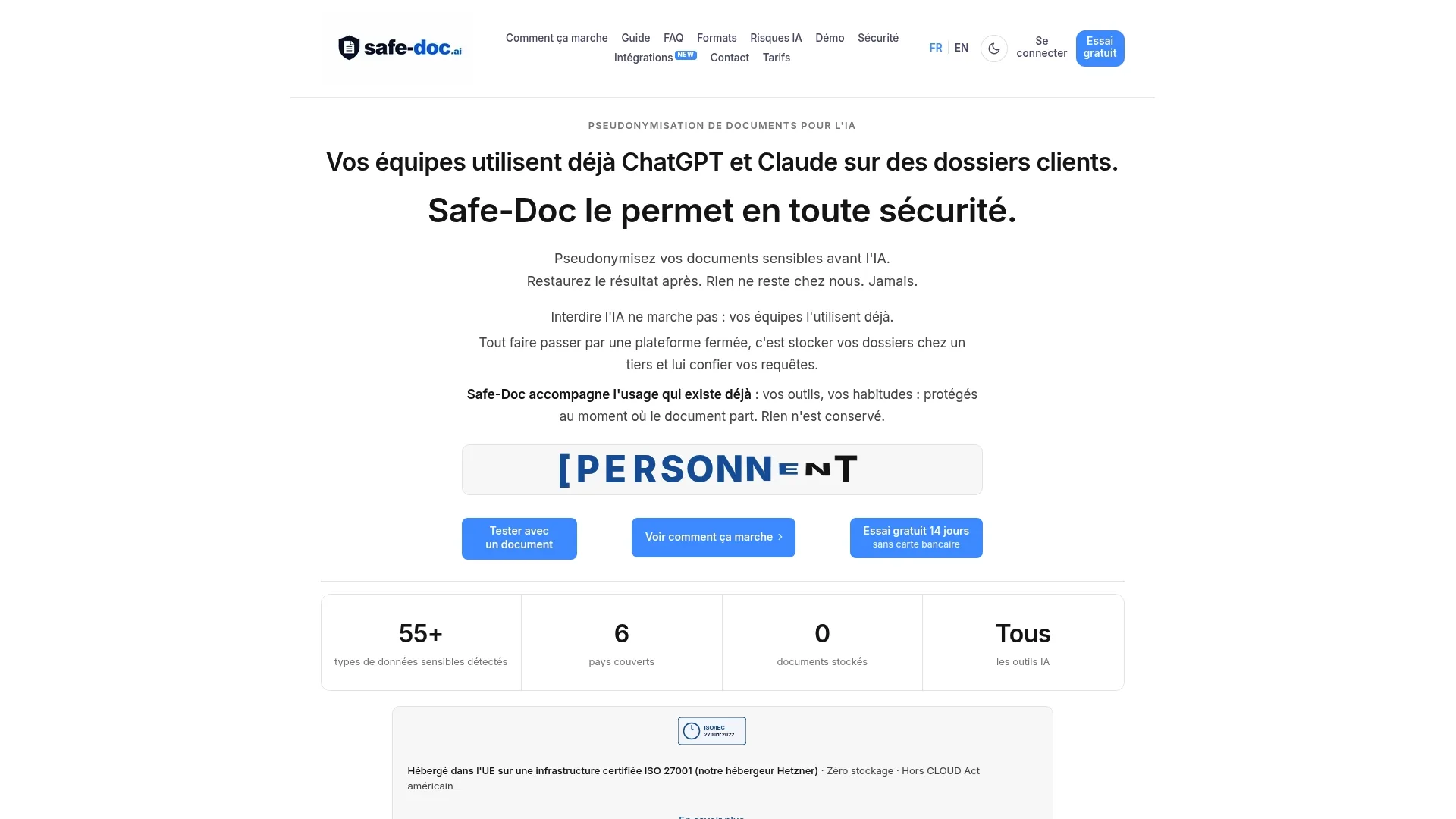
Safe-doc integrates with existing workflows and allows HR professionals to continue using their usual tools while remaining GDPR-compliant. The platform guarantees real-time processing with zero data retention, eliminating the residual risk associated with Shadow AI. The audit and pseudonymization solutions offered by Safe-doc are designed for DPOs and HR managers seeking operational compliance, not merely documentary compliance.
Frequently Asked Questions
What is an HR data breach under the GDPR?
An HR data breach is any security incident exposing employees' personal data, whether accidental or malicious, as defined by Article 4.12 of the GDPR.
Which HR data is most exposed to breaches?
Payslips, social security numbers, health data, disciplinary records, and badge logs are the HR data most frequently involved in breach cases.
What is the deadline to notify the CNIL of an HR breach?
The employer must notify the CNIL within a maximum of 72 hours after becoming aware of the breach. If the exposed sensitive data presents a high risk, affected employees must also be informed directly.
What penalties does a company face for a GDPR breach in HR?
Fines can reach 4% of worldwide annual turnover, with an average cost estimated at 4.4 million euros per incident in 2025. Employment tribunal litigation and reputational damage compound these penalties.
How can AI-related HR data breaches be prevented?
Pseudonymizing documents before any AI processing is the recommended method. It reduces the exposure of personal data without changing HR teams' tools or work habits.