


Financial statements are documents densely packed with personal data as defined by the General Data Protection Regulation. Payslips, invoices, bank statements, and tax returns all contain identifying information subject to GDPR obligations. For finance and data management professionals, ignoring this framework exposes the organization to fines of up to €20 million or 4% of annual worldwide turnover. Personal data compliance in financial statements under the GDPR is therefore not optional: it is a legal obligation that has been in force since 2018.
What personal data appears in financial statements?
Financial statements contain far more than numbers. Every accounting document processes information that directly or indirectly identifies a natural person, bringing it within the scope of the GDPR.
Here are the most common categories of personal data in financial documents:
- Identification data: surnames, first names, postal and email addresses of employees, customers, and suppliers.
- Banking data: RIB (bank identity statements), IBAN, account numbers, payment details.
- Tax data: SIREN numbers, tax identification numbers, VAT declarations, tax filings.
- Payroll data: payslips, salary amounts, social security contributions, sick leave records.
- Contractual data: general terms and conditions of sale, invoiced amounts, order histories.
The distinction between sensitive and non-sensitive data remains important. Banking and tax data are not sensitive data in the strict sense of Article 9 of the GDPR, but they present a high risk in the event of a breach. Particular attention is therefore required.
A frequently overlooked point concerns responsibility for third-party data. Finance professionals working for B2B companies sometimes process the personal data of their clients' own end customers. This indirect responsibility significantly broadens the compliance perimeter that must be monitored.

What legal bases support the processing of financial data?
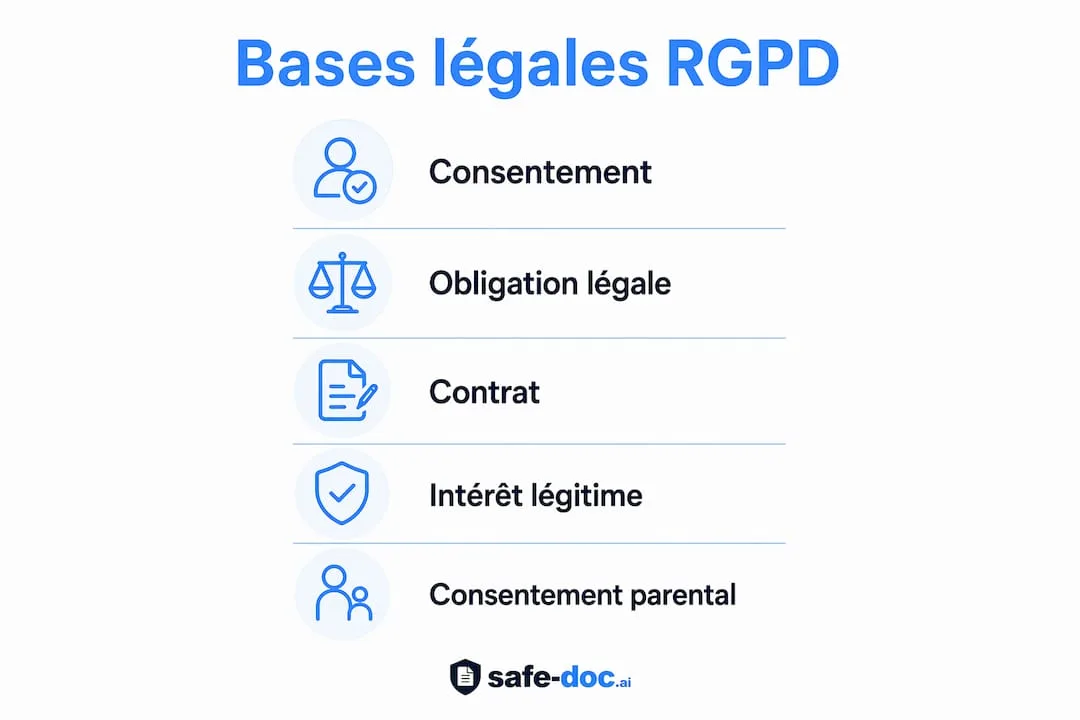
The processing of personal data in financial statements relies primarily on two GDPR legal grounds, without requiring the consent of the data subjects.
1. Legal obligation (Article 6.1.c of the GDPR): The Commercial Code, the General Tax Code, and social obligations require the maintenance of certain accounting documents. The organization has no choice: it must retain this data to comply with the law.
2. Performance of a contract (Article 6.1.b of the GDPR): Invoicing, payroll processing, and supplier management require the processing of personal data. These processing activities are directly linked to the performance of contractual relationships.
3. Legitimate interest (Article 6.1.f of the GDPR): Certain analytical processing operations or fraud prevention measures may rely on this basis, provided that the organization's interest does not override the rights of the data subjects.
These legal bases do not, however, exempt organizations from information obligations. Privacy notices must specify the purpose of the processing, the retention period, and the rights of individuals. This transparency is mandatory, even when consent is not required.
How to reconcile retention periods and the right to erasure?
The retention of financial data creates a genuine regulatory conflict. The right to erasure provided for by the GDPR directly conflicts with the legal retention periods imposed by accounting and tax law.
| Document type | Legal retention period | Legal basis |
|---|---|---|
| Customer and supplier invoices | 10 years | Commercial Code |
| Payslips | 5 years | Labor Code |
| Tax returns | 6 years | Tax Procedures Code |
| Commercial contracts | 5 years | Civil Code |
Legal retention periods take precedence over the right to erasure. This means that an individual cannot demand the deletion of their data if its retention is required by law. This primacy is explicitly recognized by the GDPR in Article 17.3.b.
Managing this conflict involves the targeted purging of non-essential data while retaining the minimum transactional information required. In practice, an invoice must be retained for ten years, but superfluous contact data can be deleted as soon as the commercial relationship ends.
Pro tip: Implement a documented selective purge policy. Distinguish between data subject to mandatory retention and ancillary data, and schedule their automatic deletion at the legal deadline. This approach reduces risk exposure without violating accounting obligations.
What technical measures protect financial data?
The security of financial data relies on precise technical and organizational measures required by Articles 25 and 32 of the GDPR. The Privacy by Design approach integrates these measures from the design stage of systems, not as an afterthought.
The essential technical measures to implement are as follows:
- Pseudonymization: replacement of personal identifiers with tokens or codes. Pseudonymization preserves the traceability and auditability of financial statements while limiting data exposure. It differs from anonymization: the link to the individual remains technically recoverable, which allows for internal audits.
- Encryption of data at rest and in transit: financial files stored on servers or exchanged via messaging must be encrypted. An intercepted unencrypted file constitutes a data breach under the GDPR.
- Access control: only employees who need access to financial data should have it. Access rights must be reviewed regularly.
- Access logging: every consultation or modification of a financial statement must be logged to enable audit in the event of an incident.
The risk associated with unsecured AI tools deserves particular attention. Using AI tools without a pseudonymization layer exposes organizations to major risks of unauthorized disclosure, particularly when handling financial statements. This phenomenon, known as Shadow AI, occurs when employees use consumer-grade tools like ChatGPT to analyze documents containing unmasked personal data.
Pro tip: Before using an AI tool to analyze a financial statement, systematically pseudonymize the document. Replace names, RIB, and tax identification numbers with neutral codes. Safe-doc applies this step automatically, without storing the original document.
The security architecture of your processing tools is as critical as the measures applied to the data themselves. A tool that stores processed documents creates additional risk, even if the data is pseudonymized upstream.
How to prove GDPR compliance of financial statements?
GDPR compliance is not declared: it is proven. The accountability obligation imposed by Article 30 of the GDPR requires maintaining a processing register documenting each personal data processing activity.
This register must contain, for each financial processing operation:
- The purpose of the processing (e.g., payroll management, customer invoicing).
- The categories of data processed and the individuals concerned.
- The retention periods applied.
- The security measures implemented.
- Any subcontractors and transfers outside the EU.
Maintaining a clear register is not only a legal obligation but also the primary tool for responding to CNIL inspections and internal audits. A CNIL inspection without an up-to-date register exposes the organization to immediate formal notice.
Audit preparation also involves documenting data protection impact assessments (DPIAs) for high-risk processing, such as large-scale automated processing of payroll data. This documentation demonstrates that the organization assessed the risks before deploying its processing operations.
Key points
GDPR compliance of financial statements rests on three inseparable pillars: documented legal bases, respected retention periods, and technical measures applied from system design.
| Point | Details |
|---|---|
| Legal bases without consent | Articles 6.1.b and 6.1.c of the GDPR cover the majority of financial processing operations. |
| Legal periods take priority | Invoices (10 years), payroll (5 years), tax (6 years) take precedence over the right to erasure. |
| Pseudonymization before anonymization | Pseudonymization preserves auditability while limiting data exposure. |
| Mandatory processing register | Article 30 of the GDPR requires documenting each processing operation to prove compliance. |
| Shadow AI risk to be managed | Unsecured AI tools expose financial data to uncontrolled leaks. |
What fifteen years of compliance have taught me about financial statements
Most finance professionals approach the GDPR as a project to complete once and then forget. This is the most costly mistake I observe. Compliance is an ongoing process, not a fixed state. Systems evolve, subcontractors change, regulations are refined. What was compliant in 2022 may no longer be so in 2026.
What strikes me most is the systematic underestimation of indirect responsibility. An accounting firm processing the financial statements of a B2B client often manipulates, without realizing it, the personal data of that client's own end customers. Responsibility extends far beyond the visible perimeter. This reality demands vigilance that generic tools cannot ensure.
The real shift in approach is to integrate data protection into financial tools from their design, not to add a compliance layer after deployment. Privacy by Design is not a theoretical concept: it is an architectural decision made when choosing software, data flows, and access controls. Professionals who actually apply it pass their CNIL audits without stress. Others discover the gaps under pressure.
- Jacques
Safe-doc to secure your financial data without changing your tools
Finance professionals who use AI tools to analyze financial statements face real risks if no protective layer is in place.
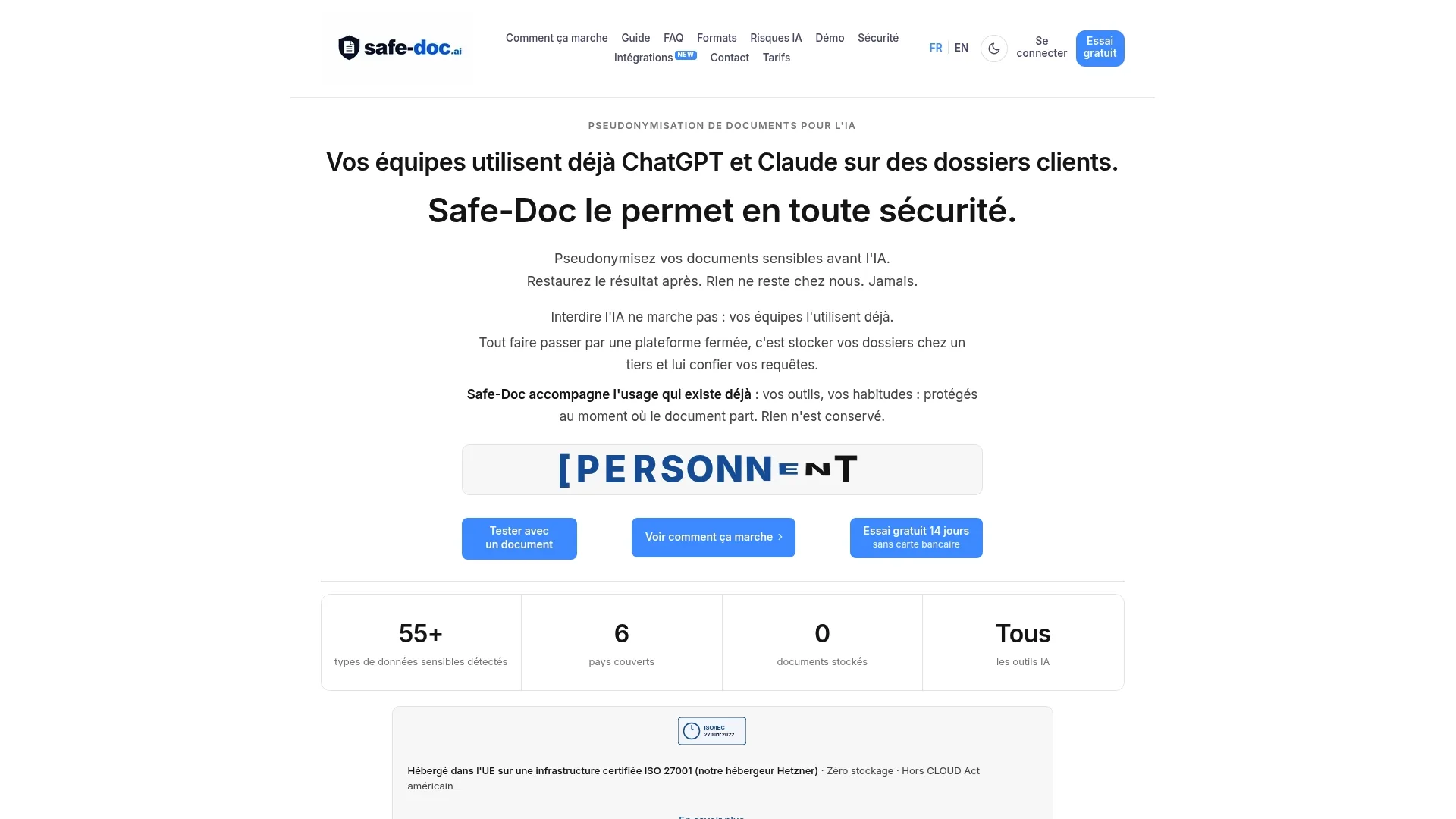
Safe-doc solves this problem by automatically pseudonymizing your sensitive documents before they reach an AI tool. Names, RIB, tax identification numbers, and payroll data are replaced with neutral tokens in real time. The original document is not durably stored. You continue to use ChatGPT or Claude as usual, but your data remains protected. The solution is designed to meet the requirements of Articles 25 and 32 of the GDPR and integrates directly into existing workflows. Discover how pseudonymization and GDPR audit can apply to your financial statements, or consult the GDPR pseudonymization guide to understand the technical differences between pseudonymization and anonymization.
Frequently asked questions
Do financial statements contain personal data within the meaning of the GDPR?
Yes. Payslips, invoices, RIB, and tax returns contain data that identifies natural persons. The GDPR fully applies to these documents.
Can financial data be erased at an individual's request?
No, if a legal obligation requires its retention. Legal retention periods (10 years for invoices, 5 years for payroll) take precedence over the right to erasure provided for in Article 17 of the GDPR.
What is the difference between pseudonymization and anonymization in financial statements?
Pseudonymization replaces identifiers with codes but retains the link to the individual, which enables audits. Anonymization permanently removes this link, rendering the document outside GDPR scope but unusable for internal controls.
Is a processing register required for financial data?
Yes. Article 30 of the GDPR requires every organization to maintain a register documenting the purposes, durations, and security measures for each processing operation, including accounting and financial processing.
What risks does using AI tools on non-pseudonymized financial statements pose?
Sending non-pseudonymized financial documents to consumer AI tools constitutes a potential GDPR violation. These tools may process and retain data in non-compliant environments, exposing the organization to penalties and leaks of sensitive data.