

Before sending any document to a third-party artificial intelligence service, one measure takes precedence over all others: pseudonymize identifying data client-side, then encrypt the content with keys you control (BYOK approach). Without this step, you expose your organization to irreversible leakage, because the cloud provider can technically access transmitted data, index it, or use it to improve its models.
Three priority actions to implement immediately:
- Pseudonymize before sending: replace names, contract numbers, company registration numbers, HR data, and any personally identifiable information with neutral identifiers, retaining the mapping table on your own infrastructure.
- Sign an Article 28 GDPR-compliant DPA: contractually require a prohibition on using your data to train models, a certified deletion clause, and audit rights.
- Favor a sovereign architecture or on-premises deployment for the most sensitive data; only use Enterprise APIs with training opt-out when written contractual evidence is obtained.
Table of contents
- What legal obligations apply to you in France for cloud AI?
- Pseudonymization or anonymization: which to choose for your AI processing?
- Which architectures guarantee control over your data with a third-party LLM?
- How to evaluate a cloud AI pseudonymization provider?
- What implementation plan should you prepare in-house?
- What AI-specific risks must you anticipate?
- Safe-doc: real-time pseudonymization, zero storage, GDPR compliance
- Key takeaways
- What legal teams and CIOs often underestimate
- Official sources and references for further reading
What legal obligations apply to you in France for cloud AI?
The CNIL and ANSSI explicitly recommend avoiding consumer-grade AI tools for processing sensitive internal data. This is not a warning in principle: it is a formal recommendation that engages the data controller's liability in the event of an incident.
Legal liability remains with the data controller: delegating hosting to a third party does not exempt you from the obligation to conduct a DPIA and formalize contractual clauses. Entrusting data to a cloud provider does not transfer GDPR responsibility-it remains entirely yours.
The CNIL recommends conducting a DPIA (Data Protection Impact Assessment) whenever an AI system processes personal data at scale or involves automated decision-making. This assessment must map risks, define the technical and organizational measures adopted, and be documented before production deployment.
ANSSI, meanwhile, recommends favoring SecNumCloud-qualified providers and architectures that limit exposure to extraterritorial laws. The 2018 U.S. Cloud Act can compel a U.S.-based provider to deliver data hosted in Europe to U.S. authorities. The physical location of servers is therefore not enough: the legal nationality of the provider matters just as much. For a comprehensive guide to AI contractual obligations, the practical implications of Article 28 are detailed sector by sector.
Pseudonymization or anonymization: which to choose for your AI processing?
The distinction is legally fundamental. Anonymized data no longer allows, by any reasonably available means, re-identification of the person concerned: it falls outside the GDPR's scope but often loses all business utility. Pseudonymized data remains technically re-identifiable via a protected mapping table: it remains subject to the GDPR but allows analytical processing, enrichment, and controlled restoration.
For enterprise AI use cases, complete anonymization is rarely practical. Analyzing a contract, processing an HR file, or conducting M&A due diligence requires maintaining the semantic coherence of the document. Pseudonymization is therefore the appropriate compromise: it reduces exposure risk while preserving processing utility.
To be legally effective, three technical conditions must be met:
- The mapping table must be encrypted with a recognized algorithm and stored separately from the pseudonymized data.
- Key management must remain under the exclusive control of the data controller (BYOK principle).
- Each access to the mapping table must be logged and auditable.
Pro tip: Refer to Safe-doc's [pseudonymization vs. anonymization comparison](https://safe-doc.ai/blog/pseudonymisation-vs-anonymisation.html) to identify the appropriate protection level for each document type before configuring your AI pipeline.
Which architectures guarantee control over your data with a third-party LLM?
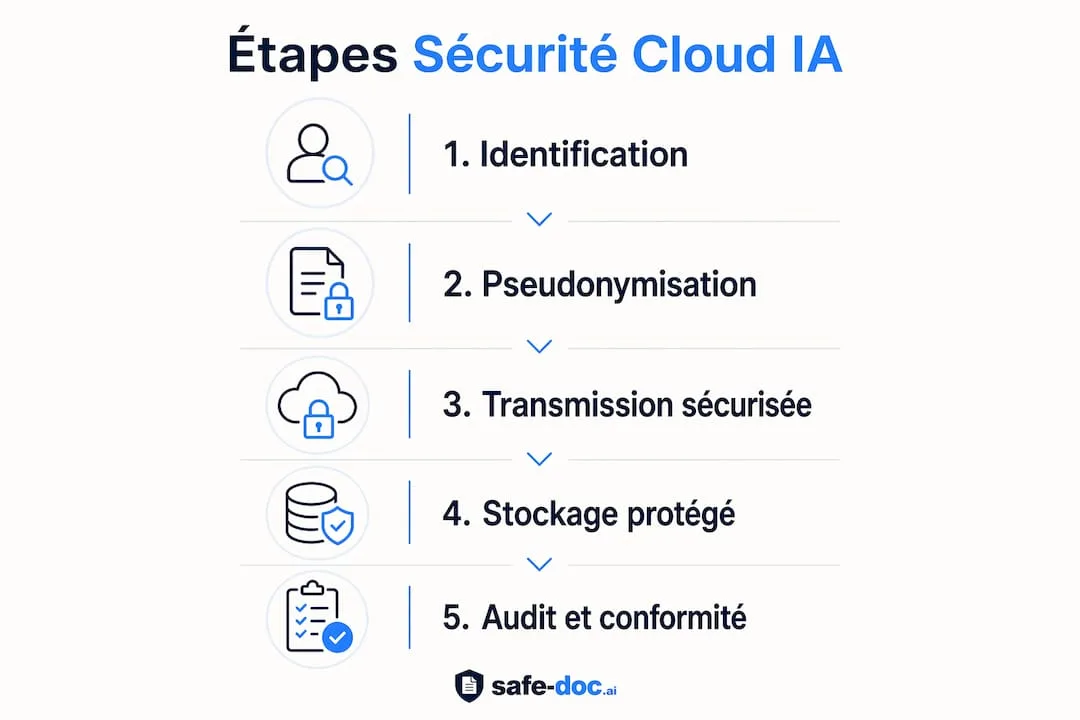
The recommended secure flow follows four sequential steps: raw data extraction, pseudonymization in a local gateway (or client-side installed agent), client-side encryption with your own keys, then minimal transmission to the LLM API with the Enterprise training opt-out enabled.

| Architecture pattern | Sovereignty level | Typical use case |
|---|---|---|
| On-premises deployment (Mistral, LLaMA) | Maximum | Ultra-sensitive data, healthcare or defense sectors |
| SecNumCloud sovereign cloud (Scaleway, OVHcloud, Outscale) | High | SMEs and mid-caps subject to strict GDPR |
| Enterprise API + BYOK + pseudonymization | Moderate | General productivity with enhanced controls |
| Public API without controls | Low | Avoid for any sensitive document |
The zero-storage pattern deserves particular attention: processing occurs in-memory or streaming, without persistent indexing by the provider. Coupled with a zero-storage-by-design architecture, this pattern eliminates the risk of data reuse after the session.
For RAG (Retrieval-Augmented Generation) architectures, the vector database must be hosted in the European Union, embeddings encrypted, and prompts injected only from a controlled layer that has previously pseudonymized document fragments.
Pro tip: The best operational practice is to implement pseudonymization in a local gateway that processes and encrypts data before any exchange with an external API, then log each transaction for audit purposes.
How to evaluate a cloud AI pseudonymization provider?
Before signing with a provider or deploying an internal solution, systematically verify these criteria:
1. Signable Article 28 DPA: the contract must explicitly prohibit use of data for model training, set a zero or minimal retention period, and provide for a certificate of deletion.
2. Incident notification within 24 hours: requiring a notification SLA shorter than the legal 72-hour deadline (Article 33 GDPR) gives you margin to prepare your own notification to the CNIL.
3. BYOK and client-side encryption: the CNIL identifies client-side encryption as the most protective approach for cloud confidentiality.
4. Zero storage by design: verify that the architecture retains no data after processing, not merely by policy but structurally.
5. Access logs and audit rights: logs must be accessible to the data controller and exportable for external audit.
6. Verifiable certifications: ISO 27001 covering the full scope of the service, SecNumCloud for the most sensitive data, HDS if the healthcare sector is involved.
7. Recent penetration testing reports: a pentest less than 12 months old, conducted by an independent third party, is a concrete signal of security maturity.
An NDA alone is insufficient. A comprehensive GDPR DPA must include training prohibitions, retention periods, audit rights, and deletion certificates-without which contractual protection remains incomplete.
What implementation plan should you prepare in-house?
| Phase | Indicative duration | Primary owner |
|---|---|---|
| Data mapping and DPIA | 2-4 weeks | DPO + CIO |
| Pseudonymization prototype (synthetic data) | 2-4 weeks | CIO + project team |
| Gateway and BYOK integration | 4-8 weeks | CIO + CISO |
| Security testing and compliance validation | 2-4 weeks | CISO + DPO |
| Production deployment and monitoring | Continuous | CIO + DPO |
A complete proof of concept generally takes 4 to 8 weeks; full production deployment requires 3 to 6 months depending on IT system complexity and sector-specific requirements. Fictitious or synthetic data is recommended by the CNIL for testing phases, avoiding exposure of real data before controls are validated.
The main cost items to anticipate: adaptation of existing IT systems, deployment of a key management module (HSM or BYOK service), external audits and pentests, and sovereign service licenses or on-premises infrastructure for internally deployed models.
What AI-specific risks must you anticipate?
Threats specific to AI systems go beyond traditional vulnerabilities. The CNIL dossier on AI system security identifies several specific attack categories:
- Membership inference: an attacker determines whether a specific record was used to train the model, indirectly revealing sensitive data.
- Model inversion: by querying the model in a targeted manner, it becomes possible to reconstruct training data.
- Data poisoning: injection of corrupted data to bias model outputs.
- Exfiltration via responses: a misconfigured model can return fragments of confidential documents in responses to other users.
Countermeasures to implement combine data minimization before transmission, robust pseudonymization, filtering of model outputs, and red team exercises to test system boundaries. Organizationally, mastering Shadow AI requires training teams on AI security, strict access rights limitations, and monitoring of undeclared use.
Pro tip: In healthcare and finance sectors, add document watermarking before pseudonymization: in the event of a leak, you can identify the source of the compromised document.
Safe-doc: real-time pseudonymization, zero storage, GDPR compliance
Establishing a secure architecture for third-party cloud AI takes time and resources. Safe-doc addresses this need with a directly operational approach: the solution pseudonymizes your sensitive documents in real time, before any transmission to ChatGPT, Claude, or any other LLM, without durably storing the processed data.
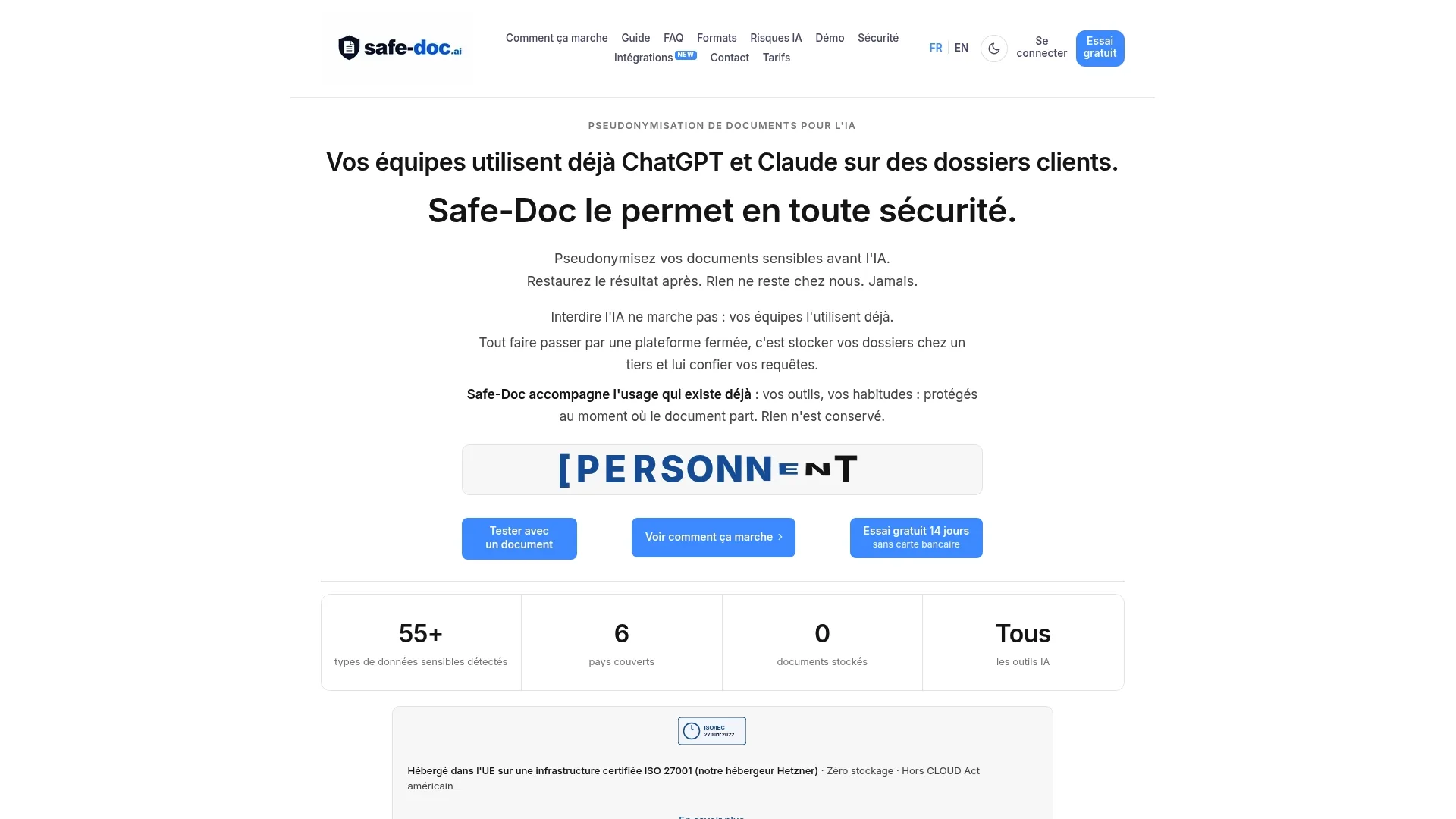
Concretely, Safe-doc operates as a transparent protection layer between your teams and the AI tools they already use. Identifying data is replaced on the fly, keys remain under your control (BYOK), and each transaction is logged for audit. For legal departments, DPOs, and HR or M&A teams, Safe-doc offers a page dedicated to DPA and compliance commitments as well as a DPO service page to support compliance efforts. Contact us for a demonstration or proof of concept tailored to your sector.
Key takeaways
Client-side pseudonymization combined with a signed Article 28 DPA constitutes the minimum foundation for securing sensitive documents when using a third-party AI cloud.
| Point | Details |
|---|---|
| Pseudonymize before sending | Replace all identifying data client-side, encrypted mapping table under your control. |
| Article 28 DPA mandatory | Training prohibition, certified deletion, audit rights, and incident notification within 24 hours. |
| DPIA before production | Map risks and document measures before any AI deployment on personal data. |
| Zero-storage architecture | Favor in-memory processing without persistent indexing by the third-party provider. |
| Safe-doc | Real-time pseudonymization, zero storage by design, BYOK, and logging for GDPR compliance. |
What legal teams and CIOs often underestimate
Most organizations approach cloud AI data security as a technical problem to be solved once and for all. This is a framing error. The risk surface evolves with each new model, each update to a provider's terms of use, each new business use case. Compliance is not a steady state: it is an ongoing process.
What I recommend to teams starting out: don't search for the perfect solution before acting. Begin with high-risk processes, those where HR, health, or M&A data is already flowing to undeclared AI tools. Pseudonymizing these flows as a priority immediately reduces the exposure surface, even if the rest of the IT system is not yet secured. Generalizing afterward is much simpler when an initial scope is controlled and documented.
The combination of technical measures and solid contractualization (complete DPA, not merely an NDA) is what truly reduces legal surface area in the event of an incident. One without the other leaves blind spots that neither your insurer nor the CNIL will ignore.
Official sources and references for further reading
- Security recommendations for a generative AI system (ANSSI/CNIL): reference guide on confidentiality, integrity, and availability controls for AI systems.
- CNIL recommendations for companies considering cloud services: contractual checklist and security requirements for public cloud.
- Development of AI systems: CNIL recommendations: DPIA framework and data controller obligations.
- CNIL dossier on AI system security: analysis of AI-specific threats (inference, inversion, poisoning).
- Cloud encryption practices (CNIL): recommendations on client-side encryption, BYOK, and synthetic data.
- Security and architecture Safe-doc: technical documentation on zero-storage policy and security guarantees.
- GDPR and legal data processing: guide on DPIAs, DPAs, and sector-specific compliance.
- Safe-doc for legal departments: use cases and implementation for legal teams and DPOs.
This article is general information and does not constitute legal advice. For your specific situation, consult your DPO or a data law specialist.