


Legal data processing under the GDPR refers to any operation applied to personal information within a legal context: collection, retention, consultation, transmission, or destruction. Legal professionals face strict obligations regarding GDPR legal data processing, including clear designation of data controller and processor roles, implementation of appropriate security measures, and maintenance of a register compliant with Article 30. The February 23, 2026 law, which establishes legal privilege for in-house counsel, adds a layer of complexity that every data protection officer must master immediately.
Table of Contents
- What are the responsibilities of the data controller and processor for legal data?
- What technical and organizational measures secure legal data processing?
- How does the February 23, 2026 law impact legal data management under GDPR?
- What registers and documents are essential for GDPR compliance in a legal firm?
- Key takeaways
- What I observe in practice since the 2026 law
- Safe-doc supports legal professionals in their GDPR compliance
- Frequently asked questions
- Recommended resources
What are the responsibilities of the data controller and processor for legal data?
The distinction between data controller and processor forms the foundation of GDPR compliance for any law firm. This distinction does not depend on the legal status of the entity, but rather on the instructions given and the purposes pursued. A firm that defines the processing objectives is a data controller. A service provider that executes processing according to the firm's instructions is a processor.
The data controller assumes the following obligations:
- Define the purposes and means of processing clients' personal data.
- Guarantee the effective exercise of data subjects' rights: access, rectification, erasure.
- Conduct a Data Protection Impact Assessment (DPIA) before deploying any high-risk tool.
- Notify the CNIL within 72 hours of any data breach.
The processor must:
- Act exclusively according to the documented instructions of the data controller.
- Apply technical and organizational measures appropriate to the sensitivity of the data.
- Notify any data breach to the controller without undue delay.
- Sign a processing agreement compliant with Article 28 of the GDPR.
Under Article 28 of the GDPR, any legal organization processing data on behalf of clients must have a written Data Processing Agreement (DPA). The absence of this contract directly exposes the firm to CNIL sanctions. This document must specify the subject matter, duration, nature, and purpose of the processing, as well as the obligations and rights of each party.
Pro tip: Systematically verify that every external service provider (host, case management software, AI tool) has signed a compliant DPA before any access to client data. An absent or incomplete DPA is sufficient to establish your liability during a CNIL inspection.
The data controller / processor distinction is often unclear for legal professionals, yet it determines the entire compliance architecture. Clarifying this point at the outset of any relationship with a service provider avoids costly reclassifications later.
What technical and organizational measures secure legal data processing?
Legal data security relies on concrete measures, not statements of intent. The processor must implement encryption and access controls as mandatory minimum measures. These requirements also apply to the data controller, who must ensure their effective implementation by all service providers.
Best practices to deploy in a law firm follow a progressive logic:
1. Encryption of data at rest and in transit. All communications containing personal data must use secure protocols (TLS 1.2 minimum). Client databases must be encrypted.
2. Pseudonymization of sensitive documents. Pseudonymization under Article 4(5) of the GDPR reduces risk in the event of a leak by rendering data unusable without the lookup key.
3. Granular access control. Each team member accesses only the files necessary for their role. Access is logged and reviewed quarterly.
4. Regular system updates. Unpatched software represents the primary attack vector. A documented update schedule is proof of diligence during audits.
5. Periodic internal audits. An annual audit at minimum detects compliance drift before a CNIL inspection.
6. Documented incident management. Every security incident, even minor, must be recorded in a dedicated register.
Key figure: Over 4,600 breach notifications were submitted to the CNIL in 2023. This volume illustrates the actual frequency of incidents and the need for a well-established notification process.
The CNIL recommends that processors notify controllers within 24 to 48 hours of detecting an incident. This short timeframe allows the controller to meet the legal obligation to notify the CNIL within 72 hours. A firm without a written procedure on this matter assumes major documentary risk.
Pro tip: Before deploying any AI tool that processes data covered by professional privilege, a [DPIA is mandatory](https://tensoria.fr/blog/ia-juridique-rgpd-souverainete-cabinet-avocats-france). Document the identified risks, selected measures, and the DPO's opinion. This document becomes your shield during an inspection.

A compliant firm does not stop at contractualization: the actual deployment of technical measures is what the CNIL verifies first. Declarations without technical evidence do not constitute an admissible defense.
How does the February 23, 2026 law impact legal data management under GDPR?
The February 23, 2026 law establishes legal privilege protecting the confidentiality of legal consultations by in-house counsel. This protection reinforces the position of lawyers who also serve as Data Protection Officers (DPO). It does not, however, remove any existing GDPR obligation.
The conditions for applying legal privilege are precise:
- The consultation must come from a qualified lawyer employed by the company.
- It must concern a legal question within the scope of professional activity.
- It must be clearly identified as confidential and covered by privilege.
- The lawyer-DPO must formally distinguish independent GDPR opinions from consultations covered by privilege.
"The protection granted by legal privilege does not remove GDPR obligations, particularly in the event of suspected administrative infringement: documents may be placed under seal and subject to a specific judicial procedure." Source: Squire Patton Boggs
The CNIL therefore retains the right to intervene even on documents covered by privilege when an administrative infringement is suspected. This reality requires increased documentary rigor, not a relaxation of obligations.
Legal professionals must keep several practical points in mind:
- Maintain a separate register of consultations covered by privilege and independent GDPR opinions.
- Train lawyer-DPOs in the formal distinction between these two types of opinions.
- Do not use legal privilege as an argument to defer GDPR compliance.
- Anticipate sealing procedures by clearly documenting the nature of each document.
The dual role of lawyer and DPO creates a grey area that the 2026 law has not entirely resolved. The DPO must clearly arbitrate between their role as independent GDPR advisor and opinions covered by privilege to avoid any legal confusion during an inspection.
What registers and documents are essential for GDPR compliance in a legal firm?
GDPR compliance in a law firm is measured first by the quality of its documentation. The processing register is mandatory under Article 30 of the GDPR. It must detail purposes, data categories, retention periods, and security measures applied.
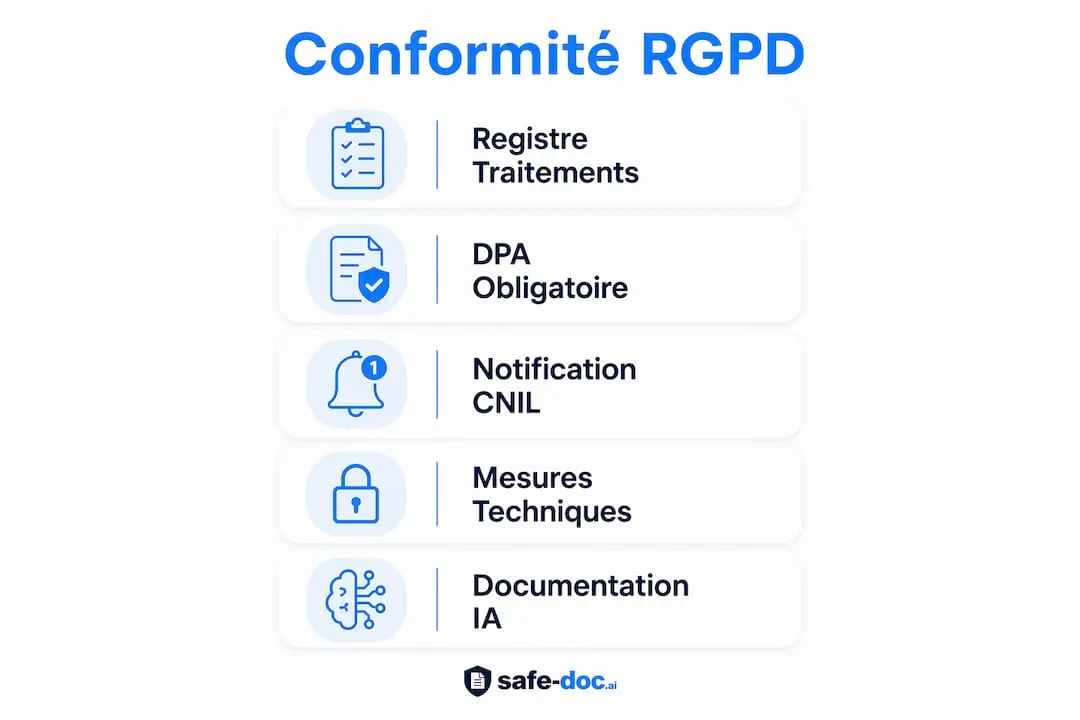
| Mandatory document | Minimum required content |
|---|---|
| Processing register (Art. 30) | Purposes, data categories, retention periods, security measures |
| Privacy notices | Legal basis, data subjects' rights, DPO contact details |
| Processing agreements (DPA) | Subject matter, duration, nature of processing, obligations of the parties |
| Rights management procedure | Response deadlines, identity verification process |
| Incident register | Date, nature, impact, measures taken, CNIL notification |
Documented procedures for managing data subject rights requests are often neglected. A firm must respond to any access, rectification, or erasure request within one month. This deadline is verifiable and enforceable.
Documentary obligations to maintain include:
- Annual update of the processing register after any change in systems or service providers.
- Revision of privacy notices with every change in legal bases used.
- Verification of DPA compliance upon renewal of service provider contracts.
- Documentation of GDPR training provided to staff.
Cumulative penalties for GDPR non-compliance have exceeded 5 billion euros since 2018. Failure to maintain the processing register can result in a fine of up to 10 million euros. These figures illustrate that documentation is not an administrative formality but a direct financial issue.
For law firms using AI tools, documentation must also cover processing carried out via these tools, including corresponding DPIAs and DPAs signed with vendors.
Key takeaways
GDPR compliance for legal data requires rigorous documentation, effective technical measures, and clear role distinction-reinforced since 2026 by legal privilege without replacing other obligations.
| Point | Details |
|---|---|
| Role distinction | Precisely identify the data controller and processor before any processing of client data. |
| Mandatory DPA | Any service provider accessing legal data must sign a contract compliant with Article 28 of the GDPR. |
| Effective technical measures | Encryption, pseudonymization, and access control are verified by the CNIL, not merely declared. |
| Limited legal privilege | The February 23, 2026 law protects legal consultations but does not suspend any GDPR obligation. |
| Ongoing documentation | Processing register, incident register, and rights procedures must be kept current at all times. |
What I observe in practice since the 2026 law
The February 23, 2026 law generated understandable enthusiasm among in-house counsel. Many view it as a new protection that simplifies their work. My observation differs: this law has primarily revealed the extent of the shadow DPO problem-the poorly isolated lawyer who accumulates roles without formally distinguishing them.
The shadow DPO is a vulnerability that the CNIL penalizes. A lawyer who renders GDPR opinions without formal independence, then invokes legal privilege to protect those same opinions, creates legal confusion that worsens their situation during an inspection. The solution is not in the privilege; it lies in the clear separation of duties.
What I have learned from extensive work on these subjects: GDPR compliance in a law firm is not achieved once and for all. It is maintained through living procedures, regularly revised, and through technical tools that reduce human risk. Pseudonymizing documents before processing them with AI tools, as Safe-doc proposes, is one of the most effective measures for reconciling productivity and data protection. It concretely reduces the exposure surface without blocking workflows.
My most direct advice: do not treat GDPR as a project to complete. Treat it as a permanent function, with an identified owner, appropriate tools, and living documentation.
- Jacques
Safe-doc supports legal professionals in their GDPR compliance
Law firms and in-house legal departments handle highly sensitive data daily. GDPR compliance requires tools that protect this data without burdening existing processes.
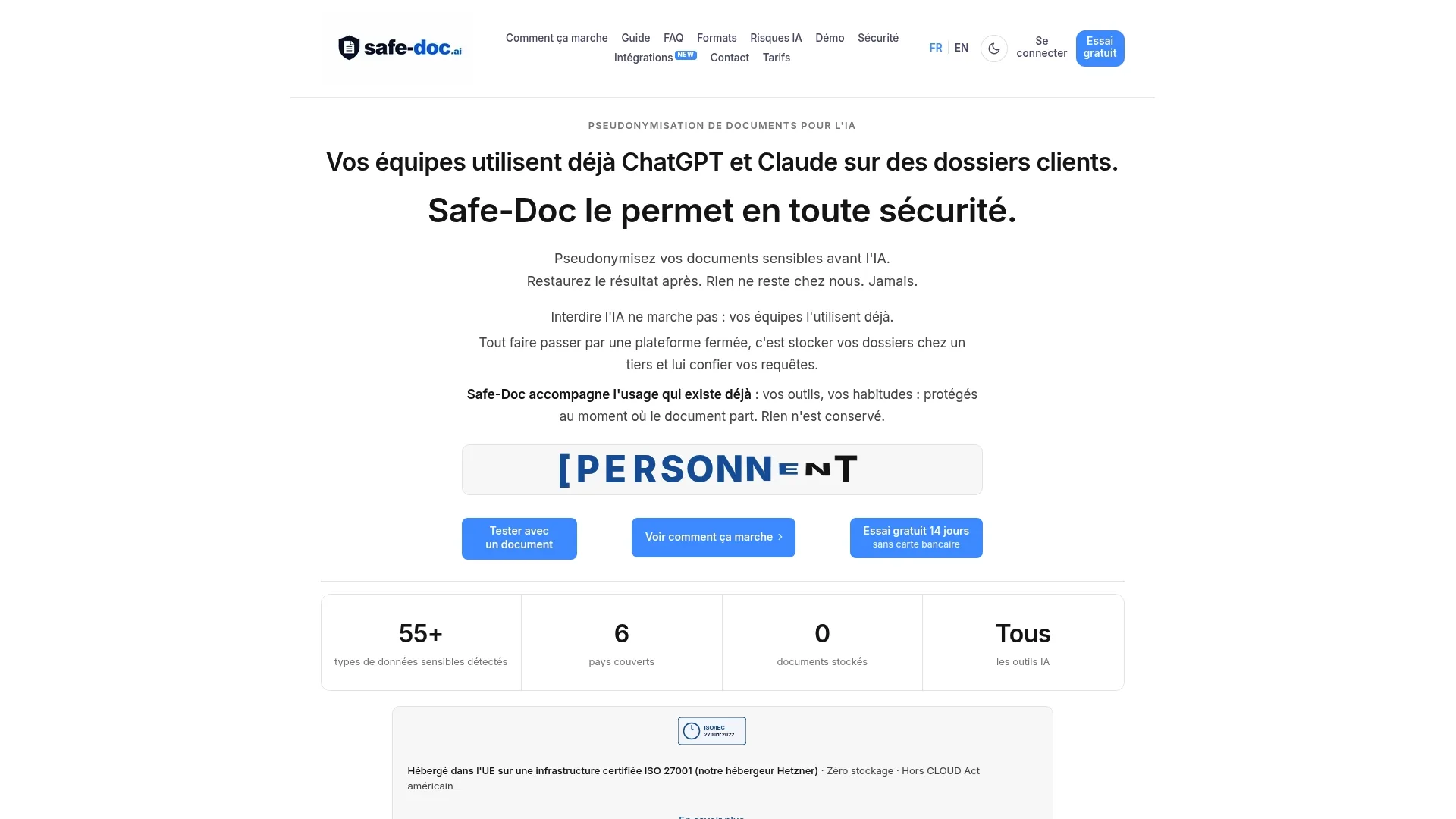
Safe-doc meets this need with an approach centered on pseudonymizing sensitive documents before processing them with AI tools. The platform does not durably store documents and guarantees real-time processing. Legal professionals can thus use AI tools like ChatGPT or Claude on client files without exposing personal data. Safe-doc also offers DPO support and audit resources tailored to GDPR requirements specific to the legal sector. To discover how to secure your processing today, explore the solutions dedicated to law firms.
Frequently asked questions
What is legal data processing under GDPR?
Legal data processing refers to any operation on personal data carried out in a legal context: collection, consultation, retention, or transmission. The GDPR requires the data controller to define purposes, secure the data, and respect data subject rights.
When is a DPA mandatory for a law firm?
A DPA is mandatory whenever an external service provider accesses personal data on behalf of the firm, in accordance with Article 28 of the GDPR. The absence of this contract exposes the firm to direct CNIL sanctions.
Does legal privilege exempt from GDPR obligations in 2026?
No. The February 23, 2026 law protects the confidentiality of legal consultations by in-house counsel, but does not suspend any GDPR obligation. The CNIL can still intervene in the event of suspected administrative infringement, including on documents covered by privilege.
What is the deadline for notifying the CNIL of a data breach?
The data controller has 72 hours to notify the CNIL after becoming aware of a breach. The CNIL recommends that processors alert controllers within 24 to 48 hours to enable compliance with this legal deadline.
Does pseudonymization alone guarantee GDPR compliance?
Pseudonymization significantly reduces risk by rendering data unusable without the lookup key, but it does not replace other GDPR obligations. It must be combined with an up-to-date processing register, compliant DPAs, and documented incident management procedures.