


Confidentiality in artificial intelligence contracts encompasses all contractual clauses that govern data use, security, and protection throughout its entire lifecycle. A generic confidentiality clause is insufficient: AI contracts require specific provisions covering personal data processing, model training prohibitions, audit rights, and post-contract data restitution. The key regulatory frameworks are the GDPR (particularly Article 28 on data processing agreements, or DPAs) and the European AI Act. Mastering these AI contractual obligations is now a core competency for every legal and compliance professional.
What are the essential clauses for confidentiality in artificial intelligence contracts?
A robust AI contract rests on a DPA compliant with Article 28 of the GDPR. Article 28 mandates a detailed contractual framework: written instructions, confidentiality obligations, security measures, use of sub-processors, assistance with data subject rights, and deletion or return of data at contract termination. This framework constitutes the minimum baseline. Any contract that deviates from it exposes the data controller to direct enforcement action by the CNIL or its European counterparts.
The clauses to integrate systematically are:
- Model training prohibition: This clause protects the client's strategic data by prohibiting the provider from using that data to train, fine-tune, or improve its models without prior written consent. It must explicitly cover derived artifacts: embeddings, metadata, and fine-tuned models.
- Rapid breach notification: The processor must notify any personal data breach within a maximum of 24 hours after becoming aware of it. The contract must specify the minimum content of this notification and the assistance procedures for reporting to the supervisory authority.
- Audit and log access clauses: The client must be able to audit processing logs to verify GDPR and AI Act compliance. The concrete procedures (notice period, frequency, scope, confidentiality of findings) must appear in the contract.
- Restitution, deletion, and reversibility: Certified deletion and data portability must be contractually guaranteed at contract conclusion, with migration assistance if necessary.
Pro tip: Require that the model training prohibition covers not only raw data but also all derived artifacts produced during contract execution. A provider who refuses this extension signals real risk.
How to segment the data lifecycle in contracts?
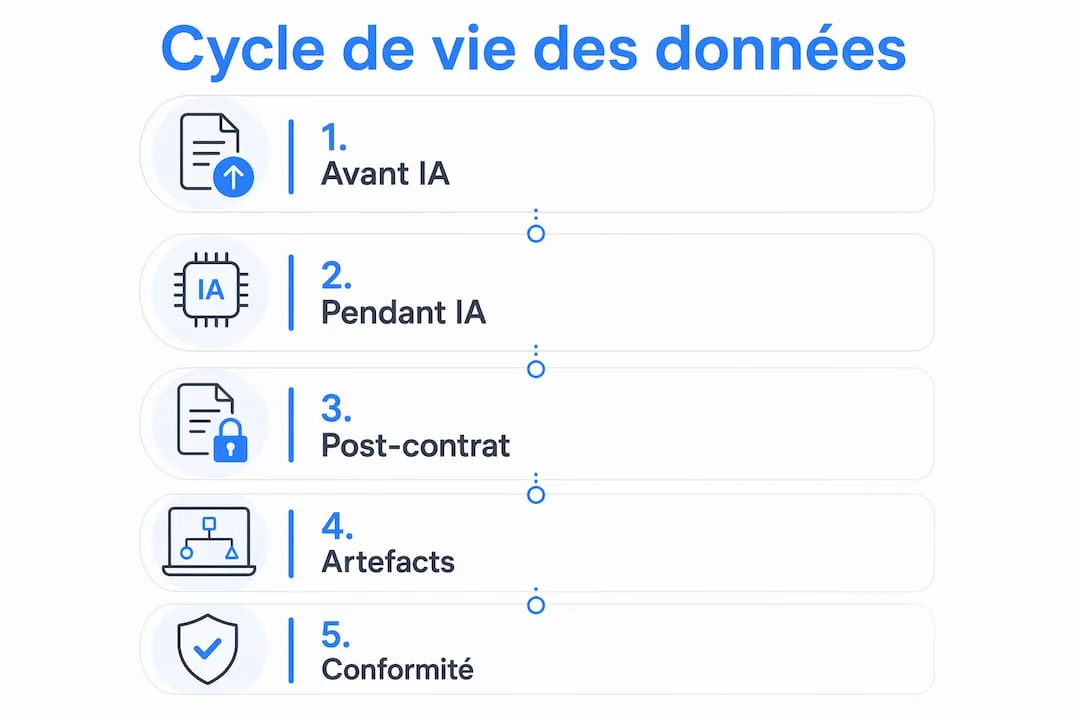
Data lifecycle segmentation is the most effective method for preventing leaks and complying with legal obligations. It consists of distinguishing three data categories according to their phase of existence in the AI system, and applying distinct rules for purpose, rights, and retention period.

| Phase | Data Type | Key Contractual Rules |
|---|---|---|
| Before AI | Data provided by client (contracts, HR files, customer data) | Limited purposes, restricted access, documented legal basis |
| During AI | Prompts, processing logs, intermediate results | Short retention period, reuse prohibition, auditable logs |
| After AI | Derived data (embeddings, fine-tuned models, metadata) | Certified deletion or restitution, prohibition of residual use |
Derived artifacts constitute the most underestimated risk. Embeddings produced from confidential legal documents can encode sensitive information in non-obvious ways. Implementing a data matrix with precise assignment of purposes, durations, and restitution conditions prevents these artifacts from being exploited outside the contractual scope. This matrix must be annexed to the DPA and updated with each system evolution.
Pro tip: Request from the provider an exhaustive list of all artifacts produced during contract execution. If this list does not exist, the post-contract deletion clause cannot be verified or enforced.
How to guarantee GDPR and AI Act compliance through contractualization?
Regulatory compliance cannot be decreed: it must be contractualized. Here are the four obligations to integrate into any AI contract involving personal data or high-risk systems.
1. GDPR framework for controller and processor: The data controller defines purposes and means. The processor acts on documented instructions. The DPA formalizes this allocation and must be signed before any processing. Any modification of the provider's general terms or privacy policy requires the client's prior written consent. Failing this, the client must be able to terminate without penalty within a contractually fixed period, for example 60 days.
2. AI Act technical documentation: AI contracts must provide for up-to-date technical documentation covering the complete model chain (foundation model and adaptations), accessible to competent authorities. This documentation must be contractually guaranteed by the provider, with an obligation to update upon system evolution.
3. Audit procedures and access rights: The contract must specify the client's right to conduct audits, access processing logs, and receive periodic compliance reports. Log control is often the pivot point between a theoretical contract and a truly effective one.
4. Stability of terms clause: Any unilateral modification of data use conditions by the provider must trigger a formal notification obligation to the client. This clause protects against gradual purpose creep, common in AI SaaS contracts.
| Obligation | Regulatory Basis | Corresponding Contractual Clause |
|---|---|---|
| Processing on instruction | GDPR Art. 28 | DPA with written instructions |
| Technical documentation | AI Act | Updated technical annex |
| Breach notification | GDPR Art. 33 | 24-hour deadline, defined minimum content |
| Stability of terms | Contractual best practice | Modification clause with termination right |
What are the legal risks related to AI confidentiality?
The legal risks linked to data protection in AI contracts are concrete and documented. Identifying them upstream enables their neutralization through appropriate clauses.
- Trade secret violation via artifacts: A provider that reuses embeddings produced from client data may indirectly disclose strategic information to third parties or other clients. This risk is aggravated when the training prohibition clause does not cover indirect uses.
- Late breach notification: Notification exceeding the 24-hour deadline exposes the data controller to a sanction from the CNIL, regardless of the provider's liability. The contract must provide for a contractual penalty in case of late notification by the processor.
- Technical dependency and abusive data retention: Some providers condition data restitution on high migration fees or excessive delays. Reversibility and post-contract deletion are often neglected but decisive elements for lasting confidentiality.
- Lack of portability: Without an explicit portability clause, the client may find themselves unable to recover their data in a usable format. This situation creates contractual dependency that weakens any provider-switching strategy.
- Unregulated unilateral modifications: A provider who modifies its privacy policy without the client's prior consent may broaden processing purposes without the client being informed in time to react. The stability of terms clause is the only effective contractual protection against this risk.
For professionals who wish to deepen their understanding of GDPR and AI compliance requirements, audit and contractualization mechanisms are detailed in Safe-doc's specialized resources.
Key points
Confidentiality in AI contracts rests on five non-negotiable clauses: DPA compliant with GDPR Article 28, training prohibition covering derived artifacts, breach notification within 24 hours, audit rights on logs, and certified post-contract restitution.
| Point | Details |
|---|---|
| DPA compliant with GDPR Art. 28 | Formalize instructions, confidentiality, security, and data deletion before any processing. |
| Extended training prohibition | Explicitly cover embeddings, metadata, and fine-tuned models, not just raw data. |
| Notification within 24 hours | Contractualize deadline, minimum content, and penalties for processor delay. |
| Lifecycle segmentation | Apply distinct rules to provided data, logs, and derived artifacts. |
| Post-contract reversibility | Guarantee portability, certified deletion, and migration assistance from signing. |
What fifteen years of contract practice taught me about AI confidentiality
Most AI contracts I review contain a DPA. Very few contain a DPA that actually works. The difference rarely lies in the document's length. It lies in the precision of clauses on derived artifacts and the quality of audit procedures.
The point that still surprises me is provider resistance to the extended training prohibition clause. When a provider agrees to prohibit use of raw data but refuses to include embeddings in the scope, that's a red flag. It means embeddings have value to them. And that value comes from your data.
The post-contract phase is systematically under-negotiated. Legal teams concentrate their energy on signing and forget that real exposure begins at termination. I have seen situations where sensitive data remained in a provider's systems six months after contract end, due to lack of a certified deletion clause with deadline and proof.
My practical advice: treat the reversibility clause like a financial clause. Negotiate it with the same rigor as a penalty clause. A provider who cannot commit to a certified deletion timeline and documented migration procedure does not deserve your contractual trust.
The AI Act adds a welcome layer of complexity. Mandatory technical documentation finally creates contractual leverage to require processing chain traceability. Use it systematically in your negotiations.
- Jacques
Safe-doc to secure your sensitive data before AI
Contractual clauses protect on paper. Safe-doc protects in practice, even before data reaches the provider's AI system.
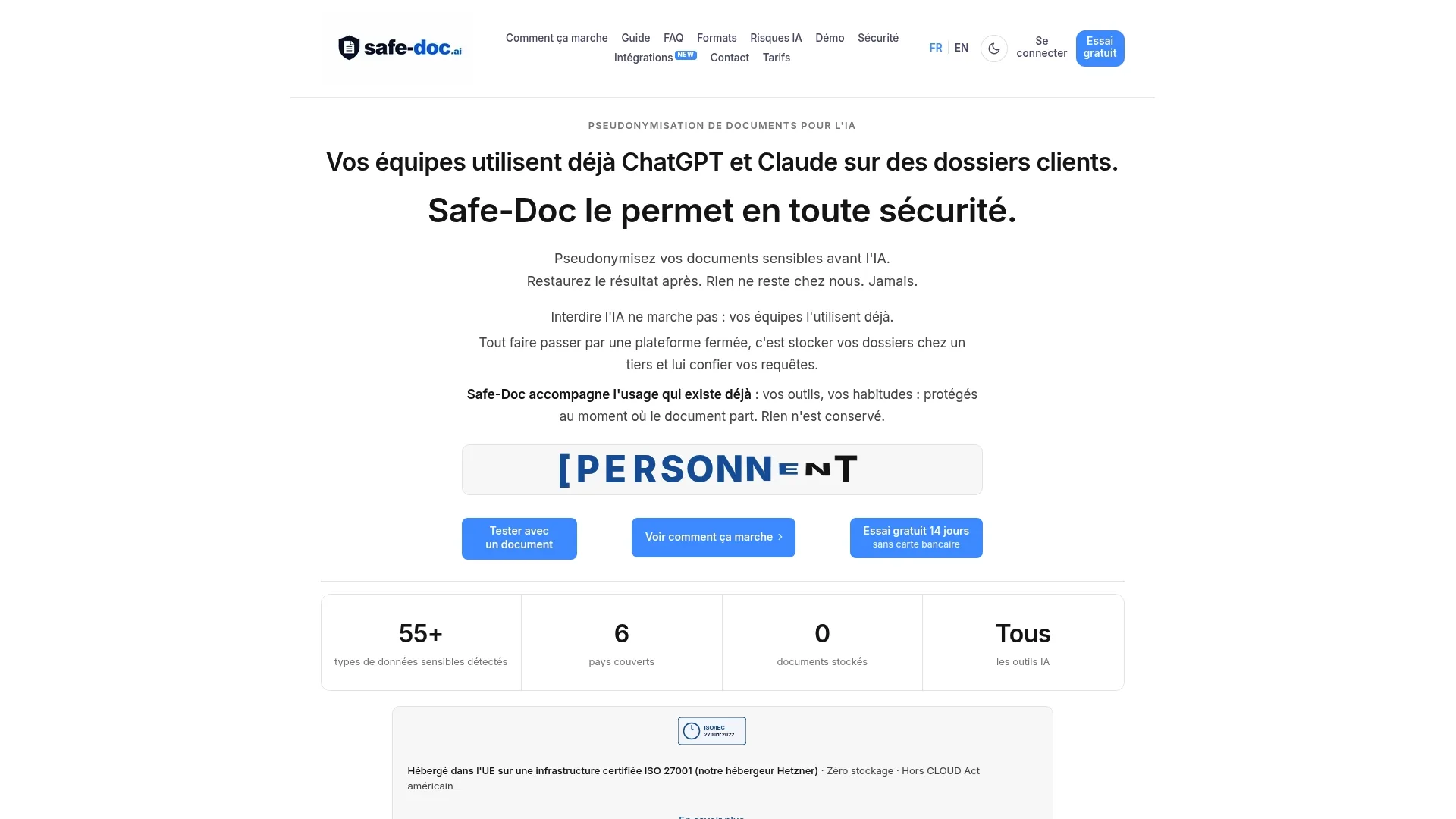
Safe-doc pseudonymizes sensitive documents in real time, without durably storing them. Legal and compliance professionals can thus use ChatGPT, Claude, or any other AI tool on confidential documents without exposing personal data or violating their contractual obligations. The solution is designed to meet GDPR and AI Act requirements and integrates into existing workflows without changing habits. For DPOs and compliance officers, Safe-doc offers a complete pseudonymization and audit service adapted to the most demanding AI contracts.
Frequently asked questions
What is a DPA in an AI contract?
A DPA (data processing agreement) is the contract mandated by Article 28 of the GDPR between the data controller and processor. It defines instructions, security measures, audit rights, and data deletion conditions.
Why prohibit model training in the contract?
Without this clause, the provider may use your data to improve its own models. The clause must cover raw data and all derived artifacts, including embeddings and fine-tuned models.
What deadline applies for notifying a data breach?
The processor must notify the data controller within a maximum of 24 hours after becoming aware of the breach. This deadline must be explicitly stated in the DPA.
How does the AI Act modify contractual obligations?
The AI Act requires complete and up-to-date technical documentation on the model processing chain. This documentation must be contractually guaranteed by the provider and accessible to competent authorities upon request.
What to do if the provider unilaterally modifies its terms?
A stability of terms clause must provide that any modification of general terms or privacy policy requires the client's prior written consent. Failing this, the client must be able to terminate the contract without penalty within a contractually fixed period.