

Pseudonymization replaces a person's direct identifiers-name, social security number, address-with a pseudonym, making it impossible to directly attribute the data to an individual without access to a separately maintained lookup table. The GDPR explicitly defines it in Article 4(5) as a technical measure encouraged to reduce risks associated with personal data processing. Unlike anonymization, pseudonymization remains reversible, preserving the operational value of the data for longitudinal analysis or cross-referencing.
For IT teams and data protection officers, the benefits of pseudonymization in data flows are tangible:
- Reduced risk of direct identification: an attacker who intercepts a pseudonymized stream cannot link the data to a real person without the key.
- Easier GDPR compliance: pseudonymized data remains subject to the GDPR, but processing benefits from lighter obligations in certain contexts (research, internal analysis).
- Preservation of referential integrity: relationships between records are maintained, which complete anonymization often destroys.
- Secure sharing with third parties: a service provider or AI tool can process the data without accessing real identities.
- Reduced impact of a breach: if exfiltrated data is unreadable without the key, notification obligations may be relaxed.
Table of contents
- What legal framework applies to pseudonymization in France?
- What technical methods can you use to pseudonymize your IT flows?
- What are the persistent risks despite pseudonymization?
- How to implement pseudonymization in your IT flows?
- Pseudonymization and AI: how to secure your flows in a modern environment?
- Concrete use cases in French companies
- How to manage access rights during pseudonymization?
- Key points
- Pseudonymization is not a checkbox
- Safe-doc protects your IT flows without changing your tools
What legal framework applies to pseudonymization in France?
Pseudonymization operates within a dual framework: the European GDPR and the French Data Protection Act, both overseen by the CNIL. Pseudonymized data remains personal data under the GDPR: it is indirectly identifying, and its processing remains subject to all regulatory obligations, including defining a legal basis, a retention period, and procedures for exercising data subject rights.
Nevertheless, the GDPR explicitly encourages pseudonymization as a security measure. It contributes to the principle of privacy by design and, in certain carefully analyzed cases, may dispense with breach notification to the CNIL if the exfiltrated data is unreadable without the secure key.
According to Gérard Haas, a lawyer specializing in digital law, pseudonymization must be evaluated actor by actor according to the reasonable means of re-identification available. An internal department that holds the lookup table processes personal data; an external service provider without access does not. This relativity is at the heart of the identifiability test that every data controller must conduct.
Practical obligations for DPOs and IT teams include:
- Document the processing in the record of processing activities, specifying the pseudonymization measures applied.
- Physically separate the lookup table from the pseudonymized data.
- Define access rights to the key in a strict and traceable manner.
- Conduct an identifiability test for each actor in the flow to correctly qualify the data's status.
- Maintain regulatory monitoring: the CNIL regularly publishes recommendations on anonymization and pseudonymization techniques.
Pro tip: Pseudonymization should not be used merely as a compliance label. Gérard Haas reminds us that it must be a documented lever for risk reduction, not a rhetorical alibi in the face of a CNIL audit.
What technical methods can you use to pseudonymize your IT flows?
Four main families of techniques cover the majority of pseudonymization needs for IT data flows. The choice depends primarily on the level of reversibility required and the sensitivity of the data processed.
Tokenization replaces a sensitive value (bank card number, patient identifier) with a random token that has no mathematical link to the original value. The lookup table is stored in a separate vault. This is the preferred method in payment environments and healthcare systems because it leaves no exploitable footprint in the flow itself.

Deterministic encryption always produces the same pseudonym for the same input value, preserving referential integrity between records. It is reversible with the key, making it suitable for longitudinal analyses where you must track an individual over time without knowing their identity.
Regular expression masking detects identifying patterns in free text (email addresses, phone numbers, proper names) and replaces them with generic tags. Supervised AI tools, which rely on named entity recognition models, automate this process with far greater precision than static rules, especially for unstructured data.
Sequential or random pseudonym assigns an arbitrary identifier to each individual. Simple to implement, it suits processing where re-identification is never necessary in production.
- Tokenization: irreversible without the vault, ideal for payment flows and health data.
- Deterministic encryption: reversible with key, preserves joins between tables.
- Masking by rules or AI: suitable for free text, emails, contracts, tax filings.
- Sequential pseudonym: quick to deploy, without the possibility of re-identification in production.
The choice of method must also account for data structure: a structured flow (relational database) tolerates deterministic encryption, while an unstructured flow (legal correspondence, HR notes) requires masking via AI or regular expressions.
What are the persistent risks despite pseudonymization?
Pseudonymization reduces risk; it does not eliminate it. The main danger remains re-identification through cross-referencing: a recipient who possesses another data source (employee list, public customer database, geographic data) can sometimes identify an individual based solely on their pseudonymized attributes. The CNIL underscores this risk and emphasizes that pseudonymized data remains personal data precisely for this reason.
Compromise of the lookup table or cryptographic key is the other critical vector. If an attacker gains access to the key, the entire system falls. Key management must therefore be carried out in a separate environment, with strict access controls and comprehensive logging of every consultation.
Points of vigilance to integrate into your security policy:
- Re-identification by inference: seemingly innocuous attributes (age, postal code, occupation) may suffice to identify a person in a small dataset.
- Poor separation of environments: storing the lookup table on the same server as the pseudonymized data nullifies the protection.
- Uncontrolled access to the key: every consultation of the key must be traced and justified.
- Data breach on pseudonymized data: if unauthorized reversal is possible, the incident constitutes a breach under the GDPR and may trigger a notification obligation.
- Lack of regular audits: re-identification techniques evolve; pseudonymization deemed robust in 2023 may no longer be so in 2026.
How to implement pseudonymization in your IT flows?
Implementation begins with precise mapping. Before choosing a technique, you must identify which flows carry directly identifying data, at what frequency, to which recipients, and in what form. This mapping directly feeds into the processing register required by the GDPR.
Once flows are identified, selecting the method follows the criteria outlined above: reversibility necessary or not, data structure, volume, and performance constraints. Secure key management must be treated as a project in its own right: isolated environment, nominative access, periodic key rotation, logging.

An often-overlooked point: pseudonymization is not a permanent state. As the CNIL notes, the same data can be pseudonymized for one department and personal for another, depending on who holds the key. Documenting data lineage-tracking who has access to what and when-is therefore essential to maintain compliance over time.
Practical recommendations for IT teams:
- Map flows before any technical implementation, involving the DPO from this stage.
- Choose the method based on the need for reversibility and data structure (structured vs. unstructured).
- Isolate the lookup table in a dedicated environment with nominative and logged access.
- Integrate pseudonymization into CI/CD pipelines so it automatically applies to each new flow.
- Train teams: a developer who bypasses pseudonymization to "facilitate testing" creates a real vulnerability.
- Plan regular audits with the DPO and legal team to verify that measures remain appropriate for current risks.
Pseudonymization and AI: how to secure your flows in a modern environment?
The growing use of artificial intelligence tools in French companies creates a new risk vector: Shadow AI. Employees use consumer AI assistants to analyze contracts, draft sensitive emails, or process HR data without the IT department or DPO being informed. Personal data then leaves the company perimeter without any protection.
Automated AI pseudonymization directly addresses this problem. Named entity recognition models, trained on business corpora, filter sensitive data in real time before it reaches an external service. The document transmitted to the third-party tool no longer contains names, SIRET numbers, addresses, or bank references: only consistent pseudonyms that preserve the text's meaning for processing.
Safe-doc fits into this logic. The platform inserts a layer of pseudonymization between your documents and the AI tools your teams already use, without changing their work habits. No documents are stored; processing occurs in real time, eliminating the risk of leakage through data accumulation in a third party.
Best practices for AI environments:
- Pseudonymize before any sending to an external AI tool, whether a conversational assistant or a document processing API.
- Verify pseudonym consistency: the same individual must receive the same pseudonym throughout the document for the AI to produce a usable result.
- Document AI flows in the processing register, specifying the pseudonymization measures applied.
- Evaluate data sovereignty: prefer solutions hosted in Europe or guaranteeing processing without storage.
Concrete use cases in French companies
Tax filings and legal correspondence
Accounting firms and finance departments handle tax filings containing personal data on executives, partners, and beneficial owners. Pseudonymizing these documents before transmitting them to an analysis tool or external service provider significantly reduces exposure risk. Confidential accounting data can thus be processed by AI tools without real identities being accessible to the service provider.
Human resources and employee files
HR teams process sensitive data daily: pay slips, evaluations, sick leave, disciplinary files. When an AI tool is used to analyze these documents (anomaly detection, file synthesis), prior pseudonymization ensures that the model processes only pseudonyms. Safe-doc offers a solution dedicated to HR teams that allows AI use on employee files without exposing personal data.
Legal departments and sensitive documents
Corporate lawyers draft and analyze contracts, transfer deeds, and correspondence with regulatory authorities. These documents contain directly identifying information about natural and legal persons. Pseudonymizing names, addresses, and contractual references before any AI analysis or transmission to a third party is a precautionary measure that French legal departments are progressively adopting to remain GDPR-compliant.
Research and development
R&D teams working on customer data to train or test models benefit from pseudonymizing their datasets from the collection phase. This allows them to share data with partners or computing providers without violating data subject rights while maintaining the structure necessary for statistical analysis.
How to manage access rights during pseudonymization?
Access rights management is where many implementations fail. Pseudonymization creates two levels of data: the pseudonymized data, accessible to a broad scope, and the lookup table (or cryptographic key), whose access must be strictly limited. Confusing these two levels is like leaving the key in the door.
The principle of least privilege applies here with particular rigor. Only actors with a documented business need to access the real identity should be able to consult the lookup table. In practice, this often concerns the DPO, certain members of the legal team, and, in specific cases, the data controller. Developers, data analysts, and external service providers work exclusively on pseudonymized data.
Each access to the key or lookup table must be logged: who consulted what, at what time, and for what reason. This traceability is essential in the event of a CNIL audit or security incident. It also enables detection of abnormal behavior, such as repeated access to the table outside normal hours.
Periodic review of access rights is often neglected. An employee who changes roles or leaves the company may retain access rights to the key if no automatic revocation process is in place. Integrating pseudonymization access rights management into employee onboarding and offboarding procedures is a simple but effective measure.
Pro tip: Use a secrets manager (such as HashiCorp Vault or AWS Secrets Manager) to store and distribute cryptographic keys. These tools offer native logging, automatic rotation, and granular access control, far beyond what a simple configuration file can guarantee.
Key points
Well-implemented pseudonymization reduces the risk of direct identification in IT flows while maintaining GDPR compliance and the operational utility of data.
| Point | Details |
|---|---|
| Legal status of data | Pseudonymized data remains personal data subject to the GDPR; only complete anonymization escapes this. |
| Reversibility as an asset | Controlled reversibility preserves referential integrity, unlike anonymization, which often destroys relationships between records. |
| Key management, critical point | The lookup table must be isolated in a separate environment with nominative access and logged for each consultation. |
| Reduced impact of a breach | Robust pseudonymization may eliminate the need to notify the CNIL if exfiltrated data is unreadable without the secure key. |
| Safe-doc for AI flows | Safe-doc pseudonymizes documents in real time before sending them to an AI tool, without storing any data, for immediate GDPR compliance. |
Pseudonymization is not a checkbox
We still too often see companies declaring they "pseudonymize their data" in their processing register without verifying whether the applied technique genuinely resists a re-identification attempt. Gérard Haas is right to speak of an alibi: poorly designed pseudonymization gives a false impression of compliance while leaving data exposed.
What strikes me about real implementations is that the problem is almost never technical. The tools exist, the methods are documented by the CNIL, the legal frameworks are clear. The real problem is organizational: the lookup table ends up on a network share accessible to the entire team, the cryptographic key is hard-coded in the code repository, access rights are never revised. Pseudonymization then becomes a label without substance.
The other blind spot concerns AI. French companies are adopting generative AI tools at a pace that security policies cannot match. Every document sent to an AI assistant without prior pseudonymization is a potential leak. The good news is that AI-automated pseudonymization is now mature enough to integrate into flows without significant friction for users.
Effective pseudonymization in 2026 is not a one-off measure. It is a continuous process: regular audits, updating techniques in the face of evolving re-identification methods, training teams, reviewing access rights. Companies that understand this treat pseudonymization as a discipline in its own right, not as a step in their GDPR compliance project.
Safe-doc protects your IT flows without changing your tools
Your teams already use AI tools to analyze contracts, process HR files, or prepare tax filings. The problem is not the tool: it's that personal data leaves without protection. Safe-doc sits between your documents and the AI you use, pseudonymizes sensitive data in real time, and does not durably store anything. Result: your employees keep their habits, and you keep control.
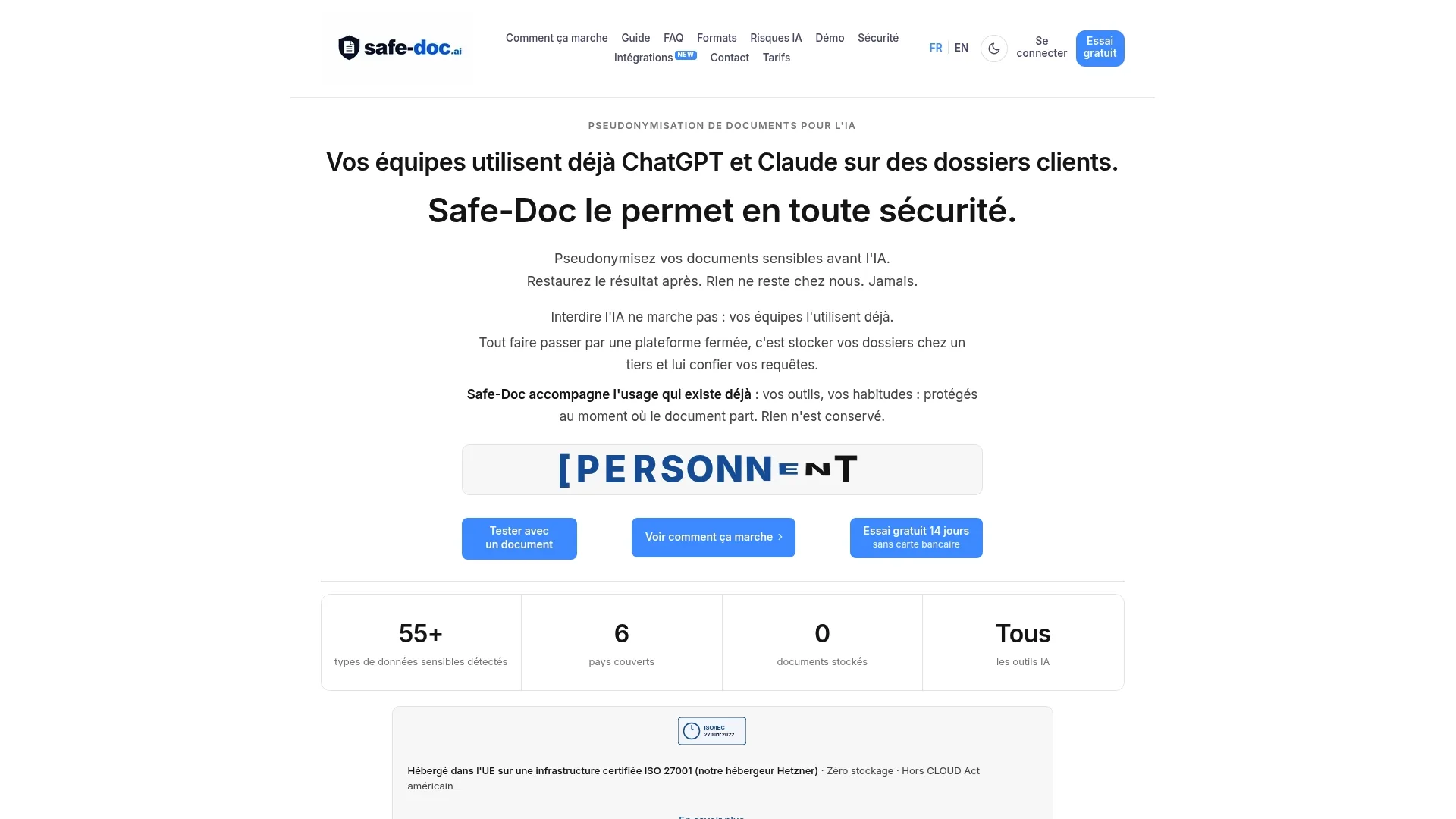
Concretely, Safe-doc automatically detects and replaces names, identifiers, bank references, and other directly identifying data before each transmission to an external service. GDPR compliance becomes a structural asset, not a manual verification for each use. For DPOs and CISOs seeking to frame Shadow AI without blocking productivity, this is a direct answer to the problem. Discover how Safe-doc's advanced pseudonymization works and request a demonstration for your IT environment.