

Pseudonymize PDFs reversibly, preserving format and lookup table in an encrypted vault, before sending anything to an LLM. Article 4(5) of the GDPR recognizes this approach as a data minimization measure, and CNIL clearly distinguishes it from irreversible anonymization. A solution like Safe-Doc processes documents without durably storing them, directly meeting this requirement.
Executive summary:
- Reversible pseudonymization is essential when data must be restored for internal use or rigorous analysis, while irreversible anonymization suits external sharing.
- Effective removal of sensitive data requires complete purging of the PDF text layer, not merely visual masking or superficial obfuscation.
- Implementation must respect strict governance: encryption, access control, logging, and documentation to ensure GDPR compliance and prove traceability.
- A reliable pipeline includes OCR extraction, precise detection of sensitive entities, replacement with stable aliases, and secure storage of the encrypted mapping.
- Solutions like Safe-Doc process PDFs in real time without permanent storage, offering guaranteed compliance and audit readiness without risk of leaks.
Table of contents
- Reversible pseudonymization or irreversible anonymization: how to decide?
- How to pseudonymize a PDF without losing its usability?
- What technical pitfalls render pseudonymization ineffective?
- What checklist to follow for production deployment of pseudonymization?
- What to produce to prove compliance during an audit?
- Why Shadow AI makes this question urgent
- Safe-Doc: process sensitive PDFs without storing them anywhere
- Sources
Reversible pseudonymization or irreversible anonymization: how to decide?
The choice hinges on a single question: will you need to return to the original data? If counsel must review a contract after it passes through an AI assistant, or if an auditor must trace an operation, reversible pseudonymization is essential. It replaces data with stable aliases and maintains a lookup table that enables controlled restoration.
Irreversible anonymization, by contrast, suits documents permanently leaving the enterprise perimeter with no path back to original identities. CNIL does not mandate it systematically: the regulator requires minimization, not necessarily irreversibility, and recognizes pseudonymization as a compliant measure in its own right.
Practical decision criteria:
- Restoration requirement: internal use or temporary AI analysis favors pseudonymization.
- Final destination: public release or transmission to an external third party points toward anonymization.
- Residual risk: the larger and more correlatable the corpus, the greater the re-identification risk weighs in the balance.
- Retention period: a mapping kept long-term increases exposure if the vault is compromised.
Documenting this choice in the processing register remains the best protection during an audit.
How to pseudonymize a PDF without losing its usability?
The workflow that preserves both confidentiality and real-world document use follows straightforward logic, yet every step matters.
1. Inventory and classify PDFs by sensitivity: contracts, HR files, and due diligence materials demand different levels of rigor.
2. Extract text, running scanned documents through an OCR engine; otherwise sensitive data remain invisible to automated processing.
3. Detect sensitive entities: names, addresses, case numbers, financial data-anything constituting personal information.
4. Replace with stable aliases and generate an exportable mapping, typically JSON format, to ensure consistency across multiple linked documents.
5. Export the pseudonymized version while retaining original layout, then isolate the mapping in an encrypted vault with restricted access.
6. Send the pseudonymized version to the LLM, retrieve the output, then restore real values only in the secure environment-never on the AI provider side.
This document preprocessing approach before language model ingestion limits leak risk while keeping analysis workflows functional, as Florence Chatelot highlights in her analysis of GDPR and AI pipelines.
Pro tip: Generate one mapping per corpus of related documents (a client file, a merger transaction) rather than per isolated file. You gain consistency for cross-analysis and limit the number of vaults to secure.
What technical pitfalls render pseudonymization ineffective?
A black rectangle placed over PDF text deletes nothing: it visually hides content, but the underlying text layer remains indexable and copyable. This is the most frequent and most dangerous error, widely documented in practical guides on document anonymization: only a true purge of the text layer, via a permanent redaction function, effectively eliminates the data.
Other blind spots deserve equal vigilance:
- Scanned PDFs depend entirely on OCR quality: an imperfect recognition rate lets entire identities slip through without triggering alerts, justifying manual review for high-risk batches.
- Structured PDF form fields (field metadata, hidden values, comments) often escape tools that process only visible text.
- Electronically signed documents pose an integrity problem: modifying content after signing invalidates the signature, requiring pseudonymization before signing or work on a copy dedicated to analysis.
- Production metadata (export software, version history) can reintroduce information the primary processing had neutralized.
A pipeline that neglects any one of these points exposes the organization to a false sense of compliance-the worst situation facing an audit.
What checklist to follow for production deployment of pseudonymization?
Scaling from pilot to general use requires clear governance, not just a good tool.
1. Define roles and access to the mapping: who may consult, restore, delete it, and under what validation.
2. Encrypt flows and temporary storage using AES-256 at rest and TLS 1.3 in transit, with automatic deletion of intermediate files after processing.
3. Set a retention policy for the mapping consistent with the actual processing purpose, never by default.
4. Test by regular sampling the quality of sensitive entity detection, particularly on new document types.
5. Require a DPA and no-train clause from any downstream LLM provider to ensure outputs are not used to retrain third-party models.
A GDPR compliance checklist dedicated to PDFs recommends adding encryption, retention period, logging, and eIDAS compliance for signatures. Proof of accountability rests not on storing the content itself but on cryptographic input and output fingerprints associated with each operation-a distinction CNIL emphasizes in its anonymization recommendations.
What to produce to prove compliance during an audit?
A CNIL inspection or internal audit request demands precise artifacts, not statements of intent.
- Timestamped operation logs indicating who initiated what processing and when.
- A cryptographic fingerprint of each input and output document, without retaining the content itself.
- An exportable audit report in PDF format summarizing processing carried out over a given period.
- A processing register documenting purpose, legal basis, and technical measures applied.
- Criteria triggering a data protection impact assessment (DPIA), notably volume processed and sensitivity of data categories.
Why Shadow AI makes this question urgent
Shadow AI continues in parallel, often invisible to security teams, because employees and contractors paste sensitive PDFs into consumer assistants without a second thought. Formalizing a traceable pseudonymization pipeline is no longer methodological comfort. It has become, in my view, a compliance control as foundational as workstation encryption was a decade ago.
- Jacques
Safe-Doc: process sensitive PDFs without storing them anywhere
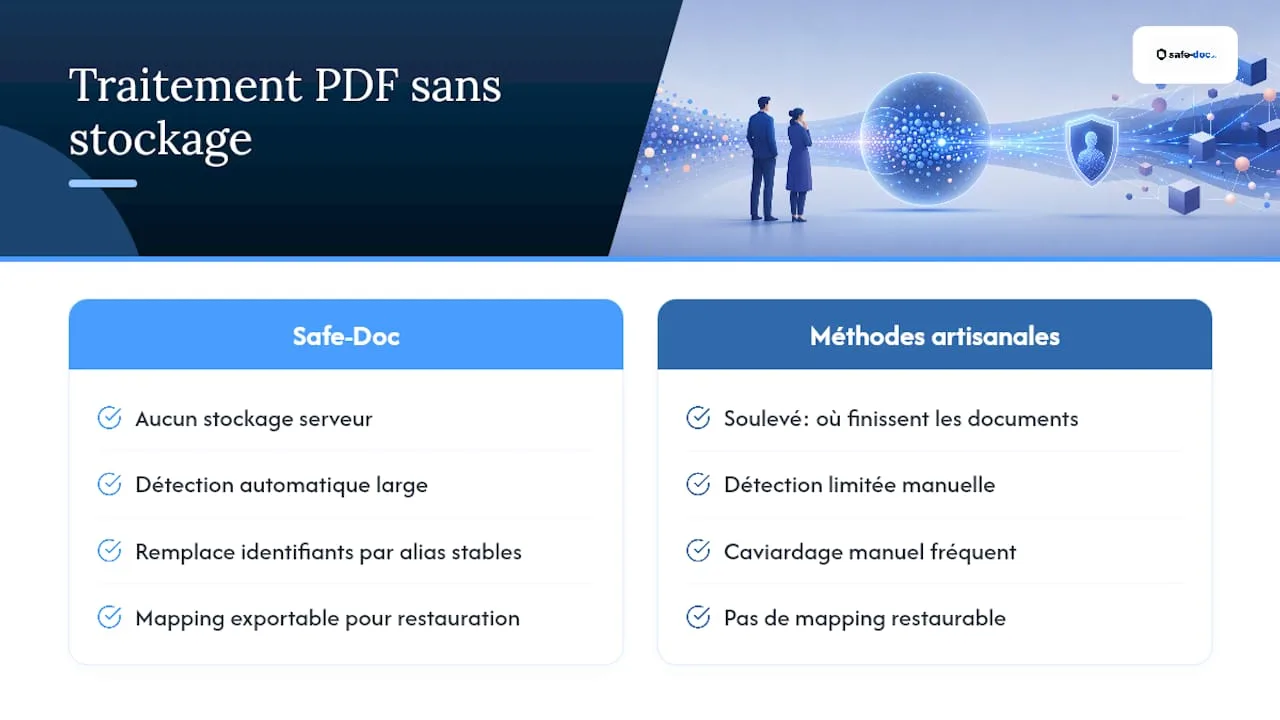
Certain solutions process each PDF in real time without durably storing it on their servers, eliminating a common point of friction for CIOs facing traditional pseudonymization tools: the question of where documents end up once sent.
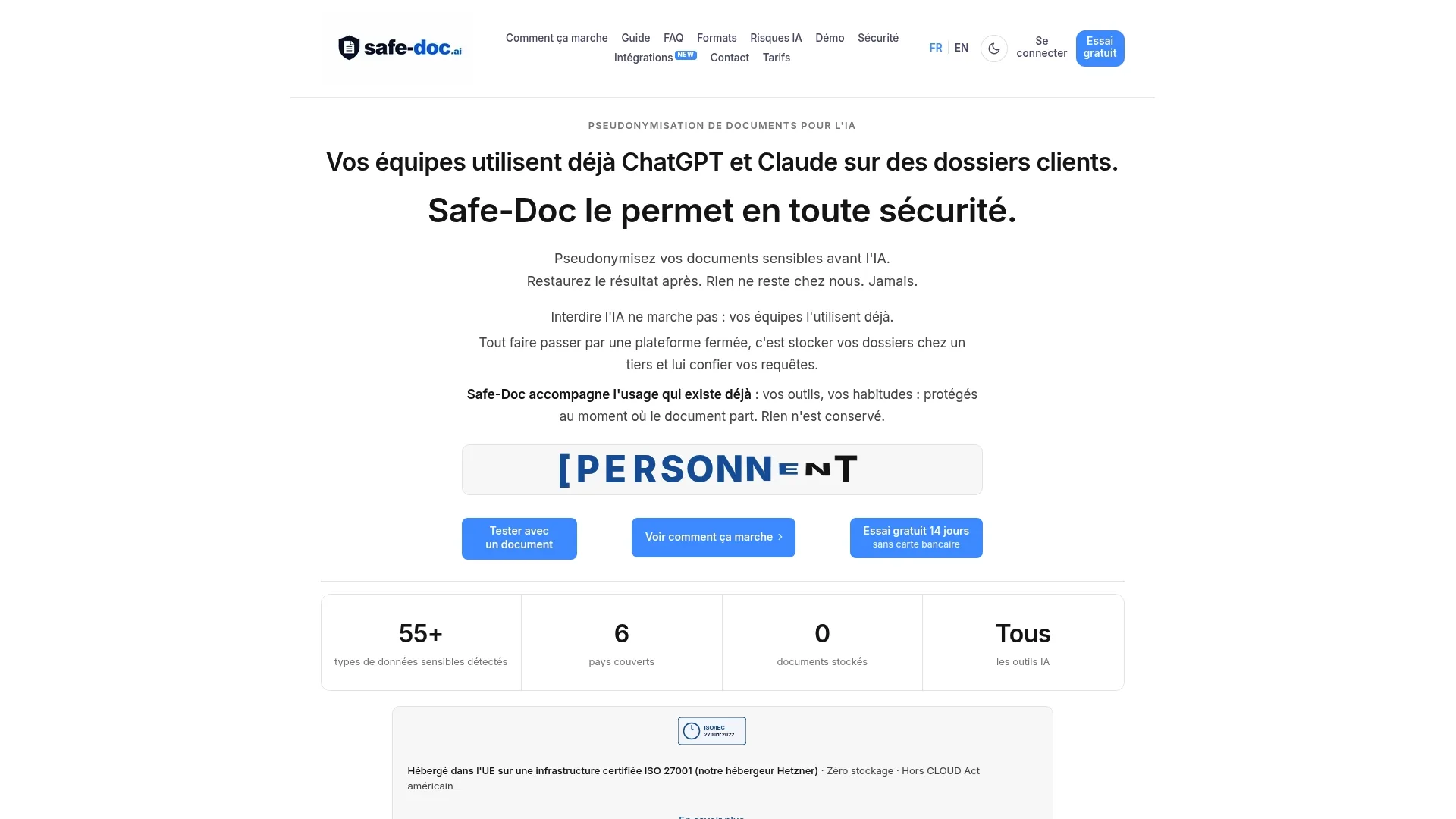
Certain platforms automatically detect a wide range of sensitive data types, replace identifying entities with stable aliases, and generate an exportable mapping to restore actual values once analysis is complete. They can also produce an audit report and residual risk analysis-elements sometimes absent from artisanal redaction methods. Some law firms, HR teams, and M&A due diligence operators rely on this type of pipeline to continue using ChatGPT or Claude without exposing confidential data, via a web interface or REST API integration inserted into existing tools.
For a legal officer or CISO who must decide quickly, the page dedicated to DPOs details compliance guarantees and audit procedures. Request a demonstration to evaluate processing on your own documents before any deployment decision.
Sources
CNIL sets the legal framework for pseudonymization. Agilotext's practical guide details actual redaction techniques. The iFillPDF checklist covers operational obligations, and Florence Chatelot explains issues specific to AI pipelines.