


Pseudonymization of employee files is defined by Article 4 of the GDPR as the replacement of a person's direct identifiers with coded aliases, while maintaining a secure correspondence table that enables controlled re-identification. This technique differs fundamentally from anonymization, which makes any re-identification impossible. For HR managers and DPOs, mastering employee file pseudonymization-explained here in both its legal and operational dimensions-has become a concrete compliance requirement. Recent case law from the CJEU in 2025 and the French Council of State in 2026 has clarified that pseudonymized data remains personal data whenever re-identification remains possible by reasonable means.
What are the essential differences between pseudonymization and anonymization?
Pseudonymization maintains reversibility: an identifier such as "EMP-4872" replaces the name "Martin Dupont," but the correspondence table maintained separately allows recovery of the real identity. Anonymization, by contrast, permanently removes any link between the data and the person. This distinction is not merely technical-it determines whether or not the GDPR applies to the processing in question.
Anonymized data falls outside the scope of the GDPR. Pseudonymized data remains fully subject to it. This means the data controller must continue to ensure a legal basis, respect employee rights, and limit retention periods, even after pseudonymization.

Pro tip: Never describe a processing activity as "anonymized" if you maintain a correspondence table, even if encrypted. The CJEU's September 4, 2025 judgment applies the criterion of reasonable re-identification capacity, not declared intent.
Here is a comparative table of the two approaches as applied to employee files:
| Criterion | Pseudonymization | Anonymization |
|---|---|---|
| - | - | - |
| Re-identification possible | Yes, via correspondence table | No, irreversible |
| GDPR scope | Yes, fully applicable | No, excluded |
| Typical use | Active internal processing, AI, auditing | Statistics, research, definitive archiving |
| Protection level | High but conditional | Maximal |
| Residual risk | Re-identification by cross-referencing | Near zero if properly implemented |
The legal distinction between the two methods underpins your entire compliance strategy. Choosing the wrong classification exposes the organization to CNIL sanctions.
How to apply pseudonymization in compliance with employee file requirements?
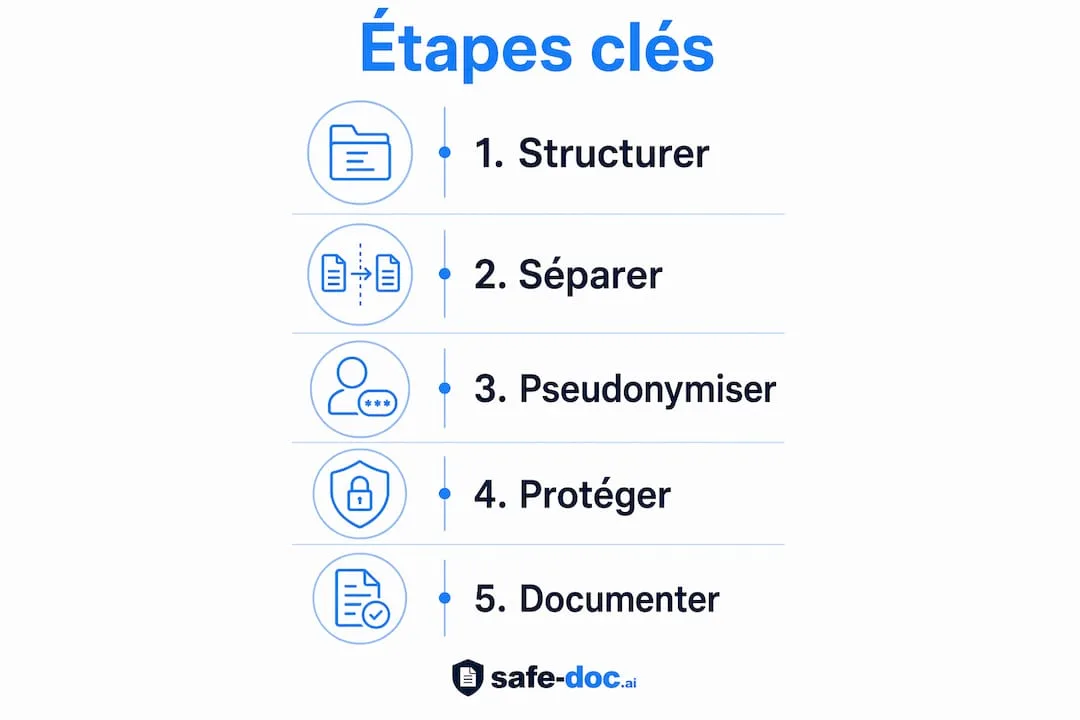
Compliant implementation rests on rigorous data organization well before selecting a technical tool. Good regulatory practices require precise file structuring, strict access restrictions, and exclusion of any data not directly related to the employment relationship.
Structure and classify data before pseudonymizing
The first step is to map the data categories present in each employee file: identification data, contractual data, disciplinary data, health data. Each category requires a different level of protection. Health data, for example, requires enhanced pseudonymization and a specific legal basis under Article 9 of the GDPR.
Key steps for secure pseudonymization
- Identify fields to pseudonymize: surnames, first names, social security numbers, addresses, internal identifiers linked to the individual.
- Generate stable aliases: use a deterministic algorithm so the same individual always receives the same alias in a given system, facilitating internal cross-references.
- Isolate the correspondence table: store this table on a separate server, with access rights limited to authorized personnel only (DPO, legal department).
- Restrict access by role: only authorized HR managers access active files; operational managers see only the data necessary for their scope.
- Log each access: a secure HRIS must record who accessed which file, when, and in what context.
- Set retention periods: GDPR compliance requires defining precise deadlines based on the nature of the data and deleting or anonymizing upon expiry.
Pro tip: [Management of re-identification keys](https://safe-doc.ai/dpo-fr.html) is the most vulnerable link in the system. Treat this table as a critical asset: AES-256 encryption, logged access, quarterly review of authorizations.
Clear file structuring with strict separation between active and archived data significantly reduces the risk of cross-leakage. This is also what CNIL auditors check as a priority during inspections.
What tools and techniques facilitate pseudonymization of disciplinary files?
The techniques available today go well beyond simple manual masking. Modern methods combine cryptography, automation, and granular access control to efficiently process disciplinary files without exposing identities.
Four technical approaches to know
1. Asymmetric encryption: identifiers are encrypted with a public key; only the private key, kept outside the processing system, allows re-identification. This method is suitable for long-term archives.
2. Tokenization: each identifier is replaced by a random token with no mathematical value. The actual link between token and identity exists only in the token vault, isolated from the rest of the system.
3. Supervised AI for automatic detection: models trained on HR corpora automatically detect and mask named entities (names, places, dates of birth) in textual documents. This significantly speeds up processing of large disciplinary files.
4. Attribute-based access control (ABAC): each access to a file is conditioned by specific attributes (role, department, hierarchical level, request context). File-level isolation via ABAC is the most effective method for preventing cross-leakage in AI-integrated systems.
| Technique | Primary use case | Reversibility | Implementation complexity |
|---|---|---|---|
| - | - | - | - |
| Asymmetric encryption | Long-term archives | Yes, with private key | Medium |
| Tokenization | Active processing, databases | Yes, via vault | High |
| Supervised AI | Automatic document masking | Not applicable | Medium |
| ABAC | Granular access control | Not applicable | High |
AI augmentation provides real value in processing disciplinary files, particularly for detecting indirect identifiers the human eye might miss. It does not replace the DPO's or HR manager's judgment on the legal classification of the processing.
Safe-doc applies precisely this principle: the platform pseudonymizes documents in real time before transmitting them to an AI tool such as ChatGPT or Claude, without durably storing the original document. HR teams maintain their work habits while remaining compliant.
What are the real risks and common mistakes to avoid?
Poorly implemented pseudonymization creates a false sense of security. Re-identification risks through data cross-referencing constitute the primary threat: combining an alias with a department, hire date, and position is often enough to identify a person in a small organization.
The most common errors observed in practice are:
- Confusing pseudonymization with anonymization: wrongly classifying processing as anonymized to exempt oneself from the GDPR exposes the organization to CNIL reclassification and associated sanctions.
- Neglecting background data: in disciplinary files, indirect identification elements such as screenshots, access badges, or timestamps must be pseudonymized just as names are.
- Omitting to inform employees: pseudonymization does not exempt from the obligation of transparency. Data subjects must be informed of processing of their data, even in pseudonymized form.
- Failing to document methods: in the event of an audit, the absence of a processing register or formalized pseudonymization policy constitutes a violation in itself.
- Centralizing the correspondence table in the same system: storing the re-identification key in the same database as the pseudonymized data cancels most of the protection.
Pseudonymization does not relieve the data controller of its GDPR obligations. Transparency toward employees, the legal basis of processing, respect for individual rights, and limitation of retention periods remain fully applicable requirements, even when data is pseudonymized. Precise documentation and regular assessment of re-identification risk are essential for defending compliance during an audit.
The consequences of non-compliance are concrete: administrative fines up to 4% of global turnover, public formal notices, and damage to employer reputation. The CJEU's September 4, 2025 judgment tightened the criteria for assessing re-identification risk, making approximations even less tolerable.
Key takeaways
Pseudonymization of employee files requires rigorous organization, isolated management of re-identification keys, and continuous documentation to remain GDPR-compliant in the face of audits.
| Point | Details |
|---|---|
| - | - |
| Precise legal definition | Pseudonymization maintains reversibility; the GDPR applies in full to pseudonymized data. |
| Mandatory key separation | The correspondence table must be stored on a separate system, with logged and restricted access. |
| Cross-re-identification risk | Combining alias, department, and hire date is enough to identify a person in a small organization. |
| AI as tool, not guarantor | Supervised AI detects identifiers automatically, but the DPO remains responsible for legal classification. |
| Continuous documentation | Each method, each access, and each retention period must be formalized to withstand a CNIL audit. |
What practice has taught me about pseudonymization in organizations
Most organizations approach pseudonymization as an IT project. That's where everything starts to go wrong. The technology represents only a third of the work. The remaining two-thirds belong to governance: who decides which data is pseudonymized, who controls the correspondence table, who verifies that access is consistent with actual authorizations.
I've seen organizations invest in powerful tokenization tools, then store the correspondence table in the same SharePoint directory as the HR files. The tool was sound. The organization was not.
What actually works is treating pseudonymization as a living process, not a box-checking project. This involves quarterly review of authorizations, annual assessment of re-identification risk, and updating documentation with each change to the system or processing scope.
AI is a useful accelerator, particularly for detecting indirect identifiers in long documents. But it also amplifies design errors. If your access architecture is poorly conceived, AI will process data it shouldn't see-faster and at greater scale.
My concrete recommendation: before pseudonymizing, map your HR data flows on paper. Identify each point where a real identity could be reconstructed by cross-referencing. Only then choose your tools.
- Jacques
Safe-doc to pseudonymize your employee files in compliance
HR teams and DPOs who use AI tools to process employee files face a concrete risk: transmitting unprotected personal data to external systems. Safe-doc solves this problem by pseudonymizing documents in real time before sending them to an AI model, without durably storing the original file. The solution dedicated to HR teams enables continued use of ChatGPT or Claude on sensitive disciplinary files, with a layer of GDPR-compliant protection. For DPOs who must document and audit their processing activities, the Safe-doc compliance and audit page details the available technical and organizational safeguards.
Frequently asked questions
What is pseudonymization according to the GDPR?
Pseudonymization is defined in Article 4 of the GDPR as the processing of personal data in such a way that it can no longer be attributed to an individual without the use of additional information kept separately. Pseudonymized data remains personal data subject to the GDPR.
What is the difference between pseudonymization and anonymization for HR files?
Pseudonymization retains the possibility of re-identification via a secure correspondence table, maintaining the application of the GDPR. Anonymization permanently removes any link with the person and falls outside the regulatory scope, but it is irreversible and unsuitable for active files.
Can AI be used on disciplinary files without pseudonymization?
No. Transmitting non-pseudonymized disciplinary files to an external AI tool constitutes a transfer of personal data without sufficient safeguards, in violation of the GDPR. Prior pseudonymization is the minimum required measure before any AI processing.
What are the risks if pseudonymization is poorly applied?
The primary risk is re-identification by cross-referencing data, even without access to the correspondence table. Sanctions include fines up to 4% of global turnover and public formal notices by the CNIL.
How to document pseudonymization for a CNIL audit?
The processing register must mention the categories of pseudonymized data, the methods used, retention periods, and access authorizations. A formalized internal policy and access logs to the correspondence table constitute the evidence expected during an inspection.