


Automated HR data anonymization is the process that irreversibly removes any information capable of identifying an employee in a document or database. This definition is not merely technical. It directly conditions your GDPR compliance and your exposure to sanctions. For HR professionals and compliance officers, anonymize HR data automated processing represents a management obligation today, not an option. The European Data Protection Board (EDPB) sets precise criteria, and failures expose the organization to fines reaching up to €20 million or 4% of global annual turnover.
How to anonymize HR data with automated processing
Before any implementation, you must precisely identify which data falls within the scope for processing. Sensitive HR data covers a wide spectrum: names, social security numbers, addresses, health data, performance evaluations, disciplinary information, and banking data. Each category follows distinct retention rules.
Legal durations vary by document type. Rejected CVs must be anonymized or deleted no more than 2 years after the last contact with the candidate. Payroll documents, by contrast, may be retained for up to 50 years. This asymmetry requires HR teams to segment their automated processing by document category, not apply a single blanket rule.
Prior documentation is a legal obligation, not a formality. The automated anonymization process itself constitutes processing subject to the GDPR, meaning it requires an identified legal basis and an updated record of processing activities. Here are the essential prerequisites before deploying automated processing:
- Data mapping: list all personal fields present in the HRIS, HR files, and archived documents.
- Classification by sensitivity: distinguish ordinary data from special categories (health, origin, beliefs).
- Definition of retention periods: associate each category with its legal duration and schedule corresponding deletions or anonymization.
- Documented legal basis: formalize the legal justification for processing in the GDPR register.
- Impact assessment (DPIA): conduct a Data Protection Impact Assessment if the processing is likely to generate high risk to individuals' rights.
What techniques and tools enable automated HR anonymization?
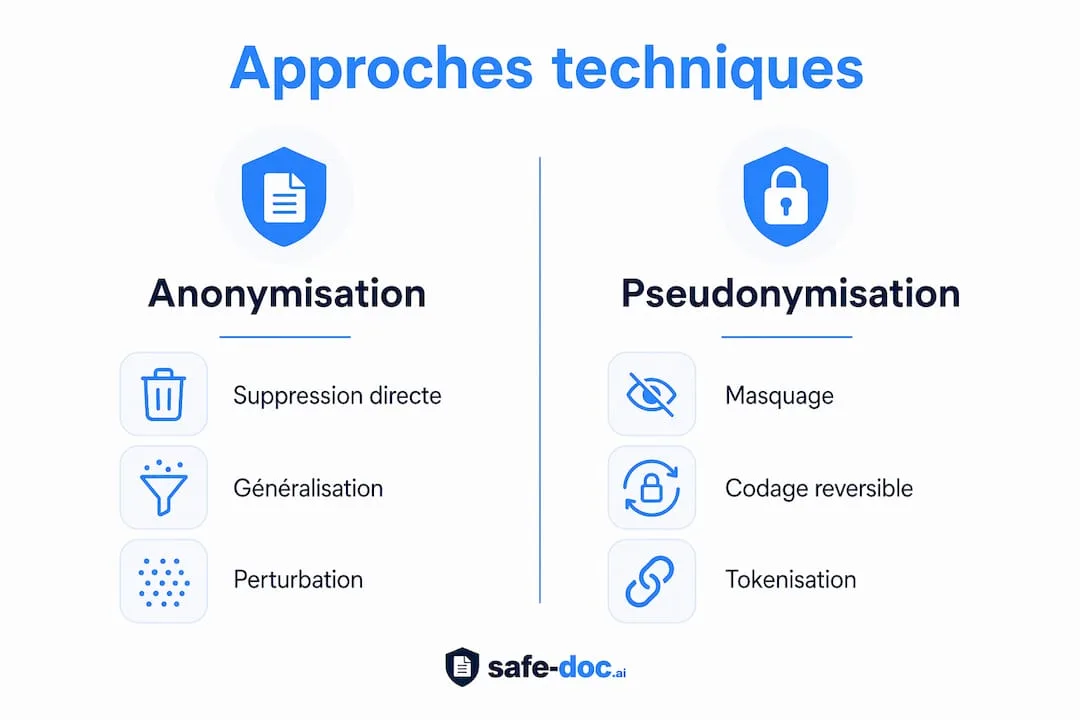
Anonymization vs. pseudonymization: a distinction that changes everything
The legal irreversibility of anonymization allows data to exit the scope of the GDPR. Pseudonymization remains under strict regulation because the link to the person can be reestablished. In practice, most companies confuse these two concepts. Pseudonymization is often preferable in daily HR operations: it maintains a useful link between data while reducing exposure. Understanding this distinction between anonymization and pseudonymization is the starting point of any HR data protection strategy.
The main technical approaches
Automated scripts and Named Entity Recognition (NER) tools guarantee more reliable anonymization than manual processing, particularly at large documentary volumes. NER technology automatically identifies names, places, dates, and identifiers in text, then replaces or deletes them. This approach reduces the risk of human oversight, which is the primary cause of incomplete anonymization.

| Technique | Principle | Main advantage | Main limitation |
|---|---|---|---|
| Direct deletion | Erasure of identifying fields | Simple to implement | Loss of analytical value |
| Generalization | Replacement with less precise value (e.g., age → age range) | Preserves statistical utility | Residual re-identification risk |
| Pseudonymization | Substitution with reversible fictitious identifier | Link preserved for internal use | Remains under GDPR |
| Automated NER | AI-powered named entity detection and processing | Large-scale processing | Requires business-specific configuration |
| Aggregation | Grouping into collective statistics | No individual data exposed | Unusable for individual records |
Pro tip: Combine NER detection with a human validation rule on a 5% sample of processed documents. This spot check detects configuration errors before they propagate across the entire corpus.
How to integrate automated anonymization into existing HR processes
Integration into an existing HRIS follows a logic of successive layers. It does not replace workflows in place. It grafts onto them to trigger automatic actions at precise moments in the data lifecycle.
Here are the steps for structured integration:
1. Map document flows: identify when each document type enters the HRIS, who accesses it, and when it must be archived or deleted.
2. Configure automatic triggers: set rules that activate anonymization at legal deadlines (contract termination, retention period reached, recruitment file closure).
3. Implement access control: restrict access to not-yet-anonymized data to authorized persons only, with logging of each consultation.
4. Activate audit trail: integration of anonymization into HRIS includes filing, access control, audit trail, and scheduled deletion to ensure compliance and traceability.
5. Maintain human intervention: Article 22 of the GDPR prohibits any exclusively automated HR decision without significant human intervention. A responsible person must validate sensitive decisions resulting from automated processing.
6. Document each step: record processing parameters, execution dates, and volumes processed in the GDPR register.
Access management deserves particular attention. A document undergoing anonymization remains personal data in its entirety. Access must be limited to the strict minimum throughout the processing duration. Once anonymization is validated, the document exits the GDPR perimeter and can be treated as ordinary data.
What challenges and mistakes to avoid during automated anonymization
The most frequent risks
Imperfect anonymization is the primary risk. A document may appear anonymized on the surface but contain combinations of residual data that allow re-identification of a person. For example, the combination of job title, department, and hire date may suffice to identify an individual in a small organization.
- Overlooked indirect fields: file metadata (author, creation date) often contain personal information that basic tools do not process.
- Partial anonymization: processing the body of a document without processing attachments or headers.
- Absence of re-evaluation: anonymization must be regularly reassessed because external databases and algorithms evolve, which can compromise the initial robustness of processing.
- Undetected algorithmic biases: algorithmic bias auditing is essential to prevent AI from recreating discriminatory correlations despite anonymization of input data.
- Non-compliance of the process itself: forgetting that anonymization, as long as it is not completed, remains processing subject to the GDPR.
Technically successful anonymization may become legally insufficient if external re-identification techniques progress. The robustness of processing must be reassessed at minimum once per year, or at each significant evolution of analysis tools available on the market.
Ongoing compliance as a discipline
Compliance in anonymization is not a state. It is a regular practice. The EDPB criteria for true anonymization cover three dimensions: resistance to individualization, correlation, and inference. Processing that satisfies these three criteria at deployment may no longer satisfy them two years later if external analysis capabilities have progressed. Planning annual audits of the system is a good governance practice, not an additional constraint.
Key points
Automated anonymization of HR data requires a combination of validated NER techniques, rigorous documentation, and regular reassessment to remain GDPR-compliant.
| Point | Details |
|---|---|
| Mandatory EDPB criteria | Anonymization must resist individualization, correlation, and inference to exit GDPR scope. |
| Variable retention periods | CVs are kept 2 years maximum; payroll documents may extend to 50 years depending on regulations. |
| NER for large volumes | Automatic named entity detection reduces human oversights and ensures consistent processing at scale. |
| Mandatory human intervention | Article 22 of the GDPR prohibits exclusively automated HR decisions without significant human validation. |
| Essential annual reassessment | Re-identification techniques evolve; processing compliant today may no longer be compliant in 18 months. |
What field experience reveals about HR anonymization
By Jacques
After years supporting HR teams on compliance projects, I observe a recurring error: confusing pseudonymization with complete anonymization, then believing the work is finished. This is not an error of bad faith. It is an error of understanding the legal framework, and it is costly.
The reality I observe in the field is that pseudonymization is often the best operational response for HR. It allows maintaining a link between data for internal management needs while reducing exposure. Complete anonymization applies to permanently archived data, aggregated statistics, or datasets transmitted to third parties. Mixing the two approaches in the same process without clearly distinguishing them creates legal gray areas difficult to defend before the CNIL.
What concerns me more is the absence of governance over time. Many organizations deploy an anonymization tool, configure it once, then never reassess it. Yet re-identification capabilities progress each year. Robust processing in 2023 may be insufficient in 2026. The real discipline is regular auditing, not initial deployment.
Automation remains the best protection against human error at large volumes. But it does not exempt from rigorous governance with regular audits. The two are complementary, not substitutable.
- Jacques
Safe-doc to automatically pseudonymize your HR data
HR teams processing large volumes of employee files need a tool that acts before data reaches an external AI model. Safe-doc meets this need by pseudonymizing sensitive documents in real time, without durably storing them.
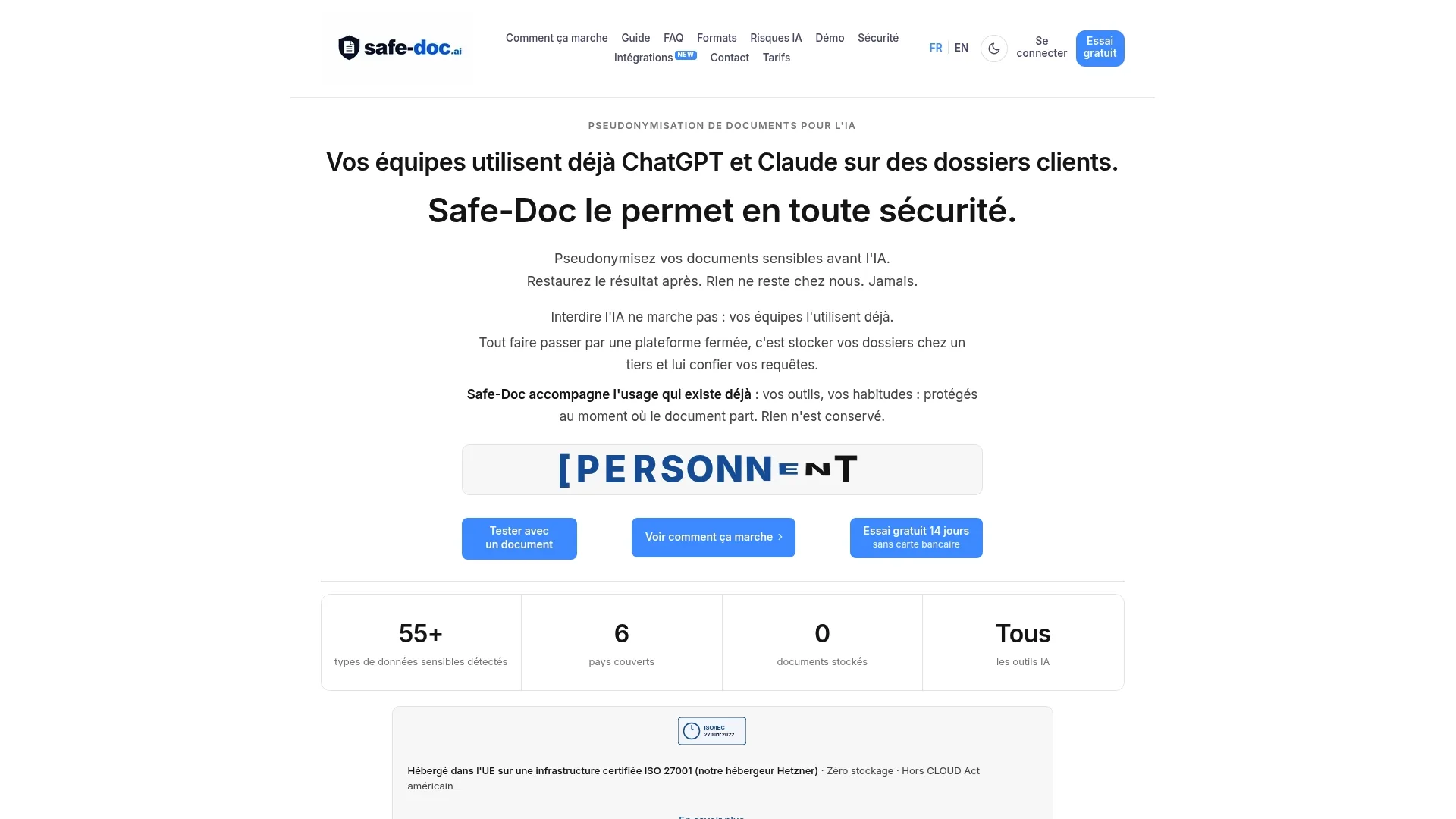
Safe-doc uses Named Entity Recognition (NER) to automatically identify and mask personal information in HR files, contracts, evaluations, and pay slips. Processing integrates into your existing workflows without changing your work habits. HR professionals and DPOs thereby have a GDPR-compliant protection layer, with zero-storage architecture guaranteeing that no sensitive data transits to third-party servers. Compliance becomes an ongoing process, not a checkbox to tick.
Frequently asked questions
What is HR data anonymization under the GDPR?
HR data anonymization is the process that irreversibly removes any information capable of identifying an employee. Once anonymized, data exits the scope of GDPR application according to EDPB criteria.
What is the difference between anonymization and pseudonymization in HR?
Pseudonymization replaces identifiers with reversible codes and remains subject to the GDPR. Anonymization permanently removes the link to the person and frees data from any regulatory obligation linked to personal data protection.
How does NER detection work to anonymize HR documents?
NER technology automatically analyzes text to identify names, dates, addresses, and identifiers, then replaces or deletes them. It processes large document volumes in a consistent manner, significantly reducing risks of oversight compared to manual processing.
Does Article 22 of the GDPR apply to automated HR processing?
Yes. Article 22 of the GDPR prohibits any exclusively automated HR decision without significant human intervention. This applies to hiring, evaluation, or termination decisions produced by an algorithm without human validation.
How often should an automated anonymization system be reassessed?
An anonymization system must be reassessed at minimum once per year. Re-identification techniques evolve, and processing judged sufficient at deployment may become insufficient if external analysis capabilities progress.