


Storing sensitive legal documents in the cloud exposes law firms and legal departments to two distinct categories of risks: technical vulnerabilities and regulatory conflicts. The GDPR imposes strict security and traceability obligations, while the U.S. CLOUD Act can compel a cloud provider to disclose data covered by attorney-client privilege, even when hosted in Europe. Cloud risks related to sensitive legal documents extend far beyond cybersecurity concerns. They engage the professional liability of legal practitioners and expose organizations to substantial financial penalties.
Table of Contents
- What are the legal and regulatory risks associated with cloud storage for sensitive documents?
- Which technical measures should be strengthened to secure sensitive documents in the cloud?
- How to manage the risks associated with Shadow AI in legal document processing?
- What are the regulatory obligations for compliance and audit?
- Key takeaways
- What fifteen years in the field taught me about legal cloud risks
- Safe-doc: process your sensitive documents with AI in complete compliance
- Frequently asked questions
- Recommended reading
What are the legal and regulatory risks associated with cloud storage for sensitive documents?
The CLOUD Act represents the most underestimated threat in legal cloud environments. This U.S. law authorizes American authorities to compel any U.S. cloud provider to disclose stored data, regardless of geographic location. American laws create a jurisdictional conflict that is difficult to resolve without robust technical safeguards. This conflict places European firms in an untenable position: comply with European law or obey a U.S. court order.
The 2023 Proskauer Rose incident illustrates this risk concretely. A misconfigured Azure server exposed 184,000 files protected by attorney-client privilege. This incident demonstrates that breaches do not always originate from external attacks, but often from misconfiguration of mainstream cloud services.
Contractual compliance via a data processing agreement (DPA) does not neutralize CLOUD Act risk. Only sovereign architecture with customer-controlled encryption provides effective legal protection.
GDPR regulatory risks compound this exposure. Here are the obligations most frequently overlooked in cloud environments:
- Records of processing activities: mandatory for any organization processing sensitive data or employing more than 250 people, under Article 30 of the GDPR.
- Breach notification: any data breach must be reported to the relevant supervisory authority (CNIL in France) within 72 hours of discovery.
- Restrictions on transfers outside the EU: any transfer to a third country must rely on adequate safeguards, often absent from standard cloud contracts.
- Data subject rights: data contained in legal files often includes personal data of third parties, subject to rights of access and erasure.
The risk associated with artificial intelligence tools amplifies these vulnerabilities. Since 2024, France's National Bar Council has recommended never entering identifying data into non-compliant AI tools. This recommendation remains largely ignored in daily practice.
Which technical measures should be strengthened to secure sensitive documents in the cloud?
Securing legal documents in the cloud rests on four technical pillars. Each addresses a specific vulnerability identified in real-world incidents.
1. Customer Managed Keys (CMK): Standard encryption provided by the cloud provider is insufficient. If the provider holds the keys, it can be legally compelled to disclose them. Client-side encryption technically blocks third-party access, including in response to U.S. court orders.
2. SecNumCloud-certified sovereign hosting: Cloud operators certified by ANSSI (France's cybersecurity agency), such as OVHcloud, Outscale, or Bleu, offer reduced exposure to extraterritorial influences. This certification guarantees that data remains under French and European jurisdiction.
3. Dynamic document classification: Controls based on data classification and real-time inspection are more effective than traditional perimeter-based approaches. A document classified as "confidential" automatically triggers access and sharing restrictions.
4. Access logging and traceability: Every access to a sensitive document must be logged with timestamp, user identity, and action performed. This logging is indispensable for supervisory authority audits or internal investigations.
5. Data Protection Impact Assessment (DPIA): A DPIA is essential for any high-risk tool, particularly AI solutions processing legal files. It identifies vulnerabilities before deployment and documents corrective measures.
Pro tip: Before signing a contract with a cloud provider, systematically verify three points: the physical location of servers, the identity of the parent company (U.S.-based or not), and the encryption key management policy. These three elements determine your actual exposure to the CLOUD Act.
Article 32 of the GDPR requires technical measures appropriate to the level of risk, including encryption, strong authentication, and incident response plans. These measures are not optional. They constitute the minimum baseline expected by supervisory authorities during inspections.

How to manage the risks associated with Shadow AI in legal document processing?
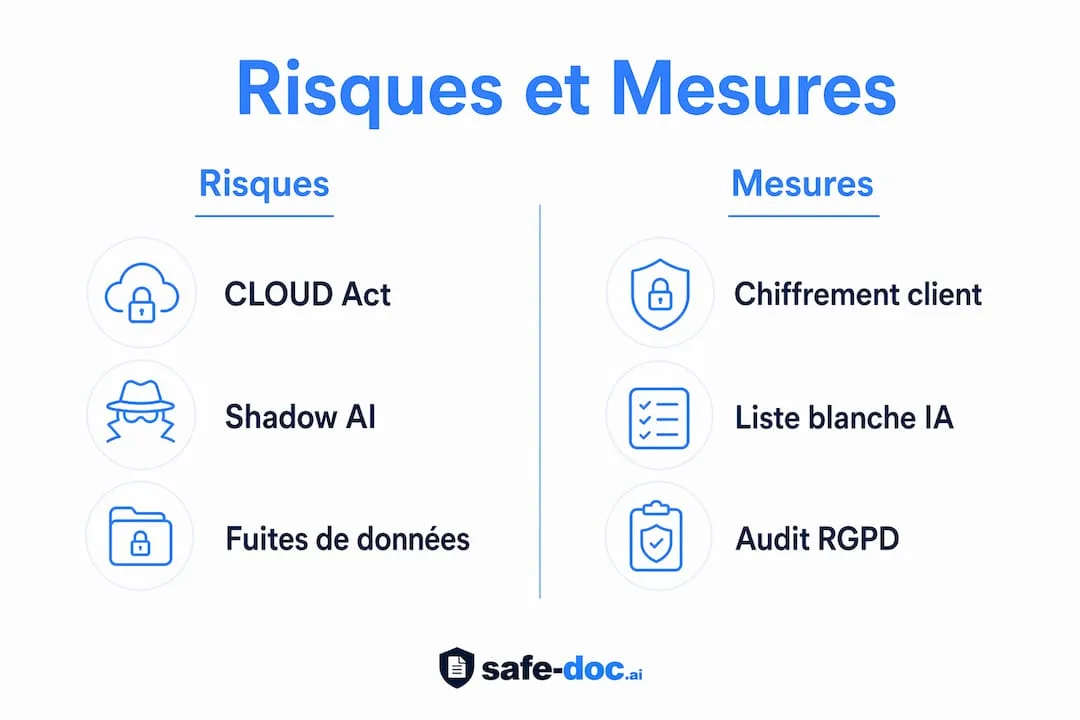
Shadow AI refers to the use of AI tools not approved by IT management, often on employees' own initiative. This phenomenon is particularly dangerous in legal environments, where every piece of data transmitted to an external tool may constitute a violation of attorney-client privilege.
Risk factors specific to consumer AI tools include:
- Model training: Some AI tools use input data to improve their models. A confidential contract pasted into a prompt can thus feed a third-party system.
- Lack of traceability: Interactions with uncontrolled AI tools are not logged by the organization's information system.
- Algorithmic bias: In HR or recruitment matters, biases present in training data can produce discriminatory recommendations, exposing the employer to liability.
- Prompt-based leaks: Personally identifiable information transmitted in a prompt constitutes a data transfer under the GDPR, often without valid legal basis.
Employees often use uncontrolled AI tools, exposing sensitive data without awareness. This risk is heightened in legal environments where confidentiality is a professional obligation, not merely best practice.
Pro tip: Establish a whitelist of approved AI tools and train your teams in [data pseudonymization](https://safe-doc.ai/blog/pseudonymisation-vs-anonymisation.html) before using any external tool. Pseudonymization replaces identifying data with codes, making the document usable by AI without exposing the individuals concerned.
Shadow AI poses a growing challenge in legal settings, where sensitive data flows through uncontrolled prompts. The most effective technical response combines detection of unauthorized use with systematic pseudonymization or anonymization before AI processing.
What are the regulatory obligations for compliance and audit?
The regulatory obligations applicable to legal professionals processing data in the cloud are precise and binding. The following table summarizes the main requirements and their practical implementation.
| Regulatory obligation | Legal basis | Practical implementation |
|---|---|---|
| Records of processing activities | Article 30 GDPR | Document each processing operation: purpose, data categories, retention period, recipients |
| Security measures appropriate to risk | Article 32 GDPR | Encryption, multi-factor authentication, logging, incident response plan |
| Data Protection Impact Assessment (DPIA) | Article 35 GDPR | Mandatory for any high-risk processing, particularly via AI or extraterritorial cloud |
| Breach notification | Article 33 GDPR | Report to supervisory authority within 72 hours, with description of incident and remedial measures |
| Oversight of transfers outside the EU | Articles 44-49 GDPR | Standard contractual clauses, adequacy decision, or refusal of transfer |
Supervisory authorities have significantly tightened sanctions. Cumulative fines exceeded €100 million in 2024. This trend confirms that non-compliance is no longer a theoretical risk but a concrete financial exposure.
The processing register is mandatory for any organization processing sensitive data or employing more than 250 people. This document must be kept current and available immediately upon inspection. Legal departments that delegate this responsibility without oversight expose the organization to direct sanctions.
GDPR compliance also represents an operational advantage. An organization that masters its document lifecycles reduces incident management costs and improves client trust. Compliance obligations become a competitive differentiator when integrated into business processes rather than treated as an administrative burden.
For IT leaders, integrating these requirements calls for automated solutions capable of generating the processing register, detecting access anomalies, and producing audit reports. A zero-storage architecture mechanically reduces the exposure surface by retaining no data after processing.
Key takeaways
Protecting sensitive legal documents in the cloud requires sovereign architecture, customer-controlled encryption, and formalized AI governance to satisfy GDPR requirements and neutralize CLOUD Act risk.
| Point | Details |
|---|---|
| CLOUD Act risk | A U.S. cloud provider can be compelled to disclose your data, even when hosted in Europe. |
| Customer-managed encryption essential | Customer Managed Keys technically prevent any third-party access, including pursuant to court order. |
| Mandatory processing register | Article 30 of the GDPR requires this document for any organization processing sensitive data. |
| Shadow AI, invisible risk | Unapproved AI tools expose confidential data without leaving traces in the information system. |
| DPIA before any AI deployment | Impact assessment is mandatory for any high-risk processing, particularly via artificial intelligence. |
What fifteen years in the field taught me about legal cloud risks
Most legal professionals I meet believe their contract with a cloud provider protects them. It doesn't. A well-drafted DPA cannot withstand an order from the U.S. Department of Justice. I've seen firms sign 40-page contracts with impeccable confidentiality clauses, then store their data with an operator whose parent company is based in Seattle. Contractual protection ends where U.S. law begins.
What concerns me more is Shadow AI. Employees don't have bad intentions. They're trying to save time, and mainstream AI tools are effective. But every prompt containing a client name, case number, or contract clause is an uncontrolled data transfer. In a law firm, this can constitute a violation of attorney-client privilege. In an HR department, it can expose employee data without legal basis.
My concrete recommendation: start by mapping actual AI use in your teams before deploying a policy. You'll be surprised by what you discover. Then, choose an architecture that pseudonymizes data before it reaches an AI tool, without blocking your teams' work. Security that slows people down too much gets bypassed. Transparent security gets respected.
Regulatory monitoring is the third pillar often neglected. The GDPR is evolving, the AI Act is entering into progressive application, and supervisory authorities regularly publish sector-specific guidance. An annual audit of your processing register and cloud contracts is not a luxury. It's the minimum to avoid sanctions during an unannounced inspection.
- Jacques
Safe-doc: process your sensitive documents with AI in complete compliance
Safe-doc addresses precisely the risks described in this article. The platform automatically pseudonymizes identifying data before any AI processing, without storing any documents. Your teams continue using the AI tools they know, like ChatGPT or Claude, without exposing client or employee data. For legal departments and IT leaders, Safe-doc also produces the elements necessary for your GDPR compliance and audit, including processing traceability and documentation of pseudonymization measures. Shadow AI protection is built in by design: no sensitive data reaches an external tool without prior processing. Discover how Safe-doc secures sensitive legal files for legal departments.
Frequently asked questions
What is the CLOUD Act and why does it concern European firms?
The CLOUD Act is a U.S. law that authorizes American authorities to compel any U.S. cloud provider to disclose data, regardless of location. A European firm using a cloud service from a U.S. operator is therefore exposed to this obligation, even if its data is hosted in France.
Is data encryption sufficient to protect legal documents in the cloud?
Encryption is insufficient if the cloud provider holds the keys. Only customer-managed encryption (Customer Managed Keys) guarantees that the provider cannot access the content, even under legal compulsion.
What is Shadow AI and how can it be detected in a legal organization?
Shadow AI refers to the use of AI tools not approved by IT management. To detect it, audit outbound network flows and survey your teams about their actual practices. A whitelist policy of approved tools, combined with a pseudonymization solution, reduces this risk at the source.
Is the processing register mandatory for a law firm?
Yes. Article 30 of the GDPR requires this register for any organization processing sensitive data. Law firms process sensitive data by nature and must keep this document current, under penalty of supervisory authority sanctions.
How does pseudonymization reduce the risks associated with AI processing of sensitive documents?
Pseudonymization replaces identifying data with codes before the document reaches an AI tool. AI processing is performed on a document stripped of directly identifiable personal data, thus reducing the risk of GDPR violation and breach of attorney-client privilege.