

Outbound data protection (outbound DLP) refers to a set of controls that automatically detect and block the exfiltration of sensitive data before it leaves the enterprise perimeter. In practical terms, a DLP solution analyzes every outgoing flow, identifies at-risk information, and applies immediate action without human intervention.
Typical automated actions of an outbound DLP solution:
- Blocking: transfer is interrupted upon detection of unauthorized sensitive data.
- Automatic encryption: the data is transmitted, but remains unreadable without the decryption key.
- Quarantine: the document is held for human validation before sending.
- Pseudonymization: personal identifiers are replaced by reversible substitutes, in accordance with Article 4(5) of the GDPR.
- Irreversible anonymization: permanent removal of any link to the data subject.
- Logging and reporting: each event is recorded in an exportable log, forming the basis of GDPR auditability.
Safe-doc is a SaaS solution that specifically covers real-time pseudonymization and anonymization, without storing the processed documents.
Table of Contents
- How Does DLP Work on Outgoing Data?
- What Automated Actions Can You Apply at the Exit Point?
- Pseudonymization or Anonymization: When to Apply Each?
- Shadow AI: Why Real-Time Filtering Is Becoming Essential
- How to Integrate DLP into Your Architecture Without Creating Silos
- How to Choose and Implement an Outbound DLP Solution
- Timelines and Costs: Benchmarks for Budgeting a DLP Project
- Safe-doc: Real-Time Pseudonymization for Outgoing Data
- Key Points
- Pseudonymization as a Pivot, Not an Option
- Safe-doc: The Solution to Pseudonymize Your Outgoing Data Without Storing Your Documents
- Useful Sources and References
How Does DLP Work on Outgoing Data?
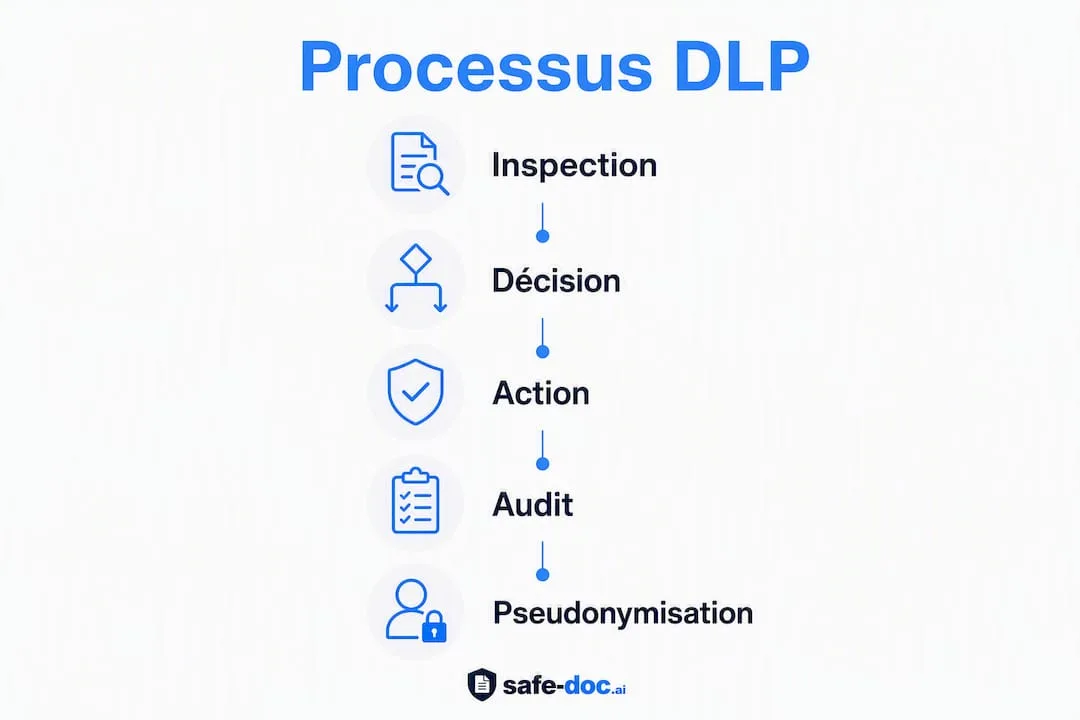
The technical flow follows three stages: inspection, decision, action. The DLP engine intercepts outgoing traffic (email, browser, API, copy/paste to an AI interface), enriches it with context (user identity, source application, destination), then applies the defined policy.

For detection, modern solutions combine several techniques. Digital fingerprinting creates a unique signature for each confidential file; any partial copy triggers an alert. Pattern matching classifies text based on its probability of belonging to a protected category: a 16-digit number in an HTTP response will be identified as a credit card number. Regular expressions and keyword rules complement this system for specific business cases. Automatic classifiers can cover numerous types of sensitive data, from social security numbers to contractual clauses.
Data in use, particularly copy/paste operations to AI interfaces, represents one of today's most critical leak vectors. A stateless processing mode, without document retention, addresses this constraint: the document is analyzed in flight, the action is applied, and nothing is stored.
What Automated Actions Can You Apply at the Exit Point?
| Action | When to Apply | Main Advantage | Limitation |
|---|---|---|---|
| Blocking | Highly sensitive data, unauthorized recipient | Zero exfiltration risk | May block legitimate flows (false positives) |
| Encryption | Transfer authorized but channel not secure | Confidentiality preserved in transit | Key management required |
| Quarantine | Ambiguous context, business validation needed | Human control maintained | Operational latency |
| Pseudonymization | Internal collaboration, AI use, external review | Controlled reversibility, GDPR Art. 4(5) compliance | Secure mapping must be managed |
| Anonymization | Sending to public AI, long-term archiving | Irreversibility = maximum protection | No re-identification possible |
| User Warning | Moderate-risk behavior | Awareness without blocking | Depends on team discipline |
The ability to audit each event is a key differentiator for legal officers: each action must generate a timestamped log and an exportable PDF report to constitute enforceable proof of compliance.
Pro tip: During the first weeks of deployment, favor warning mode over systematic blocking. You'll refine rules on real data without disrupting business flows, then gradually transition to more restrictive actions.
Pseudonymization or Anonymization: When to Apply Each?
The distinction is legally critical. Pseudonymization, as defined in Article 4(5) of the GDPR, replaces identifiers with substitutes while retaining an encrypted mapping that allows re-identification under controlled conditions. It reduces risk, but the data remains "personal data" within the meaning of the regulation. Anonymization removes any link to the individual: the data falls outside the scope of the GDPR, but re-identification becomes impossible.
Use cases for outgoing flows:
- Sending to an external AI assistant (ChatGPT, Claude): anonymization recommended. The document must no longer contain identifiable PII; no mapping is transmitted to the external tool. Safe-doc provides a practical guide for this scenario.
- Internal review or cross-team collaboration: pseudonymization appropriate. Collaborators work on a document where names are replaced, but the legal officer can restore original data via secure mapping export.
- Audit or transmission to a controlled external service provider: pseudonymization with encrypted mapping export, documented re-identification procedure.
- Long-term archiving without need for re-identification: irreversible anonymization, proof of non-storage to be maintained for the processing register.
Legal officers gain efficiency with solutions capable of exporting a secure mapping for reversibility while guaranteeing irreversible anonymization when the purpose requires it.
Shadow AI: Why Real-Time Filtering Is Becoming Essential
Shadow AI refers to the undeclared use of AI tools by employees, outside any security framework validated by IT. A lawyer pasting a contract into ChatGPT, an analyst submitting a financial spreadsheet to an online assistant: these are accidental exfiltrations, without malicious intent, but with potentially serious consequences.
Key benchmark: A real-time, stateless filtering layer integrated into SaaS flows significantly reduces the probability that sensitive documents are stored in uncontrolled external services.
The critical vector is precisely data in use: copy/paste, entry into a prompt, drag-and-drop to a web interface. These actions escape traditional network controls if the DLP solution does not intercept them at the application or browser level.
Pro tip: Map the AI interfaces used in your teams before deploying your DLP rules. The most common tools (writing assistants, online translators, summarization tools) are often the first vectors of involuntary leakage. Consult our analysis of [risks related to Shadow AI](https://safe-doc.ai/shadow-ai-fr.html) for an inventory of the most common scenarios.
How to Integrate DLP into Your Architecture Without Creating Silos
A fragmented DLP policy, with one module for email, another for web, and a third for APIs, creates blind spots and conflicting rules. The unified approach, often supported by a SASE architecture, applies a central rules engine across all flows: web, messaging, access points, and API.
Unified approaches reduce misconfiguration risks and simplify governance compared to siloed assemblies. DLP integrates naturally with a CASB to obtain complete visibility into SaaS applications, including non-approved ones.
Minimum integration checklist for a CIO:
- HTTPS traffic inspection (TLS decryption required to analyze content)
- Compatibility with PDF, DOCX formats and Data Room environments
- REST or MCP API connectors for internal application flows
- Centralized logs with export capability (SIEM or PDF report)
- Documented and audited encryption key management
- Acceptable latency SLA for critical flows (real-time processing)
How to Choose and Implement an Outbound DLP Solution
Recommended Implementation Steps
1. Data audit: map the types of sensitive data processed, their outgoing flows, and at-risk surfaces (email, SaaS, API, AI interfaces).
2. Targeted POC: test on a limited scope with representative documents; measure false positives, latency, and block rate.
3. Initial rules in warning mode: deploy without blocking to refine classification on real data.
4. Progressive scale-up: enable blocking and pseudonymization on high-risk flows, then extend.
5. Periodic policy review: data types and usage patterns evolve; quarterly rule review is recommended.
Questions to Ask Your Vendor
Classification accuracy at the source is crucial to avoid false positives that paralyze teams. Ask these questions before any commitment:
- Do you have a GDPR-compliant DPA clause, with processing localized in Europe?
- Where are event logs stored and how can they be exported?
- What is the procedure for restoring the pseudonymization mapping?
- Is processing stateless (no document retained after processing)?
- How many types of sensitive data do your classifiers cover (PII, financial data, contractual clauses)?
- What are the latency SLAs for real-time processing?
Timelines and Costs: Benchmarks for Budgeting a DLP Project
A POC typically takes 2 to 6 weeks depending on the complexity of flows to be tested. Initial deployment on priority surfaces (messaging, AI interfaces) spans 4 to 12 weeks. Complete scale-up, with API connector integration and rule tuning, requires 2 to 6 months.
On pricing, pseudonymization-oriented DLP SaaS solutions generally operate on a model combining per-seat subscription and volume of pages processed, with additional packs for high volumes and enterprise offers on quote. Cost drivers include: number of active connectors, level of ML analysis, audit requirements, and monthly document volume.
Budget additional resources for rule tuning and human validations during scale-up. This is where the system's actual precision is determined.
Safe-doc: Real-Time Pseudonymization for Outgoing Data
Safe-doc directly addresses the needs described in this guide, with an architecture designed for lawyers and CIOs who handle sensitive documents daily.
Main features:
- Automatic detection of 90+ data types: PII, financial data, contractual clauses, HR information.
- Real-time pseudonymization and anonymization, without document retention (stateless mode).
- Encrypted mapping export for controlled re-identification, with residual risk analysis.
- Exportable event logs and PDF reports for GDPR auditability.
- DPA clause available at safe-doc.ai/dpa-fr.html, with processing compliant with GDPR Article 4(5).
- REST and MCP API integrations, PDF, DOCX, and Data Room support.
Concrete use cases: pseudonymize a contract before analysis by an external AI assistant, anonymize HR files before transmission to a service provider, process sensitive legal documents without storing data. Processing without storage is an architectural guarantee, not merely a policy statement.
A POC is available to validate compatibility with your infrastructure before any commitment.
Key Points
DLP for outgoing data effectively protects organizations when it combines classification precision, complete auditability, and stateless processing, particularly against Shadow AI risk.
| Point | Details |
|---|---|
| Operational Definition | Outbound DLP detects and controls sensitive data before it leaves the enterprise, in real time. |
| Available Actions | Blocking, encryption, quarantine, reversible pseudonymization, and irreversible anonymization depending on context. |
| GDPR Requirement | Auditability mandatory: timestamped logs, exportable PDF reports, and DPA clause to be required from vendor. |
| Shadow AI | Real-time stateless mode is the appropriate technical response to leaks via copy/paste to AI interfaces. |
| Safe-doc | Real-time pseudonymization and anonymization, 90+ types detected, zero storage, DPA available for POC. |
Pseudonymization as a Pivot, Not an Option
Most DLP guides treat pseudonymization as one action among others, on the same level as blocking or encryption. This is a framing error. For a legal officer or CIO who must reconcile GDPR compliance with operational AI use, pseudonymization is the only mechanism that preserves the value of the document while neutralizing the risk of personal data exposure.
Blocking means refusing collaboration. Encryption shifts the problem to key management. Pseudonymization allows the document to circulate, be analyzed, annotated, or submitted to an AI, without personal data ever being exposed to an unauthorized third party. Controlled reversibility, with secure mapping export, is what distinguishes a business solution from a simple blocking tool.
The challenge is not choosing between security and productivity. It's building an architecture where both coexist, with sufficient traceability to respond to a CNIL audit when it arrives.
Safe-doc: The Solution to Pseudonymize Your Outgoing Data Without Storing Your Documents
Your teams already use AI assistants. The question is no longer whether to prevent this, but how to ensure sensitive data doesn't accompany them. Safe-doc intercepts documents before sending, pseudonymizes or anonymizes critical information in real time, and retains nothing.
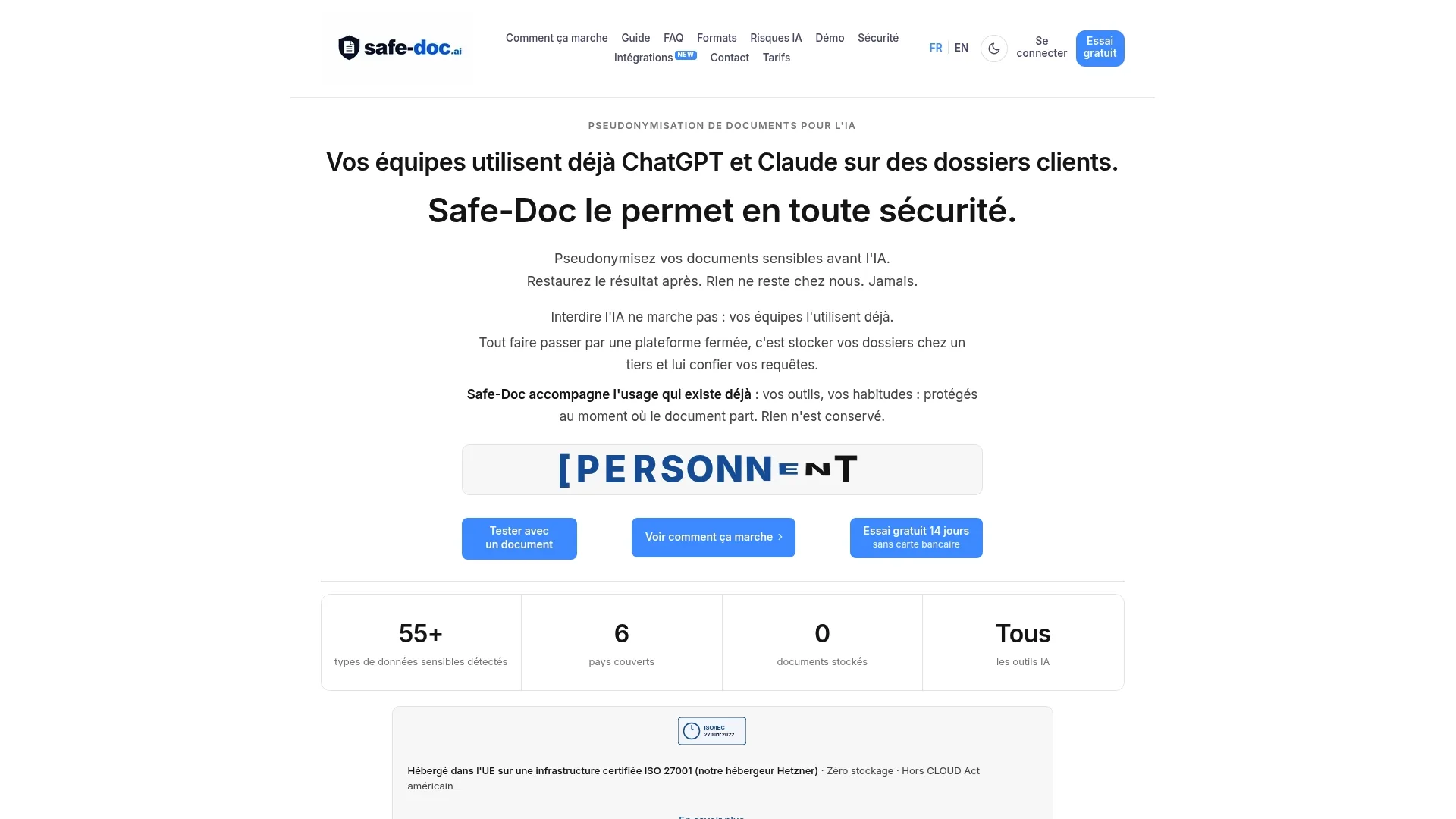
Unlike a general DLP solution that blocks and creates friction, Safe-doc maintains workflows while guaranteeing GDPR compliance: DPA clause available, exportable logs, stateless mode by design. For legal officers and CIOs who need enforceable proof of compliance, this is a concrete difference.
Consult the DPO and compliance page to access contractual documentation and request a POC adapted to your context.
Useful Sources and References
- Cloudflare: What is DLP? - definitions, data states, and SASE integration.
- Microsoft Security: Overview of DLP - data in use and unified approaches.
- OVHcloud: Data loss prevention - GDPR compliance, auditability, and mapping export.
- Snowflake: Fundamentals of DLP - classification accuracy and the role of ML.
- Barracuda Networks: DLP glossary - digital fingerprinting, pattern matching, email use cases.
- Forcepoint DLP - automatic classifiers and actions on 90+ data types.
- Proofpoint: DLP reference - messaging, access points, and deployment strategy.
- Safe-doc: GDPR pseudonymization Art. 4(5) - technical guide on pseudonymization and compliance.
- Safe-doc: DPA clause - contractual commitment and data processing.
- CNIL: GDPR - official text - French regulatory reference for compliance.