

Deploy a pseudonymization API in stateless mode, behind strong authentication, and document each data flow for your Data Protection Impact Assessment (DPIA). That's the priority action, even before choosing your NER framework. A pseudonymization API intercepts text, detects personal data (names, addresses, case numbers), and replaces them with aliases that may or may not be reversible, as defined in Article 4(5) of the GDPR.
Here are the actions to complete before writing the first line of integration code:
- Choose a detection engine (NER/tokenizer) suited to your document corpus.
- Configure an isolated Docker container with environment variables separated from secrets.
- Generate and store your encryption keys in a dedicated vault (KMS or Vault), never in code.
- Write unit tests covering ambiguous entity-detection edge cases.
- Log each call to document the processing flow under Article 30 of the GDPR.
Public implementations such as that of the French Court of Cassation or the API documented by Teavaro show comparable endpoint patterns. A SaaS solution like Safe-doc-which detects more than 90 types of sensitive data without durably storing documents-illustrates another path: API integration without managing the pseudonymization infrastructure yourself.
Key points
A reliable pseudonymization API combines stateless operation, strong authentication, key separation, and complete documentation for the DPIA.
| Point | Details |
|---|---|
| - | - |
| Favor stateless mode | Reduces the attack surface and simplifies GDPR qualification of the processing activity. |
| Separate mapping keys | Isolate key management from the role that operates the API infrastructure, as recommended by the CNIL. |
| Document each flow | Record frequency, format, and pseudonymization procedure for the DPO's DPIA. |
| Test edge cases | Fuzz PII patterns and test re-identification resistance, not just the happy path. |
| Secure without infrastructure | Safe-doc processes documents in real time without storage, detecting more than 90 types of sensitive data. |
Table of contents
- Technical and regulatory prerequisites before deployment
- How to install and launch the pseudonymization API
- What endpoints does a pseudonymization API expose?
- Operational security and GDPR compliance for your API
- How to test a pseudonymization API before production
- Which deployment architecture should you choose to scale the API?
- How to integrate the API into your development stack
- What to do about the most common API errors
- How Safe-doc implements these principles daily
- What most guides gloss over
- A layer of protection rather than a new platform to manage
- Frequently asked questions about deploying a pseudonymization API
- Sources
Technical and regulatory prerequisites before deployment
Before launching anything, verify your runtime environment. Most open-source implementations run on Linux with a containerized runtime (Docker or Podman) and rely on Python or Node.js depending on the NER library chosen. The Court of Cassation repo, for example, uses a specialized tokenizer for legal language-a reminder that a generic NER model is not always sufficient.
Your environment variables must strictly separate mapping keys from source database access credentials. The CNIL explicitly recommends physically or logically separating raw data from pseudonymized data.
On the regulatory paperwork side, prepare in parallel:
- An up-to-date record of processing activities (Article 30 register) including the new pseudonymization flow.
- A Data Protection Impact Assessment (DPIA) if the volume or sensitivity of the data justifies it.
- A logging policy compliant with Article 30 of the GDPR.
- Technical documentation for API consumers, as required by the CNIL.
Pro tip: favor stateless mode whenever confidentiality is critical. An architecture that stores no data in a database drastically reduces your attack surface and simplifies your DPIA dossier.
How to install and launch the pseudonymization API
Deployment generally follows the same pattern whether it's an open-source project or a managed service. Here are the concrete steps:
1. Clone the repository and inspect the `.env.example` file to list required variables.
2. Build the image with `docker build -t pseudo-api .`
3. Define your secrets (KMS key, hash salt) in a `.env` file excluded from version control.
4. Start the service with `docker compose up -d`.
5. Check service health via the `/health` endpoint.
A minimal `docker-compose.yml` generally combines two services: the pseudonymization application itself and, optionally, a database for lookup tables if you maintain a reversible mapping.
Once the container is running, validate your installation with this checklist:
- The `/health` endpoint responds `200 OK`.
- The `/docs` (OpenAPI) documentation is accessible.
- A `POST /pseudonymize` call on test text returns a structured response.
- The logs contain no raw data in plaintext.
Pro tip: tag each Docker image with the commit hash and run a vulnerability scan (Trivy, Grype) before any production deployment. An unscanned image is an open door you haven't even checked.
What endpoints does a pseudonymization API expose?
The central endpoint, often named `/pseudonymize` or `/ner`, accepts JSON containing a document identifier and the text to process. The Court of Cassation repo illustrates this pattern well: the request sends `idDocument` and `text`, the response returns a list of detected entities accompanied by a human verification checklist for ambiguous cases.
A minimal example in `curl`:
```
curl -X POST https://your-api/pseudonymize \
-H "Authorization: Bearer YOUR_TOKEN" \
-H "Content-Type: application/json" \
-d '{"idDocument": "doc-123", "text": "Jean Dupont lives in Lyon."}'
```
In Python, with the `requests` library:
```python
import requests
response = requests.post(
"https://your-api/pseudonymize",
headers={"Authorization": "Bearer YOUR_TOKEN"},
json={"idDocument": "doc-123", "text": "Jean Dupont lives in Lyon."}
)
print(response.json())
```
Around this main endpoint, you'll often find:
- `/mapping/{id}` to retrieve or rotate a lookup table.
- `/stats` to monitor processed volumes.
- `/health` for infrastructure monitoring.
Handle errors properly: a `401` signals an expired token, a `429` an exceeded quota, a `500` often an unavailable NER model. Add exponential-backoff retries and ensure your requests are idempotent, especially for automatic retries.
Frequent question: should you send the entire document or just excerpts? Sending excerpts limits exposure but complicates detection of entities linked across multiple sentences. Most serious implementations process the entire document in an encrypted, ephemeral session.
Operational security and GDPR compliance for your API
Authentication must rely on a regularly rotated bearer token, ideally supplemented by mTLS for server-to-server exchanges. Always separate the role that manages the API infrastructure from the role that holds decryption keys for mapping tables: that's one of the CNIL's most concrete recommendations on secure data sharing via API.
The choice between storage and stateless mode changes everything for your compliance posture. A reversible mapping stored in a database never removes the processing from GDPR scope, regardless of technical robustness. The CJEU reminds us that a contextual assessment is required: if a recipient has reasonable means to re-identify a person, the data remains personal, pseudonymized or not.
The difference between pseudonymization and anonymization is not cosmetic. Anonymization, to fall outside GDPR scope, must prevent any singling out, linkability, or inference. Pseudonymization, on the other hand, almost always remains processing of personal data, with all the obligations that entails.
Your operational compliance checklist should include:
- Legal qualification of the processing under Article 4(5) of the GDPR.
- Complete logging of access to lookup tables.
- Encryption in transit and at rest, with regular key rotation.
- Periodic penetration tests on exposed endpoints.
Pro tip: document the frequency, format, and exact pseudonymization procedure applied to each document type. That's precisely what your DPO will ask for to draft the DPIA, and improvising it in a meeting always costs more time than recording it during development.
How to test a pseudonymization API before production
Three levels of testing are essential:
1. Unit tests on the detection engine, with datasets covering compound names, partial addresses, and ambiguous case numbers.
2. Integration tests on each endpoint, with mocks for the KMS and mapping database.
3. End-to-end tests simulating a complete flow, from initial request to mapping retrieval.
In CI, isolate these tests in a sandbox environment completely disconnected from your real data. Automate execution with `pytest` or `npm test` depending on your stack.
A few points never to overlook:
- Test re-identification resistance on edge cases, not just the happy path.
- Fuzz your PII detection patterns with spelling variants.
- Verify behavior under load: timeouts, quotas, degraded-mode behavior.
A typical pipeline chains build, SAST/DAST scan, test execution, then canary deployment to limit the impact of a production regression.
Which deployment architecture should you choose to scale the API?
Three models dominate. Containerized deployment on Kubernetes, with horizontal autoscaling, suits sustained and predictable loads. Serverless absorbs sporadic spikes well, without permanent infrastructure to maintain. Batch processing remains relevant for large volumes of documents processed offline, like an entire data room to pseudonymize overnight.

Whatever the model, isolate the network accessing the source database in a private zone, with strict rules limiting inbound connections. Place your KMS keys behind minimal-access policies, never directly accessible from the public internet.
For the NER engine, the GPU vs. CPU choice depends mainly on volume: model quantization and embedding caching significantly reduce latency under heavy load. For the mapping table, sharding and segment-level encryption limit the impact of a partial compromise.
Pro tip: if confidentiality trumps everything else, consider an edge or client architecture, with local processing via the Web Crypto API rather than systematic upload to a remote server. Fully local implementations show you can drastically reduce the exposure surface without sacrificing functionality.
How to integrate the API into your development stack
The three most requested languages for integration are Python, Node.js, and simple `curl` for manual testing. In Node.js, a typical call looks like this:
```javascript
const response = await fetch("https://your-api/pseudonymize", {
method: "POST",
headers: {
"Authorization": "Bearer YOUR_TOKEN",
"Content-Type": "application/json"
},
body: JSON.stringify({ idDocument: "doc-123", text: "Jean Dupont lives in Lyon." })
});
const data = await response.json();
```
The recommended call pattern remains constant: an authentication header, a minimal JSON body, explicit error handling with exponential backoff, and idempotent requests to secure automatic retries.
Before considering integration complete, verify:
- That each detected entity is properly handled client-side, including undetected cases.
- That the returned mapping is logged without ever exposing raw data in plaintext.
- That acceptance tests cover at least one scenario per document type processed.
Frequent question: should you use an SDK or call the API directly? Without an official SDK, calling the REST endpoints documented in OpenAPI directly remains the simplest solution. Well-crafted `/docs` documentation often saves more time than a poorly maintained SDK.
What to do about the most common API errors
A `401` almost always signals an expired or malformed token: check your authorization headers first before suspecting a server-side bug. A `429` indicates an exceeded quota, often resolved by spacing out calls or negotiating a higher limit. A `500` frequently points to an unavailable NER model, to diagnose via application logs and the `/health` endpoint.
Quick diagnostic method:
- Reproduce the error with an isolated `curl` call, outside your application code.
- Verify that environment variables and KMS access are properly loaded.
- Check the container logs to identify the exact breakpoint.
Frequent question: what to do if the service remains unstable after a restart? Temporarily switch to degraded stateless mode, without database writes, to isolate the cause between the detection engine and the persistence layer.
How Safe-doc implements these principles daily
Safe-doc applies this logic end-to-end: automatic detection of more than 90 types of sensitive data, real-time processing without default storage, and mapping export to restore original documents when necessary.
Integration is done via a standard REST API or via ready-to-use connectors, with native support for PDF, DOCX, and full data rooms.
Concretely, Safe-doc covers the following use cases:
- Pseudonymization of contracts or legal documents before sending to a generative AI tool.
- Residual risk audit after processing, with exportable report for the DPO.
- Integration into existing workflows without changing team drafting habits.
What most guides gloss over
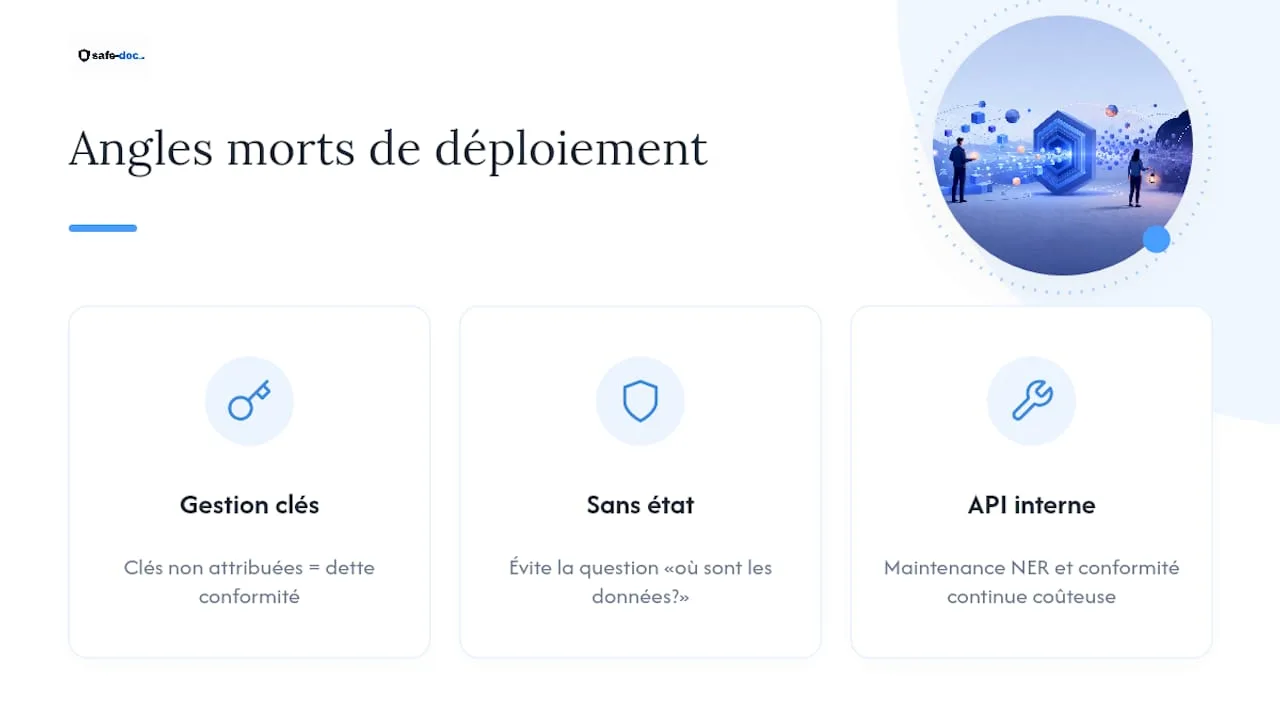
Most pseudonymization tutorials stop at the technical diagram: detect, replace, return. That's the easy part. The real obstacle-the one that causes entire deployments to fail-lies in key management and flow documentation for the DPO. A technical team that deploys an API without having defined who holds the mapping keys, and under what conditions they can be revoked, builds a compliance debt it will discover at the worst moment, often during an audit.
The other blind spot concerns the stateless choice. Many teams perceive it as a technical constraint when it's primarily a compliance decision that simplifies everything else. Not storing means not having to answer the question "where is the data and who can read it?" That simplicity is worth more than any performance optimization.
Finally, the temptation to build your own in-house pseudonymization API deserves honest questioning. It's a solid project for an isolated, well-controlled case, but maintaining the NER engine, detection models, and ongoing compliance requires an investment that many teams underestimate at startup.
A layer of protection rather than a new platform to manage
Unlike open-source implementations you must host, maintain, and evolve yourself, Safe-doc integrates as a layer of protection on top of the AI tools your teams already use, without changing their work habits.
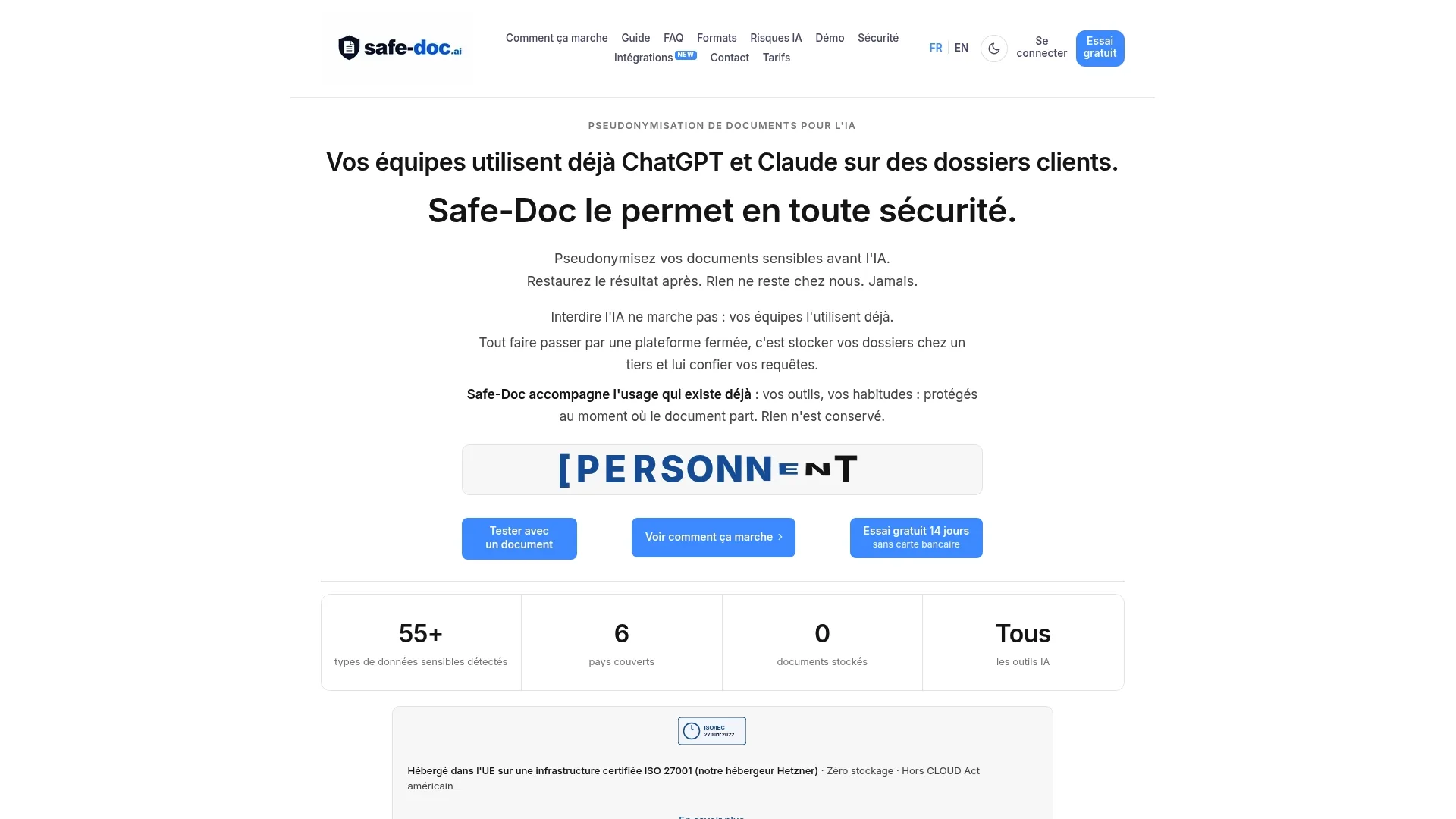
Where an in-house deployment requires managing the NER engine, key rotation, and mapping-table scalability, Safe-doc processes documents in real time without durably storing them, with detection covering more than 90 types of sensitive data. For a legal team, IT department, or consulting firm handling contracts or confidential documents, this avoids building a pseudonymization infrastructure to focus on core business.
If your priority is to quickly secure your teams' use of ChatGPT or Claude without blocking their workflows, the pseudonymization and anonymization page details the product approach. Legal teams and DPOs will find on the compliance and audit page a concrete starting point for framing their DPIA.
Frequently asked questions about deploying a pseudonymization API
Should you choose reversible or irreversible mode for pseudonymization?
It depends on downstream use: if you need to restore original documents, an encrypted reversible mapping is required. If no restoration is necessary, an approach closer to anonymization further reduces GDPR obligations.
Is an open-source pseudonymization API sufficient for professional use?
Technically yes, but NER model maintenance, key management, and compliance monitoring represent an ongoing burden that many teams underestimate compared to an integrated SaaS solution.
What is the concrete difference between pseudonymization and anonymization in an API?
Pseudonymization remains reversible under certain conditions and remains processing of personal data within the meaning of the GDPR, while true anonymization removes data from the regulation's scope by preventing any re-identification.
This article constitutes general information and does not replace advice from a qualified attorney. Consult a qualified legal professional regarding your individual case before acting on this content.
Sources
- Technical recommendation on the use of application programming interfaces (APIs) for secure sharing of personal data
- Cour-de-cassation/pseudonymisation-api
- Pseudonymization and GDPR: the real conditions for leaving (or not) the scope of personal data