

Pseudonymization is defined in Article 4(5) of the GDPR as processing personal data in such a way that it can no longer be attributed to a specific data subject without the use of additional information, which is kept separately. In the contractual context, this technique serves as the first line of defense for protecting personal data while enabling contract analysis and management. Best practices for contract pseudonymization rest on three inseparable pillars: explicit contractual clauses, proven technical measures, and documented organizational governance. This guide outlines concrete requirements for legal professionals and compliance officers in 2026.
Table of Contents
- What are the essential contractual clauses for effective pseudonymization?
- What technical measures should be applied to guarantee robust pseudonymization?
- How to organize governance and traceability around pseudonymization?
- What distinction must be made between pseudonymization and anonymization in contractual contexts?
- How to adapt best practices according to contractual context and AI tools?
What are the essential contractual clauses for effective pseudonymization?
Contracts involving pseudonymized data must contain specific clauses to comply with the GDPR. A general confidentiality clause is insufficient.
The re-identification prohibition clause is the most critical element. Prohibiting any attempt at re-identification by the recipient, whether direct or by cross-referencing, is a major requirement arising from Article 28 of the GDPR. This clause must explicitly address indirect methods: cross-referencing databases, statistical inference, and use of third-party data.

The obligation to implement technical and organizational measures must be stated in precise terms. The contract should list expected protocols, such as encryption of data at rest and securing transmissions, rather than vaguely referring to "appropriate measures."
Contractual consequences in the event of breach must be clearly defined. This includes the right to immediate termination, proportionate financial penalties, and the obligation to notify within a defined timeframe aligned with the 72-hour requirement provided for by the GDPR.
The periodic risk review clause is often omitted, yet it is indispensable. Reviewing pseudonymization-related techniques and contracts annually allows for assessing re-identification risks as technological capabilities evolve. This obligation flows from Recital 26 of the GDPR.
Pro tip: Include in each contract a technical annex listing the pseudonymization algorithms used, their version, and the date of their last evaluation. This annex becomes documentary evidence in the event of a CNIL inspection.
What technical measures should be applied to guarantee robust pseudonymization?
The robustness of pseudonymization rests on precise technical choices, not intentions. Here are the protocols to implement:
- AES-256 encryption of data at rest. Recommended measures include AES-256 for stored data, whether archived contracts or mapping tables. This standard is recognized by ANSSI as sufficient for sensitive data.
- Secure transmission via TLS 1.3. Any communication of pseudonymized data between systems must use TLS 1.3. Earlier versions have known vulnerabilities and should no longer be accepted in subprocessing contracts.
- Role-based access control (RBAC). Only individuals whose function requires it should access pseudonymized data. Role-based management mechanically limits the attack surface and facilitates auditing.
- Secured mapping tables. The consistency of pseudonymization relies on mapping tables that enable the same conversion across a complete corpus. These tables must be stored separately from pseudonymized data, with restricted and logged access.
- Interoperability with local AI tools. Artificial intelligence processing must be performed on already-pseudonymized data. Local pseudonymization before any transfer to a cloud ensures that personal data is not exposed to uncontrolled external processing.
The combination of these five measures forms a technical foundation aligned with the recommendations of the European Data Protection Board (EDPB). Each measure taken in isolation leaves vulnerabilities. Their joint application reduces residual risk to an acceptable level.
Pro tip: Regularly test the robustness of your pseudonyms with simulated re-identification attacks. A specialized provider can conduct this test annually and produce a report usable during a CNIL audit.
How to organize governance and traceability around pseudonymization?
Technique alone is insufficient. Effective pseudonymization requires rigorous organization around processes and people.
1. Documented internal policy. A written usage policy known to the entire team is essential to prevent human error. This document must specify who can access what, in what context, and according to what procedure. It must be signed by each relevant employee.
2. Training and awareness for teams. A policy that is not understood is an ineffective policy. Short and regular training sessions, focused on concrete cases drawn from contractual activity, produce better results than generic annual training.
3. Logging of access and modifications. Traceability via access logging is essential for any manipulation of documents containing pseudonymized data. Each log entry must include the user identifier, date, time, and nature of the operation.
4. Audit and regular review. Practices and associated contracts must be reviewed at least once a year. This audit verifies the adequacy of technical measures, the relevance of contractual clauses, and the evolution of re-identification risks.
5. Management of access authorizations and revocations. Any departure or change of position must trigger immediate revocation of access to pseudonymized data and mapping tables. This process should be automated as much as possible to avoid oversights.
Pro tip: Designate a pseudonymization lead within the legal team. This role, distinct from that of the DPO, ensures daily operational monitoring and serves as the contact person during audits.
What distinction must be made between pseudonymization and anonymization in contractual contexts?
The distinction between pseudonymization and anonymization is fundamental in law. Confusing the two leads to serious errors in contract drafting.
Pseudonymization replaces direct identifiers with pseudonyms, but re-identification remains possible if the mapping key is available. Pseudonymized data remains personal data as long as this key exists. The GDPR therefore applies in full.
Anonymization, on the other hand, permanently removes any link to the data subject. Anonymized data falls outside the scope of the GDPR. But true anonymization is technically very difficult to achieve, especially on contractual corpora rich in context.
| Criterion | Pseudonymization | Anonymization |
|---|---|---|
| - | - | - |
| Re-identification possible | Yes, with the key | No (in theory) |
| GDPR scope of application | Yes, in full | No |
| Required contractual clauses | Yes | No (if truly anonymized) |
| Rights of data subjects | Maintained | Extinguished |
| Residual risk | Present | Very low if properly done |
Pseudonymization does not exempt from contractual requirements or the need to maintain a data processing agreement compliant with Article 28 GDPR. This point is often misunderstood: contracts drafted as if the data were anonymized when they are only pseudonymized create false legal security. To explore this distinction between pseudonymization and anonymization further, specialized resources help avoid these qualification errors.
How to adapt best practices according to contractual context and AI tools?
The use of artificial intelligence in contract management amplifies risks related to personal data. The following recommendations apply specifically to this context.
- Pseudonymize locally before any cloud transmission. Preparing contracts for AI use requires working locally with tools that enable pseudonymization before sending to cloud services. This step prevents any leakage of personal data to uncontrolled third-party servers.
- Require a strict data processing agreement (DPA). Pseudonymization does not eliminate the obligation to conclude a DPA compliant with Article 28 GDPR, even if the data is masked. Any AI provider processing contracts must sign this document before any operation.
- Maintain human oversight of AI outputs. The primary risk when using AI in contracts is linked to human error and the absence of a well-defined usage policy. A lawyer must validate each result produced by AI from pseudonymized data.
- Document authorized use cases. Assisted drafting, clause analysis, and deadline management are legitimate uses. Each use case must be listed in the internal policy with the data concerned and associated measures.
- Verify pseudonym consistency across the entire corpus. The same individual must receive the same pseudonym in all documents of the same case file. This consistency is essential for AI analysis to produce reliable results without exposing actual data.
For teams working on complex operations such as mergers and acquisitions, pseudonymization in data room contexts follows the same principles but with enhanced traceability requirements.
Key takeaways
Data protection in contracts requires an explicit re-identification prohibition clause, technical measures compliant with GDPR standards, and documented governance reviewed annually.
| Point | Details |
|---|---|
| - | - |
| Re-identification prohibition clause | To be integrated into each contract, targeting direct and indirect re-identification methods. |
| Mandatory technical measures | AES-256, TLS 1.3, RBAC, and separate mapping tables form the minimum baseline. |
| Pseudonymization distinct from anonymization | Pseudonymized data remains personal: the GDPR applies in full. |
| Governance and traceability | Access logging, written policy, and annual review are non-negotiable. |
| AI and local pseudonymization | Pseudonymize before any transmission to a cloud service to avoid data leakage. |
What I observe after years of supporting legal teams
Pseudonymization is often treated as a checkbox in compliance projects. This is a fundamental mistake.
What I have observed in the field is that the teams that succeed at contractual pseudonymization are not those with the best tools. They are the ones with a written policy, understood and applied by everyone. A well-drafted contract with a precise re-identification prohibition clause is worth more than ten poorly configured technical tools.
The other blind spot I regularly encounter: confusion between pseudonymization and anonymization. Experienced lawyers draft contracts assuming their data is anonymized when it is only pseudonymized. This qualification error exposes the organization to avoidable CNIL sanctions. The distinction between these two concepts deserves dedicated training, not just a paragraph in an internal memo.
Finally, the arrival of AI in contractual workflows changes the situation on one specific point: attack surface. Before AI, a poorly pseudonymized contract remained in a closed system. Today, it can be sent to a language model hosted abroad in seconds. Local pseudonymization before any AI processing is no longer optional. It is a baseline requirement.
- Jacques
Safe-doc for compliant and audited contractual pseudonymization
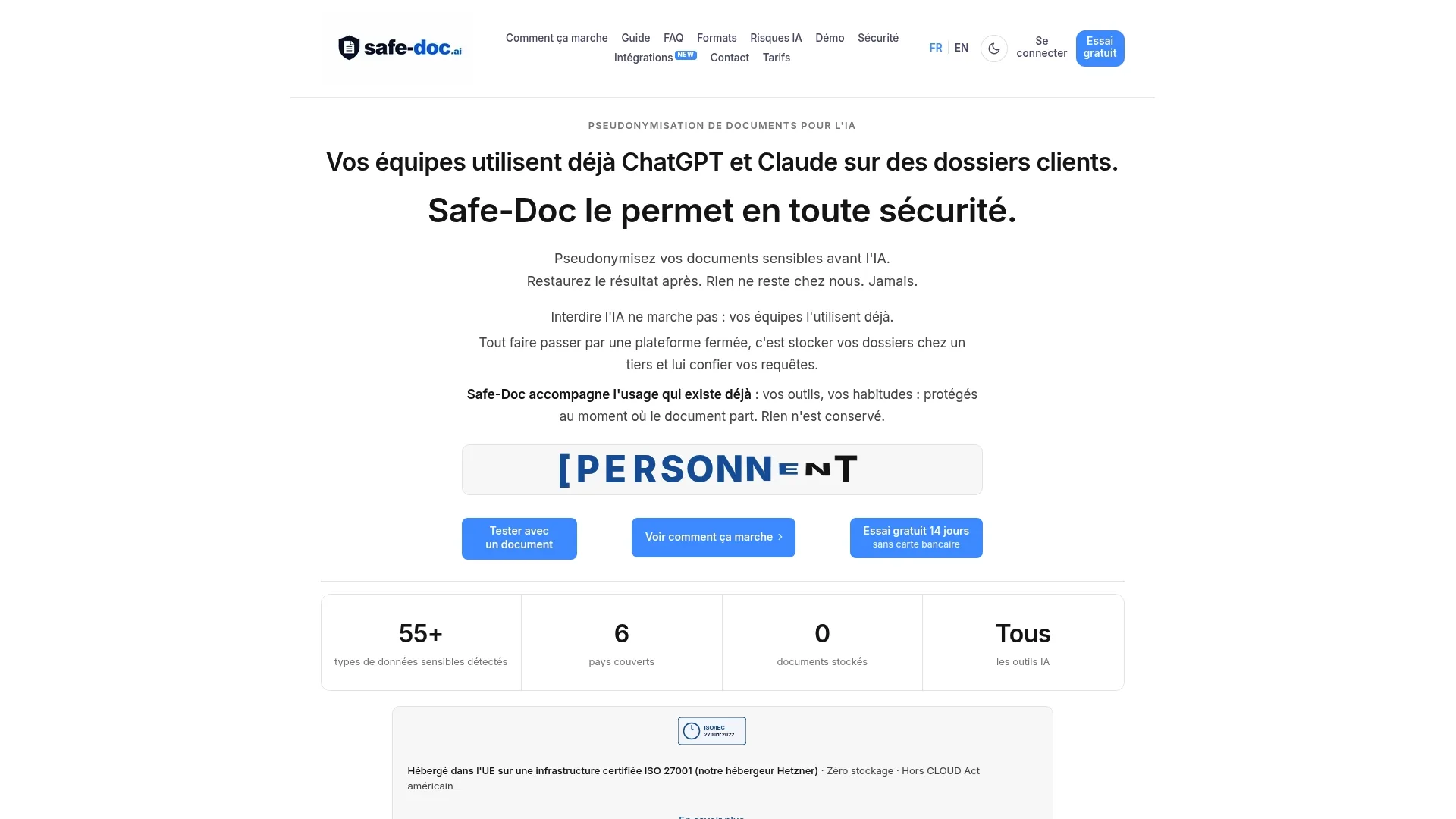
Legal teams and DPOs seeking to structure their approach to contractual pseudonymization find a concrete solution in Safe-doc. The platform pseudonymizes sensitive documents locally, never storing them, before any AI processing. Contracts, payslips, and sensitive documents are processed in real time with complete traceability. Safe-doc integrates with existing AI tools like ChatGPT and Claude, without changing team work habits. For compliance officers, Safe-doc's DPO audit and compliance services cover the entire cycle: implementation, documentation, and periodic review of practices.
Frequently asked questions
What is a re-identification prohibition clause?
It is a contractual clause that prohibits the recipient from attempting to identify the individuals behind the pseudonyms, whether directly or by cross-referencing data. It is recommended under Article 28 of the GDPR for any contract involving pseudonymized data.
Does pseudonymization eliminate GDPR obligations?
No. Pseudonymized data remains personal data as long as the re-identification key exists. The GDPR applies in full, including the obligation to conclude a data processing agreement compliant with Article 28.
What is the difference between pseudonymization and anonymization in a contract?
Pseudonymization allows re-identification with the mapping key; anonymization permanently removes it. A contract dealing with pseudonymized data must include specific GDPR clauses, unlike truly anonymized data.
Should data be pseudonymized before using AI on contracts?
Yes. Pseudonymization must occur locally, before any transmission to an AI service hosted in the cloud, to avoid any exposure of personal data to uncontrolled external processing.
How often should pseudonymization practices be reviewed?
An annual review is recommended by Recital 26 of the GDPR. It must assess whether the techniques used remain sufficient in the face of evolving re-identification capabilities and update contractual clauses accordingly.