


The answer is straightforward: yes, you must pseudonymize your data before any analytical review, as soon as generative AI or an external service provider enters the loop. The CNIL (France's data protection authority) considers pseudonymization the technical security measure recommended under Article 32 of the GDPR to limit the risk of reidentification and data leakage. When processing presents a high risk, a Data Protection Impact Assessment (DPIA) becomes necessary to document this choice.
Concretely, before sending a corpus of accounting records or contracts to an analytical review, three steps are essential:
- Remove or replace direct identifiers (names, IBANs, email addresses, social security numbers).
- Preserve the statistical utility of the data so the analysis remains valid.
- Store the mapping table separately, encrypted, with restricted and logged access.
Pseudonymization is not an administrative formality. It's the filter that allows you to leverage AI without turning an audit into a confidentiality incident.
Key points
Pseudonymization before analytical review protects both GDPR compliance and professional privilege, without sacrificing the statistical value of the audited data.
| Point | Details |
|---|---|
| - | - |
| Pseudonymization remains mandatory | Pseudonymization reduces the risk of reidentification but does not exempt you from GDPR obligations or professional privilege. |
| Distinguish pseudonymization from anonymization | Only irreversible anonymization removes data from the scope of the GDPR, which is rarely achievable in practice. |
| Document via a DPIA | An impact assessment must cover the purposes, residual risks and robustness tests performed. |
| Plan for human QA | A manually verified sample limits the error rate of automatic NER tools. |
| Safe-Doc as an integrated solution | Safe-Doc pseudonymizes in real time without document storage, with mapping export and auditability report. |
This article constitutes general information and does not substitute for advice from a qualified attorney. Consult a qualified legal professional regarding your individual case before acting on this content.
Table of contents
- Definition and legal status: pseudonymization versus anonymization
- Concrete risks of an analytical review without pseudonymization
- When pseudonymization is enough and when to aim for anonymization
- Operational procedure for pseudonymizing a corpus before analysis
- How to document the process for the CNIL and internal audit
- Minimum checklist before sending documents to an AI or analytical review
- Practical perspective: why this approach is necessary
- Recommended solution: Safe-Doc to secure your analytical reviews
- Sources
Definition and legal status: pseudonymization versus anonymization
Article 4 of the GDPR defines pseudonymization as the processing of personal data in such a way that they can no longer be attributed to a person without additional information, kept separately. In other words, the operation remains reversible as long as the mapping table exists somewhere. This is precisely what distinguishes pseudonymization from anonymization: the latter irreversibly destroys the link and removes the data from the scope of the GDPR, while pseudonymization remains fully subject to it.
Many projects that present themselves as "anonymization" in reality produce only partial pseudonymization. The difference is not cosmetic-it entirely changes the applicable legal regime.
For an audit firm, this nuance has direct consequences:
- Pseudonymizing reduces the risk, but does not exempt you from the legal basis, retention period, or the rights of the data subjects.
- The professional privilege that governs audit engagements remains engaged even after pseudonymization: the pseudonymized data remains confidential client information.
- Only anonymization demonstrated to be irreversible genuinely alleviates GDPR obligations, which remains technically difficult to guarantee on context-rich corpora.
Concrete risks of an analytical review without pseudonymization
Submitting raw identifying data to an analytical review exposes the firm to three distinct families of risks. The first is legal: undocumented processing of personal data, combined with a risk of reidentification, constitutes a GDPR violation subject to sanction. The second directly affects professional ethics, since professional privilege can be breached as soon as a third party (AI or subcontractor) accesses client information without contractual oversight.
The third risk is technical and often underestimated:
- Reuse or unintentional training of an AI model on data transmitted via a consumer interface.
- Exfiltration by a poorly supervised service provider, in the absence of a signed Data Processing Agreement (DPA).
- Transfers outside the European Union without appropriate safeguards, particularly to non-localized cloud infrastructures.
At the analytical level itself, identifiers left in place can introduce bias into the conclusions: an auditor who spots a known name in a sample of expense reports or HR files risks, consciously or not, influencing their judgment. The CNIL explicitly recommends that a signed processing agreement constitutes the bare minimum as soon as an external service provider intervenes on personal data.
When pseudonymization is enough and when to aim for anonymization
The choice between simple pseudonymization and reinforced measures depends on four criteria: the sensitivity of the data processed, the scale of the corpus, the possibility of cross-referencing with other sources, and the level of professional obligation attached to the engagement.
For aggregate analyses, governance indicators or consistency checks on large volumes, pseudonymization is generally sufficient, provided it is applied consistently across the entire corpus. However, certain scenarios require going further:
- Health data or sensitive information within the meaning of Article 9 of the GDPR.
- Litigation contexts where a counterparty could seek to cross-reference data.
- Individual nominative analyses comparable to surveillance of natural persons.
In these cases, it is best to combine pseudonymization, statistical aggregation, strong encryption, strict access control and active sample reidentification testing.
Pro tip: never decide the level of protection on behalf of the client without prior discussion. Document the reasoning in the DPIA, even for a file that seems "low risk" to you.
Operational procedure for pseudonymizing a corpus before analysis
Here is a sequential method applicable to the majority of financial audit engagements:
1. Prepare the corpus: pass scanned documents through OCR, then remove hidden metadata (author, creation dates, comments) before any further processing.
2. Detect identifiers: combine named entity recognition (NER) and business rules to identify names, IBANs, addresses, tax numbers.
3. Substitute consistently: replace each identifier with a stable pseudonym across the entire corpus, so that the same person keeps the same alias everywhere.
4. Isolate the mapping table: store it encrypted, on a separate medium, with restricted and logged access.
The minimum technical and organizational measures include encryption in transit (TLS 1.2 or higher) and at rest, rigorous key management, hosting preferably located in the European Union, and a DPA signed as soon as an external service provider intervenes. The CNIL details these measures in its recommendations on the development of AI systems.
Quality control should never be neglected. The Etalab pseudonymization guide illustrates this point well: on a large corpus of automatically processed decisions, a significant portion were subject to manual verification, because rule engines alone produce too high an error rate without human review. Therefore, plan:
- A human review on 5 to 10% of the sample when starting a new document type.
- Reidentification tests to verify that no trivial cross-referencing remains possible.
- An NER error rate indicator monitored over time, with a correction plan if this rate drifts.
Pro tip: automate pseudonymization via an API or plugin rather than one-off manual processing. A reflex that depends on the memory of a tired employee on a Friday evening will always end up being forgotten.
How to document the process for the CNIL and internal audit
A DPIA linked to the use of AI and pseudonymization must describe the purposes of the processing, assess the residual risks after pseudonymization, list the technical and organizational measures applied, and present the results of robustness tests.
The processing register completes this framework with the scope of application, the legal basis retained, the retention period, external data flows, signed DPAs and the exact location of the data. In the event of an inspection or internal quality review, the expected auditability evidence includes:
- Access logs to the mapping table.
- QA reports from the human sample review.
- Documented results of reidentification tests.
- The exact parameters of the pseudonymization method applied.
Minimum checklist before sending documents to an AI or analytical review
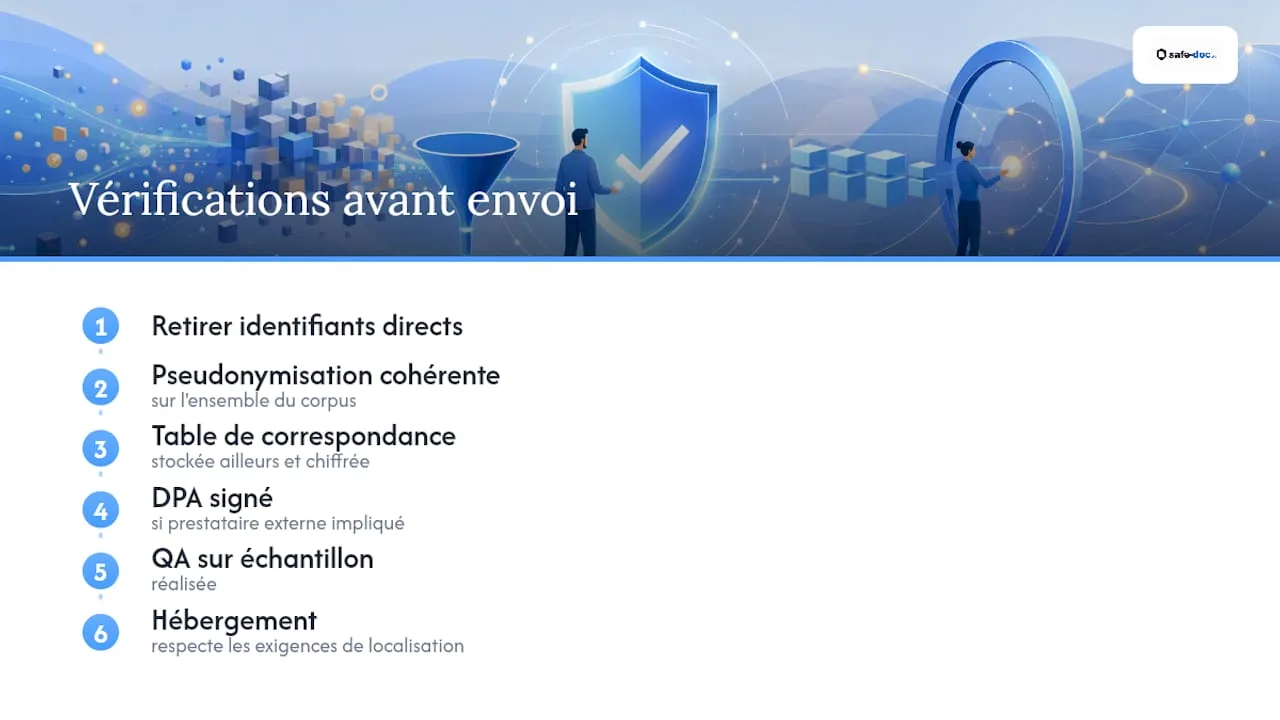
Before any submission, verify that direct identifiers are removed, that pseudonymization is consistent across the entire corpus, that the mapping table is stored elsewhere and encrypted, that a DPA is signed if an external service provider is involved, that QA has been performed on a sample, and that the hosting complies with localization requirements.
Practical perspective: why this approach is necessary
The temptation, in auditing, is to move quickly: copy and paste extracts into a consumer AI to save time. This approach ignores the fact that pseudonymization does not slow down the analysis-it secures it without distorting its statistical value. The real question is not "to pseudonymize or not", but "to pseudonymize in an ad hoc manner, or with a documented and tested procedure". An integrated tool like Safe-Doc allows this step to be handled without complicating the existing workflow.

Recommended solution: Safe-Doc to secure your analytical reviews
Unlike manual copy and paste which requires you to remove identifiers one by one, Safe-Doc pseudonymizes your documents in real time, without durably storing the processed files.
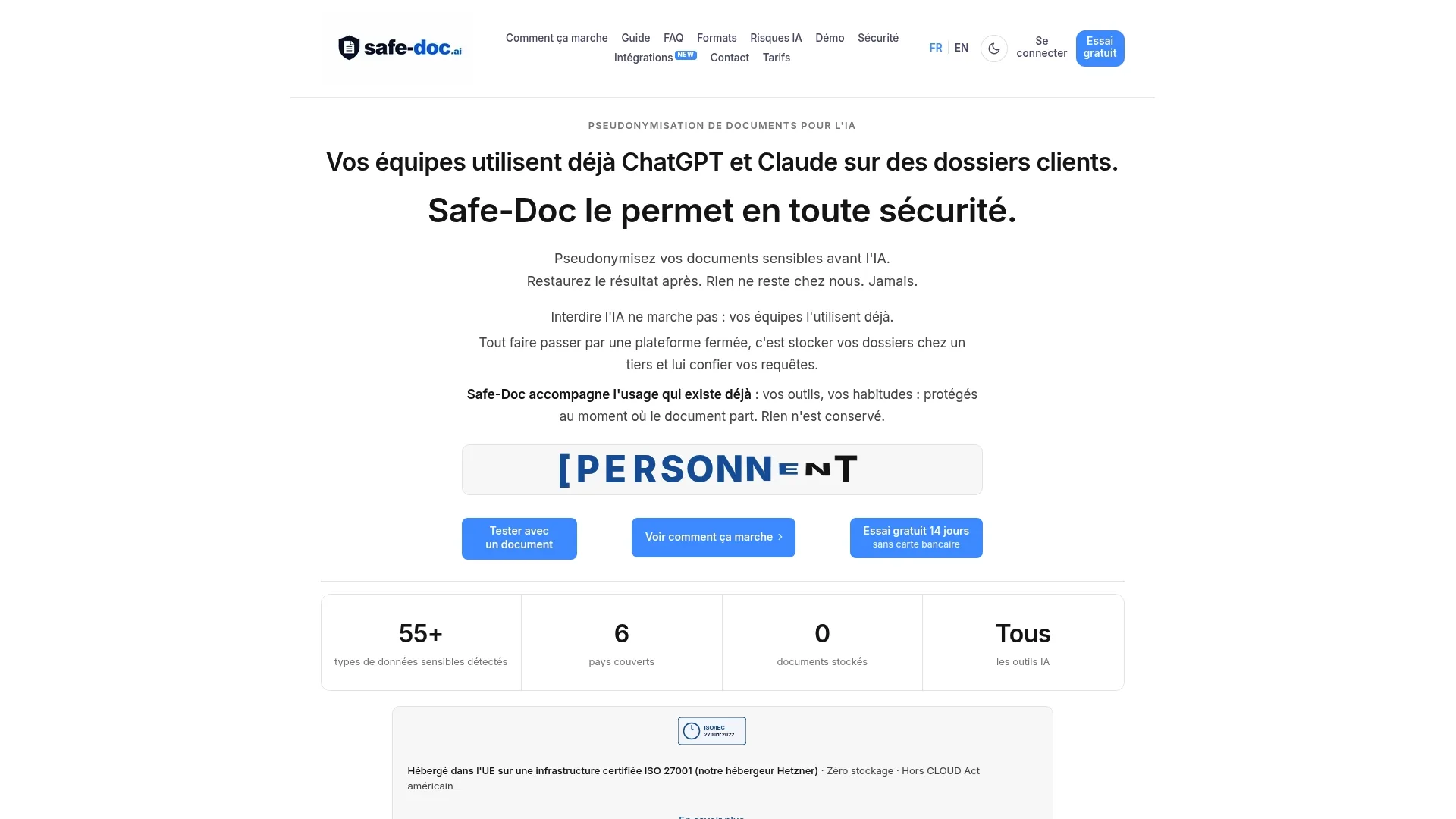
The platform automatically detects many types of personal and confidential data, exports an encrypted mapping table to restore the data once the analysis is complete, and integrates via API or plugin to avoid any change in team habits. Each processing generates an auditability report in PDF, useful for documenting your DPIA and responding to an inspection. For an audit firm, this means being able to continue using ChatGPT or Claude on client files without exposing identifying data or sacrificing speed of analysis. Visit the DPO page to see how to integrate this layer of protection into your next engagement.