


Anonymization of balance sheet data is defined as the process of making it irreversibly impossible to identify a natural person from financial information. Under the GDPR, truly anonymized data falls outside the scope of the regulation, removing associated legal obligations. The advantages of balance sheet data anonymization are therefore legal, operational, and security-related. Both the CNIL and the Conseil d'État have clarified the strict criteria that must be met for anonymization to be legally recognized. Mastering these criteria protects your organization from sanctions of up to 4% of global annual turnover or €20 million.
Table of contents
- What are the compliance benefits of anonymization?
- How does anonymization improve balance sheet data security?
- What operational benefits for sharing and collaboration?
- What technical methods guarantee irreversible anonymization?
- Key points
- My point of view on anonymization as a governance lever
- Safe-doc for compliant anonymization of your balance sheet data
- Frequently Asked Questions
- Recommendations
What are the compliance benefits of anonymization?
Irreversible anonymization removes data from the scope of the GDPR. This exemption eliminates notification obligations, limited retention requirements, and the need to manage data subject rights.

The distinction from pseudonymization is fundamental. Pseudonymization replaces identifiers with codes, but the data remains personal data subject to the GDPR. Anonymization, by contrast, permanently destroys any means of reidentification. Pseudonymization is not anonymization: only an insignificant risk of reidentification allows data to fall outside the regulation's scope, according to Conseil d'État decision no. 498628 of 13 February 2026.
For financial statements, this distinction has direct consequences. A balance sheet containing personal data about directors, shareholders, or employees remains subject to the GDPR as long as reidentification is technically possible. Once anonymized according to CNIL criteria, this same document can be shared, archived, or analyzed without additional regulatory constraints.
- Elimination of GDPR obligations: no processing register required, no imposed retention period for anonymized data.
- Reduced risk of sanctions: maximum GDPR fines (4% of global turnover or €20 million) no longer apply to truly anonymized data.
- Simplified audits: anonymized data falls outside the scope of CNIL inspections.
- Relief from data subject rights: access, rectification, and erasure rights no longer apply.
Pro tip: Systematically document your anonymization process, including the methods used and tests performed. This documentation serves as your proof of compliance in the event of an inspection.
How does anonymization improve balance sheet data security?
Anonymization mechanically reduces the attack surface exposed in the event of a data breach. A balance sheet from which personal data has been irreversibly removed holds no value for an attacker seeking to exploit personal information.
Securing test environments represents one of the most concrete benefits. Technical teams regularly use real data to test applications or migrations. These environments are often less protected than production systems. Injecting anonymized but realistic data into these contexts eliminates the risk of exposing sensitive financial data.
Here are recommended practices for secure balance sheet anonymization:
1. Map personal data present in each balance sheet before any operation.
2. Apply a combination of techniques: randomization of identifying values, generalization of amounts, removal of direct identifiers.
3. Destroy matching keys irreversibly after anonymization.
4. Test the robustness of the result against the three CNIL criteria: individualization, correlation, and inference.
5. Document each step to ensure process traceability.
The robustness of anonymization must be reassessed regularly. Publicly accessible databases and cross-referencing technologies evolve rapidly. A method deemed sufficient in 2024 may become insufficient in 2026 when faced with new inference tools.
Pro tip: Plan an annual reassessment of your anonymization methods. Integrate this review into your data governance calendar alongside security audits.
What operational benefits for sharing and collaboration?
Anonymization of balance sheet data facilitates secure sharing internally and with external partners, while reducing legal constraints related to data protection. Finance teams, external auditors, and business partners can access necessary data without requiring complex contractual clauses.
The usual barriers to financial data sharing largely disappear. An anonymized balance sheet does not require a data processing agreement under Article 28 of the GDPR. Contract negotiation timelines shrink. Teams can focus on analysis rather than managing permissions.
"Anonymization must be viewed not only as a technique but as a resilience strategy that relieves teams of regulatory complexity and promotes secure data sharing."
Concrete business use cases are numerous:
- Transmission to statutory auditors: anonymized data enables analytical verification without exposing personal data of directors or shareholders.
- Sector benchmarking: anonymized balance sheets can be aggregated and shared with analysis firms without risk of reidentification.
- Inter-subsidiary collaboration: international groups can centralize anonymized financial data without triggering non-EU transfer obligations.
- Team training: new employees train on realistic data without accessing actual information.
The analytical value of balance sheets is preserved after anonymization. Financial ratios, cash flow trends, and performance indicators remain usable. Only information enabling identification of a natural person is removed.
What technical methods guarantee irreversible anonymization?
Effective anonymization relies on a combination of randomization and generalization to satisfy the three cumulative CNIL tests. These three tests evaluate whether an individual can be isolated in the dataset (individualization), whether data can be linked together to identify a person (correlation), and whether information can be inferred about an individual (inference).
The distinction between anonymization and pseudonymization is both technical and legal. The following table summarizes the key differences:
| Criterion | Anonymization | Pseudonymization |
|---|---|---|
| - | - | - |
| Reversibility | Irreversible | Reversible with key |
| GDPR status | Out of scope | Personal data |
| Matching key | Permanently destroyed | Stored separately |
| Data subject rights | Not applicable | Applicable |
| Residual risk | Insignificant (objective) | Present |
Anonymization is not binary but a continuum. Irreversibility is the decisive criterion. The complete and permanent destruction of reidentification keys distinguishes true anonymization from disguised pseudonymization.
A major point of attention concerns AI anonymization projects. The majority of so-called "AI anonymization" projects actually produce pseudonymization, retaining the status of personal data and associated GDPR obligations. Named entity recognition (NER) tools replace identifiers without destroying them. The result remains reversible if the key is retained.
The technical limitations of anonymization are worth understanding. On small financial datasets, generalization can render data unusable for analysis. Cross-referencing with public databases (trade registers, legal publications) may enable partial reidentification. This is why the legal framework requires a risk-based approach to reidentification, accounting for technologies and means available at the time of assessment.
Pro tip: For small-entity balance sheets, favor generalization of amounts by ranges rather than deletion. You preserve analytical value while making reidentification insignificant.
Key points
Irreversible anonymization of balance sheet data eliminates GDPR obligations, reduces risk of sanctions, and frees teams to share and analyze financial data without regulatory constraints.
| Point | Details |
|---|---|
| - | - |
| GDPR exemption | Irreversible anonymization removes data from the regulation's scope, eliminating compliance obligations. |
| Pseudonymization distinction | Pseudonymization remains subject to the GDPR; only irreversible anonymization offers true exemption. |
| Test environment security | Anonymized data protects balance sheets in less secure technical contexts. |
| Facilitated sharing | Anonymized balance sheets are shared without processing agreements or GDPR contractual constraints. |
| Periodic reassessment | Anonymization methods must be reviewed regularly as reidentification technologies evolve. |
My point of view on anonymization as a governance lever
After years of observing financial data management practices in businesses, I find that anonymization remains under-exploited. Most organizations treat GDPR compliance as a constraint to manage, not as an opportunity to simplify governance.
The most common mistake I see is confusing pseudonymization and anonymization. Entire teams believe they have anonymized their balance sheets when they have simply replaced names with codes. The result remains personal data, with all associated obligations. The Conseil d'État decision of February 2026 clarified this point unambiguously, but ground-level practices have not yet caught up.
What also strikes me is the underestimated organizational impact of true anonymization. When balance sheet data is genuinely anonymized, legal teams spend less time managing access requests and processing contracts. Data teams can test, analyze, and share without waiting for approvals. This is a real velocity gain, not theoretical.
My recommendation for 2026 is to treat anonymization as an ongoing process, not a one-off project. Reidentification technologies evolve. A robust method today may become insufficient in eighteen months. Integrate an annual review into your governance, document each decision, and do not let your technical teams alone decide what constitutes sufficient anonymization. This is a legal decision as much as a technical one.
- Jacques
Safe-doc for compliant anonymization of your balance sheet data
Professionals handling sensitive financial statements face a concrete challenge: using modern analysis tools, including AI, without exposing personal data. Safe-doc addresses this need by offering a layer of pseudonymization before AI processing, allowing teams to continue using their usual tools without changing workflows.
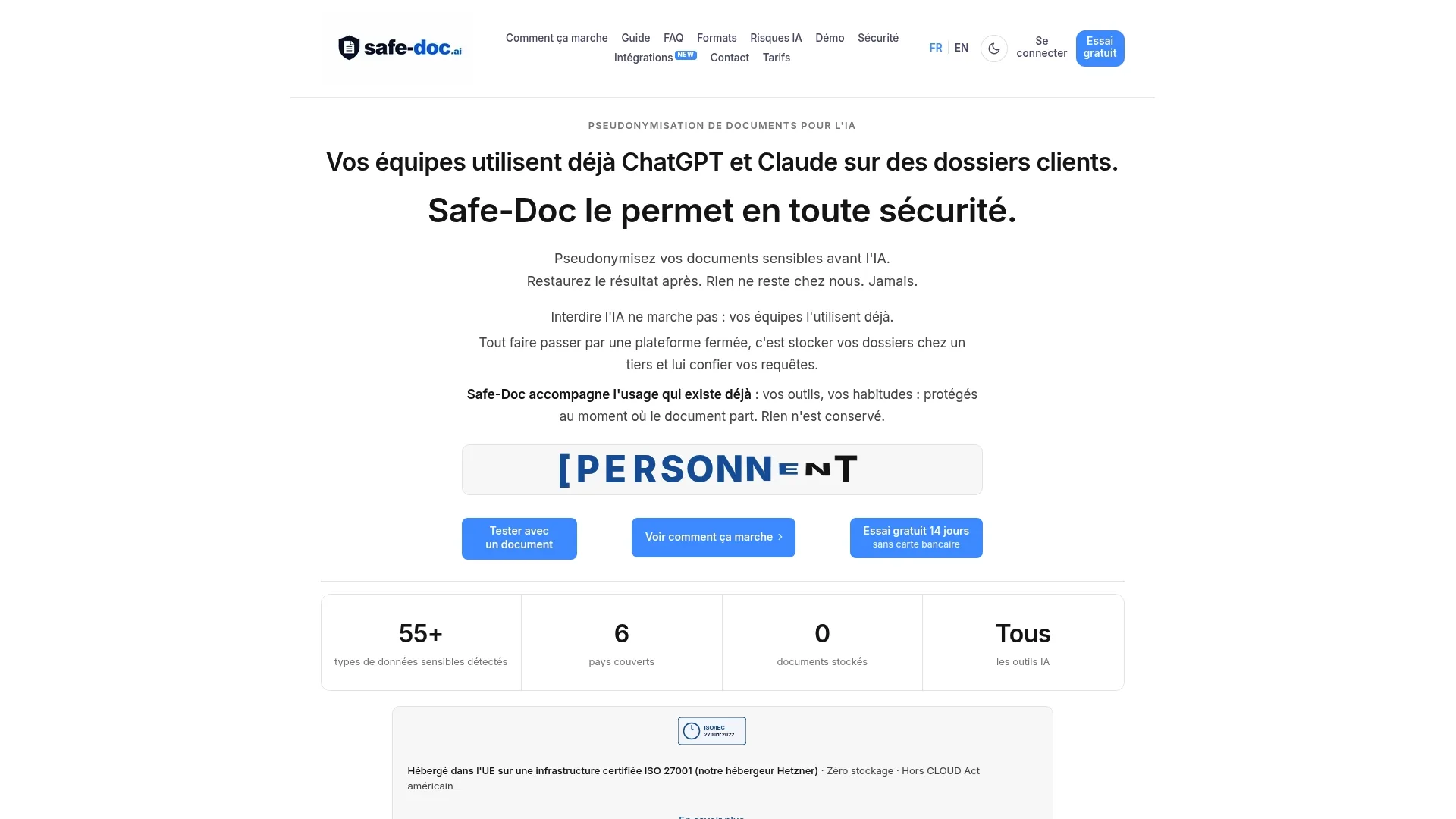
Safe-doc does not durably store processed documents. Processing occurs in real time, without data retention, directly meeting GDPR minimization requirements. For compliance officers and DPOs seeking to regulate AI use on financial data, Safe-doc's compliance and audit page details available technical and legal guarantees. The solution integrates into existing environments without friction and without replacing tools already in place.
Frequently Asked Questions
What is anonymization of balance sheet data?
Anonymization of balance sheet data is the process of making it irreversibly impossible to identify a natural person from information contained in a financial statement. Once anonymized, this data falls outside the scope of the GDPR.
What is the difference between anonymization and pseudonymization?
Pseudonymization replaces identifiers with codes but remains reversible; the data remains personal data subject to the GDPR. Anonymization permanently destroys any means of reidentification and exempts data from the GDPR.
What are the three CNIL tests to validate anonymization?
The CNIL evaluates three cumulative criteria: individualization (isolating an individual), correlation (linking data to identify a person), and inference (deducing information about an individual). All three tests must be satisfied simultaneously.
Should anonymization methods be regularly reassessed?
Yes. Cross-referencing technologies and public databases evolve, which can make a previously sufficient method vulnerable to reidentification. Annual reassessment is recommended to maintain compliance.
Does AI anonymization guarantee true anonymization?
No. Most AI tools actually apply pseudonymization by replacing identifiers without destroying them. The result remains personal data subject to the GDPR if the matching key is retained.