


Before sending any audited document to an AI tool, apply three measures without exception: pseudonymize sensitive data consistently, verify that your Data Protection Impact Assessment (DPIA) covers this processing, and sign a data processing agreement (DPA) that includes a "zero training" clause. Document every step. An auditor will not take your word for it.
- Classify first: distinguish confidential data (contracts, balance sheets), personal data (names, emails, contract numbers), and public data before any processing.
- Pseudonymize consistently: replace "Jean Dupont" with "Client_A" throughout the entire document, not just at the first occurrence.
- Encrypt in transit: use TLS 1.3 or equivalent between your workstation and the AI tool API.
- Maintain logs: keep access logs, proof of pseudonymization, and-if you use a third-party tool-proof of data deletion after processing.
Pro tip: Always verify that your DPA contains an explicit clause prohibiting the provider from using your data to train its public models. Without this guarantee, your documents may feed models accessible to third parties.
Table of contents
- What GDPR obligations apply when you use AI on audited data?
- Pseudonymization or anonymization: how to choose based on your audit context?
- How to pseudonymize your documents before sending them to AI
- What an auditor expects from your compliance documentation
- What technical risks does AI introduce and how to contain them
- Key points
- Why pseudonymization is a real game-changer in audits
- Safe-doc: the protection layer for your AI-audited documents
- Official references to keep in your audit file
What GDPR obligations apply when you use AI on audited data?
The CNIL recommends a DPIA for any AI system processing personal data at scale or involving automated decision-making. For companies subject to audit, this obligation is not optional: Article 35.7 of the GDPR mandates specific minimum content.
A valid DPIA must cover:
- Description of processing operations and their purposes.
- Proportionality assessment: are the data processed strictly necessary?
- Risk assessment for data subjects (leakage, re-identification, discrimination).
- Planned security measures: pseudonymization, encryption, access control.
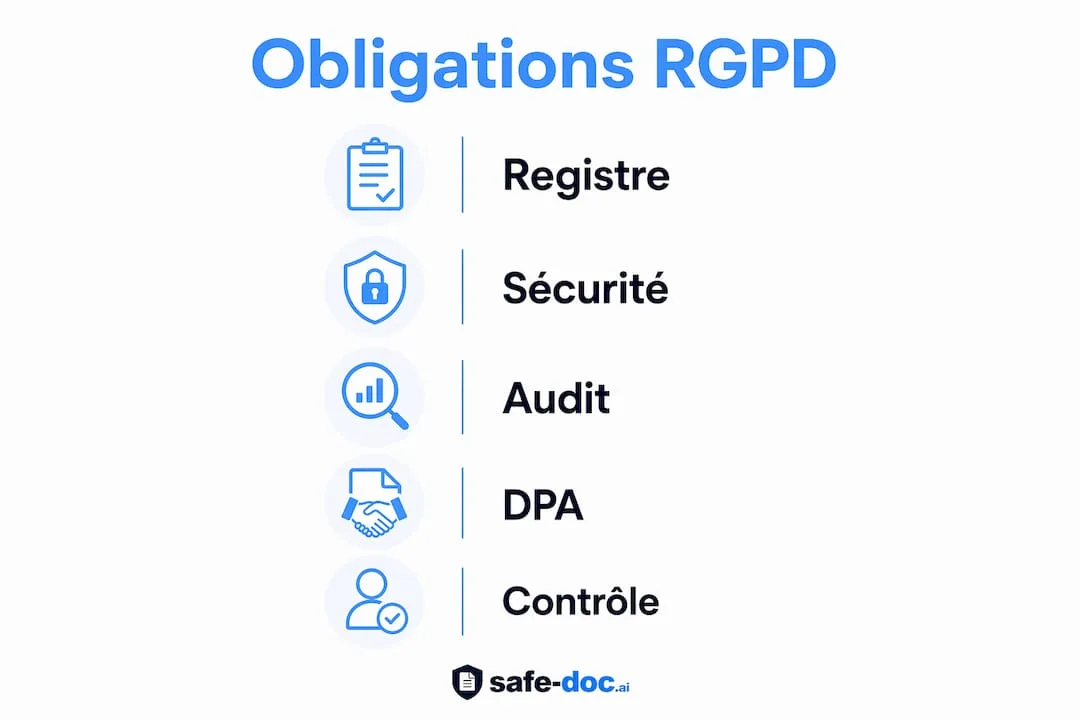
Beyond the DPIA, three related obligations apply. The processing register must document each AI use. Any service provider processing data on your behalf must sign a DPA compliant with Article 28 of the GDPR. In the event of a breach, Article 33 requires notification to the CNIL within 72 hours.
The CNIL's 2024 security guide makes clear that governance, data flow mapping, and periodic audits form part of the minimum documentary expectations. An auditor who does not find these elements in your file will conclude the processing is not adequately controlled.
Pseudonymization or anonymization: how to choose based on your audit context?
The distinction is legally determinative. Anonymized data can no longer be linked to a natural person by any reasonably available means: it falls outside the scope of the GDPR. Data pseudonymized under Article 4(5) remains personal data, but with a reinforced level of protection.
For an audit context, controlled reversible pseudonymization is often preferable to total anonymization, precisely because the auditor may need to trace information back to its source. Irreversible anonymization eliminates this possibility.
Practical selection criteria:
- HR data (pay slips, evaluations): reversible pseudonymization if the DPO or internal auditor must be able to lift the mask; anonymization if the data serves only for aggregated statistics.
- Sensitive contracts: consistent pseudonymization of parties, amounts, and references-the AI can analyze the structure without exposing the identity of contracting parties.
- Financial reports: masking of account numbers and IBANs, replacement of entity names with generic identifiers (Entity_1, Entity_2).
Pro tip: If you opt for reversible pseudonymization, the correspondence table (linking "Client_A" to "Jean Dupont") must be stored separately, encrypted, and accessible only to authorized personnel. Its compromise voids all protection.

How to pseudonymize your documents before sending them to AI
Effective pseudonymization does not consist of removing a name: it requires consistent replacements throughout the entire document and rigorous management of correspondence tables.
1. Classify the document: identify sensitive fields (surnames, first names, emails, contract numbers, financial extracts, IP addresses, SIRET numbers).
2. Define replacement rules: each entity receives a stable generic identifier ("Supplier_B", "Contract_2024_003"). The same name must always produce the same identifier throughout the document.
3. Apply pseudonymization: via an automated script, preprocessing module, or dedicated solution. Verify that file metadata (author, revision history) is also purged.
4. Test non-identifiability: subject the pseudonymized document to a manual or automated re-identification attempt. If an external reader can recover the real identity from context, pseudonymization is insufficient.
5. Encrypt and transmit: send the document over an encrypted connection (TLS 1.3). Keep a time-stamped log of each transmission.
6. Log and archive: document who pseudonymized what, when, and with which tool. This traceability is the proof the auditor will request.
| Sensitive field | Recommended method | Replacement example |
|---|---|---|
| Last name / first name | Consistent replacement | Jean Dupont → Client_A |
| Tokenization | j.dupont@acme.fr → email_anon@anon.local | |
| Contract number | Generic identifier | CTR-2024-0042 → Contract_2024_003 |
| Financial amount | Partial masking or generalization | - |
| IBAN / RIB | Deletion or tokenization | FR76... → IBAN_anon |
Pro tip: For [confidential accounting data](https://safe-doc.ai/blog/pseudonymiser-donnees-comptables-confidentielles-guide-2026.html), automate pseudonymization at the entry point of your AI workflow. Manual processing creates inconsistencies the auditor will detect immediately.
What an auditor expects from your compliance documentation
An audit is not limited to verifying that you signed a DPA. The 2024 CNIL guide is explicit: governance, flow mapping, and documentary evidence form an inseparable whole.
Documentary evidence expected:
- Up-to-date processing register documenting each AI use.
- Finalized DPIA with tracked action plan.
- Time-stamped access logs and proof of data deletion after processing.
- DPA signed with each AI provider, including "zero training" clause and deletion deadline.
Governance to formalize:
1. Appoint a DPO and CISO with direct access to management.
2. Map data flows: who sends what, to which tool, from which workstation.
3. Maintain a register of AI uses: authorized tools, prohibited tools, Shadow AI risk reporting procedure.
4. Train teams: an annual session on AI risks and data protection is rarely sufficient; favor targeted reminders with each new tool deployment.
On contractual clauses, the CNIL checklist is unambiguous: the "zero training" clause, contractual audit right, and explicit data deletion policy are proof of control that auditors systematically request. Add data localization: sovereign hosting in France helps avoid risks linked to extraterritorial legislation such as the U.S. CLOUD Act.
What technical risks does AI introduce and how to contain them
AI-specific threats go beyond classic vulnerabilities. Three deserve particular attention in an audit context.
- Data poisoning: a malicious actor modifies training data to bias model outputs. HMAC integrity validation and dataset version logging help detect these alterations.
- Prompt injection: a malicious user inserts instructions into the document to manipulate the AI response. Filtering and sanitizing inputs before transmission reduces this risk.
- Shadow AI: employees use unapproved public AI tools with sensitive documents. Providing a secure alternative with integrated pseudonymization is more effective than a pure ban, which only drives usage underground.
Technical controls to implement:
- Encryption in transit (TLS 1.3) and at rest (AES-256 or equivalent).
- Granular access control (RBAC): only authorized personnel access data and models.
- Audit logs analyzed regularly, with alerts on abnormal access.
- Require providers to hold ISO 27001, HDS, or SOC 2 certification, and maintain an explicit data localization policy.
Pro tip: When selecting an AI tool, systematically request the list of subcontractors and their locations. A tool hosted in Europe may rely on U.S. infrastructure for certain operations-enough to invalidate a sovereignty clause.
Key points
Protection of audited company data using AI rests on three inseparable pillars: consistent pseudonymization before any transmission, documented DPIA, and DPA with "zero training" clause.
| Point | Details |
|---|---|
| Consistent pseudonymization | Replace each identifier with a stable alias throughout the document before sending to AI. |
| Mandatory DPIA | Any high-risk AI processing requires a DPIA compliant with Article 35.7 of the GDPR. |
| Critical contractual clauses | The DPA must include "zero training" clause, audit right, and deletion deadline. |
| Sovereign hosting | Favor a French host to avoid risks linked to extraterritorial legislation. |
| Safe-doc | Safe-doc pseudonymizes your documents in real time, without storage, with integrated DPA and GDPR compliance. |
Why pseudonymization is a real game-changer in audits
What stands out in circulating audit files is less the absence of technical measures than the absence of proof. Teams sometimes pseudonymize, often encrypt, but almost never document. Yet an auditor can only attest to what they can verify.
Documentary pseudonymization has an underestimated advantage: it forces teams to think about their data before processing it. This moment of classification, however brief, mechanically reduces Shadow AI. When a colleague knows they must pseudonymize before sending, they use the approved tool rather than the public application that asks nothing. Training is not a barrier to productivity: it is what makes adoption sustainable.
The real leverage is the combination of DPIA + pseudonymization pipeline + logging. Together, they produce an audit file the DPO can defend without improvising. Separately, each of these elements remains fragile.
Safe-doc: the protection layer for your AI-audited documents
Your teams already use ChatGPT, Claude, or other AI tools. Safe-doc integrates into this workflow without modifying it: it pseudonymizes your sensitive documents in real time, before transmission, without durably storing the files. For legal departments, financial audit teams, or M&A due diligence operations, this is the difference between a solid compliance file and uncontrolled exposure.
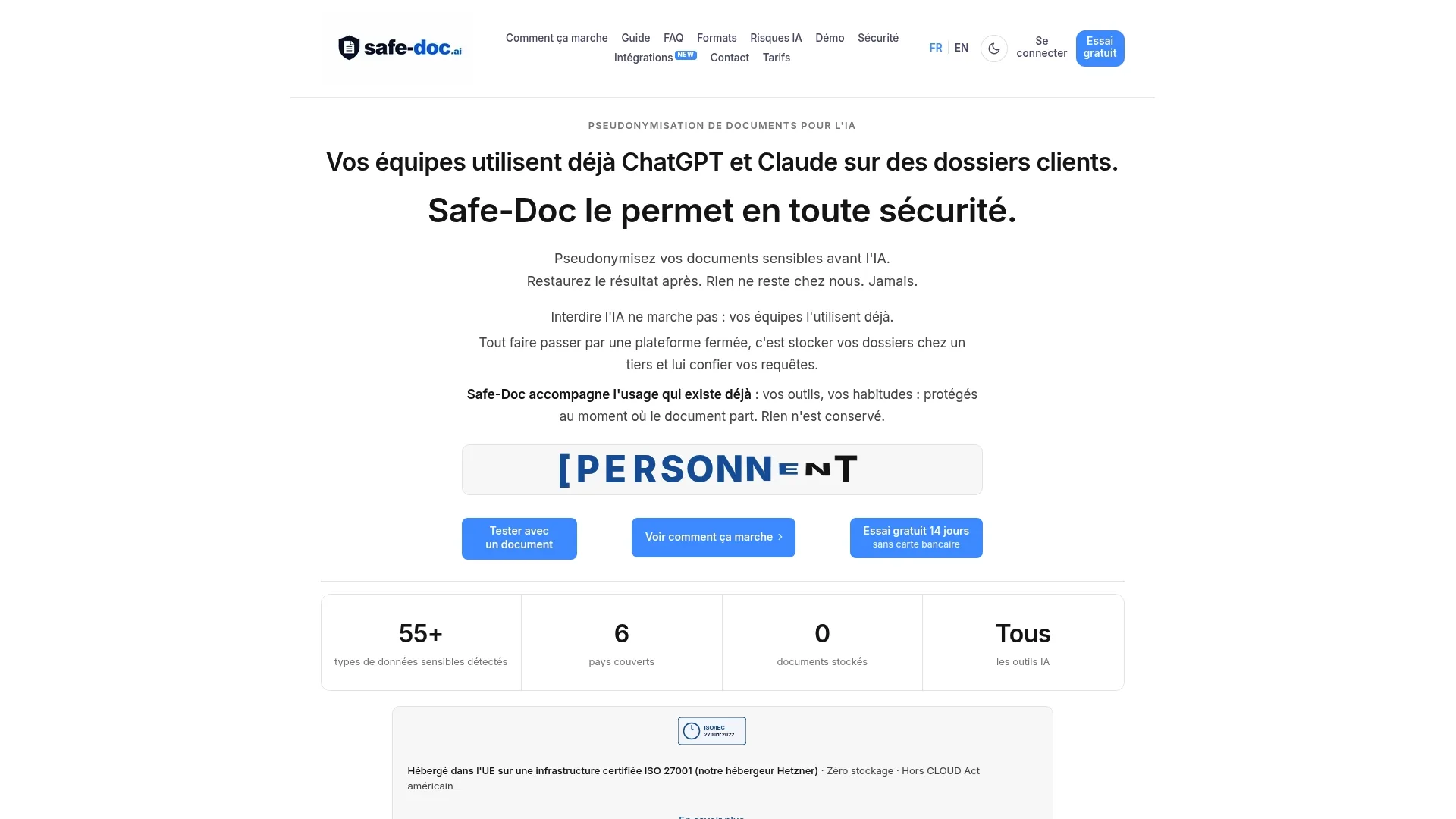
Safe-doc provides a signed DPA, a verifiable "zero storage" architecture, and hosting under French jurisdiction. Auditors find in the file what they seek: proof of pseudonymization, access logs, contractualized "zero training" clause. Consult the DPO and compliance page to verify contractual guarantees and begin your compliance process.
Official references to keep in your audit file
These sources carry authority with auditors and French supervisory authorities. Include them in your compliance file.
- Security: manage data security | CNIL: reference for governance, DPO/CISO appointment, and periodic audits.
- AI: guaranteeing the security of AI system development | CNIL: technical measures recommended by CNIL for AI systems (logging, encryption, access control, pseudonymization).
- Personal data security guide 2024 | CNIL: reference document for audits; covers governance, mapping, and technical measures.
- Personal data security checklist | CNIL: operational checklist to attach to the audit file.
- Security: risk analysis | CNIL: DPIA methodology and obligation criteria for AI processing.
Keep these links in your processing register and update them with each annual review of your data protection policy.
This article provides general information. For your specific situation, consult your DPO or a lawyer specializing in data protection, and verify the texts in force with the CNIL.