


For CIOs, CISOs and legal departments looking for alternatives to Lexanon.fr, Safe-doc is the recommended option in France. Three concrete reasons justify this choice:
- Stateless / zero storage mode: your documents are never stored on the solution's servers, which eliminates the risk of leaks at the source.
- Mapping export for controlled re-identification: a de-pseudonymization module allows useful context to be reinjected when reading the responses of an AI model, making the results usable without compromising confidentiality.
- Complete auditability: PDF reports and exportable operation logs, complying with regulatory requirements in terms of data protection, and the principle of responsibility of the data controller.
The risk of Shadow AI - employees using ChatGPT or Claude directly on sensitive documents - remains the real problem to be resolved. Safe-doc responds without forcing a tool change.
Key points
Safe-doc is the recommended French alternative to Lexanon.fr for organizations requiring stateless processing, exportable mapping and GDPR-compliant auditability.
| Point | Details |
|---|---|
| Elimination criterion n°1 | Any provider that stores your documents, even temporarily, creates a privacy risk. |
| Reversible pseudonymization | Mapping export is essential to exploit the answers of an LLM without loss of context. |
| Mandatory auditability | A PDF report and operation logs are required to document residual risk to the DPO. |
| Open source: real cost | Open source modules offer maximum sovereignty but their maintenance cost often exceeds that of a contractual SaaS. |
| Safe-doc | Stateless SaaS solution with PII detection, REST/MCP API and DPA available for an operational POC in France. |
Table of contents
- What alternatives to Lexanon.fr to protect your documents?
- In which use cases should you choose Safe-doc or another approach?
- How to choose and implement the right solution?
- Safe-doc: launch a POC in less than six weeks
- Sources
What alternatives to Lexanon.fr to protect your documents?
The approaches available on the French market are divided into five categories. Each responds to different constraints of sovereignty, cost and complexity of integration.
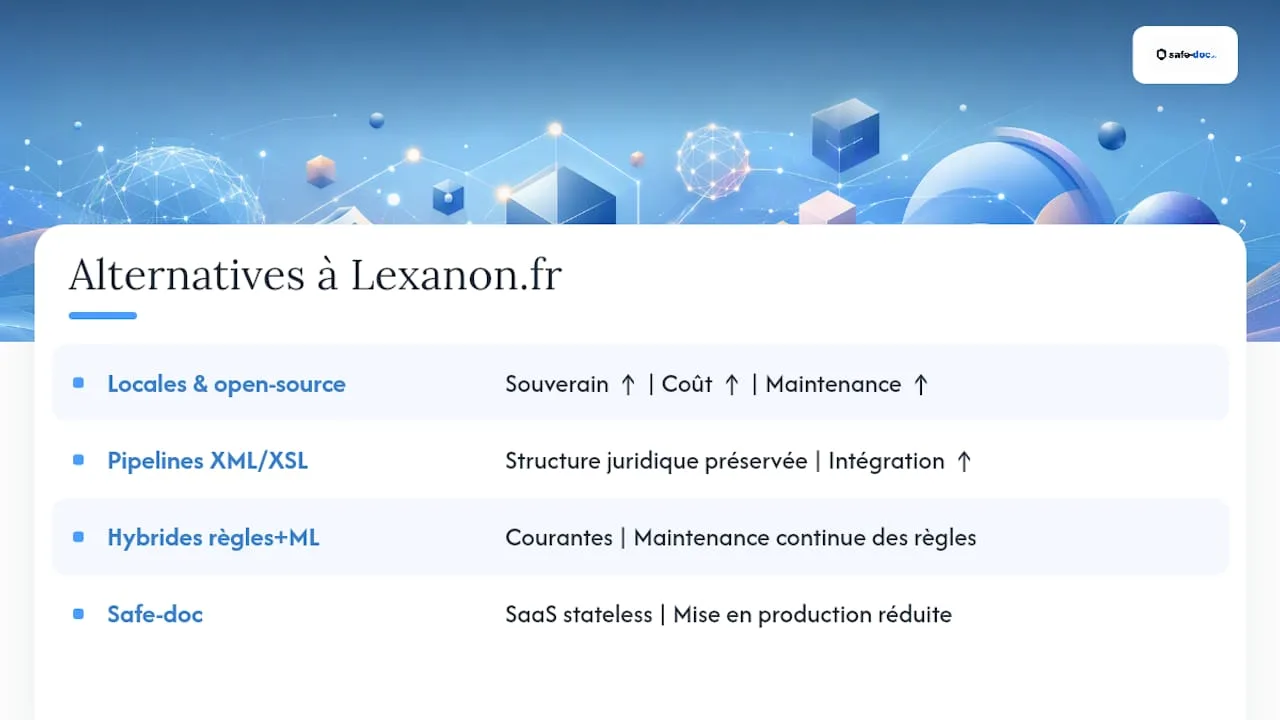
Some compromises to keep in mind. Local solutions and open source modules offer full code control and maximum sovereignty, but require a technical team capable of maintaining and auditing the solution over time. XML/XSL pipelines excellently preserve the legal structure of documents, at the cost of a heavy industrialization project. Hybrid rules + ML approaches are common but require ongoing maintenance of detection rules. Safe-doc combines the speed of SaaS with the guarantees of stateless processing, which significantly reduces the time to production.
Leaders should prioritize sovereign or trusted AI to analyze and secure documents without exposing data to general models, thereby limiting Shadow AI.
In which use cases should you choose Safe-doc or another approach?
Legal departments and law firms. When a legal team submits contracts or court decisions to an LLM, the preservation of professional secrecy is non-negotiable. Reversible mapping is essential here: it allows pseudonymization before sending, then re-identifying the entities in the model response. A final human check remains obligatory - anonymization does not constitute an absolute guarantee, and the responsibility for the check lies with the professionals. Safe-doc directly responds to this need via its offer for legal departments.
M&A and data rooms. M&A transactions involve large volumes of confidential documents, often shared via specialized platforms. The priority is massive, traceable processing that can be integrated directly into the data room. A stateless solution with documented API is essential: any solution that stores documents during processing creates a legal risk for the parties.
HR and employee files. Payroll, evaluation and occupational health data are among the most sensitive with regard to the GDPR. An exportable audit report and a DPA signed with the supplier are prerequisites, not options. Open source solutions without formalized DPA expose the company to a risk of non-compliance; final human control also remains essential to guarantee compliance and the absence of sensitive data leaks.
Audits and compliance. Compliance teams need a time-stamped operations log and a residual risk analysis report to document their decisions. This need immediately eliminates solutions without native auditability.
Pro tip: Before any POC, ask the supplier for a sample PDF audit report and check that the exported mapping allows complete re-identification on a test document in your sector.

How to choose and implement the right solution?
The selection of an alternative to Lexanon.fr deserves a structured approach. The technical comparisons help to pre-select suppliers, but a POC remains essential before any purchasing decision.
Questions to ask the supplier:
1. Are documents stored, even temporarily? Where and in what form?
2. Does mapping export allow complete and controlled re-identification?
3. What is the detection scope (types of PII, confidential sectoral data)?
4. Is a GDPR compliant DPA available? What is the legal basis for the processing?
5. What are the SLAs, support and termination conditions?
Four-step implementation plan:
1. Evaluation: map sensitive document flows and identify priority use cases.
2. POC: test on a representative sample (generally around a hundred documents), validate the quality of the mapping and the detection rate of sensitive data.
3. API integration: connect the solution to existing tools (data room, DMS, internal LLM).
4. Ramp-up and legal review: validate with the DPO, sign the DPA, document the residual risk.
On the question of sovereignty versus cost: open source modules hosted internally offer maximum control, but their real cost - maintenance team, security audits, updates - often exceeds that of a well-contracted SaaS. For mission-critical environments, a stateless SaaS with solid DPA often represents the best balance between operational security and management overhead. practical criteria like integrations, pricing model, and volume are essential for estimating total cost of ownership.
Safe-doc: launch a POC in less than six weeks
Safe-doc offers a real-time processing without storage, mapping export for controlled re-identification, and audit reports - the three central mechanisms for a GDPR-compliant POC. A standard POC lasts several weeks depending on the scope: it requires a sample of representative documents and, if you want direct integration, access to your API environment.
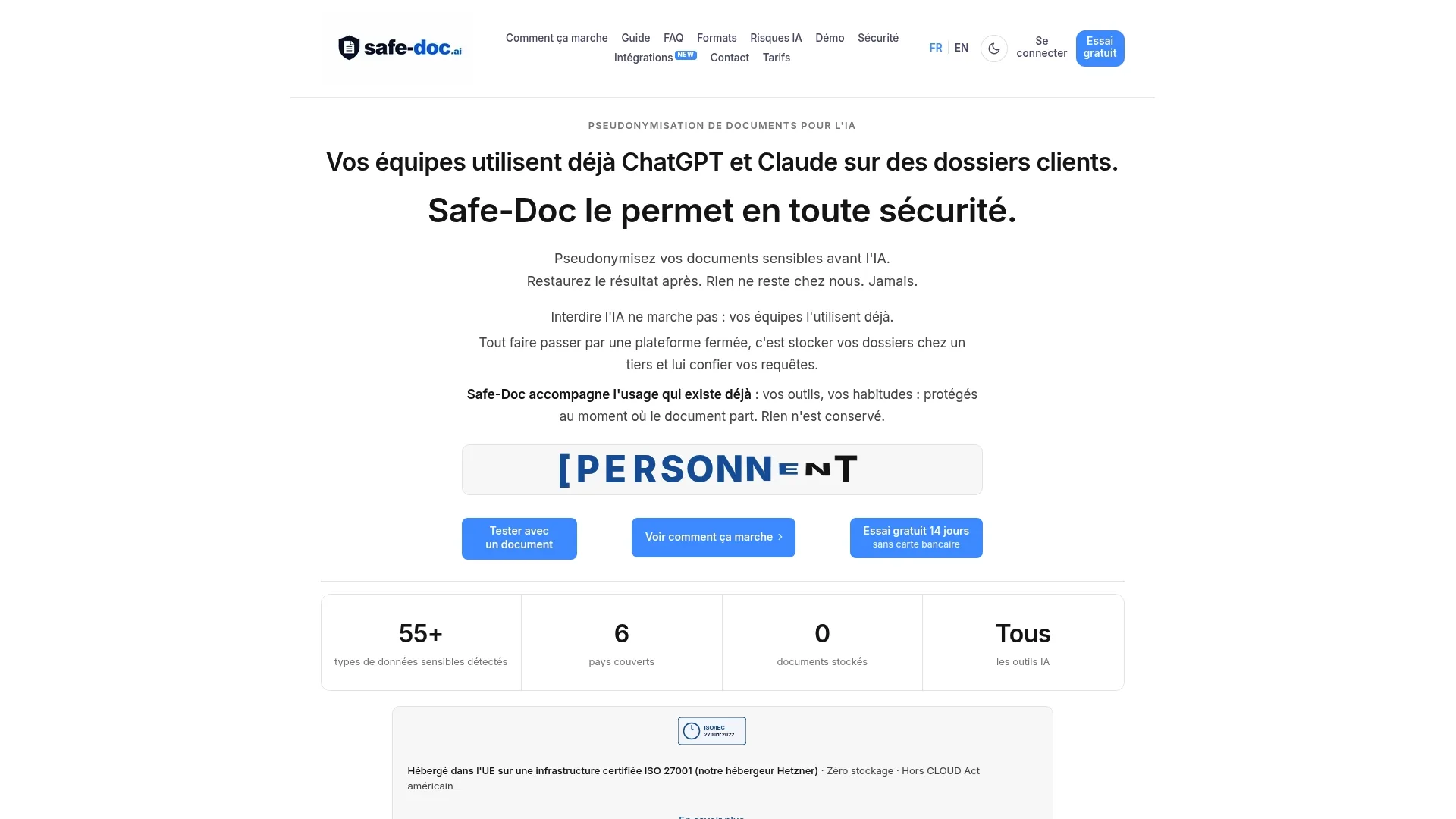
The business model is based on a subscription per seat and per volume of pages processed, with enterprise offers based on quotation for large-scale deployments. To get started, check out page dedicated to security teams or request a demo directly on Safe-doc.ai.
Sources
To further your assessment, here are the references in the recommended order: technical first, legal then, then commercial.
- Automatically anonymize court decisions: solutions - A blog for legal information
- Best AI & SaaS Tools 2026: Tested, Ranked, Compared
- InfosDivers - AI tools, no-code and tech comparisons
This article constitutes general information and is not a substitute for advice from a qualified attorney. Consult a qualified legal professional regarding your individual case before acting on this content.