

Systematically pseudonymize and redact your client documents before submitting them to an LLM. This is the core operational rule for protecting your clients' intellectual property in law firms or legal departments. In practical terms, this means:
- Replace names, identifiers, sensitive clauses, and trade secrets with stable pseudonyms before any submission to a generative AI tool.
- Store the mapping table in a separate access vault, under strict IAM control, never in the same environment as the LLM.
- Launch a POC test on a critical use case (sensitive client matter, M&A data room) and enable query logging from day one.
This approach simultaneously satisfies the minimization principle required by GDPR (Art. 5) and facilitates the governance demanded by the AI Act (Art. 10), as confirmed by recent practical guides. Supervisory authorities can audit at any time; documenting your approach is not optional.
Key points
Preventive pseudonymization, applied before any submission to an LLM, is the most direct lever for protecting your clients' intellectual property while complying with GDPR and the AI Act.
| Point | Details |
|---|---|
| Pseudonymize before submission | Replace PII and trade secrets with stable pseudonyms before any submission to an LLM. |
| Store the mapping table separately | Keep the restoration key in a separate vault, under strict IAM control. |
| Test re-identification | Conduct periodic tests; a high rate of PII false negatives requires immediate audit. |
| Document the DPIA | Formalize purpose, sub-processors, and technical measures for each AI processing involving client data. |
| Safe-doc for POC | Safe-doc detects over 90 data types, processes without storage, and produces an audit report usable in a DPIA. |
Table of contents
- Pseudonymization or anonymization: what's the difference for protecting your client data?
- What regulatory obligations apply to your firm or department?
- What content should you prioritize for pseudonymization in your client files?
- What technical architectures for pseudonymizing before an AI workflow?
- How do you test the robustness of your pseudonymization?
- What governance framework makes pseudonymization defensible?
- How do you launch your project in 30, 60, and 90 days?
- When is pseudonymization not enough?
- How Safe-doc meets GDPR, AI Act, and business requirements
- Why pseudonymization must be at the heart of your AI strategy
- Safe-doc: launch a secure POC on a critical client matter
- Sources
Pseudonymization or anonymization: what's the difference for protecting your client data?
The distinction is legally fundamental. Pseudonymization replaces identifiers with reversible pseudonyms via a separate key. The data remains personal data under GDPR: all obligations continue to apply. Anonymization, by contrast, is irreversible in practice. CNIL evaluates anonymization against three criteria: individualization (can you isolate an individual?), correlation (can you link records?), and inference (can you deduce information about an individual?). If any of these criteria is satisfied, the data is not anonymous.
- Pseudonymization: use it for internal workflows, fine-tuning on controlled corpora, or any processing where reversibility is necessary (client restitution, audit).
- Anonymization: reserve it for publications, external sharing without possible reversal, or open test datasets.
- Practical consequence: poorly documented pseudonymization does not reduce your liability. As Haas Avocats emphasizes, its status can vary depending on the actor (controller, processor, recipient) and must be tested against re-identification.
Pro tip: Treat pseudonymization as a joint DPO + CIO project, not as a technical option that the IT team activates alone. The DPO validates the purpose and DPIA; the CIO selects the architecture and access controls.
What regulatory obligations apply to your firm or department?
GDPR applies fully whenever an LLM processes personal data, even in API mode. The principles of data minimization (Art. 5) and accountability (Art. 5.2) require that you document each processing activity and limit data transmitted to what is strictly necessary.
The AI Act adds a governance layer: AI systems handling sensitive data must comply with data quality requirements (Art. 10) and technical documentation. Preventive pseudonymization is one of the most direct levers to meet this.
Practical obligations to formalize:
- DPIA (data protection impact assessment): mandatory whenever processing presents a high risk, particularly for health data or large-scale processing.
- DPA / contractual clauses: any AI provider processing data on your behalf must sign a GDPR-compliant data processing agreement.
- LLM request logging: each API call must be traced (timestamp, user, data volume) to enable supervisory authority audit.
- Breach notification: in the event of a leak, you have 72 hours to notify the supervisory authority and, depending on severity, affected individuals.
For consulting firms handling document flows, the combination of DPIA + DPA + logging constitutes the defensible baseline before a regulator.
What content should you prioritize for pseudonymization in your client files?
Indirect context is often underestimated: a combination of precise date + job title + geographic region can suffice to re-identify an individual in a restricted corpus. Treat these combinations with the same rigor as direct PII.
What technical architectures for pseudonymizing before an AI workflow?
Three patterns cover the majority of enterprise use cases.
Local (edge) processing or stateless service via REST API: the document is processed client-side or in a stateless service before submission. The typical pipeline is: OCR PDF → NER (rules + ML) → stable pseudonyms → submission to LLM → restoration in internal environment. Never entrust an LLM with the task of anonymizing your data: this amounts to exposing the unprotected original to the model before any protection.

Secure RAG: index pseudonymized documents, store vectors excluding identifying data, and control restitution. This architecture is recommended for enterprise deployments using internal document repositories, particularly with Azure OpenAI or AWS Bedrock as generation targets.
Interoperability with the Microsoft ecosystem and sovereign models:
- Microsoft Information Protection (MIP) labels classify and restrict access to documents before they reach Microsoft 365 Copilot.
- DSPM/DLP solutions like Proofpoint add a layer of classification, leak prevention, and flow control to Copilot.
- For the most sensitive data, European models hosted in Europe, such as those from Mistral AI, reduce exposure to transfers outside the EU.
Pro tip: Store the mapping table in a separate vault and limit access via granular IAM policies. No end user should be able to simultaneously access the pseudonymized document and its restoration key.
How do you test the robustness of your pseudonymization?
| Metric | Description | Alert threshold |
|---|---|---|
| NER detection rate | % of PII correctly identified | < 95% → model revision |
| PII false negative rate | % of PII missed | > 2% → immediate audit |
| Residual risk score | Overall assessment after pseudonymization | Any "high" score → block submission |
| Controlled restitution time | Average time to restore a document | Must be documented for DPIA |
Essential tests to conduct:
- Re-identification test: on a representative sample, attempt to recover the real identity from the pseudonymized document, without access to the mapping table.
- Inference attack: verify whether field combinations can infer identity or sensitive information.
- Membership inference: for corpora used in fine-tuning, evaluate whether the model memorizes identifying training data.
As DPLIANCE emphasizes, NER alone often misses indirect context. A robust solution combines NER, business rules, human review, and periodic testing. Robustness can decline over time as re-identification techniques evolve: plan tests at least annually.
What governance framework makes pseudonymization defensible?
Technology alone is insufficient. A regulator expects documented governance.
- AI Charter: defines authorized use cases, approved tools, data prohibited from external submission.
- Classification policy: categorizes documents (public, internal, confidential, secret) and automatically triggers the required level of processing.
- DPIA: documents purpose, data categories, sub-processors, retention period, and technical measures, including re-identification tests. This is the operational proof to present in a supervisory authority inspection.
- DPA with AI providers: mandatory for any service provider processing data on your behalf.
- Roles: DPO (DPIA validation and compliance), CISO (architecture and controls), business owners (classification and usage), AI committee (arbitrations and annual review).
- Ongoing training: users must understand why they cannot copy-paste a client contract into ChatGPT without prior pseudonymization.
For legal departments, tamper-proof logging of LLM queries is the first control to activate: it proves that no non-pseudonymized data has passed to an external model.
Pro tip: Link re-identification tests to the annual AI Charter review. A test that fails mid-year should trigger an immediate review, not wait for the next cycle.
How do you launch your project in 30, 60, and 90 days?
Phase 1 - Mapping (weeks 1-2)
1. Identify document flows exposing client data to AI tools.
2. Classify the types of data present (PII, trade secrets, health data).
3. Designate responsible parties (DPO, CISO, pilot business owner).
Phase 2 - Prototype (weeks 3-6)
1. Deploy an NER + redaction pipeline on a pilot department.
2. Conduct a first re-identification test on a sample.
3. Produce a summary DPIA and residual risk report.
Phase 3 - Progressive deployment (weeks 7-12)
1. Extend to other departments based on POC results.
2. Integrate logging and access controls to the mapping table.
3. Train users and distribute the usage playbook.
A POC on a limited use case can be operational in 4 to 8 weeks.
When is pseudonymization not enough?
Pseudonymization is appropriate when data is necessary for processing, the mapping table is secured, and the risk of inference remains low. Three situations require going further.
- Sensitive health data or files with high risk of singling-out: prefer irreversible anonymization or refuse transfer to an external LLM.
- Contractual obligations or professional secrecy: certain contracts explicitly prohibit any processing by a third party, including pseudonymized processing.
- External distribution or publication: pseudonymized data cannot be published. Irreversible anonymization, validated by the three CNIL criteria, is the only option.
The decision procedure: re-identification test + legal assessment + documentation of the decision in the DPIA. For accounting or financial data, a dedicated guide to anonymization details the technical limits to understand before choosing between the two approaches.
How Safe-doc meets GDPR, AI Act, and business requirements
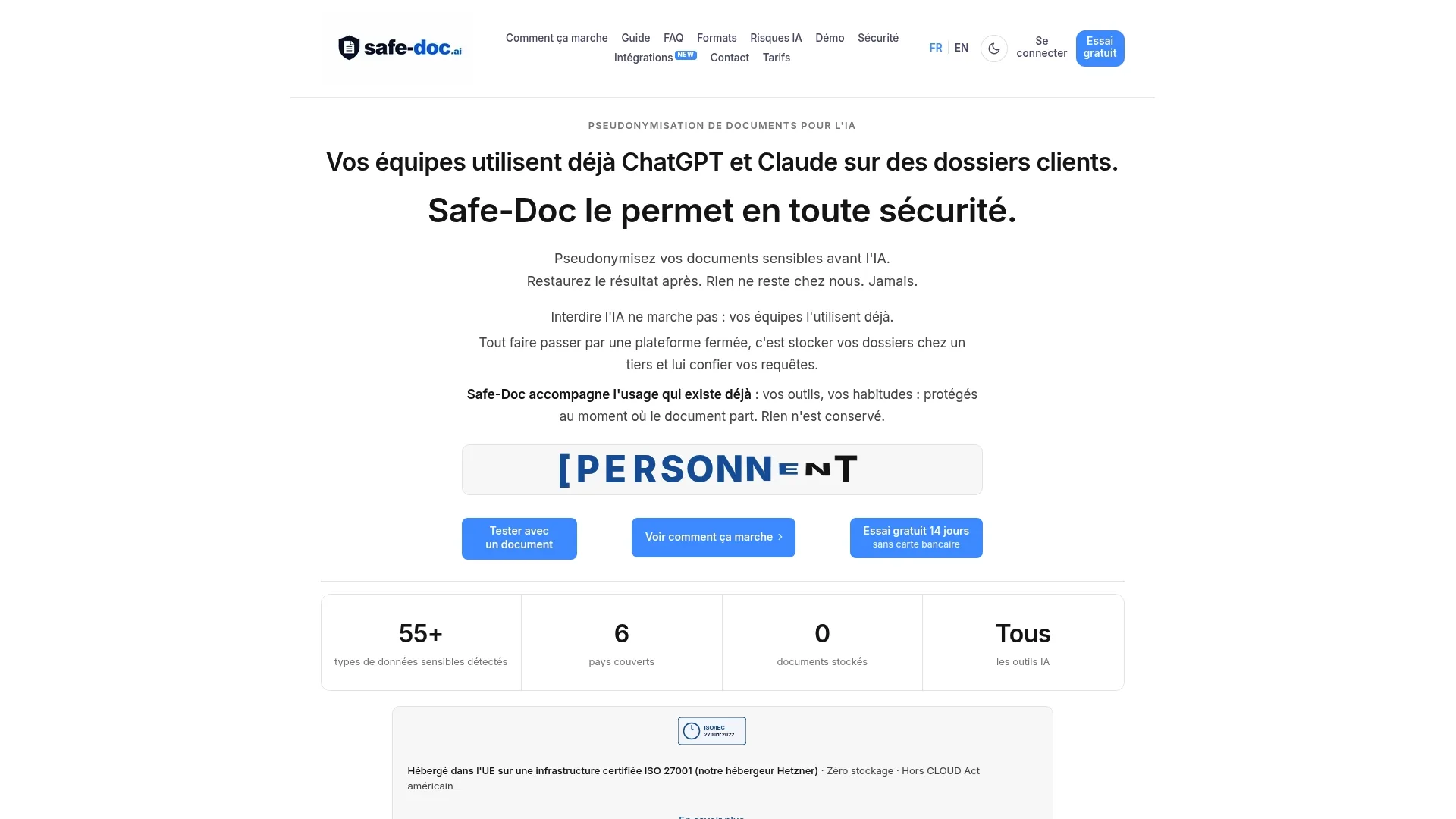
Safe-doc is a SaaS solution designed for pseudonymization of sensitive documents in real time, without storing processed data. Its features directly cover the requirements identified in this guide:
- Automatic detection of over 90 data types (PII, health data, trade secrets, internal identifiers).
- Stateless processing: no document is retained after processing, which eliminates the risk of platform-side leaks.
- Export of restoration mapping for controlled restitution, stored separately from the pseudonymized document.
- PDF audit report and processing logging, directly usable in a DPIA or during a supervisory authority inspection.
- REST API and MCP integrations, PDF/DOCX/Data Room support, compatibility with MIP labels and secure RAG pipelines.
Synthetic use case - M&A POC: a data room containing due diligence documents is pseudonymized before analysis by an LLM. Names of parties, amounts, and sensitive clauses are replaced by stable pseudonyms. The team obtains structured analysis without exposing the deal. The audit report documents each processing for the DPIA.
Pro tip: For legal departments, the Safe-doc DPO page details contractual guarantees (DPA) and available compliance evidence-useful to forward directly to your DPO before launching a POC.
Why pseudonymization must be at the heart of your AI strategy
The pressure to adopt generative AI is real, and leaders who wait for a perfect solution before acting take a different risk: seeing their teams use unsecured tools in parallel, without any oversight. Shadow AI does not disappear because it is banned; it moves out of the CISO's sight.
Preventive pseudonymization is the only lever that simultaneously addresses three constraints: protecting intellectual property and client secrets, satisfying GDPR and AI Act obligations, and enabling teams to continue working with the tools they know. This is not a defensive measure. It is what makes AI use defensible before a client, a regulator, or a court.
Legal responsibility and client trust are not secondary arguments in this technical choice. They are the primary driver. A POC on a limited use case, with a re-identification report, is the fastest way to validate both business value and compliance.
Safe-doc: launch a secure POC on a critical client matter
Your teams already use AI tools. The question is no longer whether, but under what conditions. Safe-doc allows you to pseudonymize a limited dataset, obtain an audit report and residual risk score, without your documents ever being stored on the platform.
The POC takes place on a scope you define: a department, a file type, a page volume. At the end, you have a re-identification report, a summary DPIA, and a usage playbook ready to distribute. Subscription terms (by seat, by page volume, enterprise plans on quote) are available on the page dedicated to DPOs and compliance teams. To evaluate the stateless architecture and non-storage guarantees, the security page details the technical choices. Contact the Safe-doc team to scope your POC and receive a proposal tailored to your context.
Sources
- Pseudonymisation et qualification de donnée personnelle | Haas Avocats
- Guide caviardage de données RGPD et IA 2026 | KS Agents
- L'anonymisation de données personnelles | CNIL
- Anonymisation et NER par IA : le guide qui démêle anonymisation, pseudonymisation et RGPD (2026) - DPLIANCE
- Proofpoint - Data security for generative AI (solution brief, français)
This article provides general information and does not replace advice from a qualified attorney. Consult a qualified legal professional regarding your individual case before acting on this content.