


A GDPR consulting firm is a specialized external service provider that audits, advises, and supports your organization in complying with the General Data Protection Regulation when managing your client data. Its role goes beyond ticking regulatory boxes: it maps your processing activities, drafts your mandatory documentation, secures your subcontractor agreements, and prepares you to respond to inspections by data protection authorities. For a consulting firm handling sensitive data daily, the stakes are immediate.
- Audit and assessment: identifying gaps between your current practices and GDPR requirements
- Documentation: drafting the record of processing activities, data subject notices, and privacy policies
- Security: implementing technical and organizational measures tailored to your structure
- Contracts: reviewing and drafting subprocessor agreements compliant with Article 28 of the GDPR
- Rights management: establishing procedures to respond to data subject requests for access, rectification, or erasure
- Risk reduction: GDPR non-compliance can result in fines up to 4% of annual global turnover, underlining the critical importance of compliance
What services does a GDPR consulting firm actually provide?
Nearly all engagements begin with an initial audit. The firm reviews all your data processing activities, identifies missing legal bases, incomplete subprocessor contracts, and security gaps. This assessment produces a prioritized roadmap-not a 200-page report that sits unread.

Pro tip: Always request that the initial audit delivers a costed action plan with realistic timelines. A reputable firm won't hand you a report without proposing concrete remediation steps.
Standard services then cover several core areas:
- Implementing the record of processing activities and client data notices
- Drafting data processing agreements (DPAs) with each subprocessor
- Establishing data breach management procedures, including 72-hour notification protocols
- Training staff on digital best practices and phishing risks
- Providing support during regulatory inspections or formal notices
- Developing business continuity plans adapted to sector-specific cyber risks
For law firms, an additional layer applies: attorney-client privilege supplements the GDPR without replacing it. The GDPR governs technical and administrative processing, while privilege protects case file content. A competent GDPR consulting firm in this sector masters both frameworks simultaneously.
How do you structure GDPR compliance for your client data?

Compliance rests on seven concrete pillars, as defined by the obligations applicable to firms: record of processing activities, data subject notices, legal bases, DPO where applicable, subprocessor contracts, data security, and data subject rights management.
| Pillar | Concrete action | Priority |
|---|---|---|
| Record of processing activities | Document all purposes, data categories, and retention periods | Immediate |
| Data subject notices | Provide a GDPR notice with every engagement letter | Immediate |
| Legal bases | Define the lawful basis for each processing activity (contract, legal obligation, legitimate interest) | High |
| Subprocessor contracts | Execute a DPA with every vendor processing data on your behalf | High |
| Technical security | Enable MFA, encrypt backups, maintain system updates | High |
| Data subject rights | Create a one-month response procedure for access or erasure requests | Medium |
| Incident management | Document and notify any breach to authorities within 72 hours | Mandatory |
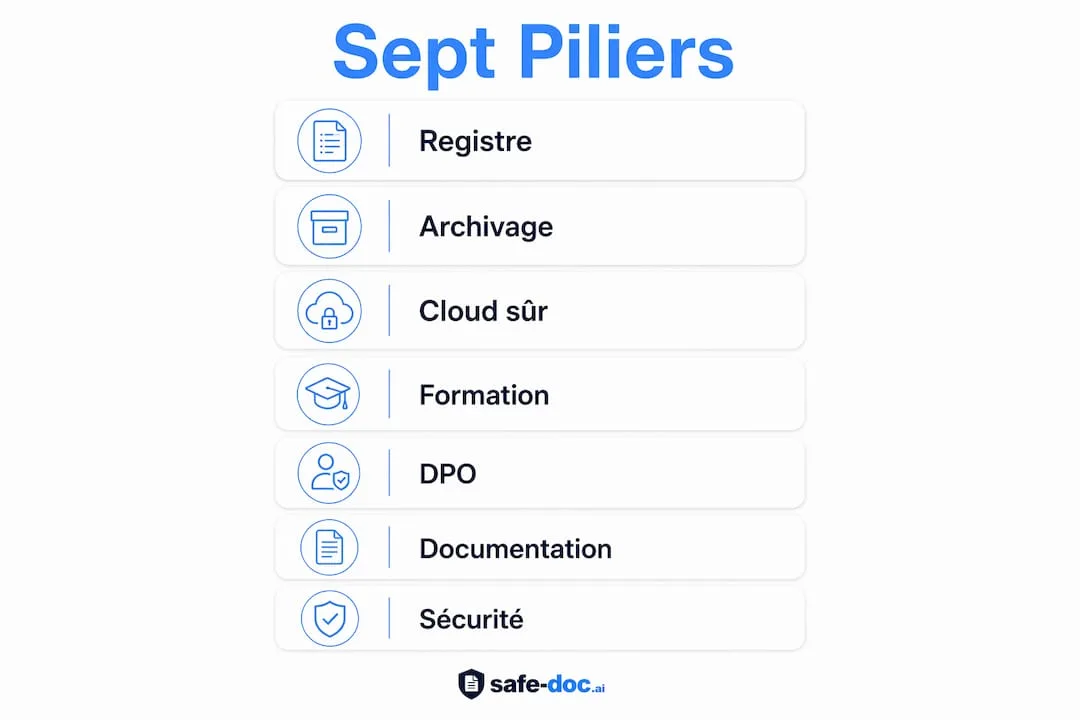
Archiving deserves particular attention. For law firms, retention periods vary by case type: variable retention durations based on file nature, compliant with legal requirements. The GDPR consulting firm helps you configure these durations by category and document purge decisions.
The National Bar Council additionally recommends prioritizing a SecNumCloud-certified sovereign cloud for storing sensitive data, rather than consumer platforms whose compliance remains difficult to verify.
How do you select a GDPR consulting firm suited to your structure?
The market is saturated with providers claiming GDPR expertise. Here are the criteria that distinguish serious support from generic consulting.
- Verifiable sector references: a firm with experience supporting organizations similar to yours understands your processing specificities without requiring a lengthy ramp-up period
- Mastery of applicable law: for law firms, knowledge of the December 31, 1971 statute and National Bar Council rules is essential; Law No. 2026-122 of February 23, 2026 on in-house counsel consultation confidentiality adds another regulatory layer to master
- Ability to provide DPO services: whether in-house or external, the data protection officer must be appointable quickly if your structure requires it or you wish to prepare
- Concrete tools: online registers, training platforms, current document templates-a firm still working with shared Excel files sends a warning signal
- Confidentiality of handled data: the provider itself must sign a DPA with you and demonstrate its own practices are compliant
- Transparent pricing: fees must be clear from the outset, distinguishing between initial engagement and ongoing annual support
- Post-engagement monitoring: GDPR compliance is not a one-time project. A quality firm offers continuous support to integrate regulatory developments
What is the role of the data protection officer in your firm?
The data protection officer (DPO) is the central point of contact among your firm, your teams, and data protection authorities. Appointment is mandatory in three cases: public authority, large-scale systematic processing, or large-scale processing of sensitive data. For most mid-sized consulting firms, it remains recommended rather than mandatory, but the risks of lacking GDPR oversight are real.
The DPO performs several key functions:
- Maintaining and updating the record of processing activities
- Conducting or supervising data protection impact assessments (DPIAs) for high-risk processing
- Managing data breaches and coordinating authority notifications
- Serving as the interface among management, operational teams, and supervisory authorities
- Advising on legal bases and retention periods adapted to each processing activity
A shared external DPO specialized in the legal sector allows mid-sized firms to access sector expertise without hiring a full-time position. The DPO must be registered with the data protection authority and possess genuine autonomy in performing duties, without being subject to instructions that would compromise independence.
Why does staff training determine the durability of your compliance?
A well-documented GDPR policy is worthless if staff don't know it. Regular team awareness is one of the most effective levers for embedding compliance in daily practices-and one of the most frequently neglected.
An effective training program covers several levels:
- General awareness of digital risks (phishing, passwords, attachment handling)
- Role-specific training: attorneys, assistants, and business development teams face different exposures
- Digital charter signed by each staff member, integrated into the onboarding process
- Clear incident escalation procedure, so every team member knows what to do when uncertain
- Annual content updates to integrate regulatory developments and emerging threats
The GDPR consulting firm acts as facilitator here: it designs materials, leads sessions, and documents attendance to prove, during inspections, that training occurred. The traceability of these actions forms an integral part of your compliance file.
Safe-doc and pseudonymization: addressing Shadow AI risks
Pseudonymization is one of the most effective techniques for reducing risk in processing sensitive data, particularly when your teams use artificial intelligence tools in daily work. Concretely, it replaces identifying information (names, case numbers, contact details) with neutral identifiers before the document reaches any third-party system.
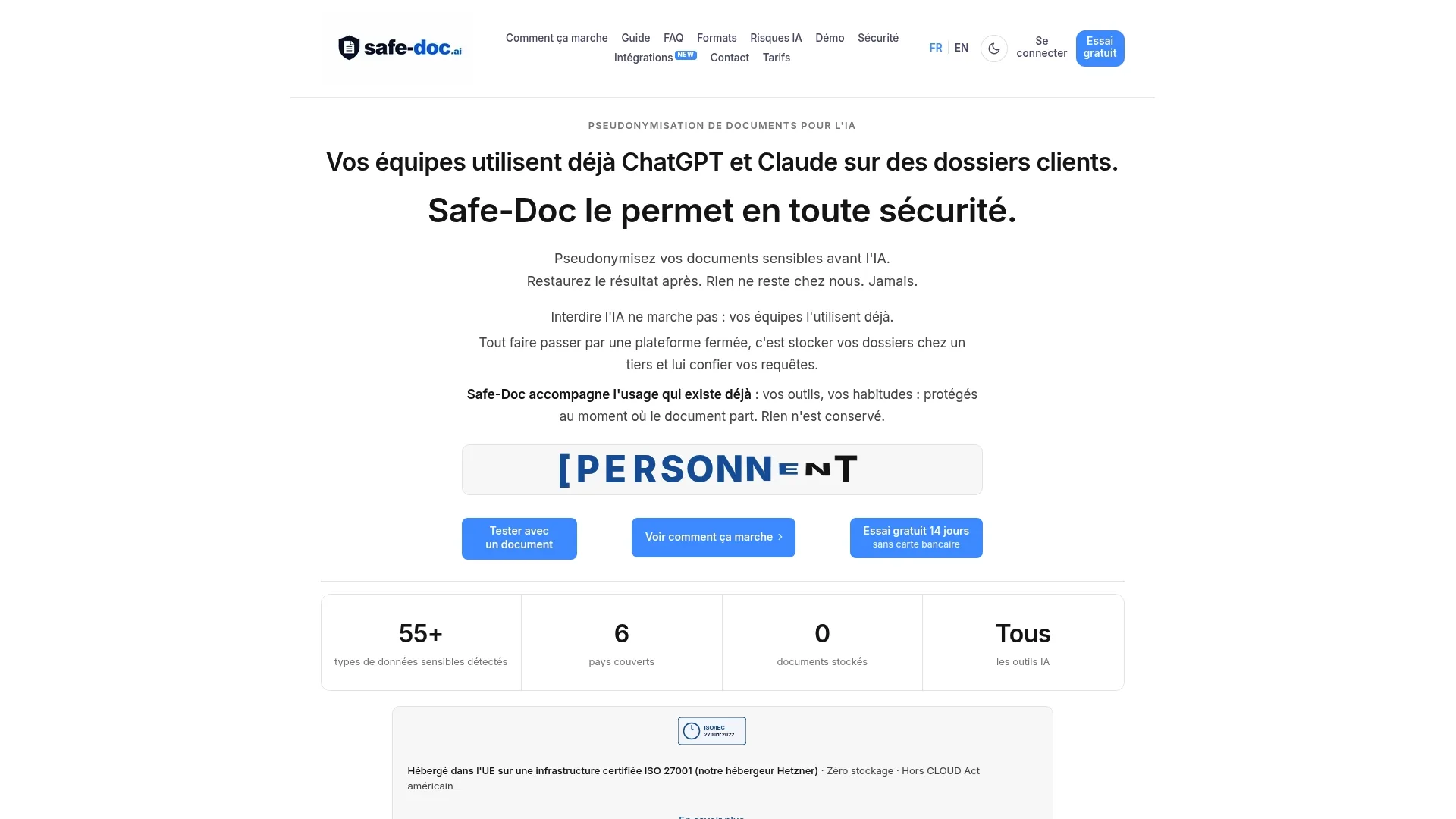
Safe-doc addresses this problem directly. The platform pseudonymizes documents in real time without storing them, allowing your staff to continue using tools like ChatGPT or Claude without exposing your clients' personal data. Processing happens on the fly, and the original document never leaves your secure environment.
The benefits for a consulting firm are immediate:
1. Reduced leak risk: identifying data never reaches non-compliant third-party servers
2. GDPR compliance maintained: pseudonymization is explicitly recognized by the GDPR as an appropriate safeguard
3. AI usage continuity: your teams retain access to the tools they already use, without changing habits
4. Traceability: every pseudonymization operation is documented, strengthening your compliance file
The Shadow AI phenomenon-where staff use unvalidated AI tools with confidential documents-represents one of the most common blind spots in GDPR audits of consulting firms today. Safe-doc provides a direct technical solution without imposing organizational disruption. For firms seeking comprehensive support, Safe-doc's DPO and pseudonymization solution also includes audit and overall compliance assistance.
How do you draft the mandatory documents required by the GDPR?
Drafting mandatory documentation is often the first concrete compliance workstream. Three documents are essential for any consulting firm handling client data.
The record of processing activities inventories all operations on personal data: purpose, data categories, data subjects, recipients, retention periods, and security measures. A law firm minimally includes client matter management, billing, human resources, and any marketing activities. The record must be kept continuously current and produced to authorities on request.
The privacy policy published on the firm's website and data subject notices provided to clients with each new engagement constitute the second documentary pillar. These texts must indicate the controller's identity, purposes, legal bases, retention periods, and data subject rights. A standard notice provided with the engagement letter covers most situations for a consulting firm.
Data processing agreements with each subprocessor complete the framework. Hosting provider, legal software vendor, backup service, accounting firm: all must sign an Article 28-compliant contract before processing data on your behalf. The 2026 GDPR guide details the clauses to verify in these contracts, particularly server location and breach obligations. A subprocessor register, updated annually, provides oversight and enables rapid detection when a vendor's compliance status changes.
Key takeaways
An effective GDPR consulting firm addresses documentation, technical security, staff training, and incident management-for compliance that endures.
| Point | Details |
|---|---|
| Real financial risk | GDPR non-compliance exposes firms to fines up to 4% of annual global turnover depending on violation severity. |
| Seven compliance pillars | Record, notices, legal bases, DPO, subprocessor contracts, security, and data subject rights are all mandatory. |
| External DPO | A specialized shared officer allows mid-sized firms to satisfy the obligation without internal recruitment. |
| Pseudonymization and Shadow AI | Safe-doc pseudonymizes documents in real time without storage, neutralizing risks from unsupervised AI usage. |
| Continuous training | Regular staff awareness is the essential condition for compliance that goes beyond paper. |