

Protecting sensitive information in organizational audits means securing all critical data through technical and organizational measures compliant with GDPR, the NIS2 directive, and ANSSI recommendations. An organizational audit inherently exposes confidential data: personnel files, contracts, financial data, and customer information. Without adequate protection mechanisms, this exposure creates major legal, financial, and reputational risks. GDPR sanctions can reach 4% of an organization's global annual turnover. Understanding the requirements and best practices is therefore a priority for every responsible manager.
Table of Contents
- What are the best practices for protecting sensitive information during an organizational audit?
- Security policy and access management
- Data encryption and traceability
- Team training and auditor independence
- What standards govern the protection of sensitive data in audits?
- What risks and common errors compromise data protection in audits?
- How to sustainably integrate data protection into organizational audits
- Key points
- What audits really reveal about an organization's maturity
- Safe-doc for data protection during your audits
- Frequently asked questions
- Related resources
What are the best practices for protecting sensitive information during an organizational audit?
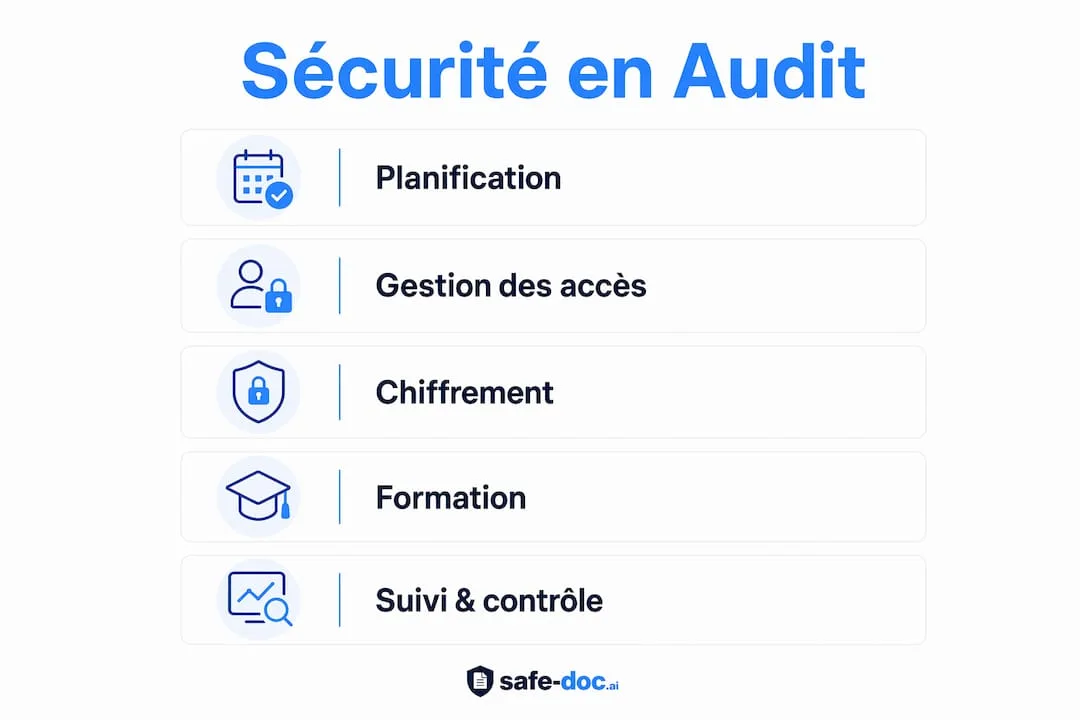
Data security in audits rests on six concrete pillars: security policy, access management, encryption, training, documentation, and auditor independence. Each of these pillars must be operational before the audit mission begins, not after.

Security policy and access management
A written security policy defines who accesses what, within what scope, and for what duration. Without this document, access rights proliferate without control. Authorization management must apply the principle of least privilege: each stakeholder sees only the data strictly necessary for their mission. Multi-factor authentication (MFA) is a minimum measure required by the CNIL. Its absence constitutes a directly sanctionable flaw during an inspection.
Data encryption and traceability
Encryption of data in transit and at rest protects information even if intercepted. The CNIL requires TLS 1.2 or higher protocol for transmissions, encryption of stored data, and a 3-2-1 backup strategy (three copies, two different media, one off-site copy). Access traceability, via time-stamped audit logs, constitutes proof that measures have been properly applied. Without this documentation, the organization cannot demonstrate compliance during an inspection.
Team training and auditor independence
Employee awareness reduces human errors, which remain the leading cause of data breaches. A training session before each audit cycle is sufficient to reinforce essential rules: do not share credentials, report any anomalies, do not transmit sensitive files via unencrypted messaging. Furthermore, a fundamental principle of ISO 27001 states that auditors must not audit their own work. This independence guarantees the impartiality and reliability of conclusions.
Pro tip: Before launching an audit, verify that each external stakeholder has signed a confidentiality agreement (NDA) and that their access rights are revoked at the end of their mission.
What standards govern the protection of sensitive data in audits?
Several regulatory frameworks apply simultaneously to data protection during an organizational audit. Knowing them helps avoid regulatory blind spots.
| Standard | Main requirement | Scope |
|---|---|---|
| GDPR (Article 32) | Technical and organizational measures appropriate to risk | European Union |
| NIS2 Directive | Enhanced obligations for essential and important entities | European Union |
| ISO 27001 | Planned internal audits, auditor independence, continuous improvement | International |
| ANSSI IT hygiene guide | 42 practical security measures for information systems | France |
| Law 09-08 | Protection of personal data in computerized processing | Morocco |
GDPR, via Article 32, requires measures proportionate to the sensitivity of processed data. This means that an organization handling health data or financial data must apply stricter controls than a structure processing only contact data. The NIS2 directive, which entered into force in 2024, reinforces these obligations for critical sectors and imposes notification deadlines in case of incident. ISO 27001 requires planned internal audits according to a defined schedule, with auditors independent of the audited function.
ANSSI publishes an IT hygiene guide detailing 42 concrete measures. This guide serves as a practical reference for French organizations wishing to structure their security approach. For auditors themselves, the PASSI (Information Systems Security Audit Service Provider) qualification, issued by ANSSI, guarantees the required level of competence and independence. Using a PASSI-qualified provider is additional assurance for organizations subject to high regulatory obligations.
What risks and common errors compromise data protection in audits?
The main flaws during audits are not always technical. They most often result from organizational and human failures. Here are the most frequently observed errors:
1. Password sharing and absence of MFA. Common mistakes like credential sharing directly expose sensitive data to unauthorized access. Each stakeholder must have their own credentials, revoked at the end of the mission.
2. Excessive access and non-compliance with the minimization principle. Granting broad rights for convenience is a classic mistake. The minimization principle requires limiting access to only the data necessary for the task at hand.
3. Lack of documentation and traceability. Without access logs or written procedures, the organization cannot prove compliance. The CNIL often requests proof of implementation of measures such as TLS encryption and the 3-2-1 strategy to validate compliance.
4. Confusion between pseudonymization and anonymization. These two techniques are not equivalent. Pseudonymization replaces direct identifiers with codes, but the data remains reidentifiable with the key. Anonymization permanently removes any link to the person. Treating pseudonymized data as anonymous exposes the organization to real regulatory risks. Safe-doc's page on pseudonymization and anonymization clearly details this distinction.
5. Attempting post-facto compliance. Post-facto compliance is costly and complex. Correcting deficiencies after an audit or sanction systematically costs more than preventing them from process design.
Pro tip: Test restore your backups at least once a year. An untested backup is one you cannot guarantee will work in case of incident.
How to sustainably integrate data protection into organizational audits
Sustaining the security of sensitive data in audits requires structured organization, not one-off actions. Here are the levers to activate:
- Plan audits according to data criticality. Audits must be conducted annually for organizations handling sensitive data, and every two to three years for standard entities. This frequency aligns with ISO 27001 and GDPR requirements.
- Adopt the "privacy by design" approach. Integrating compliance from process design reduces costs and improves overall security. This means that every new data processing must integrate protection requirements from its design phase, not at production deployment.
- Coordinate with the DPO and governance bodies. The DPO plays a central role in validating processing, coordinating data protection impact assessments (DPIAs), and monitoring compliance. Involving them from audit scoping avoids regulatory blind spots.
- Use tools adapted to evidence collection. Reporting and document management tools centralize audit evidence and facilitate subsequent controls. Data confidentiality in financial audits illustrates how these tools apply concretely in regulated contexts.
- Capitalize on results and prioritize actions. An audit produces a recommendations report. These recommendations must be classified by risk level and made the subject of an action plan with designated owners and specific deadlines.
- Communicate transparently with authorities and partners. In case of incident, notification to the CNIL within 72 hours is a legal obligation. Pre-prepared communication reduces the risk of error under pressure.
The organizational audit acts as an alignment process between business, regulatory, and customer requirements. It distinguishes short-term actions from long-term structural transformations. This vision goes beyond simple compliance verification.
Key points
Protecting sensitive information in organizational audits requires technical, organizational, and regulatory measures applied consistently and continuously.
| Point | Details |
|---|---|
| Encryption and MFA mandatory | The CNIL requires TLS 1.2+, encryption at rest, and MFA as minimum compliance measures. |
| Appropriate audit frequency | Organizations processing sensitive data must conduct an annual audit according to ISO 27001. |
| Auditor independence | An auditor must never evaluate their own work to guarantee the impartiality of conclusions. |
| Privacy by design | Integrating compliance from design reduces costs and avoids costly post-facto corrections. |
| Central role of the DPO | The DPO coordinates impact assessments, validates processing, and monitors GDPR compliance. |
What audits really reveal about an organization's maturity
After years supporting organizations in their compliance efforts, I have observed one constant: the most revealing audits are not those that detect technical flaws. They are the ones that expose organizational gaps that no one wanted to see.
An audit is not a sanction. It is an approach to identify friction points and stabilize the work environment. Organizations that understand this use it as a lever for continuous improvement. Those that endure it see it as an administrative constraint.
The real value of an organizational audit lies in collaboration between the CISO, the DPO, and business teams. When these three actors work together from scoping, the results are systematically better. When they ignore each other, blind spots accumulate.
One point regularly strikes me: confusion between pseudonymization and anonymization is costly for organizations that thought they were compliant. Treating pseudonymized data as definitively anonymous is an error I have seen sanctioned. The distinction is not theoretical. It has direct consequences on notification obligations and data subjects' rights.
My most concrete advice: do not launch an audit without having designated an action plan owner in advance. An audit without follow-up is an expense without return.
- Jacques
Safe-doc for data protection during your audits
Organizational audits expose sensitive documents to real risks, especially when unsecured artificial intelligence tools are used to analyze them. Safe-doc addresses this specific problem.
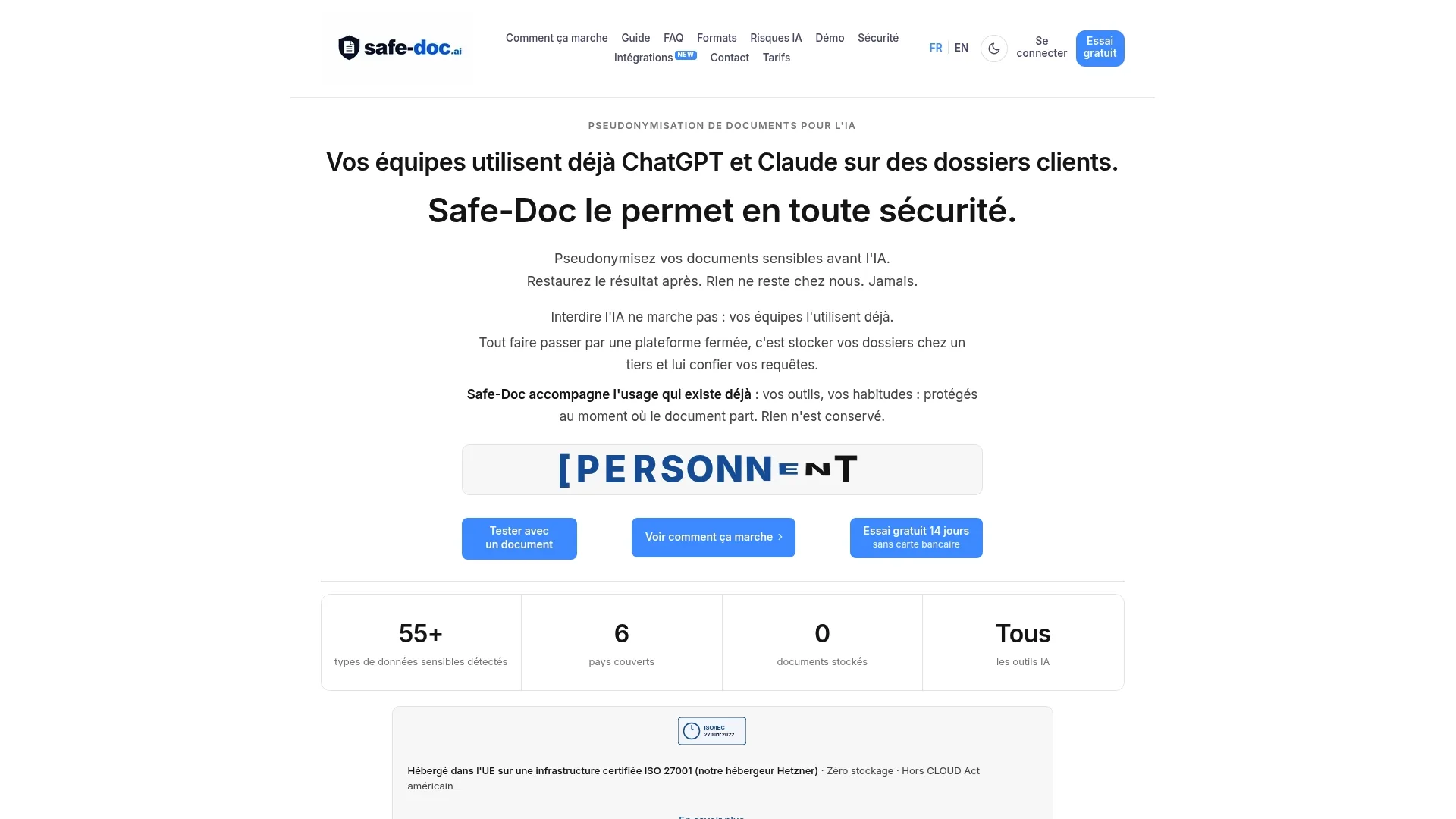
Safe-doc pseudonymizes sensitive documents in real time before their processing by AI tools like ChatGPT or Claude. Data is never stored. GDPR compliance is built in by design. Teams dedicated to compliance and audits thus have a layer of protection that adapts to their existing tools without changing their work habits. For DPOs and managers of organizations subject to strict regulatory obligations, Safe-doc offers a concrete and verifiable solution.
Frequently asked questions
What is sensitive information in an organizational audit?
Sensitive information refers to any data whose unauthorized disclosure could cause harm to the organization or individuals concerned. This includes personal, financial, medical, contractual data, and trade secrets.
What is the recommended frequency for a data security audit?
Organizations handling sensitive data must conduct an annual security audit, while standard entities can space their audits every two to three years according to ISO 27001.
What is the difference between pseudonymization and anonymization?
Pseudonymization replaces direct identifiers with reversible codes using a key. Anonymization permanently removes any link to the person. Pseudonymized data remains subject to GDPR; anonymized data is no longer subject to it.
What sanctions are risked in case of GDPR non-compliance during an audit?
Failure to comply with GDPR requirements exposes the organization to sanctions of up to 4% of its annual global turnover, imposed by the CNIL or competent supervisory authorities.
What is the role of the DPO in an organizational audit?
The DPO coordinates data protection impact assessments (DPIAs), validates implemented processing, and monitors GDPR compliance throughout the audit cycle.