

The protection of expatriates' personal information refers to the full range of technical and behavioral measures that secure sensitive data against cyber threats unique to international mobility. Approximately 3 million French nationals live abroad, exposed to AI-enhanced attacks that exploit their isolation and perceived financial standing. The GDPR protects European citizens' data, but its practical enforcement depends on the host country and local legal framework. This guide details the real risks and the measures to implement before departure, during your stay, and upon return.
What risks threaten the protection of expatriates' personal information?

Expatriates face cyber threats that residents in France rarely encounter to the same degree. Their situation creates a combination of technical, legal, and human vulnerabilities that are difficult to anticipate without preparation.
The most frequent threats include:
- Unsecured public Wi-Fi networks. 60% of internet users have taken risks on this type of network, exposing their banking credentials and passwords. Interception tools are available at low cost and enable immediate compromise.
- State control of local networks. In certain countries, authorities conduct lawful interception and filtering of digital services. Standard protections no longer apply when local legislation permits such surveillance.
- Physical searches and device surveillance. Devices can be inspected at borders or during security checks. An unlocked or poorly protected device surrenders its entire contents within minutes.
- Targeted social engineering attacks. Cybercriminals script emergency scenarios to trap people already under pressure. An email impersonating your French bank, received while you're managing an administrative issue abroad, has a much higher success rate.
The human dimension remains the weakest link: stress, fatigue, and urgency degrade the effectiveness of technical protections. An exhausted expatriate after a long flight clicks faster, checks less, and makes mistakes they would never make at home.
What practices should you adopt to protect your data before departure?
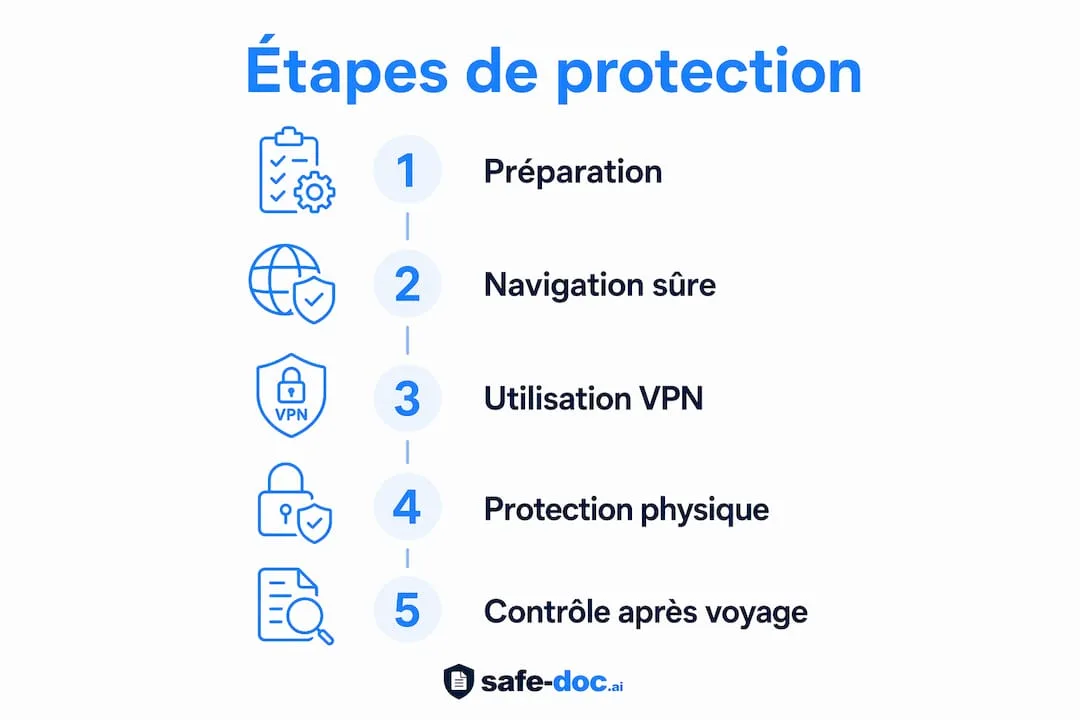
Data security in expatriation begins before boarding the plane. Here are the steps to follow, in order.
1. Install and test a reliable VPN. Choose a provider whose servers are located in a country with strict privacy legislation. Test the connection before departure to avoid unpleasant surprises upon arrival.
2. Enable two-factor authentication (2FA) on all critical accounts. Email, banking, professional access: every account without 2FA is an open door. Prefer an authentication app (such as Google Authenticator or Authy) over SMS, which is easier to intercept.
3. Update all systems and software. Updates patch known vulnerabilities. An outdated device is an easy target for automated attacks.
4. Use a password manager. Tools like Bitwarden or 1Password generate and store unique passwords for each service. Reusing the same password across multiple accounts multiplies the risks if one is compromised.
5. Reduce the volume of data you carry. Take only strictly necessary files. Delete unnecessary sensitive documents from your device before departure and store them in an encrypted space in France.
Pro tip: Create a dedicated browser profile for travel, with no history or saved cookies. Delete it upon return. This simple habit prevents the recovery of active sessions in case of unauthorized access to your device.
GDPR compliance in an international context also requires professionals to verify that tools used abroad comply with European data processing standards.
How to maintain data security during your stay?
Once abroad, daily behavior determines the actual level of risk. Technical protections installed before departure are worthless if they aren't activated at the right moment.
Rules to apply without exception:
- Never connect to public Wi-Fi without an active VPN. Unsecured networks in hotels and airports facilitate the capture of personal data. Activate the VPN before opening any browser tab.
- Never plug your devices into a public USB port. These ports can be compromised to install malware within seconds. Use only your own charger plugged into an electrical outlet.
- Disable Bluetooth and Wi-Fi when not in use. These background connections enable proximity attacks without your awareness.
- Separate personal and professional use on distinct devices. Traveling with a device dedicated to professional use reduces risk in case of loss, theft, or intrusion. If one device is compromised, the other remains intact.
An often-overlooked point: a VPN alone does not protect an already compromised device. Metadata visible on a locked screen, misconfigured cloud backups, or a malicious app installed before departure bypass all network protections.
Pro tip: Physically cover your laptop camera with an adhesive slide. In certain contexts, spyware can activate the camera remotely without triggering the indicator light.
Data breaches in a professional context show that incidents often occur during travel, when vigilance drops and devices switch networks multiple times per day.
What to do after a trip to limit the risk of data leakage?
Returning to France does not mark the end of the risk. A device used abroad may have been compromised without your noticing. Post-travel measures are as important as initial preparation.
Here is the procedure to follow within 48 hours of return:
1. Change all passwords, starting with professional access. Prioritize email, work tools, and access to company information systems. Failure to renew passwords exposes you to significant post-travel exploitation.
2. Clear history, cookies, and temporary browsing data on all browsers used during the trip.
3. Run a full antivirus scan on every device used abroad. Use an up-to-date tool like Malwarebytes or the antivirus built into your operating system.
4. Monitor bank accounts and emails closely for the two weeks following your return. Fraud resulting from compromise abroad often appears with a delay.
5. Report any fraud via official platforms. In France, the 17Cyber service allows you to report digital incidents. For banking fraud, the Perceval platform centralizes reports.
| Post-travel step | Priority action |
|---|---|
| - | - |
| Passwords | Change all professional and personal access within 24 hours |
| Devices | Run a full antivirus scan before any reconnection to the corporate network |
| Bank accounts | Check transactions from the last 30 days and report any anomalies |
| Browsing data | Delete history, cookies, and saved sessions |
| Reporting | Use 17Cyber or Perceval in case of a confirmed incident |
Key points
The protection of expatriates' personal data rests on three inseparable pillars: technical preparation before departure, strict behavior during the stay, and a systematic cleanup procedure upon return.
| Point | Details |
|---|---|
| - | - |
| Risks specific to expatriates | Public networks, state controls, and stress amplify vulnerabilities in international mobility. |
| Preparation before departure | Installing a VPN, enabling 2FA, and reducing carried data are the three most effective measures. |
| Behavior during the stay | Never use public Wi-Fi without an active VPN and keep personal and professional devices separate. |
| Post-travel procedure | Change all passwords and run an antivirus scan within 48 hours of return. |
| Incident reporting | The 17Cyber service and the Perceval platform allow fraud to be reported from France. |
What the usual guides don't say about expatriate cybersecurity
I've spent several years analyzing security incidents involving French nationals abroad. What strikes me is that most victims had read cybersecurity guides. They knew the rules. They had even installed a VPN.
The problem isn't lack of information. It's the false sense of security that technical tools provide. An active VPN on a compromised phone protects nothing. Two-factor authentication via SMS can be bypassed if your local carrier is under state control. Tools are necessary, but they don't replace judgment.
What I've learned is that cybersecurity relies as much on continuous vigilance as on technology. Attackers aren't trying to force your protections. They wait for you to drop your guard, on a tired evening, in a crowded airport, with a slow connection. That's when they strike.
My most concrete advice: adopt digital travel hygiene as strict as your physical hygiene. No public Wi-Fi without a VPN, ever. No unknown USB port, ever. And upon return, treat your device as if it had been compromised until proven otherwise. This posture seems excessive until the day it saves you from disaster.
- Jacques
Safe-doc and the protection of your data on the move
Expatriates who use artificial intelligence tools to process professional documents abroad expose sensitive data without always realizing it. Safe-doc solves this precise problem by pseudonymizing documents before they reach an AI model like ChatGPT or Claude. Personally identifiable information is masked in real time. Safe-doc does not durably store processed documents, which guarantees GDPR compliance even outside European territory.
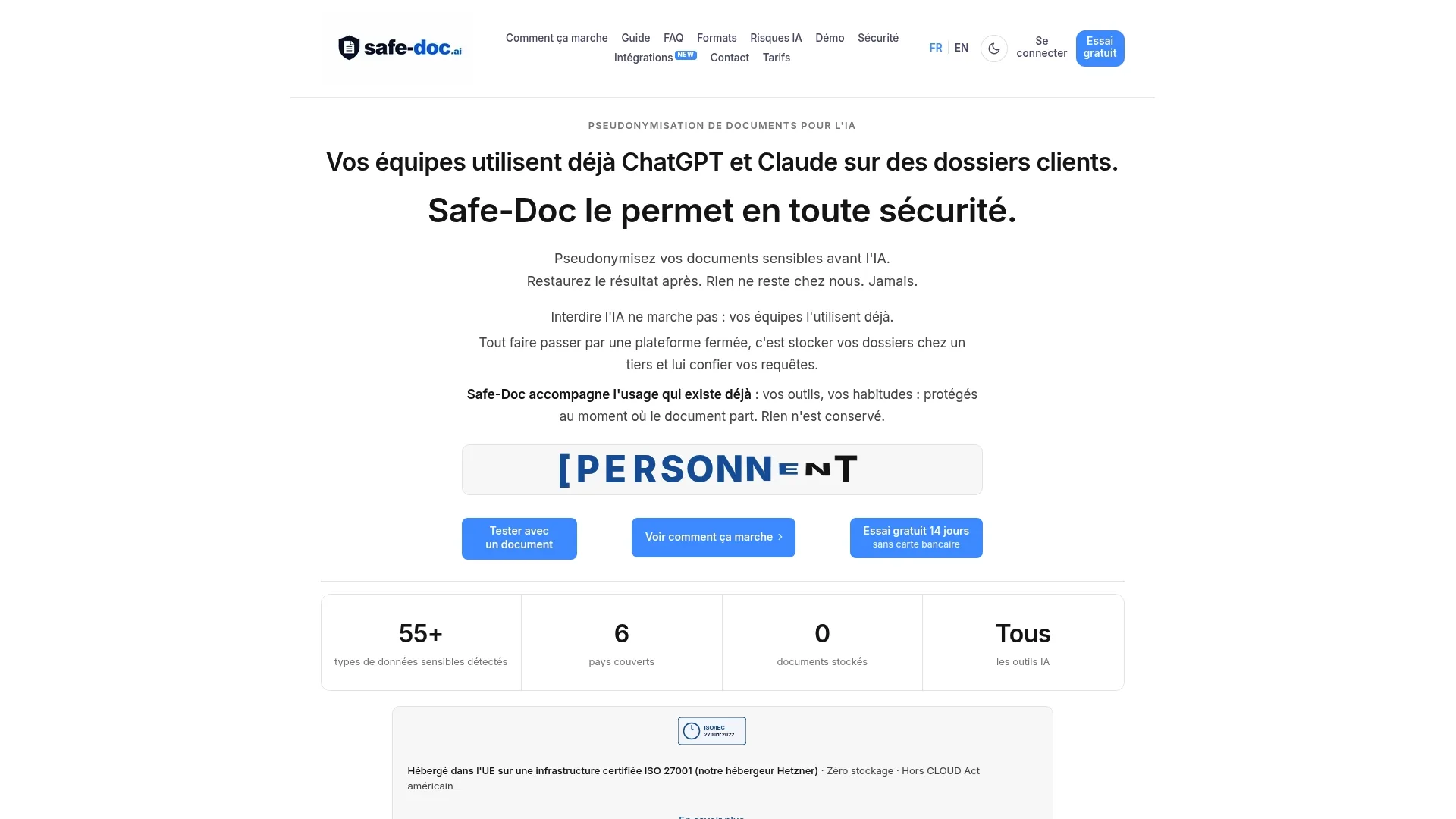
For professionals with international mobility, the pseudonymization and audit solutions offered by Safe-doc provide a concrete layer of protection without changing work habits. Consult the dedicated page to understand how Safe-doc integrates into your existing digital environment.
Frequently asked questions
What is personal data protection for an expatriate?
The protection of expatriates' personal data refers to the full range of technical and behavioral measures that secure sensitive information against cyber threats specific to international mobility. It covers devices, network connections, and daily behavior while abroad.
Why are expatriates more targeted by cyberattacks?
Expatriates are perceived as financially solvent and often isolated from their usual support networks. AI-enhanced attacks exploit this isolation and stressful moments related to travel to bypass technical protections.
Is a VPN enough to protect your data abroad?
No. A VPN encrypts network traffic but does not protect an already compromised device or the metadata visible on a locked screen. It must be combined with 2FA, a password manager, and appropriate behavior.
What should I do if my data has been compromised abroad?
Immediately change all your passwords, run a full antivirus scan, and report the incident via the 17Cyber service in France. For banking fraud, use the Perceval platform to centralize the report.
Does the GDPR protect French expatriates outside the European Union?
The GDPR protects the data of European citizens, but its enforcement depends on the host country and local legislation. In countries without reciprocal agreements with the European Union, effective protections may be limited.