

Pseudonymize your contracts locally before sending them to any external AI, keeping the mapping table separate from the processing pipeline and requiring a data processing agreement that formally prohibits training models on your documents. This is the foundation of a secure AI contract review workflow: a stateless architecture, contractual audit rights, and regular re-identification testing to verify that risk remains controlled.
In brief:
- Pseudonymization must occur before sending to an external AI, with a separate mapping table and an agreement prohibiting model training.
- Carefully mapping sensitive fields is essential, followed by automating their precise detection using a consistent NER engine across the entire document.
- The contract with the AI vendor must include an explicit training prohibition clause, enhanced audit rights, and contractual stability guarantees.
- The pseudonymization technique should favor reversible tokenization with secure management of the mapping table to prevent re-identification.
- Compliance requires documenting an audit process, updating the processing register, and ensuring rigorous logging of access and operations.
Table of contents
- How to secure contract review by an external AI
- What contractual clauses to negotiate with an AI vendor
- Which pseudonymization method preserves AI analysis quality
- What compliance evidence to produce for the workflow
- What distinguishes a workflow that stands the test of time
- Integrating Safe-Doc into your contract review workflow
- Going further on pseudonymization and GDPR
- Sources
How to secure contract review by an external AI
A secure workflow for AI contract review doesn't happen piecemeal. It follows a precise sequence where each step addresses a vulnerability left by the previous one. Here's the operational sequence to implement.
1. Map sensitive fields. Before any automation, list the categories to protect in your contracts: party identities, amounts, banking details, penalty clauses, health data if the contract contains any. This inventory work, often neglected, determines the precision of everything that follows.
2. Automate detection. A named entity recognition (NER) engine coupled with regex rules identifies names, companies, amounts, and references. Tokenization must remain consistent throughout the document: the same individual keeps the same token everywhere, otherwise the AI loses track of contractual relationships.
3. Position the pseudonymization module upstream. Processing must occur before the text leaves your perimeter, whether on the workstation, via a dedicated network gateway, or through an API proxy that intercepts the request before the call to the external model.
4. Send the transformed contract. The AI never receives the original document, only its pseudonymized version. The tool's legal reasoning remains usable if the grammatical structure and consistent tokens are preserved.
5. Restore and log. Re-injection of real data occurs via the mapping table, in a separate environment, with an access log that tracks who requested what and when.
6. Test for quality and re-identification. Compare AI results before/after transformation to verify the reasoning holds, then run re-identification tests to assess whether a third party could reconstruct a party's identity from the pseudonymized text alone.
Pro tip: Never launch a pilot on a live production contract. Test first on a batch of archived contracts with no commercial stakes to calibrate your detection rules before applying them to active files.
This architecture addresses a constraint many legal departments discover too late: the informal use of general-purpose AI on sensitive documents-what's called Shadow AI-continues in parallel with approved tools whenever the official process is perceived as too slow.
What contractual clauses to negotiate with an AI vendor
AI vendors' general terms often contain data reuse clauses that go unnoticed on first reading. You must negotiate a clause preventing any unilateral modification of data usage terms, otherwise the vendor can evolve its operating conditions without your explicit consent.
Four points must appear in any contract with an AI provider processing professional documents:
- Explicit training prohibition. The clause must cover not only raw documents but also prompts, generated responses, and any data derived from processing.
- Minimum clauses from GDPR Article 28. The processor must commit to the nature, purpose, and duration of processing, with clear segmentation of data flows between raw data, usage logs, and derived data.
- Technical audit rights. You must be able to demand concrete evidence-processing logs, storage architecture, security certifications-not just a declaration of compliance.
- Stability clause and exit mechanism. The contract must provide for termination conditions, data portability, and the vendor's inability to unilaterally change processing conditions mid-contract.
Pro tip: Systematically request audit rights accompanied by a [financial penalty mechanism](https://intelligence-privee.com/articles/contrats-ia-saas-clauses-essentielles-dsi.html) for identified breaches. A clause without quantified consequences often remains a dead letter.
A well-drafted data processing agreement conditions everything that follows in the workflow: without it, technical pseudonymization protects your data from accidental leaks but not from contractually authorized reuse.
Which pseudonymization method preserves AI analysis quality
Three techniques compete to transform a contract before sending it to an external model, and they offer neither the same security nor the same utility for AI.
- Reversible tokenization replaces each sensitive datum with a stable token associated with a separately stored mapping table. It allows restoring original values after processing.
- Salted encryption transforms data into an unreadable string but often breaks consistency across occurrences if the salt varies, disrupting AI reasoning on long documents.
- Hashing offers strong protection against direct re-identification but remains irreversible: unsuitable when the contract must return to its original form after analysis.
Token consistency remains the decisive parameter. A contract where "Jean Dupont" systematically becomes "PERSON_01" from start to finish preserves its internal logic, whereas inconsistent replacement from one occurrence to another degrades AI result quality, with the tool losing the ability to link clauses together.
The main vigilance point remains mapping table storage. It must reside in an encrypted environment, separate from the processing pipeline, ideally behind a hardware security module (HSM) or dedicated digital vault, with strictly limited access permissions to a few identified roles.
To assess system robustness, test re-identification resistance by attempting to reconstruct a party's identity from the pseudonymized text alone, cross-referenced with public sources. The CNIL reminds us that a pseudonymized document remains personal data as long as re-identification remains possible, even indirectly, unlike truly anonymized data.
What compliance evidence to produce for the workflow
Technique alone doesn't suffice to demonstrate an AI contract review workflow's compliance. A CNIL inspection or internal audit will require documented evidence, not just a well-conceived architecture.
1. Trigger a DPIA if risk warrants it. A data protection impact assessment becomes necessary when contract volume is significant, data touches sensitive categories, or the AI vendor is located outside the European Union. It must describe flows, protection measures, and residual risk after pseudonymization.
2. Update the processing register. Each flow to an external AI must appear explicitly, with mention of the pseudonymization applied and the legal basis retained.
3. Systematically log access and operations. Who initiated a restoration, at what time, on which contract: these logs must be retained for a defined period and exploitable in case of audit.
4. Train authorized teams. People authorized to manipulate the mapping table must know restoration procedures and the limits of their permissions, with periodic review of these access rights.
These elements constitute the foundation of periodic workflow audits, a condition for GDPR compliance not to degrade over AI tool updates.
What distinguishes a workflow that stands the test of time
The most widespread error is believing that removing a name suffices to protect a contract. A precise amount, an address, a signature date combined often suffice to re-identify a party without any identity appearing in clear text. Pseudonymization is not a legal alibi: it must be documented, tested, and revised at regular intervals to remain credible when facing inspection.
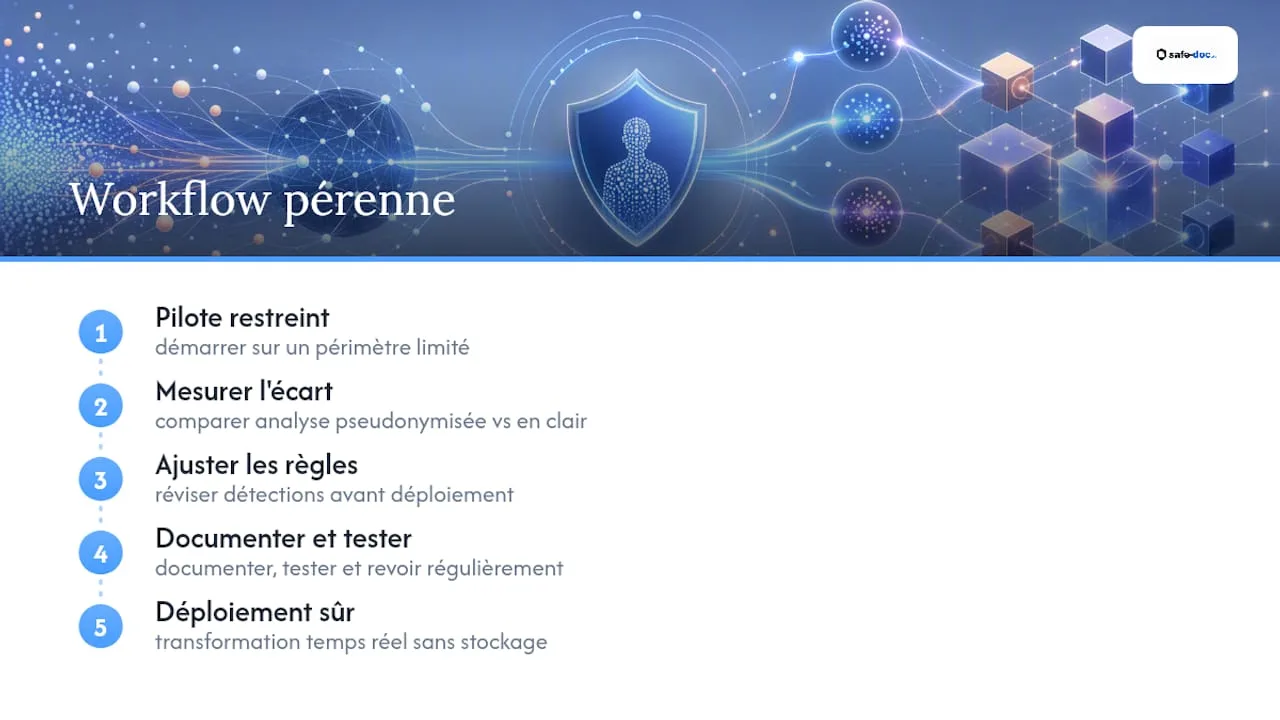
The real trade-off plays out between security and utility. Too much transformation breaks AI reasoning on the contract; too little leaves re-identification risk. The right approach is to start with a restricted pilot, measure the quality gap between pseudonymized and clear-text analysis, then adjust detection rules before any large-scale deployment.
Specialized platforms address precisely this trade-off by applying transformation in real time, without durably storing the transmitted document, avoiding creation of a new vulnerability point while you secure the first.
- Jacques
Integrating Safe-Doc into your contract review workflow
A solution can integrate directly into the pipeline described above: the platform transforms contracts in real time, without durably storing the transmitted document, avoiding the classic weakness of competing solutions that retain a copy on their servers.
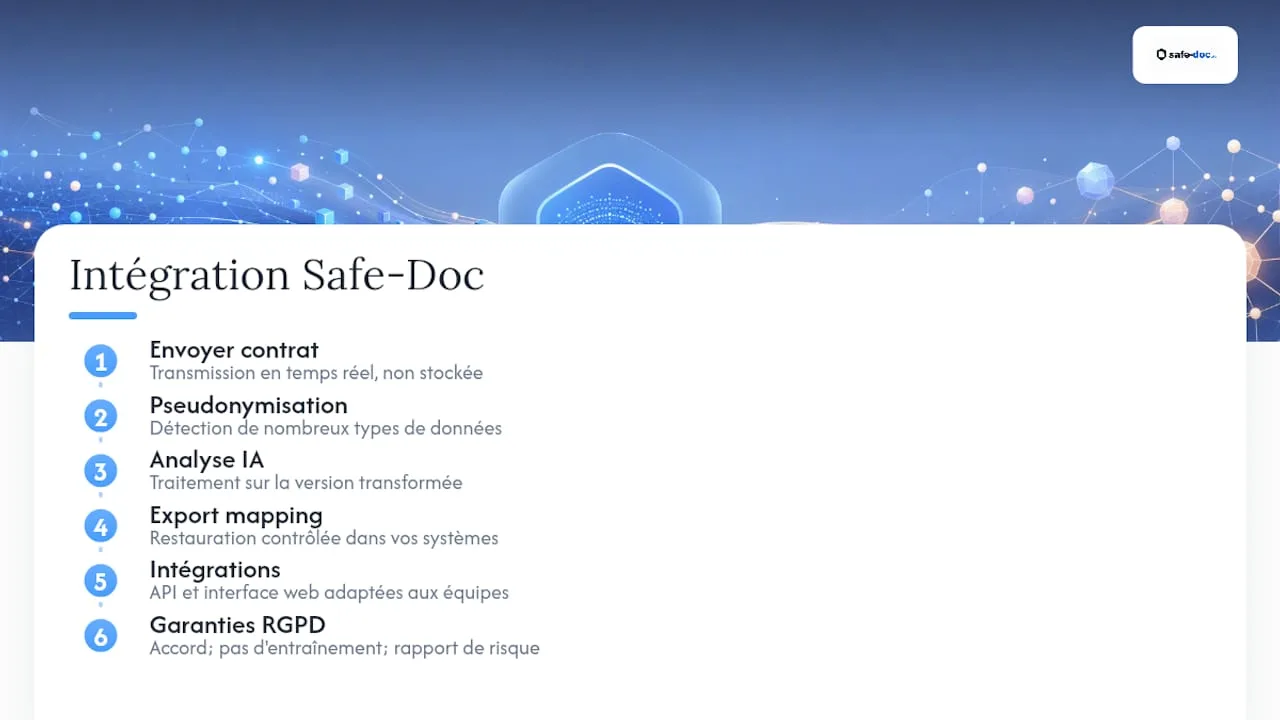
Operation remains simple to integrate: you send the contract, the solution detects and pseudonymizes numerous types of sensitive data, AI analysis proceeds on the transformed version, then a mapping export allows you to restore real data in your own systems, under your exclusive control. The detailed operation covers API integrations and web interface usage, suited to legal departments, accounting firms, and compliance teams handling high-volume files.
The architecture, compliant with GDPR Article 4(5), is accompanied by a data processing agreement excluding any model training on your documents and a residual risk analysis report for each processing operation. If you manage compliance for your organization, the dedicated DPO page details available audit guarantees. You can test the demo today to assess impact on your own contracts.
Going further on pseudonymization and GDPR
To deepen understanding of anonymization and pseudonymization criteria, the CNIL offers a comprehensive technical reference. On the contractual side, consult obligations related to AI subcontracting and the guide on architectures adapted to the sensitivity of processed data.
Sources
- Atias Avocats - AI clauses in vendor contracts (2026)
- Irénard Avocat - generative AI contracts (2026)
- CNIL - anonymization of personal data
- Hayot Expertise - pseudonymization and AI quality (2026)