

A secure HR workflow for personal data comprises all processes, technical controls, and organizational rules that govern the collection, processing, and retention of employee information while guaranteeing confidentiality at every stage. In 2026, this definition carries precise regulatory weight: the GDPR mandates notification to the CNIL within 72 hours of any breach, and a Data Protection Impact Assessment (DPIA) is mandatory for all high-risk processing-particularly when artificial intelligence tools are used to screen candidates. The stakes are clear: HR teams handle some of the most sensitive data in the organization daily, from payslips to performance evaluations, and the growing adoption of uncontrolled AI tools creates vulnerabilities that neither IT departments nor DPOs can ignore.
What are the technical pillars of a secure HR workflow?
Securing HR processes that handle personal data rests on five technical measures that 2026 sector frameworks consider non-negotiable.
- End-to-end AES-256 encryption. All data in transit and at rest must be encrypted to this standard. Hosting certified by ANSSI, ISO 27001, or HDS ensures that the underlying infrastructure meets the same requirements.
- Strong multi-factor authentication (MFA/2FA). Authentication apps like Google Authenticator or FIDO2 physical security keys significantly reduce the risk of compromised HR accounts. A password alone no longer suffices.
- Access controls based on the principle of least privilege. Each user accesses only the data strictly necessary for their role. A payroll manager should not see disciplinary files, and vice versa.
- Time-stamped logging retained for at least 12 months. Access traceability is the first piece of evidence requested during a CNIL inspection. Every consultation, modification, or export must be recorded with the user's identity and the exact time.
- Restricted APIs with time-limited tokens. Best practice is to assign limited scopes to each access token and avoid permanent tokens with global rights. Each SaaS connector must have precise permissions, never blanket administrative rights.
Pro tip: Systematically test your API integrations in a sandbox environment before any production deployment. A breach detected in testing costs infinitely less than an actual data breach.
| Technical measure | Reference standard |
|---|---|
| - | - |
| Data encryption | AES-256, ISO 27001 / HDS hosting |
| Authentication | MFA/2FA, FIDO2 keys |
| Access control | Principle of least privilege |
| Logging | Time-stamped logs, 12-month minimum retention |
| API automation | Time-limited tokens, restricted scopes |

How to integrate GDPR compliance into HR processes?
GDPR compliance in HR workflows is not a fixed state. It is an ongoing process that demands documented and verifiable actions at every stage of the data lifecycle.
1. Maintain and update the record of processing activities (Article 30 GDPR). A well-maintained record is a governance tool, not a mere administrative formality. It specifies precisely who accesses which data, for what purpose, and on what legal basis. During a CNIL audit, this is the first document requested.
2. Apply the principle of data minimization. Collect only the data strictly necessary for the stated purpose. A job application form does not justify requesting a social security number at the first stage.
3. Automate deletions and pseudonymization. Unsecured temporary files generated by HR workflows constitute frequently overlooked exposure vectors. Automating their deletion reduces the risk of accidental exposure without overburdening teams.
4. Conduct a DPIA for all high-risk processing. Using an AI tool to screen candidates or evaluate performance automatically triggers the obligation to perform a Data Protection Impact Assessment. This analysis must be documented before deployment, not after.
5. Respect the 72-hour deadline for notifying the CNIL. In the event of a breach, the organization has 72 hours to notify the supervisory authority. This deadline starts from the detection of the incident, not its resolution. An incident management procedure must therefore be written, tested, and known to all relevant parties.
Pro tip: Designate a single internal point of contact for managing HR data breaches. In the event of an incident, coordination between HR, IT, and the DPO must be immediate. One hour lost in the decision chain can be enough to exceed the legal deadline.
What operational best practices secure HR workflows?
Collaboration between HR, IT, and the DPO is the primary condition for effective security. Mapping data lifecycles without involving all three functions produces blind spots. Each brings an irreplaceable perspective: HR knows the actual uses, IT controls the infrastructure, and the DPO identifies legal obligations.
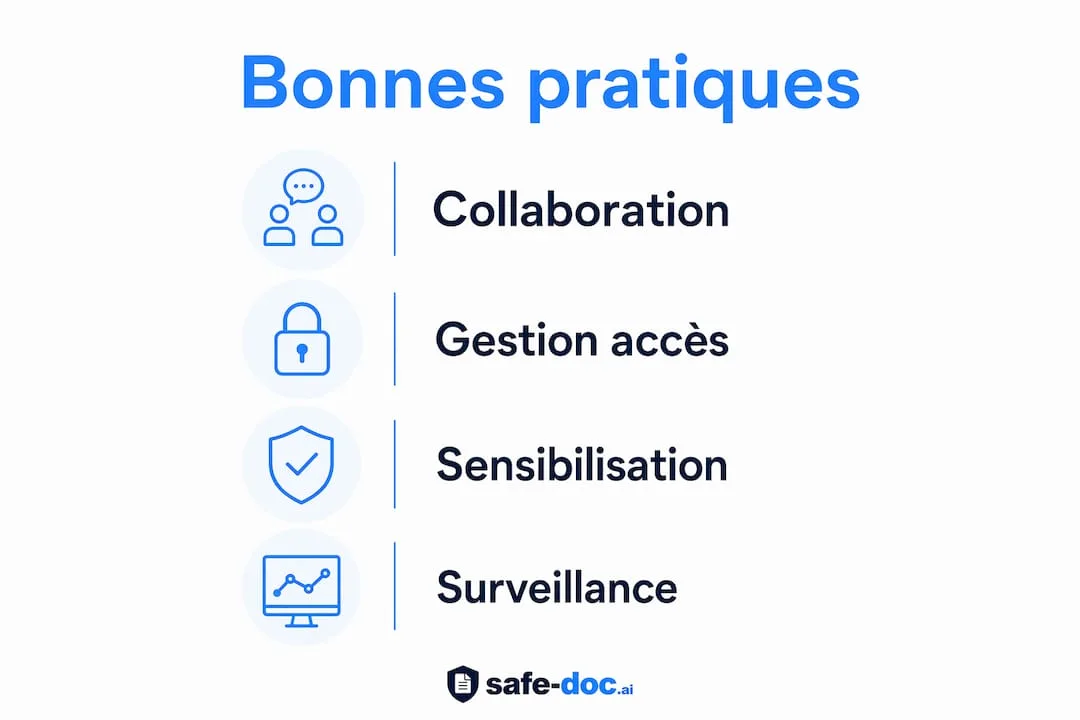
Tiered access management is the second major operational lever. Three profiles suffice in most organizations: employee, manager, and administrator. Each profile has a defined data perimeter, and any request for extended access passes through a traceable approval procedure. This segmentation also simplifies audits: it is immediately clear who accessed what.
Awareness training for HR teams remains the most often neglected link. AES-256 encryption does not protect against an employee who forwards a payroll file to their personal email. Short, regular training sessions focused on concrete cases like phishing or unauthorized file sharing produce measurable results.
Active anomaly monitoring completes the system. Configure alerts for mass data exports, connections outside usual hours, and unplanned changes to access rights. Quarterly log audits help detect unusual behavior before it becomes an incident. For further insight into the most common vulnerabilities, documented real-world HR data breaches offer concrete lessons.
How to manage AI risks in HR workflows?
Integrating artificial intelligence systems into HR processes demands heightened regulatory vigilance. Human oversight remains essential even with automated detection tools: no algorithm can substitute for human judgment in validating a decision that affects an employee.
Article 22 of the GDPR strictly regulates automated decisions. Any decision producing significant legal effects on a person-such as an algorithm-generated hiring rejection-must be open to challenge and human review. This requirement must be built into the workflow design, not added as a patch.
ISO 42001 and ISO 23894 standards provide a risk management framework specific to AI. Their adoption signals to supervisory authorities a structured and documented approach, which weighs favorably during audits.
- Conduct a DPIA before any AI deployment in HR. Automated candidate screening, absenteeism detection, or AI-driven performance analysis systematically trigger this obligation.
- Pseudonymize data before submitting it to an AI tool. Pseudonymization of personal data under Article 4(5) of the GDPR reduces exposure in the event of a leak or non-compliant use by the model.
- Document transparency toward data subjects. Employees whose data feeds an AI system must be informed, with a clear explanation of the purpose and the rights they hold.
- Check the terms of use of AI tools. Some models reuse submitted data for their training. This clause, often buried in the terms, constitutes a GDPR violation if the data is not first anonymized or pseudonymized.
Pro tip: Before integrating an AI tool into an HR workflow, systematically request written confirmation from the vendor that they do not use your data to train their models. The absence of a clear answer is an answer in itself.
Key points
A secure HR workflow for personal data requires the combination of AES-256 encryption, comprehensive logging, documented GDPR compliance, and human governance over any AI-automated decision.
| Point | Details |
|---|---|
| - | - |
| Encryption and logging | Apply AES-256 and retain time-stamped logs for at least 12 months for all HR data access. |
| Documented GDPR compliance | Keep the Article 30 register current and conduct a DPIA before any high-risk AI processing. |
| HR, IT, DPO collaboration | Map data together to avoid organizational and technical blind spots. |
| Pseudonymization before AI | Mask personal data before any submission to an artificial intelligence tool. |
| CNIL notification deadline | Prepare an incident management procedure to respect the legal 72-hour deadline. |
What the field taught me about HR workflow security
After years of supporting compliance teams on HR data security projects, one conviction has emerged: most vulnerabilities do not stem from an absence of technology. They stem from an absence of coordination.
I have seen organizations deploy top-tier encryption solutions, only to have their HR teams share candidate files via consumer storage services, because no one took the time to explain why this was problematic. Technology without training protects nothing.
What also struck me was the resistance to the principle of least privilege. Managers often request extended access "just in case." Yielding to this logic creates uncontrollable access perimeters. The rule must be firm: grant the minimum necessary access, and document any exception.
On AI, I am convinced that the real risk is not the tool itself, but unsupervised use. Shadow AI-the use of AI tools not approved by HR teams to process employee files-is today the primary source of uncontrolled exposure. The answer is not to ban it, but to offer a secure alternative that teams will naturally adopt. The 2026 HR data protection standards show that organizations investing in certified solutions significantly reduce their regulatory exposure.
- Jacques
Safe-doc: a protective layer for your HR and AI workflows
HR teams using AI tools like ChatGPT or Claude to analyze employee files take a real risk if the data is not protected beforehand. Safe-doc solves this problem by pseudonymizing sensitive documents before submission to AI, without durably storing the processed files.
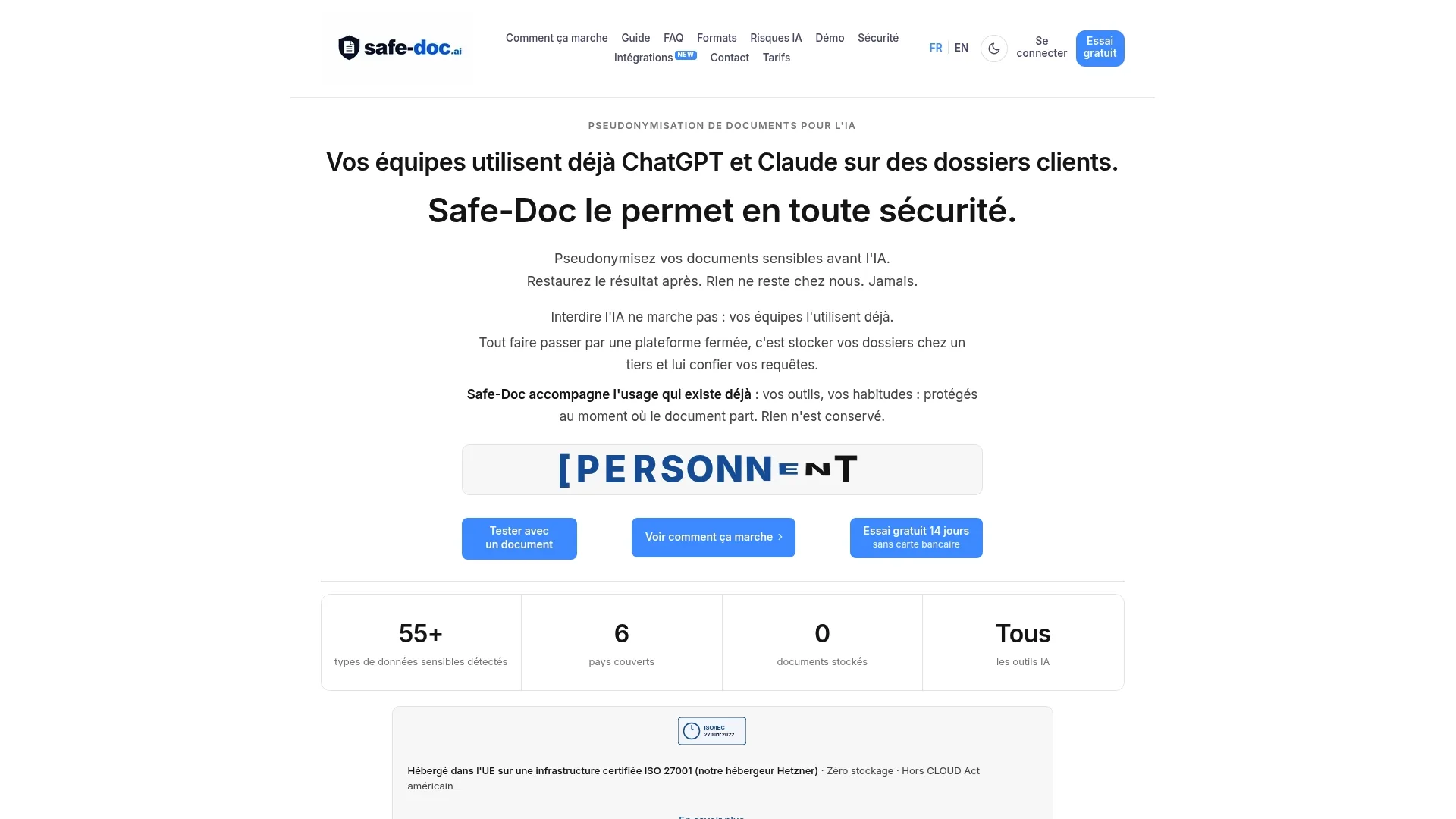
Safe-doc integrates into existing workflows without modifying them. GDPR-compliant pseudonymization is performed in real time, with full traceability of operations. GDPR-by-design compliance — processing within the European Union, no durable storage, built-in traceability — meets current regulatory requirements. For DPOs and compliance managers seeking to secure AI use in their HR processes, Safe-doc offers a concrete, operational answer today.
Frequently asked questions
What is a secure HR workflow for personal data?
A secure HR workflow for personal data is a set of processes governed by technical controls (encryption, MFA, logging) and organizational rules (tiered access, DPIA) that protect employee information at each stage of processing, in compliance with the GDPR.
When is a DPIA mandatory in HR processes?
A DPIA is mandatory whenever processing presents a high risk to the rights of individuals, particularly when using an AI tool to screen candidates, evaluate performance, or detect absenteeism. It must be conducted before the processing is deployed.
What deadline applies for notifying the CNIL in the event of an HR data breach?
Notification to the CNIL must occur within 72 hours of detecting the breach, not its resolution. This deadline begins as soon as the organization becomes aware of the incident.
Why pseudonymize HR data before submitting it to AI?
Pseudonymization reduces the exposure of personal data in the event of a leak or non-compliant use by the AI model. It allows HR teams to continue using AI tools while respecting GDPR obligations on the protection of sensitive data.
How to secure APIs used in HR workflows?
Each SaaS connector must have limited access scopes and time-limited tokens. Global administrative rights should never be assigned to an automated integration, and each new API must be tested in a sandbox environment before production deployment.