


To secure banking data and remain GDPR compliant, the absolute priority is stateless pseudonymization, robust encryption, strict access control, and risk-based governance founded on the recommendations of the CNIL, GDPR, and ANSSI.
Before going any further, here is the minimum checklist to apply:
- Processing inventory: map all banking data flows (PAN, IBAN, payment data).
- Minimization: collect and retain only data strictly necessary for the declared purpose.
- Pseudonymization or tokenization: replace sensitive data with reversible identifiers before any processing or transmission.
- Encryption: AES-256 at rest, TLS in transit, no exceptions.
- Multi-factor authentication (MFA): mandatory for all access to systems processing financial data.
- Certified hosting: favor SecNumCloud or ISO 27001 infrastructures for data remaining on French or European territory.
Essential regulatory references: GDPR (art. 32 and 4(5)), CNIL recommendations, ANSSI, and PCI DSS for card payment environments.
Table of contents
- 1. What the GDPR and the CNIL concretely require of you
- 2. Technical measures to protect card numbers and sensitive data
- 3. Organizational measures: policy, authorizations and subcontractors
- 4. How to use AI without exposing your banking data
- 5. Operational roadmap: from diagnosis to deployment
- 6. Prove your compliance: logs, DPIA and preparation for a CNIL audit
- Key points
- Operational pseudonymization: why it's the measure that changes everything
- Safe-doc: stateless pseudonymization and GDPR compliance ready to use
- Official resources to learn more
1. What the GDPR and the CNIL concretely require of you
The GDPR (art. 32) imposes technical and organizational measures adapted to the level of risk, not a fixed catalog of controls. The CNIL recommends adopting a risk-based approach and the principle of minimization: only strictly necessary data must be collected and retained. For banking data, this principle is particularly demanding, because card numbers (PAN), IBAN, and payment data carry high residual risk.
What you need to document:
- Updated processing register, including banking data flow diagrams.
- Data protection impact assessment (DPIA) whenever the processing presents a high risk, which is almost systematic for payment data.
- Subcontracting contracts compliant with art. 28 of the GDPR, with auditability clauses.
Roles and responsibilities to formalize:
- The data controller defines the purposes and security measures.
- The DPO advises, monitors, and serves as liaison with the CNIL.
- The CISO implements technical measures and manages audits.
- Operational authorizations must be documented and reviewed regularly.
"Security is a continuous process: formalizing governance, updating the register, and periodically monitoring the effectiveness of the measures." - CNIL, Practical guide to personal data security
Pro tip: Integrate banking processing mapping directly into your security plan. This allows you to prioritize the flows to pseudonymize first and justify your choices during a CNIL audit.
2. Technical measures to protect card numbers and sensitive data
Never store PANs in clear text: this is the basic rule, confirmed by CNIL deliberation 03-034, which specifies that the CVV must never be stored and that display must be truncated to the last five digits. If retention is necessary, pseudonymization or tokenization with irreversible encryption is mandatory.

| Method | Principle | Reversibility | Recommended use |
|---|---|---|---|
| Stateless pseudonymization | Replacement by an identifier, without storing the mapping server-side | Yes, via secure client-side mapping | AI flows, internal analytics |
| Tokenization | Substitution by a random token managed by a vault | Yes, via vault | Payments, long-term storage |
| Symmetric encryption (AES-256) | Encryption of raw data | Yes, with the key | Storage at rest |
| P2PE (terminals) | End-to-end encryption from point of entry | No (decryption at acquirer) | Physical payment terminals |
The PCI DSS guide recommends P2PE for terminals and encourages tokenization to avoid storing PANs, or even outsourcing storage entirely to a certified service provider.
Technical access controls to implement:
- Identity and access management (IAM) with principle of least privilege.
- MFA on all access to systems processing banking data.
- Immutable and time-stamped logging of each access, modification, or export.
The French Banking Federation underlines the priority of digital sovereignty: prefer SecNumCloud or ISO 27001 certified hosting to ensure that data remains under French or European jurisdiction, protected from extraterritorial access.
Pro tip: Systematically truncate the display of card numbers to the last five digits in your internal interfaces, in accordance with the CNIL recommendation. It's a simple measure that significantly reduces risk in the event of screenshots or unauthorized access.
3. Organizational measures: policy, authorizations and subcontractors
Human and organizational measures are as decisive as technical controls. A security breach on banking data often stems from human error or a poorly supervised subcontractor, as illustrated by numerous examples of GDPR violations.
Training and awareness checklist:
- Awareness sessions at least twice a year, with a focus on banking data.
- Regular phishing tests to measure the real level of team vigilance.
- Clear incident procedures: who to alert, within what timeframe, how to document.
- Systematic integration of new entrants into the awareness process from their arrival.
Subcontractor management, step by step:
1. Verify that each subcontractor has a documented and audited security policy.
2. Include art. 28 GDPR clauses in contracts: written instructions, confidentiality, right to audit.
3. Require technical evidence (certifications, audit reports, access logs).
4. Review subcontractor authorizations and access at each contract renewal.
Practical day-to-day measures: clean desk policy, secure destruction of paper media containing banking data, and storage of sensitive physical documents under lock and key with restricted access.
4. How to use AI without exposing your banking data
Shadow AI is the most underestimated risk in financial organizations today. Employees submit contracts, statements, or accounting tables to consumer AI tools without first pseudonymizing the data. The rule is simple: pseudonymize before any submission to an external model, and favor stateless architectures that do not store raw data.
Concrete use cases:
- Contract review: replace IBANs, party names, and amounts with pseudonyms before AI analysis, then restore via secure mapping.
- Extraction of accounting entries: pseudonymize account and SIREN numbers before processing, while retaining analytical structure.
- M&A due diligence: pseudonymize sensitive financial data from a data room before any automated analysis.
To detect Shadow AI, monitor network access logs and undeclared API integrations. A policy for the use of AI tools, validated by the DPO and the CISO, must explicitly list authorized tools and conditions of use. The risks linked to Shadow AI deserve a dedicated page in your security policy.
Pro tip: Deploy a stateless pseudonymization proxy between your teams and external AI tools. Employees continue to use their usual tools, but PANs and sensitive data never leave the organization in readable form.
5. Operational roadmap: from diagnosis to deployment
Here are the sequenced steps for pragmatic implementation of banking data protection.
1. Diagnosis and inventory: map all banking data processing, identify high-risk flows.
2. DPIA: conduct the impact assessment for processing identified as high risk.
3. Prototype/pilot: test pseudonymization on a limited scope (one flow, one department).
4. API integration: connect the pseudonymization solution to existing systems via REST API or MCP.
5. Reversibility tests: verify that mapping allows reliable and complete restoration.
6. Team training: sensitize users to new procedures before general deployment.
7. Deployment: go into production with active log monitoring.
8. Post-deployment audit: verify pseudonymization coverage, logs, KPI dashboards.
| Phase | Indicative duration | Key deliverable |
|---|---|---|
| Diagnosis and inventory | 1-2 weeks | Processing mapping |
| DPIA | 2-4 weeks | Impact assessment report |
| Pilot | 2-4 weeks | Test report, coverage rate |
| Integration and training | 2-6 weeks | API documentation, training materials |
| Post-deployment audit | 1-2 weeks | PDF audit report, KPI dashboard |
The main cost factors to anticipate: volume of pages to process, complexity of API integrations, SLA level for sovereign hosting, training plan, and frequency of external audits.
6. Prove your compliance: logs, DPIA and preparation for a CNIL audit
Documenting each technical and organizational decision is not optional: it is the condition for demonstrating compliance during a CNIL audit or internal review. The CNIL recommends encryption, multi-factor authentication, and regular audits, with thematic factsheets and an assessment checklist.
Items to keep on file:
- Up-to-date processing register, with banking data flow diagrams.
- Complete DPIA for each high-risk processing, with review date.
- Signed subcontracting contracts, including auditability clauses.
- Proof of pseudonymization or tokenization: mapping exports, coverage reports.
- Time-stamped access logs, preserved immutably and archived.
Key indicators to track:
- Average time to detect a security incident.
- Average response and notification time (72 hours maximum for the CNIL).
- Number of unauthorized accesses blocked per period.
- Pseudonymization coverage rate on processed banking flows.
Pro tip: Export PDF audit reports at regular intervals and integrate them into your compliance file. A dated and electronically signed report constitutes solid proof during an audit, much more than a simple system setting.
Key points
The most effective measure for securing banking data in GDPR compliance is stateless pseudonymization combined with AES-256 encryption, strict access control, and continuous audit documentation.
| Point | Details |
|---|---|
| Stateless pseudonymization as priority | Replace PANs and sensitive data before any AI processing or external transmission. |
| Encryption and MFA required | AES-256 at rest, TLS in transit, MFA on all access to banking systems. |
| Documented governance | Processing register, DPIA, subcontractor contracts, and archived access logs. |
| Training and Shadow AI | Raise team awareness twice a year and control undeclared AI uses. |
| Safe-doc for implementation | Safe-doc offers stateless pseudonymization, zero storage, and ready-to-use PDF audit export. |
Operational pseudonymization: why it's the measure that changes everything
Most organizations invest in encryption and access control, then consider compliance achieved. This is a perspective error. Encryption protects data at rest, but as soon as an employee extracts a file to analyze it with an AI tool, the raw data flows freely. Operational pseudonymization, on the other hand, acts at the moment of processing, where the real risk lies.
What strikes me about compliance projects is that the DPIA is often treated as an administrative formality rather than as a management tool. Yet a well-conducted DPIA on banking data flows systematically reveals undeclared processing, overly broad access, and insufficiently supervised subcontractors. This is where real vulnerabilities hide.
Safe-doc's zero-storage architecture responds precisely to this blind spot: documents are never kept on the servers, processing is stateless, and each operation generates an exportable audit report. For teams already using AI tools like ChatGPT or Claude, this means continuing to work as normal, without exposing a single account number.
Safe-doc: stateless pseudonymization and GDPR compliance ready to use
Implementing all these practices manually represents weeks of work and risks of oversight. Safe-doc is designed for DPOs, CISOs, and CIOs who want to deploy operational pseudonymization without rebuilding their infrastructure.
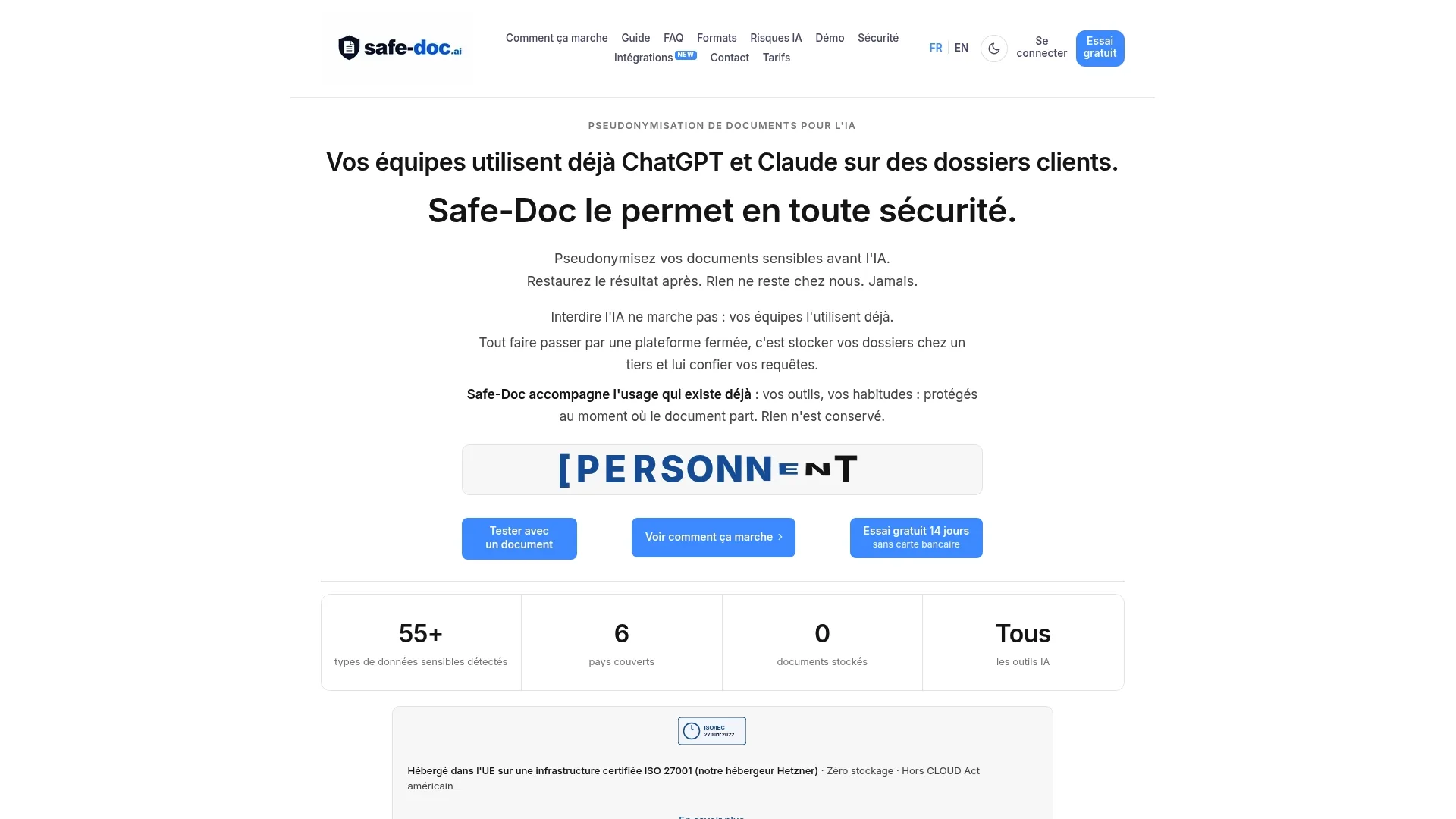
The platform automatically detects many types of sensitive data (PAN, IBAN, names, SIREN, HR data), processes documents in real time without durably storing them, and generates PDF audit reports usable directly in your CNIL compliance file. REST API and MCP integrations connect Safe-doc to your existing tools in hours. For teams using collaborative AI tools, stateless mode ensures that no raw data leaves your perimeter.
Visit the page dedicated to DPOs to find out how Safe-doc fits into your compliance framework, or request a demo to assess coverage on your own banking flows.
Official resources to learn more
- CNIL practical guide on the security of personal data: methodological reference for DPIA, technical and organizational measures, and assessment checklist.
- CNIL deliberation 03-034 on bank card numbers (Légifrance): precise rules on storage, truncated display, and the ban on keeping the CVV.
- CNIL - Banking and means of payment: sectoral practical factsheets and rights of data subjects.
- PCI DSS Guide for Small Merchants: P2PE recommendations, tokenization, and encryption best practices for payment environments.
- French Banking Federation - Data and payments: position on DORA, PSD3, and digital sovereignty for financial data.
- Safe-doc - GDPR compliance and financial data: practical guide on GDPR requirements for processing financial data and conducting a DPIA.
- Safe-doc - Pseudonymize accounting data: technical implementation guide for firms and financial departments.
This article is a general information resource. For your specific situation, consult your DPO, a lawyer specializing in data protection, or the CNIL directly.