


Sensitive data in legal client files is defined by the GDPR as any information revealing a person's ethnic origin, health status, political opinions, religious beliefs, or sex life. For legal professionals-lawyers and notaries-this definition extends to the core content of case files: contact details, financial situations, criminal records, and identity documents. Professional secrecy reinforces this protection by imposing absolute confidentiality, with criminal penalties for violations. The French data protection authority (CNIL) monitors compliance with these obligations and wields sanctioning powers of up to 4% of global turnover.
Table of contents
- What are the legal obligations concerning sensitive data in client files?
- What are the legal retention periods for files and sensitive data?
- Which technical measures effectively protect sensitive data?
- How can professional secrecy, the right to evidence, and transparency be reconciled?
- Key takeaways
- What fifteen years of legal compliance taught me about sensitive data
- Safe-doc, the protection layer for your sensitive files
- Frequently asked questions
- Further reading
What are the legal obligations concerning sensitive data in client files?
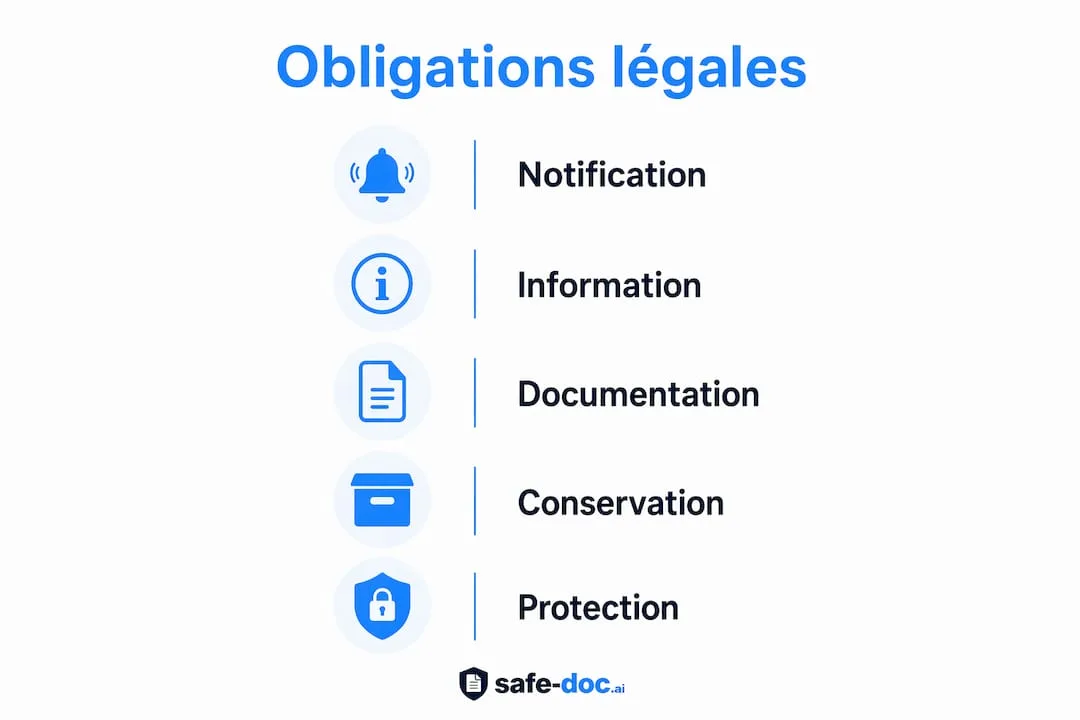
Managing sensitive data in legal client files is governed by a precise regulatory framework, structured around the GDPR and national law. Three core obligations shape daily compliance for law firms and notarial practices.
Breach notification to the CNIL

Any data breach must be notified within 72 hours of discovery. This deadline begins as soon as the data controller becomes aware of the incident, even if only partially. A firm that discovers Monday morning that a criminal case file was sent in error to a third party must notify the CNIL before Thursday morning. Failure to meet this deadline constitutes a standalone offense, regardless of the breach's severity.
Individual client notification
When transferring a practice or a client database, individual notification must be sent to each client within a maximum of one month, per Article 14.3 of the GDPR. This deadline starts running once the transfer is finalized. Best practice is to anticipate this notification from the letter of intent stage, before closing, to avoid any legal gap. A preliminary audit of the database must document the nature of the data, legal bases, and the possible presence of data relating to minors.
Documentation and internal governance
Legal obligations include:
- Maintaining a processing register, the legal document evidencing full control over all personal data flows within the firm.
- Appointing a data protection officer (DPO) for organizations processing sensitive data at scale.
- Systematically informing clients of processing purposes, retention periods, and their rights (access, rectification, erasure, portability).
- Documenting the legal basis for each processing operation, notably consent or legitimate interest.
Comprehensive documentation of processing activities forms the foundation of any defense during a CNIL audit. Without an up-to-date register, a firm cannot demonstrate compliance, even if its practices are beyond reproach.
Pro tip: When transferring a practice, begin the GDPR audit of the client database as soon as the letter of intent is signed. Waiting until closing exposes the transferor to a violation of Article 14.3 of the GDPR and personal liability.
What are the legal retention periods for files and sensitive data?
Retention periods vary according to the legal nature of the file. Applying a uniform duration across all files is a frequent and potentially sanctionable mistake. The table below summarizes applicable legal durations for the main file types.
| File type | Retention period |
|---|---|
| - | - |
| KYC and anti-money laundering (AML-CFT) | 5 years after end of client relationship |
| Legal act (fee agreement, correspondence) | 25 years |
| Serious criminal or real estate files | Up to 30 years |
| Billing data | 10 years (commercial statute of limitations) |
These durations are not recommendations. They derive from distinct legal obligations: the monetary and financial code for KYC, bar association ethical rules for legal acts, and the criminal procedure code for criminal cases. Retaining data beyond the legal period without justified grounds constitutes a violation of the GDPR's minimization principle. Conversely, premature destruction can deprive the firm of evidence in the event of litigation.
For files requiring prolonged retention beyond standard deadlines, an explicit contractual provision in the engagement letter or general terms is sufficient to establish the necessary legal basis. This provision must specify the purpose, duration, and the client's access modalities to their data.
Which technical measures effectively protect sensitive data?
Securing client data in legal files rests on concrete technical choices, not declarations of intent. Here are the essential measures for any firm handling confidential information.
- End-to-end encryption of communications. Exchanges of sensitive documents must transit through end-to-end encrypted channels. The RPVA (French Lawyers' Virtual Private Network) is the reference for legal exchanges in France.
- Abandoning standard email. Sending sensitive attachments via unencrypted email is inadequate under the GDPR. Expirable links and secure document spaces significantly reduce leak risk.
- Sovereign platforms hosted in France. Solutions hosted in France ensure that data does not transit outside European territory, a necessary condition for meeting GDPR requirements on international transfers.
- Granular access controls. Each staff member must access only the files within their scope of responsibility. Access logs enable tracing of every consultation and detection of abnormal access.
- Document pseudonymization. Before any processing by a third-party tool, data allowing direct identification of a client must be replaced with neutral identifiers. This technique reduces residual risk in the event of a leak.
Pro tip: Before using an artificial intelligence tool to analyze a case file, systematically pseudonymize names, addresses, and identification numbers. A pseudonymized document transmitted to an external tool does not constitute a data breach under the GDPR, unlike a document in its raw form.
Security by default is not an option reserved for large firms. It applies from the first criminal or family case handled, regardless of firm size. For firms seeking to structure their sensitive data governance, a documented and audited approach is the only one that withstands CNIL scrutiny.
How can professional secrecy, the right to evidence, and transparency be reconciled?
Professional secrecy is not an absolute bar to producing evidence in court. Recent case law clarifies the conditions under which its waiver is permissible.
1. Principle of proportionality. Waiving professional secrecy must be proportionate to the stakes of the dispute, indispensable to proving the case, and limited strictly to necessary documents. Judges rigorously scrutinize this criterion.
2. Anonymization and provisional sequestration. When an investigative measure concerns confidential documents, anonymization by a third party or provisional sequestration constitutes the safeguard expected by courts. These mechanisms prevent judicial retraction of the measure and forestall sanctions.
3. Strict judicial oversight. The judge exercises a proportionality review between the right to evidence and respect for private life. Overly broad or poorly targeted requests are systematically rejected. A legal professional formulating a request for document production must anticipate this filter and construct the request accordingly.
4. Sanctions for non-compliance. Violation of professional secrecy exposes one to criminal prosecution (Article 226-13 of the Criminal Code), disciplinary sanctions from the bar or notarial chamber, and civil damages. The CNIL may also sanction the data controller if the disclosure constitutes a data breach.
5. Transparency obligation to clients. The right to information of data subjects persists even in a litigation context. Masking client identities in legal documents produced in court-when their identity is not directly at issue-protects both professional secrecy and third parties' fundamental rights.
The tension between professional secrecy and the right to evidence is resolved through precision. A targeted request, accompanied by appropriate procedural safeguards, succeeds where a general request fails.
Key takeaways
Protection of sensitive data in legal client files rests on three inseparable pillars: documented regulatory compliance, technical measures calibrated to file sensitivity, and mastery of the tensions between professional secrecy and the right to evidence.
| Point | Details |
|---|---|
| - | - |
| CNIL notification within 72 hours | Any data breach must be reported to the CNIL within 72 hours of discovery. |
| Differentiated retention periods | Timelines vary from 5 years (KYC) to 30 years (serious criminal cases) depending on file type. |
| Abandoning standard email | Sensitive documents must transit through encrypted channels or secure document spaces. |
| Pseudonymization before AI processing | Replacing direct identifiers before external processing reduces GDPR breach risk. |
| Proportionality for lifting secrecy | Waiving professional secrecy requires a targeted request, limited to strictly necessary documents. |
What fifteen years of legal compliance taught me about sensitive data
Most of the firms I've advised treated GDPR compliance as a one-off project. They produced a processing register, appointed a DPO, then moved on. Two years later, the register was obsolete, access controls hadn't been updated, and staff were still emailing criminal case files via standard, unencrypted channels.
The real problem isn't lack of knowledge. Legal professionals know the GDPR. The problem is the gap between written policy and daily practice. This gap widens silently, until an audit or an incident occurs.
What I've observed in the best-protected firms is a different mindset. Security by default isn't an extra constraint. It's a reflex integrated into every stage of case handling: pseudonymize before analyzing, encrypt before sending, verify access rights before sharing. These steps take thirty seconds. They prevent weeks of crisis management.
Professional secrecy and data protection are also trust levers with clients. A firm that can demonstrate its documented compliance, access logs, and pseudonymization policy stands out concretely from those satisfied with a declaration of principle. Privacy-sensitive clients, particularly in family or criminal matters, choose their counsel partly on this basis.
- Jacques
Safe-doc, the protection layer for your sensitive files
Legal professionals using artificial intelligence tools to analyze case files face real risk if the documents transmitted contain raw data. Safe-doc solves this problem by automatically pseudonymizing identifying information before any external processing, without storing any documents.
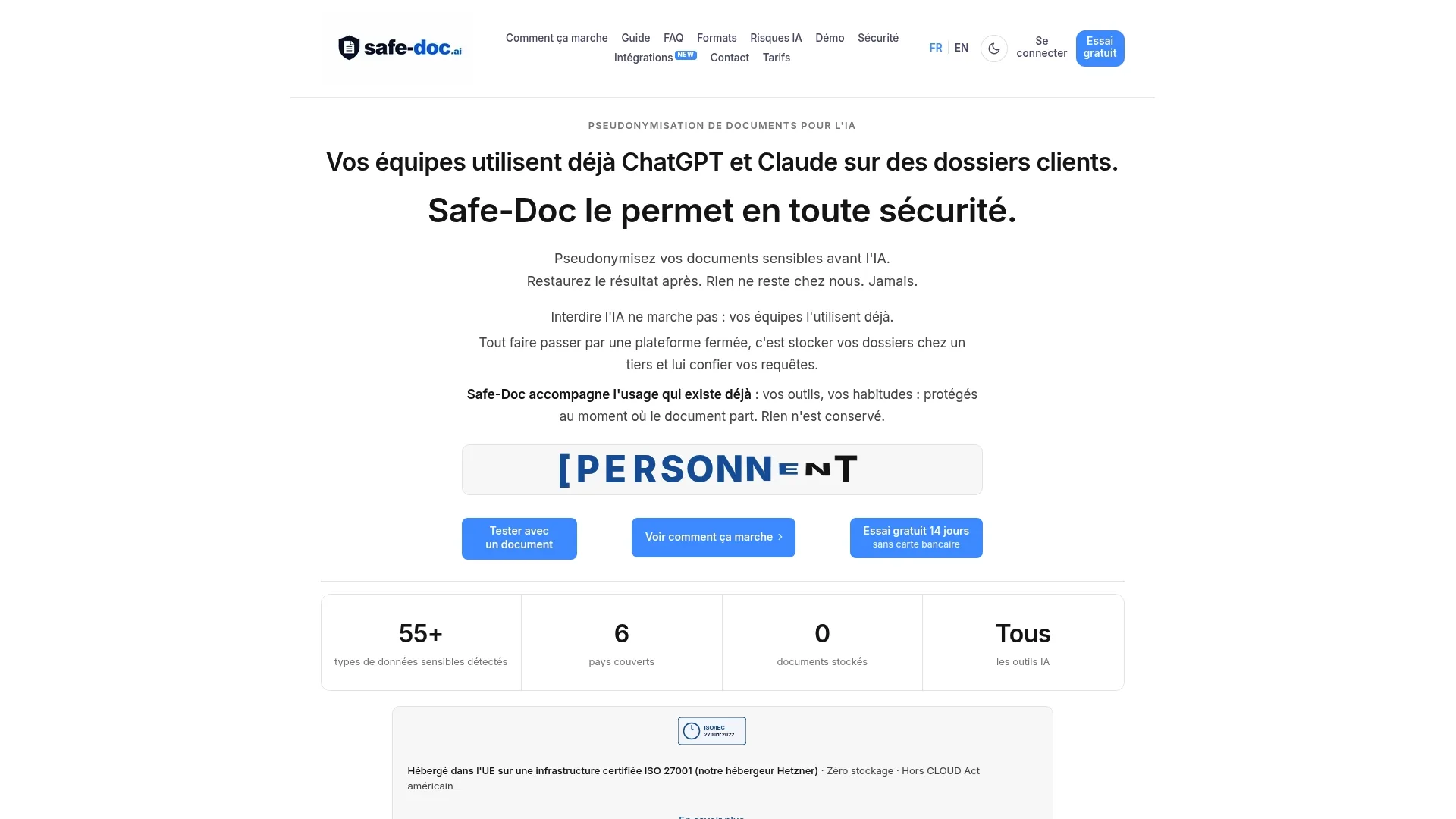
Safe-doc integrates with existing workflows and allows continued use of familiar AI tools while ensuring GDPR compliance. The GDPR-compliant pseudonymization offered by Safe-doc meets the needs of law firms, notaries, and compliance officers handling high-sensitivity files. Zero-storage architecture ensures no client data persists on servers. To understand the technical implementation, see the security and architecture page for detailed guarantees.
Frequently asked questions
What is sensitive data in a legal client file?
Sensitive data is any information revealing a person's ethnic origin, health, sex life, political opinions, or criminal record, as defined by Article 9 of the GDPR. In legal files, this includes medical records, criminal history, and detailed financial situations.
What is the deadline for notifying the CNIL of a data breach?
Notification must occur within a maximum of 72 hours after discovery of the breach. This deadline applies even if the full assessment of the incident has not been completed.
How long should a client file be retained in a law firm?
The duration varies by file type: 5 years for KYC data, 25 years for legal acts, and up to 30 years for serious criminal or real estate files.
Is pseudonymization sufficient to protect sensitive data?
Pseudonymization significantly reduces risk in the event of a leak or processing by a third-party tool, but it does not replace encryption or access control management. It constitutes an additional measure recommended by the GDPR, particularly before any processing by artificial intelligence.
Can professional secrecy be waived to produce evidence in court?
Yes, but under strict conditions: the waiver must be proportionate, limited to necessary documents, and often accompanied by anonymization or provisional sequestration. Judges systematically review these criteria before authorizing production.