


Employee health data is defined by the GDPR as sensitive special category data, subject to enhanced protection requirements. Protecting this information is not optional: it is a legal obligation under Article 9 of the GDPR, national public health legislation, and guidance from data protection authorities. For HR managers and compliance directors, understanding why protecting employee health data is critical directly affects the validity of disciplinary procedures, corporate reputation, and exposure to financial penalties. The cyber incidents of 2026 have made this imperative even more concrete.
Table of Contents
- Why protect employee health data: the legal framework
- What the GDPR actually imposes
- Medical confidentiality: an absolute boundary
- What are the risks of insufficient health data protection?
- Recent incidents with massive consequences
- What technical and organizational measures are essential?
- Implementing an information security policy
- The technical steps to deploy
- How to reconcile data protection and daily HR management?
- The minimization principle applied to HR
- Key points
- What fifteen years in the field taught me about health data protection
- Safe-doc for HR compliance on sensitive data
- Frequently asked questions
- Recommended reading
Why protect employee health data: the legal framework
The regulations governing corporate health data rest on three pillars: the GDPR, national public health codes, and case law from national courts. These texts form a coherent framework that imposes precise obligations on employers.
What the GDPR actually imposes
Article 9(1) of the GDPR prohibits the processing of health data as a general rule. Exceptions exist, but they are strictly limited. Data protection authorities require that any processing of medical data be based on an explicit legal basis, a documented purpose, and proportionate security measures. Non-compliance with the GDPR exposes organizations to sanctions of up to €20 million or 4% of worldwide annual turnover. This dual financial exposure explains why GDPR compliance has become a governance priority, not a mere administrative formality.
Medical confidentiality: an absolute boundary
Medical confidentiality is absolute: only the occupational physician may serve as the employer's contact on any matter relating to an employee's health. The treating physician must refuse all communication, even administrative, with the employer. This rule applies even during prolonged sick leave.
The essential legal obligations are:
- Prohibition on accessing diagnoses: the employer may not know the pathology or the prescribed treatment.
- Single channel: all communications concerning fitness for work must pass exclusively through the occupational physician.
- Data collection limitation: only information strictly necessary for managing the employment contract may be collected.
- Defined retention periods: medical data may not be retained beyond the legal period applicable to each document type.
"The employer may not access the diagnosis, treatment, or nature of an employee's illness, on pain of nullity of any dismissal." This rule, confirmed by recent case law, transforms any violation of medical confidentiality into a direct threat to the validity of HR decisions.
National courts have repeatedly held that any dismissal based on medical information obtained in violation of medical confidentiality is void. This case law gives employees' rights over their health data immediate and concrete impact on HR procedures.
What are the risks of insufficient health data protection?
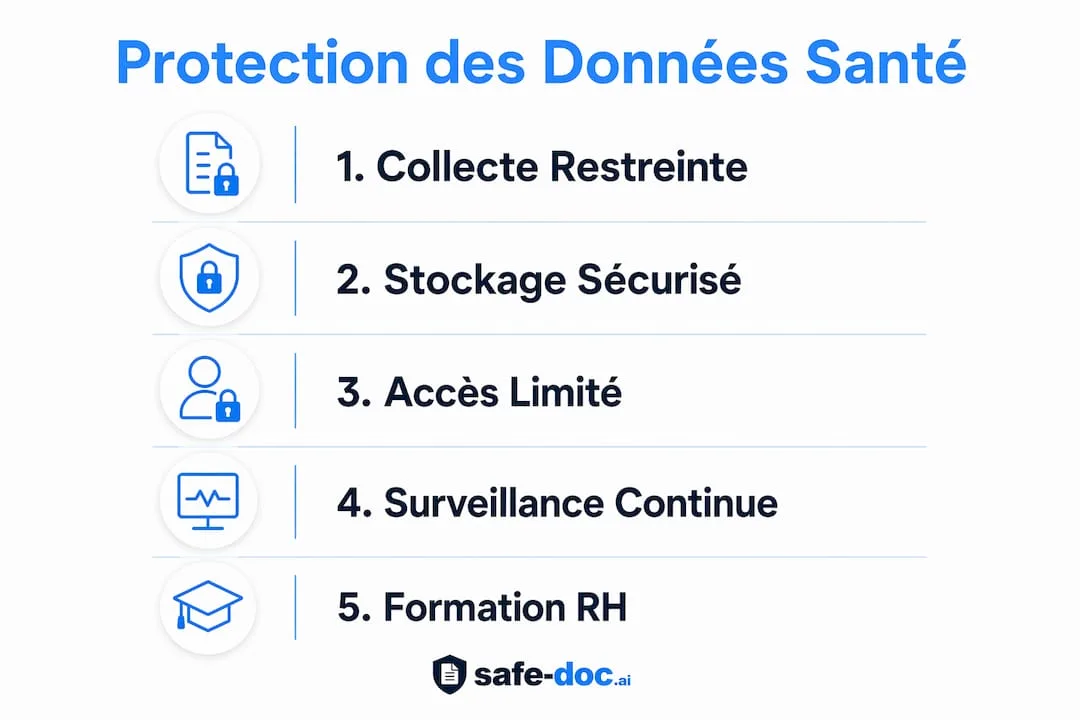
The consequences of a personal health data security breach are multifaceted. They simultaneously affect the legal, financial, and social dimensions of the organization.

Recent incidents with massive consequences
More than 355,000 employees had their occupational health records exposed during a cyberattack against SSTRN in June 2026. The same attack compromised 632,000 appointments and 309,000 HR files. These figures illustrate the scale of damage a single technical vulnerability can cause.
The Almerys cyberattack, which occurred the same year, confirmed that administrative data linked to health-name, address, health insurance number-are as valuable to cybercriminals as strictly medical data. This information is directly exploited for identity fraud and targeted phishing campaigns.
The main risks identified are:
- Data protection authority sanctions: administrative fines, compliance orders, publication of decisions.
- Nullity of dismissals: any HR decision based on illicitly obtained medical data is legally vulnerable.
- Reputational damage: a health data breach generates lasting loss of trust among employees and partners.
- Identity theft: exposed employees become targets for financial fraud exploiting their administrative data.
- Criminal liability: deliberate violation of medical confidentiality may engage the personal liability of senior management.
The technical flaw at the origin of the SSTRN incident is an IDOR (Insecure Direct Object Reference) vulnerability. This type of flaw allows access to protected data by simply modifying an identifier in a URL. Authentication alone is not sufficient protection.
These incidents show that employee health data security challenges are not purely theoretical regulatory matters. They materialize as concrete, measurable, and publicized losses.
What technical and organizational measures are essential?
Data protection authorities define minimum technical and organizational measures for any processing of sensitive data. These requirements apply directly to HR systems that manage medical or health-related information.
Implementing an information security policy
An information systems security policy (ISSP) approved by senior management is the foundation of any compliance approach. It formalizes access rules, incident management procedures, and the responsibilities of each stakeholder. Without documented ISSP, the organization cannot demonstrate compliance during a regulatory audit.
The technical steps to deploy
1. Strict access controls: each employee accesses only the data necessary for their function. Authorizations are reviewed with each position change.
2. Data encryption: data at rest is encrypted using AES-256; data in transit uses TLS 1.3 minimum. Failure to encrypt backups constitutes a sanctionable breach by data protection authorities, even without a confirmed leak.
3. Access logging: every consultation or modification of a health file is traced with timestamp and user identifier.
4. Backup management: backups are encrypted, tested regularly, and stored on media separate from the primary system.
5. Incident notification procedure: in the event of a breach, the GDPR requires notification to the supervisory authority within 72 hours. The procedure must be documented and known to all relevant stakeholders.
Pro tip: Perform a backup restoration test at least quarterly. Data protection authorities consider that an untested backup does not provide sufficient assurance under the security obligation.
The IT security policy must be subject to annual review and regular training for HR and IT teams. Human error remains the leading cause of data breaches in organizations. Training employees to recognize phishing emails or report anomalous access significantly reduces actual exposure.
How to reconcile data protection and daily HR management?
Daily management of absences, incapacities, and workplace accommodations requires HR teams to handle information adjacent to the medical domain. The boundary between what is permitted and what is not deserves precise understanding.
The minimization principle applied to HR
Data collection must remain proportionate to the stated purpose. To manage sick leave, the employer needs the duration and start date, not the diagnosis. To organize a workplace accommodation, the employer needs the functional restrictions communicated by the occupational physician, not the pathological origin of those restrictions.
A March 2026 arbitration decision clarified that employers may not require generalized access to medical information even for absences exceeding 17 weeks. This principle of minimal intrusion into privacy applies regardless of absence duration.
Best HR practices to implement are:
- Centralize medical communications through the occupational physician, never contacting the treating physician directly.
- Inform employees of their rights: right of access, right of rectification, right to erasure within legal limits.
- Document each processing activity in the register of processing activities required by the GDPR.
- Limit retention periods: medical certificates must not be kept beyond their administrative utility.
Pro tip: Include a specific confidentiality clause for health data in contracts with external HR service providers. A subcontractor who accesses this data engages the responsibility of the data controller to the same extent as internal processing.
HR GDPR compliance is a trust lever that fosters a healthy workplace climate. Rapid and transparent communication during an incident limits reputational damage and strengthens management credibility with employees. Organizations that treat compliance as a proactive approach, rather than a reactive constraint, build real competitive advantage in talent attraction and retention.
Key points
Protection of employee health data rests on three simultaneous obligations: respecting medical confidentiality, securing information systems, and minimizing data collection.
| Point | Details |
|---|---|
| - | - |
| Absolute medical confidentiality | Only the occupational physician may communicate medical information to the employer. |
| Severe GDPR sanctions | A breach can result in fines up to €20 million or 4% of worldwide annual turnover. |
| Mandatory encryption | Unencrypted backups are sanctionable by data protection authorities even without a confirmed leak. |
| Data minimization | The employer collects only what is strictly necessary to manage the employment relationship. |
| Compliance as a lever | A proactive compliance approach builds employee trust and reduces risk exposure. |
What fifteen years in the field taught me about health data protection
Most incidents I have observed do not result from sophisticated attacks. They stem from mundane failures: an HR manager transferring a medical certificate via unencrypted email, an external contractor accessing a file without formal authorization, or an absence tracking spreadsheet stored on a network share open to the entire company. These errors are avoidable. They persist because training is inadequate and procedures remain theoretical.
What strikes me more is that health data protection is often framed solely as a legal risk to manage. This is too narrow a view. An employee who knows their employer treats medical information rigorously places greater trust in the organization. That trust translates into better engagement, less information withholding during medical examinations, and more forthright cooperation during workplace accommodations.
The rise of Shadow AI adds a new dimension to these challenges. Employees use unsecured artificial intelligence tools to process sensitive HR documents, unaware that this data passes through third-party servers. Pseudonymizing documents before any processing by external AI is now the most pragmatic response to this risk. Consult the HR compliance guide 2026 for a comprehensive overview of current requirements.
Monitoring cybercrime developments is not reserved for IT teams. A compliance director who understands what an IDOR vulnerability or spear-phishing attack is makes better budgetary and organizational decisions. Minimum technical competence has become a job requirement.
- Jacques
Safe-doc for HR compliance on sensitive data
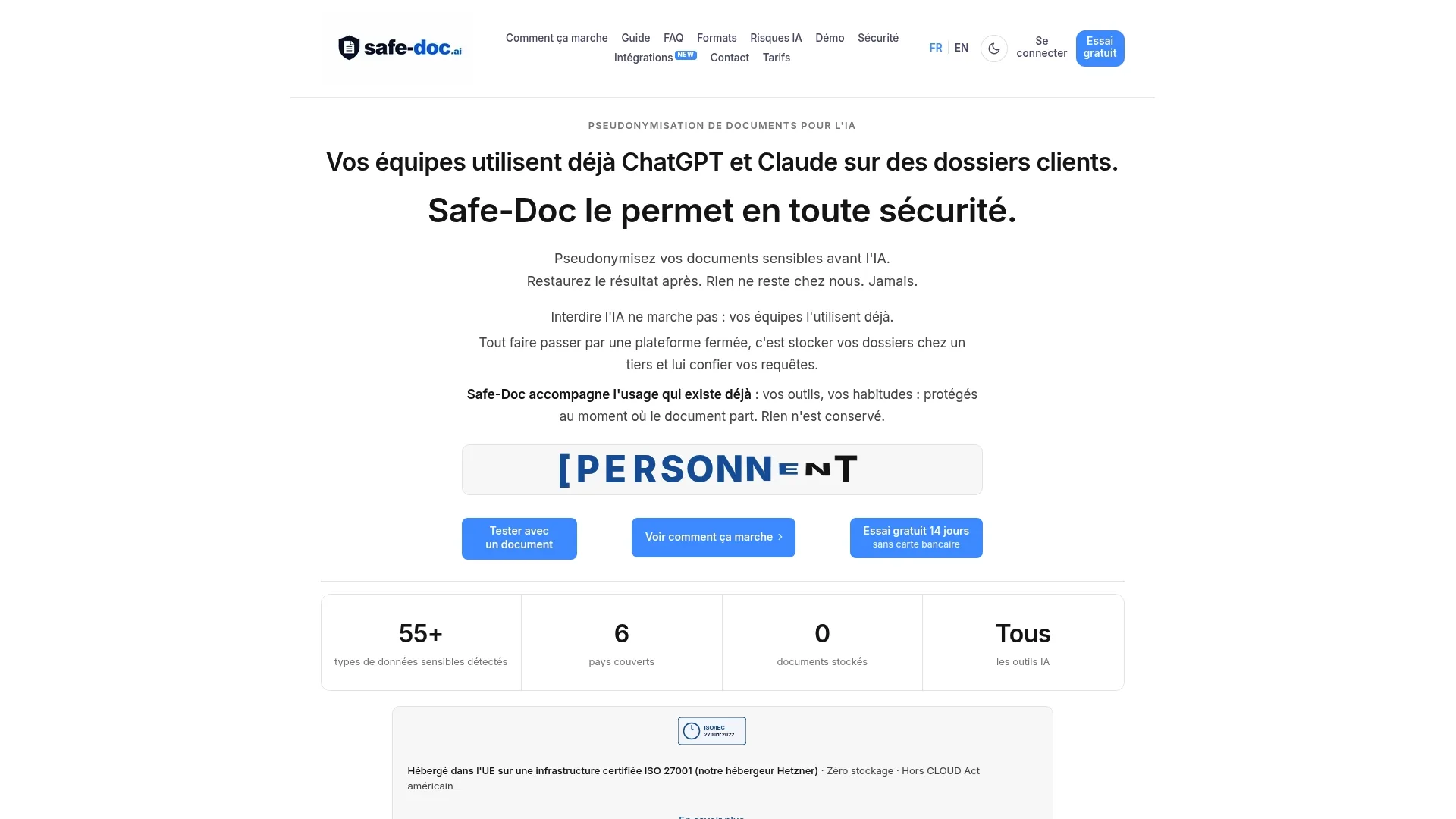
HR teams handle documents daily containing health data, incapacity information, and sensitive administrative elements. When these documents are analyzed with artificial intelligence tools, the risk of leakage becomes real if no protective layer is in place. Safe-doc addresses this problem through automatic pseudonymization of documents before any processing by external AI. Personal data is masked in real time, no documents are stored, and GDPR compliance is maintained without changing team workflows. For HR managers and DPOs seeking to secure their employee files with AI, Safe-doc offers a concrete, audited solution compliant with the AI Act.
Frequently asked questions
Why is employee health data considered sensitive?
The GDPR classifies health data as a special category because its disclosure can lead to discrimination, invasion of privacy, and direct professional harm. Processing such data is prohibited in principle, except under legally defined exceptions.
What sanctions does an employer face for violating medical confidentiality?
A dismissal based on medical information obtained unlawfully is void. Administratively, data protection authorities may impose fines up to €20 million or 4% of worldwide annual turnover.
Who may access an employee's medical data within the organization?
Only the occupational physician is authorized to receive and transmit medical information in the professional context. The employer has access only to conclusions of fitness or unfitness, never to diagnoses or treatments.
How can health data be protected when using AI tools?
Pseudonymization of documents before processing by external AI is the recommended method. It masks personally identifiable data while enabling content analysis, without storing sensitive information on third-party servers.
What rights do employees have over their health data?
Employees have rights of access, rectification, and erasure of their health data, within the limits of legal retention periods. They may also object to certain processing and request data portability under the conditions set out in the GDPR.