

Protecting data within an AI system requires applying GDPR principles from the design stage: minimizing the information collected, implementing technical safeguards for processing (pseudonymization, encryption), and conducting mandatory impact assessments for high-risk use cases. In practice, this means combining technical controls, clear internal governance, and documentation robust enough to withstand CNIL scrutiny.
In brief:
- GDPR compliance in AI demands rigorous management of consent, data minimization, transparency, and allocation of responsibilities.
- The persistent memory of agentic AI amplifies risks related to data accumulation and silent recombination, making access and deletion rights difficult to manage.
- Real-time pseudonymization, encryption, and memory compartmentalization are key measures for strengthening data security in AI projects.
- An impact assessment must be systematically performed for any high-risk AI processing, demonstrating non-identification and documenting mitigation measures.
- A compliance process must follow a structured approach, from initial scoping through operational monitoring, involving the DPO, technical teams, and governance.
Table of contents
- What GDPR principles apply to AI processing?
- Why persistent memory in agentic AI changes everything
- What technical measures actually protect data in an AI project?
- When must you conduct a DPIA for an AI project?
- What checklist should you follow to deploy compliant AI?
- How real-time pseudonymization reduces operational risk
- What decision-makers must actually prioritize
- Safe-doc: pseudonymize without changing your workflow
- Sources
What GDPR principles apply to AI processing?
Any AI system that processes personal data remains subject to the GDPR, without exception for the "intelligent" nature of the processing. The CNIL has updated its recommendations to clarify how the EU AI Regulation interacts with the GDPR-both texts apply simultaneously whenever personal data is used to train or operate a model.
Four core obligations structure your approach:
- Legal basis: consent, legitimate interest, or contract performance, depending on the use case. Training a model on customer data requires different justification than deploying a support chatbot.
- Minimization: the GDPR requires limiting collection to what is strictly necessary, which favors leaner models over data-hungry models that deliver only marginal performance gains.
- Transparency: data subjects must know when an AI system processes their data and have effective means to exercise their rights.
- Allocation of responsibilities: who is the data controller when you use a third-party model hosted by an external vendor? This question is resolved by contract, not after an incident.
The data controller remains accountable even when the processor provides the AI infrastructure. This is where many organizations go wrong: they assume that entrusting data to a reputable vendor relieves them of their obligations. It never does.
Why persistent memory in agentic AI changes everything
Agentic AI no longer processes isolated requests: it remembers, chains actions together, and builds a profile that grows richer over time. The CNIL has published a specific note on this topic, concluding that agentic AI increases risks related to persistent memory and requires reinforced compartmentalization mechanisms.
The problem isn't isolated data-it's accumulation. Information that seems innocuous in isolation (a city, a job title, a birthdate) becomes identifying when an agent cross-references it with other fragments collected from previous conversations.
Three scenarios illustrate the risk:
- An employee pastes a contract excerpt into an AI assistant that retains the history, then reuses that context for a completely different task without any purging.
- An autonomous agent queries multiple internal sources and correlates data that was never meant to appear in the same document.
- A malicious prompt attempts to extract, through successive reformulations, information memorized during earlier exchanges.
The real risk isn't data theft-it's silent recombination. An AI that retains everything eventually knows more than what each individual interaction, taken separately, should have revealed. This directly complicates the exercise of access or deletion rights: how do you guarantee complete removal of data diffused across multiple memory layers?
What technical measures actually protect data in an AI project?
Securing an AI system combines classic IT security measures with controls specific to AI components. The CNIL emphasizes that Article 32 of the GDPR requires measures appropriate to the level of risk, whether concerning infrastructure, access controls, or model-specific software libraries.
Here are the controls to activate, in order of operational priority:
1. Pseudonymize in real time before any transmission to external AI tools. Complete anonymization is rarely achievable without losing data utility; pseudonymization offers a reversible, traceable compromise.
2. Encrypt exchanges and execution environments, with rigorous key management kept separate from teams handling plaintext data.
3. Compartmentalize agent memories and strictly limit retention periods, in line with CNIL recommendations on agentic AI.
4. Deploy AI-aware DLP controls capable of inspecting prompts and files before transmission. Solutions like those described by Proofpoint for AI data security apply blocking, alerting, or replacement rules in real time.
5. Structure governance: precise access controls, team training, ethics oversight committees, and systematic access logging.
Pro tip: don't try to ban generative AI use-channel it instead. A blanket blocking policy almost always drives teams toward uncontrolled Shadow AI, which compounds the risk rather than eliminating it.
For processing hosted by external vendors, securing data entrusted to third-party AI cloud providers deserves specific contractual attention beyond internal technical measures alone.

When must you conduct a DPIA for an AI project?
The CNIL considers that a Data Protection Impact Assessment (DPIA) is in principle necessary for high-risk AI systems processing personal data, particularly when processing relies on automated profiling, systematic monitoring, or sensitive data categories.
A DPIA is not a formality. It must demonstrate, with supporting evidence, that the residual risk of identification has been properly assessed:
- Verify whether the model in use can be qualified as anonymous-the EDPB emphasizes that this qualification must be assessed case-by-case based on the probability of direct or probabilistic extraction of personal data.
- Document the mitigation measures adopted: pseudonymization, access restrictions, limited retention periods.
- Preserve technical evidence (test reports, processing logs) capable of justifying your conclusions during subsequent audits.
A model trained on personal data is never presumed anonymous by default. The burden of proof lies with you, backed by solid technical evidence.
What checklist should you follow to deploy compliant AI?
Effective compliance follows a logical sequence, from initial scoping through production monitoring. Here are the stages that structure a well-managed project:
1. Scope the project: identify the legal basis, map the personal data involved, and verify whether the processing falls within DPIA scope.
2. Integrate controls from development: robustness testing, re-identification attempts, code review of third-party AI components.
3. Secure vendor contracts before any deployment, with precise clauses on data retention and processing. Confidentiality of AI-related contracts must be negotiated upfront, not after signing.
4. Document the DPIA and have mitigation measures validated by the DPO.
5. Monitor in production: periodic audits, formalized incident procedures, effective data purging at end of retention period.
| Stage | Priority action | Typical owner |
|---|---|---|
| Scoping | Define legal basis and data scope | Project lead + DPO |
| Development | Test resistance to re-identification | Technical team |
| Pre-deployment | Finalize DPIA and contractual clauses | DPO + legal |
| Operations | Audit and purge according to retention schedule | CISO / DPO |
Skipping a stage doesn't save time-it simply shifts risk to the production phase, where correcting it costs the most.
How real-time pseudonymization reduces operational risk

An audit firm processing financial files with ChatGPT or Claude doesn't need to abandon these tools-it needs a layer that neutralizes identifying information before transmission, without durably storing it. This is precisely the principle behind real-time pseudonymization as it can be deployed.
The benefits are concrete:
- HR files, contracts, and audit documents retain their utility while masking personal data before processing.
- Restoration mapping enables recovery of original data once the AI response is obtained, without ever transiting through external storage.
- Audit reports and processing logs provide the traceability expected by a DPO during review. This approach is well illustrated in cases of pseudonymizing audit data before AI processing.
What decision-makers must actually prioritize
Most organizations treat AI compliance as a one-off project, when it requires continuous oversight: a cross-functional committee involving DPO, CISO, and business stakeholders, plus a few simple metrics (volume of pseudonymized data, detected incidents, up-to-date DPIAs) are often sufficient to maintain control. The real danger isn't AI itself-it's the blind spot created when no one monitors its actual day-to-day use.
- Jacques
Safe-doc: pseudonymize without changing your workflow
This solution positions itself as a protective layer between your teams and the AI tools they already use. Unlike solutions that require migration to a closed environment, this solution integrates into your existing workflow: documents are pseudonymized in real time, not durably stored, and restorable via secure mapping once the response is obtained.
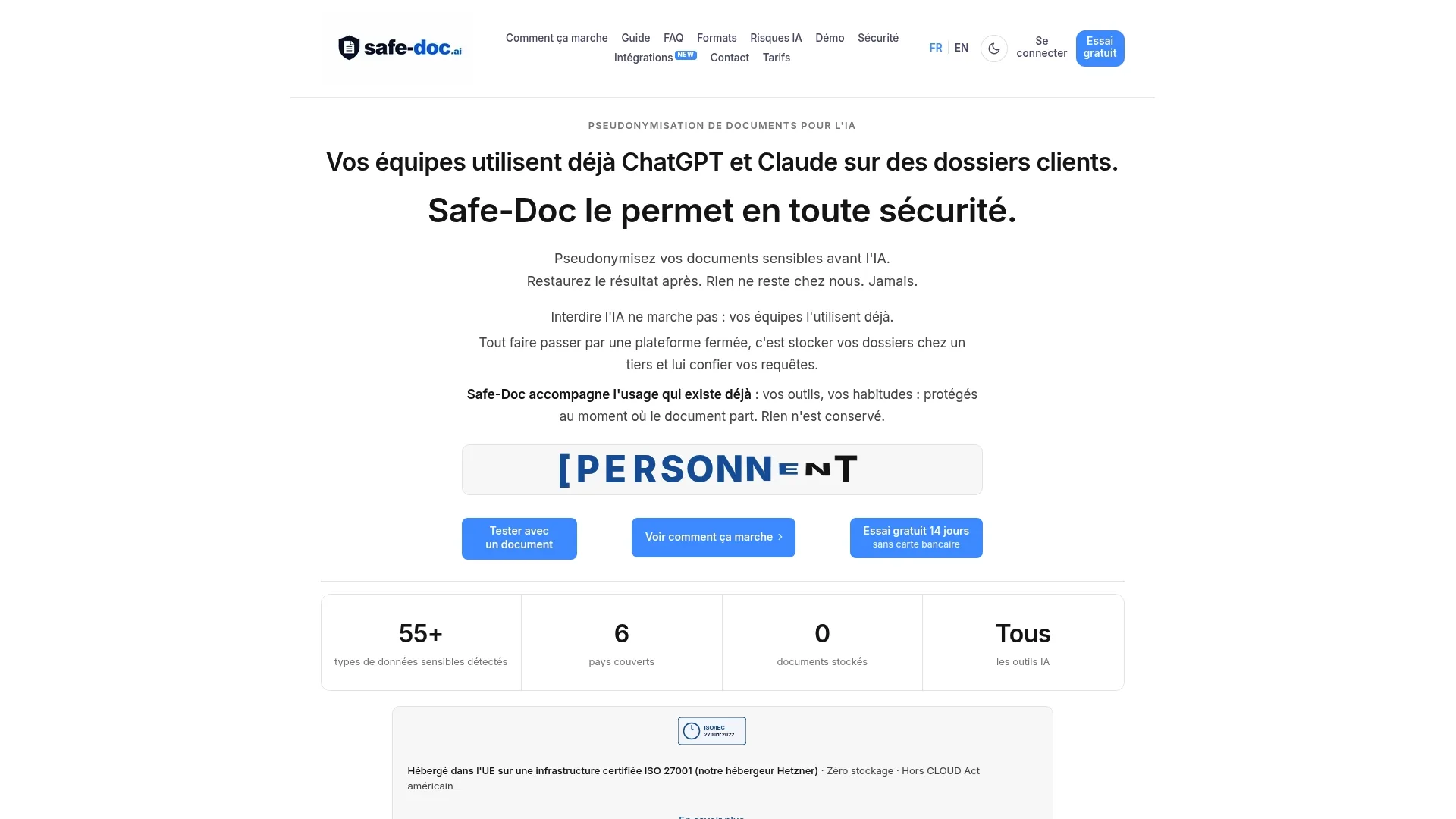
For legal departments, IT organizations, and audit firms handling contracts, HR files, or data rooms, this means continuing to use AI tools without exposing identifiable personal data. Automatic detection can cover a wide range of sensitive information, and processing can generate audit-ready reports. Discover how real-time pseudonymization works and evaluate with your DPO whether a demonstration tailored to compliance requirements aligns with your current AI initiative.
Sources
- Agentic AI and personal data protection - CNIL note (CIANum)
- EDPB Opinion on AI models and anonymization