

Best practices for consultant confidentiality rest on three pillars: GDPR compliance, rigorous technical measures, and precise contractual agreements. Since the February 23, 2026 law, legal opinions drafted by in-house counsel benefit from strict confidentiality protections subject to five cumulative conditions, with mandatory notation on each document. Professional privilege does not exempt compliance with the GDPR: the two obligations are cumulative and apply jointly. For any consultant handling sensitive data, ignoring this framework exposes you to severe financial penalties and irreparable loss of client trust.
Table of Contents
1. What technical measures are essential to protect data?
2. How to structure confidentiality agreements for strong protection?
3. What are the legal obligations in the event of a data breach?
4. How to manage the subcontracting chain for confidentiality?
5. How to turn confidentiality into a competitive advantage?
What technical measures are essential to protect data?
File encryption and rigorous password management constitute a duty of care for any consultant handling sensitive data. The annual cost of these measures is estimated between €100 and €300 per professional. This is a modest investment compared to the penalties incurred in the event of a breach.
Priority technical measures to implement include:
- Full encryption of stored files and exchanges, particularly for deliverables containing client data.
- Multi-factor authentication on all professional tools: email, storage spaces, and collaborative platforms.
- Centralized password management via a dedicated manager, with regular rotation and complexity requirements.
- Systematic updates of software and operating systems to eliminate known vulnerabilities.
- Phishing awareness: regularly train staff to recognize email intrusion attempts.
Sending sensitive documents via standard email, even password-protected, remains a major vulnerability. Today's expected standard is the use of secure platforms with complete traceability and granular access rights management.
Solutions hosted in France or the EU should be preferred for sensitive data. This requirement applies to both storage tools and artificial intelligence platforms used to process confidential deliverables.
Pro tip: Before using a generative AI tool to analyze a client report, systematically pseudonymize personal and proprietary data. Safe-doc enables you to do this in real time, without storing any documents, ensuring GDPR compliance even during daily use of ChatGPT or Claude.
How to structure confidentiality agreements for strong protection?
A confidentiality agreement without a precise definition of covered information is often unenforceable in court. Vague wording is the primary reason for rejection by courts. The solution is to systematically attach an annex listing the categories of protected data.
Key steps for drafting an effective confidentiality agreement:
1. Define the scope precisely: name the types of information covered (financial data, strategic plans, client personal data, source code, etc.).
2. Draft a detailed annex: list data categories, affected formats (digital files, paper documents, oral exchanges), and information systems involved.
3. Include proportionate penalty clauses: provide dissuasive but legally defensible financial penalties, calibrated to the nature of the engagement.
4. Specify the fate of data at mission end: return, certified destruction, or secure archiving, with explicit timelines and procedures.
5. Include a revision clause: update the agreement with each mission renewal or change in the scope of data processed.
An incomplete or overly vague NDA clause is regularly rejected by courts. This reality underscores that the drafting quality of a confidentiality agreement is as important as its existence.
The distinction between professional privilege and contractual confidentiality deserves particular attention. Professional privilege attaches to the person, while contractual confidentiality covers documents. The two must be managed separately in daily practice.
Pro tip: Have each NDA reviewed by a lawyer specializing in data law before signing. A poorly drafted agreement provides less protection than a well-formulated clause in the main contract.
What are the legal obligations in the event of a data breach?
Notification to the CNIL (French data protection authority) in the event of a serious data breach must occur within 72 hours. Failure to comply with this deadline exposes you to penalties of up to 4% of global turnover or €20 million.
Key takeaway: The 72-hour deadline runs from the moment the consultant becomes aware of the breach, not from its resolution. Any hesitation to notify costs more than the notification itself. The CNIL considers responsiveness when assessing penalties.
Internal procedures to implement before any incident:
- Incident register: document each anomaly detected, even minor, with date, nature, and measures taken.
- Rapid detection procedure: designate an internal lead responsible for qualifying incidents and triggering notification.
- CNIL notification template: prepare a standard form to accelerate filing in an emergency.
- Communication to affected individuals: inform affected clients as soon as the breach poses a high risk to their rights.
- Post-incident documentation: maintain a written record of all actions taken to demonstrate compliance in the event of an audit.
For data breaches in professional environments, the consequences often extend beyond financial penalties. Loss of trust from a major client can terminate a commercial relationship built over several years.
How to manage the subcontracting chain for confidentiality?
The subcontractor register must be kept current with their contact details, purposes, location, security measures, and contract dates. Annual reviews are mandatory to ensure ongoing compliance. Neglecting this documentation exposes the firm to joint liability in the event of an incident at a vendor.
| Register element | Expected content |
|---|---|
| Subcontractor contact details | Company name, address, DPO contact |
| Processing purpose | Precise description of data processed and usage |
| Data location | Host country, any transfers outside the EU |
| Security measures | Encryption, certifications, access policy |
| Contract date and reference | DPA number, signature and revision dates |
Each subcontractor must have a contract compliant with Article 28 of the GDPR, called a DPA (Data Processing Agreement). This contract defines the vendor's obligations regarding security, confidentiality, and incident notification. A comprehensive guide to GDPR clauses allows you to verify these documents' compliance.
Major legal risk often arises from a breach in the subcontracting chain. The absence of a clause on the fate of data at mission end in vendor contracts is the loophole most frequently exploited in disputes.
Pro tip: Include an immediate termination clause in each subcontracting contract if the vendor fails to meet its GDPR obligations. This clause must provide for certified return or destruction of data within 30 days.
How to turn confidentiality into a competitive advantage?
GDPR compliance can become a competitive advantage for consultants who know how to structure their approach and reassure clients about data security. This transformation doesn't happen spontaneously. It requires proactive communication and concrete deliverables.
Actions that produce measurable commercial impact:
- Present a compliance questionnaire at the start of an engagement: this signals to the client that data management is taken seriously from first contact.
- Provide a personalized confidentiality policy: a one- to two-page document describing the measures adopted for the engagement reassures decision-makers and legal departments.
- Adapt contractual clauses to each client: a large industrial group and an SME don't have the same requirements. Demonstrating this adaptation signals maturity.
- Document the tools used: list platforms, their certifications, and hosting conditions. Enterprise clients often demand this transparency.
- Highlight compliance in commercial proposals: a section dedicated to data security in a consulting proposal differentiates the consultant from vendors who don't address the subject.
Transforming compliance into a commercial argument through five structured steps helps consultants reassure B2B clients and differentiate themselves in the market. This approach is particularly effective in regulated sectors like finance, healthcare, and law.
The Safe-doc solution for consulting enables pseudonymization of deliverables before any AI processing, making the confidentiality approach visible and verifiable to the client.
Key points
Best confidentiality practices for consultants rest on GDPR compliance, documented technical measures, and precise contractual agreements, revised with each engagement.
| Point | Details |
|---|---|
| 72-hour notification | Report any serious breach to the CNIL within 72 hours to avoid penalties up to €20 million. |
| Precise confidentiality agreements | Attach a detailed annex to each NDA to make it enforceable in court. |
| Subcontractor register | Keep contact details, purposes, and security measures of each vendor current with annual review. |
| Encryption and authentication | Apply full encryption and multi-factor authentication across all professional tools. |
| Confidentiality as commercial argument | Present security measures in proposals to differentiate yourself with B2B clients. |
What I observe after years supporting consulting firms
Most consultants I've met know about the GDPR. Few actually apply it. The gap between theoretical knowledge and daily practice remains the real problem.
What I observe most often: NDAs signed without annexes, subcontractors never verified in two years, and deliverables sent by standard email with the password noted in the same message. These errors don't stem from bad intentions. They come from a lack of formalized processes.
The February 23, 2026 law changed the game for in-house counsel. It will shift client expectations toward their external consultants in the coming months. Firms that have anticipated this evolution will be in a position of strength. Those who wait to receive a formal compliance request from an enterprise client will be behind.
My most concrete advice: establish an annual review cycle. Every January, review your NDAs, subcontractor register, tools, and file-sharing practices. This cycle takes one day. It prevents months of litigation.
Digital technology has made confidentiality more complex, but also more verifiable. A client can now request proof of your security measures. Having a documented response is an advantage. Not having one is a direct commercial risk.
- Jacques
Safe-doc: concrete support for consultants concerned about compliance
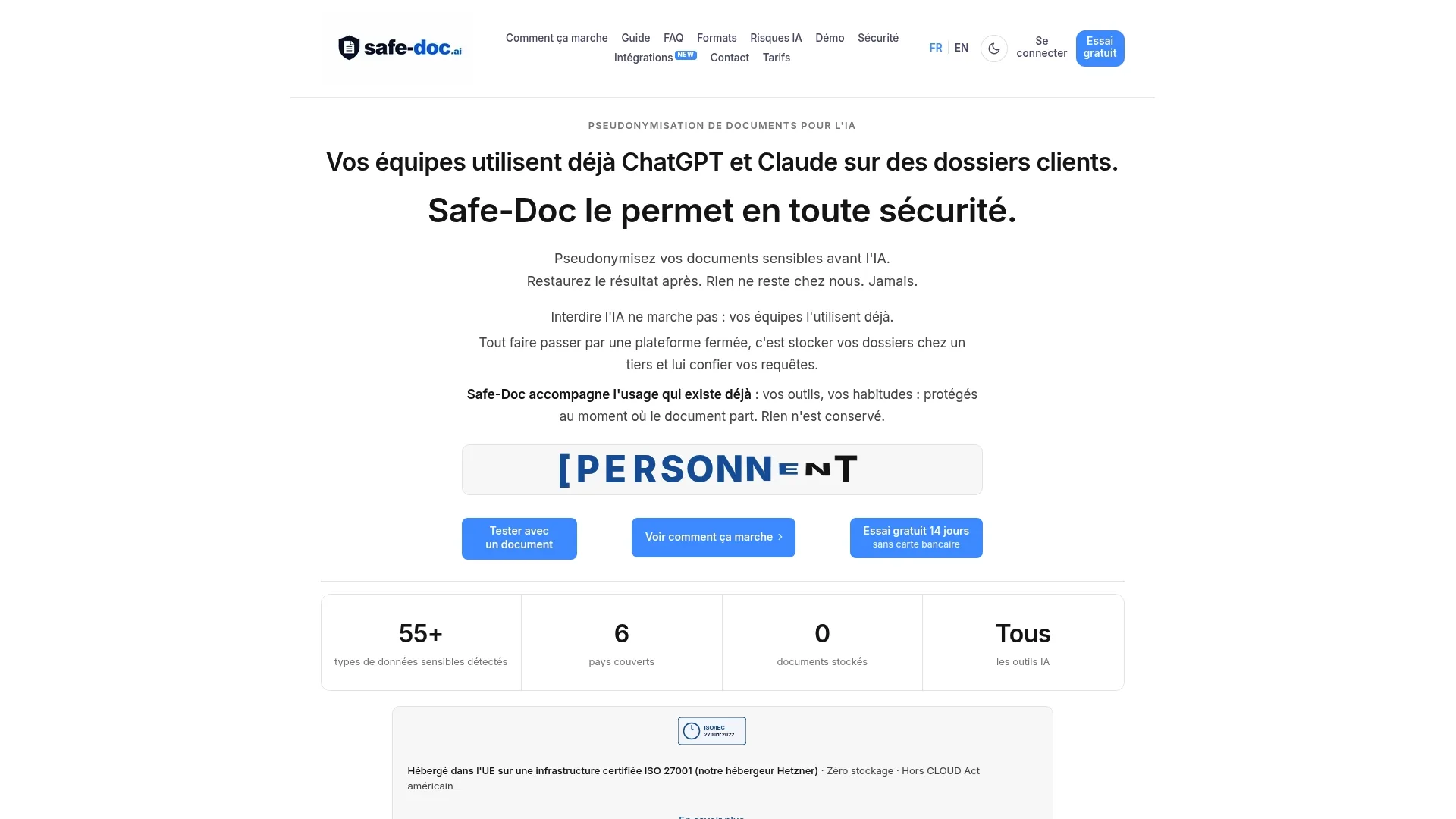
Managing the confidentiality of consulting deliverables while using AI tools has become a daily constraint. Safe-doc addresses this specific problem: the platform pseudonymizes sensitive documents before any AI processing, without durably storing files. The consultant maintains working habits with ChatGPT or Claude, and client data remains protected in real time. Safe-doc is GDPR-compliant and produces audit trail documentation usable in the event of an audit or dispute. For firms handling sensitive documents, financial reports, or personal data, it's a layer of protection that integrates frictionlessly into existing processes.
Frequently asked questions
What is a consultant's confidentiality obligation?
A consultant's confidentiality obligation is the set of legal and contractual commitments requiring protection of clients' sensitive information. It combines GDPR compliance, NDA contractual clauses, and, depending on the sector, professional privilege.
Why protect client data in a consulting engagement?
A data breach exposes the consultant to financial penalties up to €20 million and irreparable loss of client trust. Data protection is also a selling point with demanding B2B clients.
How to mask proprietary information before using AI?
Pseudonymization is the recommended method: it replaces identifying data with pseudonyms before any processing by an AI tool. Safe-doc automates this step in real time, without storing documents.
What is the deadline for notifying the CNIL in the event of a data breach?
Notification to the CNIL must occur within 72 hours of becoming aware of the breach. This deadline is set by the GDPR, and failure to comply can increase penalties.
How to manage confidentiality in a multi-client firm?
Each client must be subject to a separate confidentiality agreement, with an annex specifying covered data. Subcontractors common to multiple engagements must be documented in a register updated annually, in accordance with Article 28 of the GDPR.