

When properly protected, personal data stops being a legal constraint and becomes a commercial asset. A robust compliance framework shortens sales cycles, accelerates tender responses, and reduces customer churn. The competitive and customer-relationship benefits of data protection become tangible the moment a B2B buyer demands proof before signing.
Three signals appear consistently in customer evaluation grids:
- a completed DPIA with an available summary;
- ISO 27701 certification or equivalent framework;
- an audit report or attestation from an independent third party.
GDPR compliance is no longer an administrative burden. It has become an argument that sales teams use to close deals faster, without compromising on security.
Companies that structure this evidence typically observe shorter sales cycles, higher conversion rates on sensitive tenders, and reduced churn among accounts handling high-risk data.
Key points
Data protection becomes a measurable commercial advantage when it translates into audited evidence, shorter sales cycles, and reduced churn.
| Point | Details |
|---|---|
| - | - |
| Evidence library | Consolidate DPIAs, certificates, and standard clauses to respond faster to tenders. |
| Risk-based prioritization | Focus compliance efforts on the highest-stakes customer segments and contracts. |
| Credible signals | Display ISO 27701, published DPIA, and third-party audit attestations with scope and date. |
| Tracking KPIs | Measure pre-sales cycle, conversion rate, and churn to guide your actions. |
| Operational pseudonymization | Safe-Doc pseudonymizes sensitive documents in real time, without storage, to secure AI usage. |
Table of contents
- Data protection benefits for competitiveness and customers: the mechanisms at work
- What are the direct benefits for customer acquisition and retention?
- What costs and risks does good data protection prevent?
- What trust signals should you display to your customers?
- How to turn compliance into a concrete commercial advantage?
- Pseudonymization: a technical measure with strong commercial impact
- How to present data protection to your customers and prospects?
- Secure your sensitive documents without changing your AI habits
- Sources
Data protection benefits for competitiveness and customers: the mechanisms at work
Data protection creates value through three distinct channels, and conflating them often leads to poorly targeted investments. The first is customer trust: a buyer who sees a published DPIA or displayed certification reduces their supplier evaluation time. The second involves commercial friction in pre-sales: each unanswered security question delays a signature, sometimes by several weeks. The third, more subtle, touches operational efficiency: well-conducted data mapping often reveals unnecessary storage volumes and costly duplicates.

This last point deserves attention. A data inventory, conducted according to the method recommended by the ministerial guide on identifying sensitive data, serves two purposes at once: it reduces legal exposure and it lightens infrastructure costs by eliminating data retained without a clear purpose.

Pro tip: don't aim for maximum compliance everywhere. Prioritize your actions [based on](https://www.sirion.ai/library/contract-insights/contract-risk-prioritization-frameworks/) customer segment (large, demanding accounts versus SMEs) and actual contractual risk, otherwise you'll invest time on low-stakes processing while real points of commercial friction remain unaddressed.
What are the direct benefits for customer acquisition and retention?
On acquisition, a reusable evidence library-DPIA summaries, standard clauses, certificates-changes the dynamics of a tender. Instead of drafting a bespoke security response each time, the sales team draws from already-validated documents. This often saves several days on a decision cycle.
On retention, properly collected consent and a clean contact database improve email campaign deliverability and marketing engagement quality, two effects confirmed by the EDPB on its page dedicated to data protection benefits for SMEs.
On reputation, how a company communicates after an incident weighs as heavily on brand trust as the incident itself.
A sector study cited by Proton for Business shows that a significant proportion of executives now consider proving secure data management essential to winning new business, a figure confirming that security has moved from hidden cost to purchasing criterion.
- Accelerated acquisition through ready-to-use evidence.
- Strengthened retention through consenting, clean contact databases.
- Protected reputation through transparent incident management.
What costs and risks does good data protection prevent?
A security incident rarely costs just one thing. It costs the potential fine, the internal investigation, crisis communication time, and often the customer who doesn't renew. A properly conducted DPIA, combined with risk-proportionate measures, reduces both the likelihood of an incident occurring and its impact when it does occur. The CNIL reminds us on its page dedicated to data security that information security and privacy protection reinforce each other, with methodology and templates available to structure the approach.
Cost items to anticipate in case of breach:
- fines and administrative sanctions;
- technical and legal investigation costs;
- loss of existing customers after the incident;
- crisis communication and reputation management.
Minimum checklist before any high-risk processing:
1. inventory the data processed and their sensitivity;
2. map flows and subprocessors involved;
3. deploy risk-proportionate technical measures;
4. contractualize GDPR obligations with each subprocessor.
What trust signals should you display to your customers?
Not all signals carry equal weight. ISO 27701 certification involves a third-party organization and an audited scope. A one-off audit attestation proves a state at a given point in time. A simple privacy policy posted on a website, however, only binds the company itself, and savvy buyers know this.
The most credible signals in B2B remain AFNOR's Privacy Tech certification, a published DPIA summary, and an independent third-party audit attestation. An ISO 27701 certificate without a specified scope reassures no one, whereas a document indicating which modules are covered and the certificate issue date becomes verifiable.
Pro tip: systematically add the scope and validity date to each signal displayed. An experienced B2B buyer checks these two details before trusting the rest of the document.
How to turn compliance into a concrete commercial advantage?
Compliance only becomes a commercial advantage when translated into visible actions, not simply a box checked. Here's the sequence that works best in practice:
1. Map and classify processed data by sensitivity.
2. Deploy technical and organizational measures proportionate to the identified risk.
3. Conduct a DPIA for each high-risk processing activity.
4. Build a reusable evidence library for tender responses.
5. Train sales and legal teams on these documents so they actually use them.
This practical approach, described notably by Mdp-data, emphasizes an often-overlooked point: compliance evidence unused by sales teams is worthless. It must live in the sales process.
Pro tip: start with just three metrics-pre-sales cycle duration, conversion rate on sensitive tenders, churn rate-and tie each compliance action to one of these three figures. You'll quickly learn what works.
Pseudonymization: a technical measure with strong commercial impact
Pseudonymization replaces identifying data with reversible identifiers, unlike anonymization which makes any restoration impossible. This distinction matters: in an M&A data room or sensitive HR processing, you often need to retrieve the original identity later, which only pseudonymization permits.
Concrete use cases abound: analysis of an occupational health file by AI without exposing the employee's identity, review of an M&A data room by multiple external stakeholders, or processing of confidential legal documents without exposing mentioned third parties.
Points of vigilance not to neglect:
- maintain a reliable mapping to restore data when necessary;
- log each operation to enable later audit;
- verify that restoration keys remain separate from pseudonymized documents.
How to present data protection to your customers and prospects?
Format matters as much as content. A public DPIA summary, a product sheet specifying the exact processing scope, or a standard contractual clause integrated directly into the commercial offer convince far more than a generic privacy policy buried in jargon.
A simple, verifiable sentence works better than a vague statement. Rather than "we take security seriously," prefer "our data is pseudonymized before any third-party AI processing, with no residual storage." Practical feedback, notably that relayed by Jelenote, shows that this clarity directly improves conversion and contact database quality.
- Public, searchable DPIA summaries.
- Standard contractual clauses integrated into offers.
- Evidence library exportable in a few clicks to accelerate pre-sales.
A strategic investment, not a box-ticking exercise
Companies that treat data protection as a cost center miss its true potential. Those that translate it into concrete evidence observe shorter pre-sales cycles and faster audit responses. Best practice is to test these signals as you would a commercial offer: measure, adjust, repeat.
Secure your sensitive documents without changing your AI habits
Your teams already use ChatGPT or Claude on HR, legal, or financial files, often without a dedicated protection layer. Safe-Doc pseudonymizes these documents in real time, never storing them, before they circulate to a third-party AI.
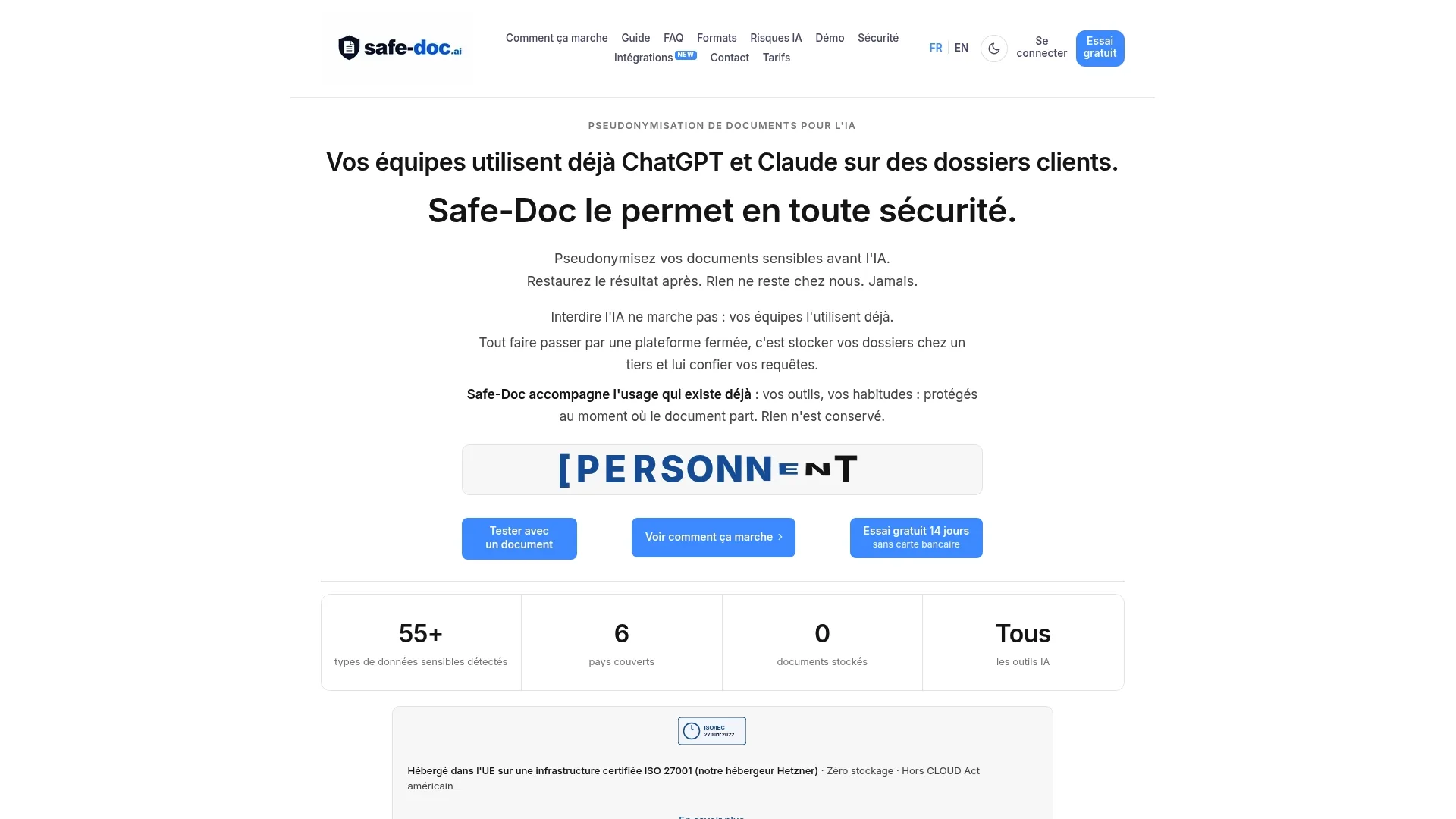
Three immediate commercial benefits flow from this approach: fewer pre-sales objections from customers asking specific questions about AI processing of their data, secure data rooms during sensitive operations, and demonstrable GDPR compliance at each processing stage, with mapping export to restore original data when needed. Stateless mode and auditability via PDF report reinforce this proof for demanding customers.
Discover the Safe-Doc pseudonymization solution for your DPO and legal teams and test how it integrates with your existing workflows.
Sources
To explore each point discussed in greater depth, several references remain essential:
- User guide for identifying sensitive data - Ministry (DGE)
- The security of data as a differentiator - Proton for Business
- Mdp-data
This article constitutes general information and does not replace advice from a qualified lawyer. Consult a qualified legal professional about your specific case before acting on this content.