

Confidential legal documents encompass all acts, contracts, and opinions protected by legal or contractual secrecy obligations, the disclosure of which exposes a company to major financial, strategic, and reputational risks. Law No. 2026-122 of 23 February 2026 strengthened this framework by granting explicit protection to in-house counsel consultations, directly impacting the 20,000 in-house lawyers in France. Mastering the types of confidential legal documents is no longer optional for legal professionals and executives: it is a compliance and risk management requirement. This article details each category, its protection conditions, and best practices for securing these confidential legal documents.
1. Internal legal consultations
An internal legal consultation is a written opinion prepared by a qualified in-house lawyer, applying legal reasoning to a specific business situation. The law of 23 February 2026 grants it explicit protection, subject to strict cumulative conditions. This document cannot be seized or disclosed to third parties in civil, commercial, or administrative proceedings.
To qualify for protection, the consultation must bear the mandatory confidentiality notice, originate from a qualified lawyer, and constitute a personalized legal analysis service. A simple strategic memo or commercial note does not meet these criteria. Substance prevails over form: the judge evaluates the actual content of the document, not merely the label affixed to it.

2. Non-disclosure agreements (NDAs)
A non-disclosure agreement (NDA) is a contract by which one or more parties agree not to disclose confidential information defined in the document. It precisely specifies the duration of protection, the scope of information covered, and the automatic financial penalties in case of breach. The NDA is the most widely used contractual tool for securing strategic information during negotiations, partnerships, or due diligence.
An often-overlooked point: the NDA does not require financial consideration to be legally valid, unlike a non-compete clause. This feature makes it accessible and quick to implement, even in urgent situations. Lawyers must take care to precisely define the categories of protected information to prevent any subsequent disputes.
3. Sensitive contracts
Employment contracts, commercial agreements, and partnership contracts regularly contain sensitive data: compensation, financial terms, exclusivity clauses, or proprietary technologies. These documents fall under document confidentiality whenever they include information whose disclosure would cause harm to one of the parties. Their protection relies on both internal contractual clauses and GDPR requirements when personal data is involved.
Managing these contracts requires strict access control. Only employees directly involved in the contract's execution should have access to it. Any uncontrolled internal distribution already constitutes a confidentiality breach.
4. Strategic documents and minutes
Management reports, board minutes, internal memos, and strategic plans form a distinct category. These documents are not always covered by an explicit legal obligation, but their disclosure can cause considerable harm. Board minutes revealing an imminent acquisition or restructuring expose the company to risks of insider trading or loss of competitive advantage.
Classifying these documents into confidentiality levels (Public, Internal, Confidential, Highly Confidential) structures their protection. Four labeling levels are commonly used to automate security measures associated with each category. This approach reduces human error and standardizes practices across teams.
5. Archives and documents subject to regulatory retention
Certain legal documents must be retained for legally defined periods: commercial contracts (five years), accounting documents (ten years), intellectual property records (variable duration). Throughout this period, their confidentiality must be maintained. Secure digital archiving with timestamping and encryption reinforces the probative value of documents and protects against accidental disclosure.
A poorly archived document loses its evidentiary force in case of dispute. Complete traceability of access and modifications constitutes a minimum requirement for any document subject to regulatory retention.
How to protect the confidentiality of these documents?
The protection of sensitive legal documents rests on three pillars: classification, technical measures, and internal procedures.
Classification and labeling
Confidentiality labeling automates document protection by triggering actions such as watermarking or encryption as soon as a document is classified. The GDPR mandates encryption and access control as legal accountability measures. Level-based classification facilitates the implementation of security policies adapted to each document type.
Technical measures
1. End-to-end encryption: protects content from unauthorized access, including in case of media theft.
2. Granular access control: limits access to each document to authorized individuals only, with differentiated rights (read, edit, share).
3. Multi-factor authentication: reduces the risk of fraudulent access to document systems.
4. Tamper-proof timestamping: certifies the date of creation and modification of a document, essential for its evidentiary value.
5. Qualified electronic signature: gives the document legal force equivalent to a handwritten signature.
Pro tip: Enable access logging on all documents classified as Confidential or Highly Confidential. In case of dispute, this log constitutes the first component of your evidentiary file.
Internal procedures
Traceability of exchanges, precise identification of transmitted documents, and rigorous timestamping form the foundation of a solid evidentiary file in case of breach. These procedures must be formalized in an internal document policy, known and applied by all relevant employees.
What are the legal conditions for confidential legal consultations?
The law of 23 February 2026 defines cumulative conditions for a consultation to benefit from legal protection. These conditions relate to three dimensions: the author, the content, and the form.
Conditions relating to the author
- The lawyer must hold a master's degree in law or a recognized equivalent qualification.
- They must practice under the supervision of a legal manager within the company.
- Training in the ethical rules of the profession is mandatory.
Conditions relating to the content
- The consultation must constitute a personalized analysis service of the law applicable to a specific case.
- It must aim to inform a concrete business decision.
- A simple strategic or commercial document does not meet this criterion.
Conditions relating to form
- The confidentiality notice must appear explicitly on the document.
- The document must be classified and tracked in a system allowing its identification.
"The confidentiality of legal consultations relies as much on the quality of intellectual reasoning as on compliance with legal and organizational formalities. The formal mention alone is not sufficient: the judge evaluates the substance of the document."
Important limitations
The protection does not apply to criminal or tax proceedings. It may also be waived by the company itself for purposes of defense or negotiation. Lawyers and executives must integrate these limitations into their risk management.
Which documents pose the greatest risks if disclosed?
NDAs and internal legal consultations concentrate the highest risks. Their breach exposes the company to contractual penalties, loss of competitive advantage, and lengthy, costly legal proceedings.
- NDA breach: triggers the civil liability of the defaulting party and activates the penalties provided in the contract. Proof of breach requires a documented evidentiary file with timestamping and traceability of exchanges.
- Leaked legal consultation: can deprive the company of its legal protection and expose its legal strategy to adverse parties.
- Disclosure of sensitive contracts: reveals confidential commercial terms and weakens the company's negotiating position.
- Unauthorized access to minutes: creates a risk of insider trading or information manipulation.
Pro tip: Maintain a register of confidential documents transmitted to third parties, with date, recipient, and purpose. This register becomes your primary evidentiary tool in case of dispute.
The difficulty in proving fault and causal link in case of breach justifies rigorous document management from the moment of document creation. Data breaches demonstrate that vulnerabilities often stem from inadequate internal practices, not solely from external attacks.
Digital solutions for secure management
Modern secure document management tools combine archiving, traceability, and encryption in a coherent architecture. The table below presents key features to look for based on document sensitivity level.
| Feature | Primary utility | Priority level |
|---|---|---|
| End-to-end encryption | Protects content in transit and at rest | Essential |
| Tamper-proof timestamping | Certifies the date and integrity of the document | Essential |
| Granular access control | Limits access to authorized persons | Essential |
| Qualified electronic signature | Confers legal force on the document | Recommended |
| Multi-factor authentication | Reduces fraudulent access | Recommended |
| Access logging | Constitutes the evidentiary file | Recommended |
| Automatic classification | Triggers appropriate protections | Useful |
Pseudonymization of personal data contained in legal documents adds a layer of GDPR-compliant protection. It enables the use of analysis tools, including artificial intelligence tools, without exposing identifying information. Processing sensitive documents without storing raw data is now a recognized best practice.
Team training remains the often-neglected link. A well-designed document policy fails if employees cannot identify a confidential document or do not understand the consequences of improper handling.
Key points
Effective protection of confidential legal documents requires rigorous classification, appropriate technical measures, and formalized internal procedures, in compliance with the GDPR and the law of 23 February 2026.
| Point | Details |
|---|---|
| Five main categories | Legal consultations, NDAs, sensitive contracts, strategic documents, and regulatory archives cover the essential scope. |
| Strict legal conditions in 2026 | The law of 23 February 2026 imposes cumulative criteria on the author, content, and form to protect legal consultations. |
| Level-based classification | Four labeling levels automate protections and reduce human error in document management. |
| Essential evidentiary file | Timestamping, traceability, and access logging form the basis of any defense in case of confidentiality breach. |
| Pseudonymization and GDPR | Pseudonymization of personal data enables the use of analysis tools without exposing sensitive information. |
My perspective on the evolution of document protection in 2026
The law of 23 February 2026 marks a genuine turning point for French in-house counsel. After years of debate about French legal privilege, companies finally have a clear legal framework. But this framework also creates a dangerous illusion: that the confidentiality notice alone is sufficient to protect a document.
What I observe in practice is that the majority of vulnerabilities do not come from external attacks. They come from within: a document sent by email without encryption, a consultation shared in an unsecured artificial intelligence tool, access granted by habit rather than necessity. The law protects legal content, not human behavior.
Technical and legal integration is the real priority for 2026. Lawyers must work with IT teams to ensure that document systems automatically apply defined protection levels. A lawyer should not have to remember to manually encrypt each consultation. The system must do it for them.
The issue of Shadow AI deserves particular attention. Employees use artificial intelligence tools to analyze confidential documents, often without protection measures. This practice circumvents all existing document policies. Protection practices in the use of AI with sensitive documents must become a governance priority, not a secondary technical matter.
- Jacques
Safe-Doc: protect your confidential legal documents with AI
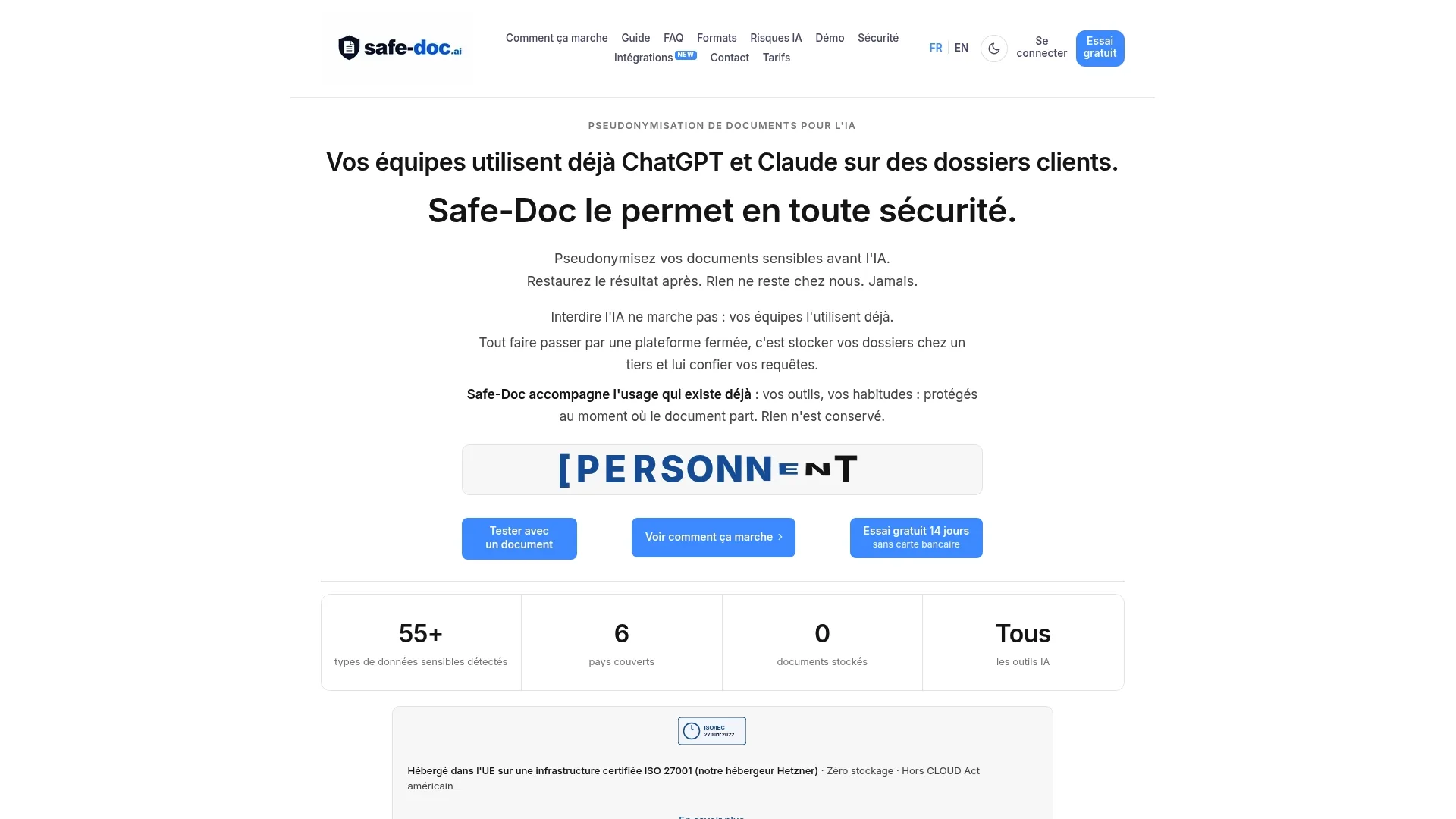
Legal professionals and executives who use artificial intelligence tools to analyze their confidential documents face real risks if these tools do not guarantee the confidentiality of processed data. Safe-Doc addresses this problem precisely: the platform pseudonymizes sensitive information before any AI processing, without durably storing the documents. Your teams maintain their working habits while complying with the GDPR and the requirements of the 2026 law. The solution dedicated to DPOs offers pseudonymization, compliance, and auditability in a zero-storage architecture. To understand how this real-time protection works, the dedicated page details each step of secure processing.
Frequently asked questions
What is a confidential legal document?
A confidential legal document is an act, contract, or opinion protected by a legal or contractual secrecy obligation, the disclosure of which exposes its holder to civil penalties or strategic harm. The law of 23 February 2026 extended this protection to in-house counsel consultations under strict conditions.
What types of legal documents are the most sensitive?
Internal legal consultations, NDAs, and contracts containing financial or strategic data are the most sensitive documents. Their disclosure triggers civil liability and may compromise the company's competitive position.
How to secure confidential legal documents?
Security is based on encryption, granular access control, tamper-proof timestamping, and classification by confidentiality levels. Pseudonymization of personal data adds GDPR-compliant protection for processing involving artificial intelligence tools.
Does confidentiality of legal consultations always apply?
No. The law of 23 February 2026 explicitly excludes criminal and tax proceedings from the scope of protection. The company may also waive confidentiality itself for purposes of defense or negotiation.
What is an evidentiary file in case of NDA breach?
An evidentiary file gathers all documented evidence of a breach: timestamping of exchanges, access logs, precise identification of transmitted documents, and traceability of communications. This file is essential for establishing fault and causal link before a court.