


GDPR compliance of court documents means rigorously applying data protection principles at every stage of processing-from evidence collection through presentation in court. This framework binds all legal professionals and companies handling personal data in litigation. The General Data Protection Regulation, in force since 2018, applies fully to documents produced in court, subject to exemptions for criminal authorities. The CNIL monitors compliance and can sanction violations independently of any judicial decision.
Table of Contents
- What are the key GDPR principles for processing court documents?
- How does 2026 case law govern admissibility of non-compliant court documents?
- What are best practices to ensure GDPR compliance when preparing court documents?
- What specific challenges do legal teams face in GDPR compliance?
- Key takeaways
- What fifteen years of GDPR tracking taught me about court documents
- Safe-doc supports legal professionals in GDPR compliance
- Frequently asked questions
- Further reading
What are the key GDPR principles for processing court documents?
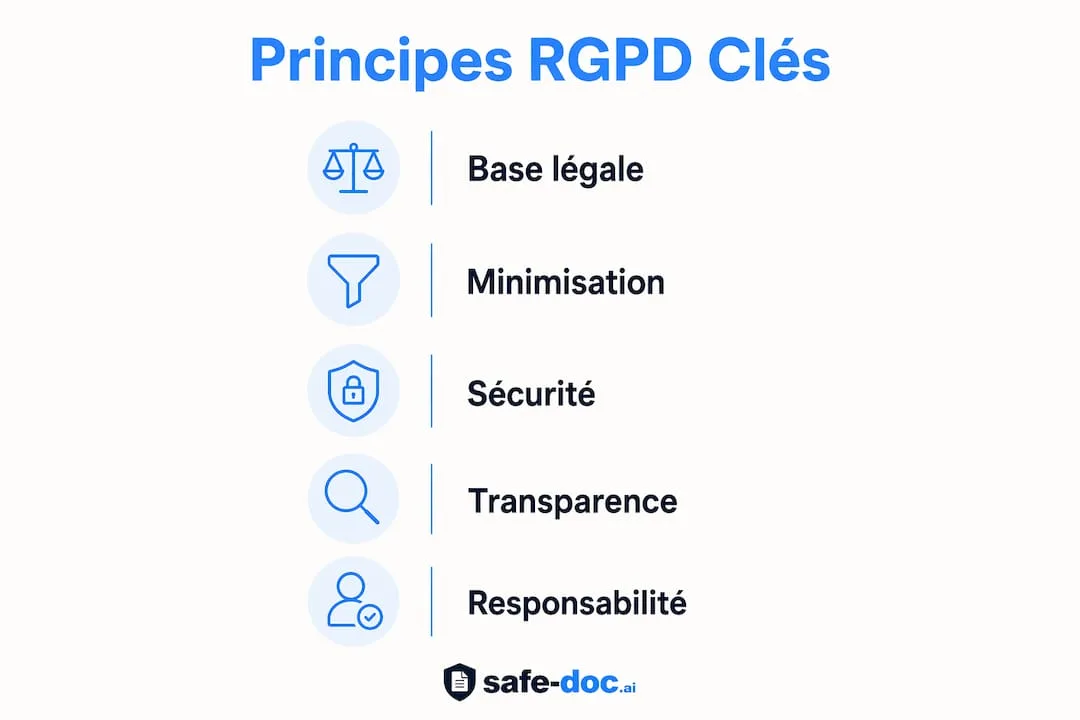
Legal basis is the first pillar of GDPR compliance for any court document. Article 6 of the GDPR requires you to identify the applicable legal ground before processing: performance of a legal obligation, legitimate interest, or contract performance. Without a clearly established legal basis, the processing is unlawful-even if a judge admits the document.
The principle of data minimization applies with equal rigor. Only data strictly necessary for the judicial purpose may appear in transmitted documents. An employment tribunal file containing information about third parties not involved in the dispute violates this principle, even if the information seems harmless.

Proportionality and purpose limitation also govern each processing operation. Data collected for one proceeding cannot be reused in another dispute without a new legal basis. This compartmentalization is often neglected by legal teams working on multiple files simultaneously.
The right of access for data subjects applies in the judicial context as well. An employee may request access to personal data in a case file. This request obliges the employer to prepare documents in advance, redacting third-party data.
- Legal basis (Art. 6 GDPR): identify the legal ground before any processing.
- Minimization: transmit only data essential to the proceeding.
- Proportionality: calibrate the volume of data against the specific purpose.
- Purpose limitation: do not reuse data collected for another dispute.
- Right of access: anticipate requests by preparing redacted versions.
Pro tip: Draft a specific processing record for each court case. This record documents the legal basis, data categories processed, and redaction measures applied. It's your first line of defense during a CNIL inspection.
How does 2026 case law govern admissibility of non-compliant court documents?
The Court of Justice of the European Union clarified in June 2026 the conditions under which evidence from non-GDPR-compliant processing may nevertheless be used in court. The CJEU ruling of June 2026 sets two cumulative conditions: the evidence must be indispensable, and its use must be proportionate to the fundamental rights at stake.
Evidence admitted by a judge despite unlawful origin does not mean immunity from CNIL sanctions. Judicial admissibility and GDPR liability of the data controller are two distinct questions governed by separate legal regimes.
The judge's role is central to this framework. The magistrate applies a two-step test: first verifying whether the evidence is indispensable to resolving the dispute, then assessing whether its use respects the proportionality principle. This test leaves considerable discretion, making file preparation all the more critical.
The distinction between judicial admissibility and GDPR liability is fundamental. The GDPR does not prohibit producing evidence containing personal data, but it does require a solid legal basis and effective processing compliance. A company may have evidence admitted in court while simultaneously receiving a CNIL warning for the same processing.
On 3 June 2026, the Versailles Court of Appeal issued a particularly instructive employment law decision. It imposed mandatory redaction of non-essential data when communicating personal documents in employment disputes. This ruling confirms that redacting third-party data is no longer optional but a procedural obligation.
Criminal judicial authorities benefit from a partial GDPR exemption, but remain subject to the Data Protection Act and CNIL principles of lawfulness, fairness, transparency, and proportionality. This exemption does not relieve companies and lawyers who transmit documents to criminal authorities from meeting their own GDPR obligations.
What are best practices to ensure GDPR compliance when preparing court documents?
Pseudonymization and redaction are the two most effective techniques for securing judicial data before transmission. Pseudonymization replaces direct identifiers with codes, allowing work on data without exposing data subjects. Redaction permanently masks irrelevant information in transmitted documents.
Here are the steps to prepare a GDPR-compliant court document:
1. Identify personal data in each document, including indirectly identifying data such as file numbers or business addresses.
2. Apply the minimization test: delete or mask any data not strictly necessary for the demonstration sought in the proceeding.
3. Document each processing operation in the register of processing activities, specifying the legal basis, purpose, and security measures applied.
4. Involve the DPO from the design phase of the evidence file, before documents are gathered. Legal certainty rests on anticipation: involving the DPO upstream prevents evidence from becoming a risk during CNIL review.
5. Trace each transmission with a timestamp and written justification, in accordance with CNIL requirements.
The CNIL requires that GDPR documents be centralized, timestamped, and justified to demonstrate compliance during inspection. A living register of processing activities, updated for each new proceeding, constitutes the strongest documentary proof during an audit.
| Step | Technique | Recommended tool |
|---|---|---|
| Data identification | Manual or automated analysis | Document processing software |
| Redaction | Masking or deletion | Pseudonymization platform |
| Documentation | Processing register | GDPR SaaS solution |
| Secure transmission | Encryption and traceability | Sovereign platform |
| Audit | Timestamping and logging | Integrated compliance tool |
The shift from manual processes to GDPR SaaS platforms is decisive for securing and tracking compliance of court documents. These solutions enable continuous procedure updates and automatic traceability of each action.
Pro tip: Never process a court document containing personal data through a consumer AI tool without prior pseudonymization. The risk of exposing data to an unauthorized third party constitutes an immediate GDPR violation, regardless of the judicial outcome.
What specific challenges do legal teams face in GDPR compliance?
Managing the right of access is the most common challenge. Employee access rights to professional personal data are nearly automatic in employment tribunal litigation. Legal teams must prepare redacted versions of files before the request is even made, requiring rigorous document organization from the case opening.
The main challenges encountered in practice are:
- Cross-department coordination: legal teams, the DPO, and IT departments often work in silos. GDPR compliance of court documents requires structured collaboration among all three from the start of each proceeding.
- Double-sanction risk: evidence admitted by a judge may simultaneously expose the company to CNIL sanctions. Legal teams often underestimate this risk, conflating judicial admissibility with GDPR compliance.
- Rapid regulatory evolution: June 2026 rulings by the CJEU and Versailles Court of Appeal changed practices within months. Teams that don't follow case law developments take real procedural risks.
- Uncontrolled AI tool use: staff frequently use consumer AI tools to analyze or draft court documents. This phenomenon, known as Shadow AI, exposes parties' personal data to non-GDPR-compliant processing.
- Archiving and retention periods: court archives must respect specific retention periods. Retaining data beyond the necessary period violates the storage limitation principle.
Modern digital tools drastically reduce training time and facilitate subcontractor risk assessment. This reduction in training time concretely improves legal teams' GDPR governance-provided the chosen tools are themselves compliant.
Key takeaways
GDPR compliance of court documents rests on three non-negotiable requirements: a documented legal basis, redaction of non-essential data, and traceability of each processing operation.
| Point | Details |
|---|---|
| Mandatory legal basis | Identify the Article 6 GDPR ground before processing any court document. |
| Systematic redaction | Mask all data not essential to the proceeding before any transmission. |
| Double-sanction risk | Judicial admissibility does not exclude CNIL sanctions for the same processing. |
| Upstream DPO | Involve the DPO from evidence file design, not after an incident. |
| Documented traceability | Centralize, timestamp, and justify each processing operation to demonstrate compliance during inspection. |
What fifteen years of GDPR tracking taught me about court documents
Most incidents I've observed don't stem from GDPR ignorance. They come from a mistaken belief: that judicial urgency justifies bypassing compliance procedures. This logic is both wrong and costly.
What I've observed repeatedly is that legal teams who involve the DPO at case opening almost never receive CNIL warnings. This is no accident. Preventive documentation transforms each processing step into proof of good faith.
The 2026 jurisprudential evolution sends a clear signal: judges and supervisory authorities are converging toward a requirement for effective, not merely formal, compliance. Producing an empty or generic processing register protects no one anymore. Recent decisions show magistrates now examine the actual quality of redaction measures applied.
My most concrete advice: treat every court document containing personal data as if the CNIL will audit it tomorrow. This posture radically changes how teams prepare files, and it eliminates the vast majority of procedural risks before they arise.
- Jacques
Safe-doc supports legal professionals in GDPR compliance
Legal teams that process sensitive documents with AI tools expose themselves to concrete GDPR risk if those tools don't pseudonymize data upstream.

Safe-doc solves this problem by automatically pseudonymizing court documents before AI processing, without durably storing files. The platform generates complete traceability of each operation, directly meeting CNIL documentation requirements. Legal teams keep their usual tools-ChatGPT, Claude-while remaining within the GDPR framework. The page for legal departments details features adapted to litigation procedures. For DPOs wishing to structure document governance, the Safe-doc DPO solution centralizes pseudonymization, audit, and traceability in a single environment.
Frequently asked questions
Does the GDPR prohibit producing personal evidence in court?
No. The GDPR does not prohibit producing evidence containing personal data, but it requires a solid legal basis and effective processing compliance. Judicial admissibility and GDPR compliance are two separate questions.
What is redaction in a court document?
Redaction means masking or deleting personal data not essential to the proceeding before transmitting a document. The Versailles Court of Appeal confirmed in June 2026 that this practice is an obligation, not an option.
Can evidence admitted by a judge still trigger CNIL sanctions?
Yes. Judicial admissibility of evidence does not exempt the data controller from GDPR liability. The CNIL may sanction unlawful processing independently of the court's decision.
When should the DPO be involved in preparing a court file?
The DPO must be involved from the evidence file design phase, before collecting documents. Late intervention limits the DPO's ability to prevent violations and document measures taken.
How do I pseudonymize a court document before AI analysis?
Pseudonymization replaces direct identifiers (names, file numbers, addresses) with neutral codes before the document is transmitted to an AI tool. Safe-doc applies this technique automatically, without storing files, enabling you to use tools like ChatGPT or Claude while remaining GDPR compliant.