


Pseudonymize personal data before any sharing or AI analysis, then entrust the final decision to a human manager: this is the golden rule for handling disciplinary files with assured confidentiality. The GDPR requires a documented legal basis, a limited retention period, and respect for the adversarial principle. Any failure exposes the employer to cancellation of the sanction, or even to employment tribunal litigation.
Priority actions to implement immediately:
- Pseudonymize names, employee numbers, and sensitive data before any transmission or AI analysis
- Communicate the file via a digital vault rather than by email
- Maintain a time-stamped access log for each consultation of the file
- Archive in an encrypted space with a defined retention period and a purge procedure
Confidentiality is an inviolable rule in disciplinary procedures; institutions maintain a register of anonymized sanctions to guarantee consistency and confidentiality.
Table of contents
- Why a disciplinary data breach can prove very costly
- What steps must be followed to create a secure disciplinary file?
- Pseudonymization or anonymization: what is the difference for HR?
- What technical methods can be used to pseudonymize HR documents?
- How to integrate pseudonymization into your HR workflow?
- GDPR and CNIL compliance checklist before any disciplinary processing
- What criteria for choosing a suitable pseudonymization solution?
- Practical example: from notification to secure archiving
- Key points
- Automation does not replace judgment: an expert conviction
- Safe-doc protects your disciplinary files without changing your tools
- Sources and recommended reading
Why a disciplinary data breach can prove very costly
A poorly secured disciplinary procedure generates three types of cumulative risks. First, the outright cancellation of the sanction: any procedural failure-untraced access, unprotected file transmission, deadline not respected-is sufficient to overturn the decision before an employment tribunal. Second, the violation of professional secrecy, the scope of which is much broader than many realize.
Case law defines professional secrecy broadly: it covers "everything that has been learned, understood, known, or guessed" in professional practice.
Finally, GDPR sanctions. Processing without a data protection impact assessment (DPIA), with untraced access, or unnecessary storage of sensitive data may render the employer liable before the CNIL. Disclosure of a sanction to colleagues or third parties without justification also constitutes an invasion of privacy giving rise to damages before the labor court.
Three risks to remember:
- Cancellation of the sanction and litigation if the procedure or confidentiality is poorly managed
- Violation of professional secrecy, punishable by one year of imprisonment and a fine of €15,000 under article 226-13 of the Criminal Code
- GDPR sanctions in the absence of a DPIA, untraced access, or disproportionate storage
HR data breaches regularly occur in disciplinary contexts, often through simple negligence in document transmission.
What steps must be followed to create a secure disciplinary file?
The disciplinary procedure follows a strict sequence, each step of which carries its own confidentiality requirements.
1. Factual finding: document the facts with date, location, and precise circumstances. The documents in the file must be time-stamped and allow the individual concerned to consult the file with the responsible officer.
2. Notification to the individual: notify in writing the grievances retained, the right to consult the file, and the right to assistance. No untraced oral communication.
3. Communication of the file: transmit the documents via a digital vault rather than by email, in accordance with official recommendations. Audio recording of a hearing constitutes processing of personal data subject to the GDPR and must be entered in the processing register.
4. Adversarial principle: allow the individual sufficient time to prepare their defense and obtain assistance.
5. Reasoned decision: the final decision rests with the competent authority, which must provide reasons in law and in fact.
6. Secure archiving: store the file in an encrypted space, with a defined retention period and a documented purge procedure.
Pro tip: Pseudonymize copies sent to the individual or their counsel: keep the mapping secure internally so you can reconstruct identity if necessary, but never transmit raw data by email.

Pseudonymization or anonymization: what is the difference for HR?
The GDPR clearly distinguishes the two concepts, and the choice between them has direct practical consequences for the disciplinary procedure.
Pseudonymization replaces direct identifiers (name, employee number, social security number) with codes or tokens, while maintaining a secure mapping allowing identity to be reconstructed. The document remains personal data within the meaning of the GDPR, but its protection is reinforced. This is the approach suited to disciplinary files, because the procedure requires being able to identify the individual at any time during the process.
Anonymization permanently removes any link to identity. Once anonymized, a document falls outside the scope of the GDPR. This is the technique used for sanction registers published or shared for statistical purposes, but it is incompatible with an active procedure that requires reversibility.
The distinction between professional secrecy and duty of discretion has practical consequences: certain information falls under broad secrecy, justifying systematic pseudonymization before any sharing.
To explore the technical implications in greater detail, Safe-doc's page pseudonymization vs. anonymization details the selection criteria according to the purpose of processing.
What technical methods can be used to pseudonymize HR documents?
| Method | Complexity | Reversibility | Human control | Legal risk | Recommended uses |
|---|---|---|---|---|---|
| Assisted manual redaction | Low | No | High | Low if rigorous | Small volumes, spot verification |
| Tokenization | Medium | Yes (with mapping) | Medium | Medium if mapping poorly protected | Automated HR flows |
| Reversible pseudonymization (encryption) | High | Yes (secure key) | High | Low if keys separated | Active disciplinary files |
| Irreversible pseudonymization | Medium | No | Low | Low for archives | Statistical registers, long-term archiving |
Tokenization assigns a unique identifier to each person; the mapping is stored separately, encrypted, with restricted access. Reversible pseudonymization by encryption is best suited to active disciplinary files: it allows controlled re-identification at each procedural step while protecting data in transit.
Points of vigilance:
- The mapping must be encrypted and stored outside the pseudonymized document
- Audit logs must trace each access to the mapping
- Over-pseudonymization can cause loss of context necessary for the decision
How to integrate pseudonymization into your HR workflow?
Technically separating automated processing from the exercise of human judgment substantially reduces the risk that an automated summary will invalidate the procedure. Here is how to structure this workflow.
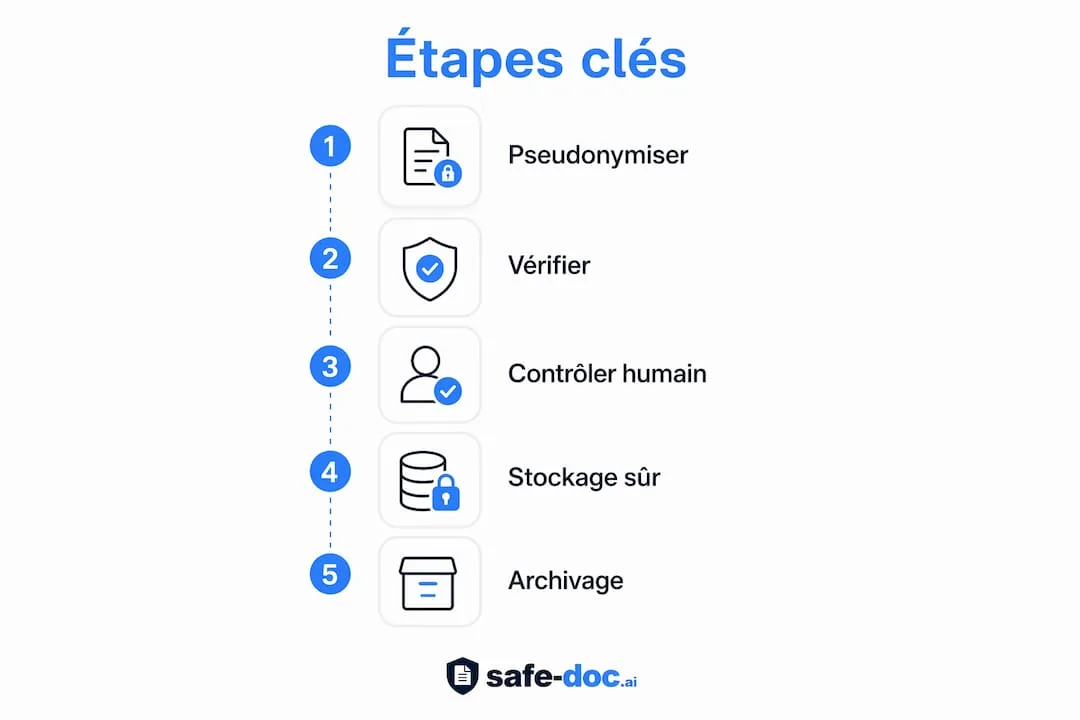
1. Secure ingestion: upload the document in an isolated environment, without an unencrypted local copy.
2. Automatic detection: identify personal data (names, dates of birth, employee numbers, possible medical data).
3. Automatic pseudonymization: replace identifiers with tokens, store the mapping offline or in a separate vault.
4. Human review: the HR manager or lawyer validates the pseudonymization and verifies that no identifying contextual element has been omitted.
5. Analysis or sharing: the pseudonymized document can be transmitted or analyzed by an AI tool without exposing raw data.
6. Final decision: always human. AI can structure, summarize, or compare, but assessment of the legal context remains the exclusive responsibility of the manager.
7. Encrypted archiving: store the final file with the associated access log.
Shadow AI-that is, use of AI tools not approved by teams-is prevented by centralizing all AI access via a pseudonymization layer and maintaining usage logs. Without this layer, raw disciplinary data flows through third-party systems without traceability or control.
Pro tip: Before deploying an AI tool on disciplinary files, verify that the solution applies the principle of [zero storage](https://safe-doc.ai/securite-fr.html): no document must be retained on the service provider's servers after processing.
GDPR and CNIL compliance checklist before any disciplinary processing
Legal framework and documentation:
- DPIA conducted if the processing presents a high risk to the rights of individuals
- Documented legal basis (legal obligation, legitimate interest according to purpose)
- Adapted information notices transmitted to the individual concerned
- Subcontracting agreements with GDPR clauses for any technical service provider
Technical security:
- Location of processing in France or in the European Union
- Data encryption at rest and in transit, key separation
- Time-stamped access log for each consultation or modification of the file
- Leak tests and periodic review of security policy
Governance and training:
- Defined retention policy and documented purge procedure
- Training of managers on the distinction between professional secrecy and duty of discretion
- Processing register updated with the new disciplinary activity
To go further on GDPR obligations applicable to legal data, Safe-doc's GDPR and legal data processing guide covers points specific to HR and legal services.
What criteria for choosing a suitable pseudonymization solution?
Technical security:
- Principle of zero storage: no document retained after processing
- End-to-end encryption, separation of roles between administrators and users
- Location of keys in France or in the European Union
Integration and compatibility:
- Compatibility with existing HRIS and digital vaults
- API available to automate document workflows
- Support for common formats (PDF, Word, emails)
Governance and audit:
- Exportable audit logs for CNIL audits
- Controlled restitution procedure (re-identification on authorized request)
- Documented SLA and legal support available
Practical example: from notification to secure archiving
Here is a sequenced scenario for a disciplinary procedure in an HR department.
1. Finding: the manager writes a dated and time-stamped factual report, transmitted to the HR department via secure internal messaging.
2. Collection of documents: testimonies and evidence are gathered in an encrypted digital file, with a dated list of documents.
3. Pseudonymization: Safe-doc replaces names, employee numbers, and sensitive data with tokens; the mapping is stored in a separate vault.
4. Communication to the individual: the pseudonymized file is transmitted via a digital vault with time-stamped proof of dispatch.
5. Adversarial hearing: the session is documented; any audio recording is entered in the GDPR processing register.
6. Human decision: the competent manager makes the reasoned decision, after legal review. No AI summary replaces this step.
7. Encrypted archiving: the complete file (documents, secure mapping, access log, decision) is archived with a planned purge date.
Key points
GDPR-compliant pseudonymization, combined with human control at every decision-making stage, is the only approach that protects both data confidentiality and the legal validity of the disciplinary procedure.
| Point | Details |
|---|---|
| Pseudonymize before any sharing | Replace direct identifiers before any transmission or AI analysis, keeping the mapping encrypted internally. |
| Respect procedural steps | Finding, notification, adversarial principle, and secure archiving are mandatory under penalty of cancellation of the sanction. |
| Documented GDPR compliance | DPIA, legal basis, access log, and purge policy must be formalized before any processing. |
| Final decision always human | AI structures and summarizes; assessment of facts and the sanction remain the exclusive responsibility of the competent manager. |
| Safe-doc for HR | Safe-doc applies the principle of zero storage and integrates with HR workflows to pseudonymize disciplinary files in real time. |
Automation does not replace judgment: an expert conviction
Pseudonymization and document analysis tools have considerably reduced the processing time for disciplinary files. But a worrying trend is emerging: HR teams delegating not only the formatting but also the interpretation of facts to automatically generated summaries. This is where legal risk concentrates.
An AI summary may miss a mitigating circumstance, misweight a disciplinary history, or ignore an element of context that only an experienced manager perceives. Before an employment tribunal, it is the employer who is accountable for the decision, not the algorithm. Legal responsibility attached to disciplinary sanctions cannot be delegated.
Automation is useful where it excels: detecting personal data, pseudonymizing documents, structuring timelines, generating draft letters. But validating facts, assessing the proportionality of the sanction, and signing the decision: these acts remain irreducibly human. Organizations that forget this expose themselves to costly cancellations, not because the technology has failed, but because they have confused productivity with accountability.
Safe-doc protects your disciplinary files without changing your tools
Your HR teams already use AI tools to save time on writing and document analysis. The problem: without a protection layer, raw disciplinary data-names, sanctions, possible medical data-passes through third-party systems without traceability or control. This is precisely what Safe-doc solves.
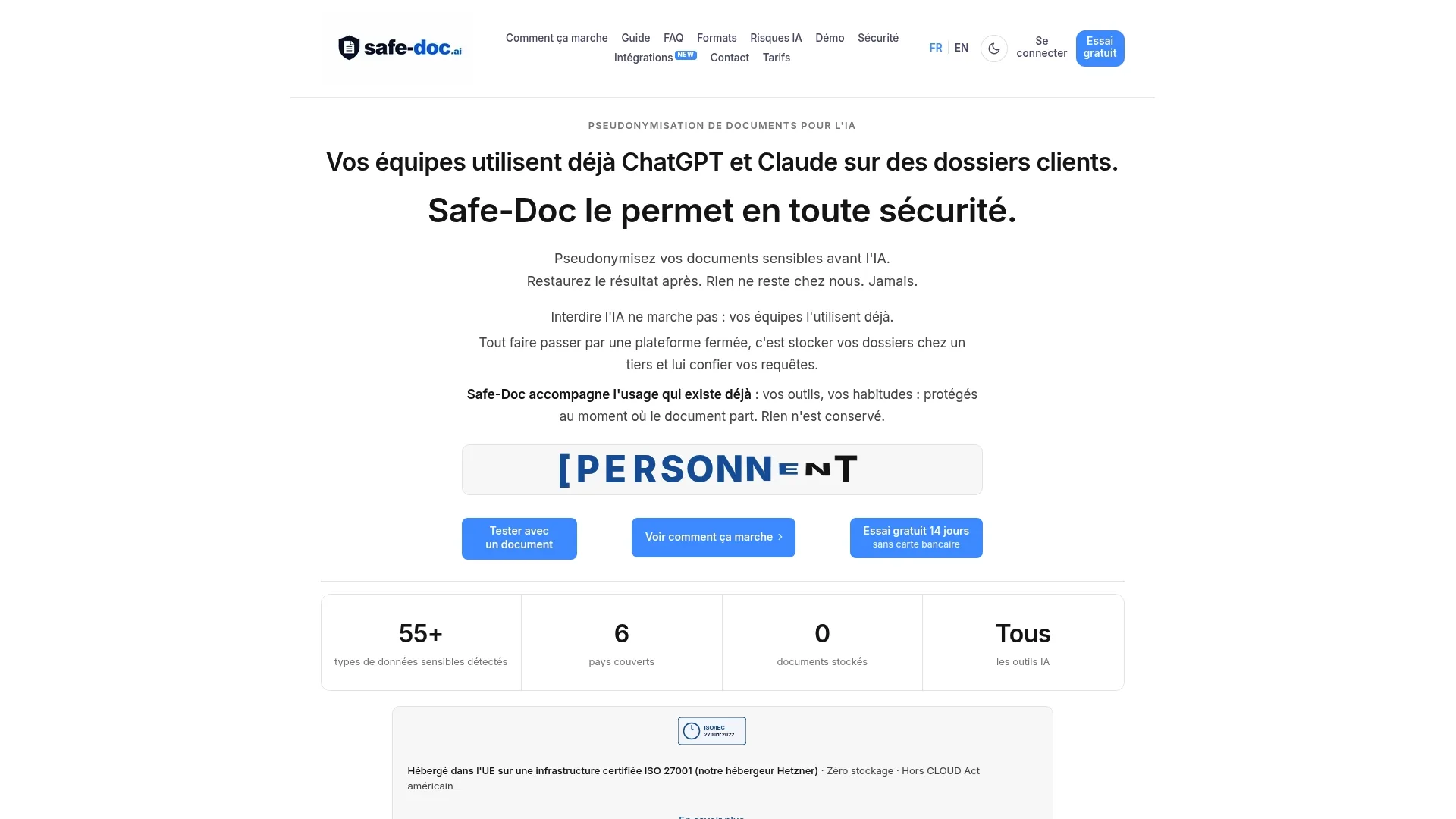
Safe-doc pseudonymizes your documents in real time, without durably storing them on its servers. Zero storage by design ensures that no disciplinary data remains exposed after processing. Access logs are exportable for your CNIL audits, and the solution integrates with existing HRIS and digital vaults. The page dedicated to HR teams presents concrete use cases, and the DPO page details GDPR compliance guarantees for data protection officers. Request a technical demonstration to see how Safe-doc integrates into your current disciplinary workflow.
Sources and recommended reading
- Disciplinary procedures - IH2EF: official reference on steps and the register of anonymized sanctions
- Disciplinary council - IH2EF: documentary requirements and confidentiality of deliberations
- Disciplinary sections procedure guide - DGESIP, February 2026: official recommendations on digital vaults and audio recordings
- Professional secrecy - SECRETPRO: jurisprudential scope of professional secrecy
- Professional secrecy in French law - Wikipedia: article 226-13 of the Criminal Code and applicable sanctions
- Initiating a disciplinary procedure - CDG 35: procedural steps in the territorial civil service
- Managing disciplinary files - XperienceRH: HR best practices and the role of augmented AI
- IGPDE training - managing disciplinary files in the civil service: skills framework and case law
- Pseudonymization vs. anonymization - Safe-doc: technical guide on GDPR implications
- GDPR and legal data processing - Safe-doc: specific obligations for HR and legal services
- Shadow AI: risks and solutions - Safe-doc: analysis of the phenomenon and control measures for teams
This article provides general information for educational purposes. For any specific situation, consult a lawyer specialized in labor law or your DPO.