

Real-time pseudonymization automatically replaces direct identifiers with pseudonyms at the very moment the data flows, before it leaves your control perimeter. In practical terms, a name, social security number, or email address is substituted on the fly, without ever being stored in its original form. The document remains usable, analysis remains possible, but exposure disappears at the critical moment: when the data leaves for a third party, a service provider, or a generative AI tool.
The operational verdict can be summed up in one sentence: activate a pseudonymization policy on your sensitive flows now, and strictly separate the management of re-identification keys from that of the pseudonymized data themselves. This separation of functions is what distinguishes robust pseudonymization from simple cosmetic dressing that would not withstand scrutiny.
Three actions deserve to be launched this week rather than in three months:
- Prioritize high-risk flows: identify exchanges of documents containing personal data sent to external AI tools (ChatGPT, Claude) or third-party service providers.
- Implement minimal logging: track who pseudonymizes what, when, and for what purpose, even in a basic form at the start.
- Launch an express impact assessment: a streamlined DPIA on the most critical flow is enough to get started, before a more complete evaluation.
A large number of organizations processing personal data with generative AI tools today do so without an intermediate protection layer, which explains the current wave of CNIL vigilance on anonymization and pseudonymization. The standard technical term to remember is that of the GDPR itself: pseudonymization, defined in Article 4(5), remains legally distinct from anonymization, a nuance that changes everything in your obligations.
Key points
Real-time pseudonymization reduces the risk of personal data exposure without interrupting the operational use of AI tools, provided re-identification keys are strictly separated.
| Point | Details |
|---|---|
| - | - |
| Prioritize high-risk flows | First identify documents sent to external AI assistants or third-party service providers. |
| Separate keys | Keep lookup tables separate from pseudonymized data, under distinct access control. |
| Document systematically | Keep the DPIA, Article 30 register, and audit-ready access logs up to date. |
| Test robustness | Conduct regular re-identification tests and penetration tests, not just at launch. |
| Adopt a proven solution | Safe‑doc pseudonymizes in real time without storage, with mapping export and integrated audit reports. |
Table of contents
- What does the legal framework say about real-time pseudonymization?
- What techniques and architectures for pseudonymizing in real time?
- Where does real-time pseudonymization provide the most value?
- How to deploy real-time pseudonymization step by step?
- How to assess the residual risk of re-identification?
- What impact does real-time pseudonymization have on performance?
- What evidence of compliance must the organization produce?
- How does a concrete case of pseudonymization for AI work?
- What tests validate the robustness of pseudonymization?
- Why real-time pseudonymization should be a priority now
- Safe‑Doc, a concrete option for pseudonymizing without storing
- Sources
What does the legal framework say about real-time pseudonymization?
Article 4(5) of the GDPR defines pseudonymization as the processing of personal data in such a manner that it can no longer be attributed to a specific data subject without the use of additional information, provided that such additional information is kept separately. This definition has direct practical consequences: pseudonymized data remains personal data within the meaning of the regulation. You never fall outside the scope of the GDPR simply because you substitute a name with a technical identifier.
This distinction is a game changer for many legal departments who wrongly believe that pseudonymizing is equivalent to anonymizing. It is not, and the complete guide on pseudonymization under the GDPR makes it clear: pseudonymization reduces risk, it does not eliminate it. Anonymization aims at the practical impossibility of re-identification, a far more demanding threshold than that of pseudonymization.
The CJEU clarified in 2025 that re-identification must be made materially and financially disproportionate for a recipient of pseudonymized data to legitimately consider them non-identifying. This requirement significantly raises the expected level of technical security, as highlighted in commentary on the CJEU decision of September 2025.
This case law has concrete repercussions on your technical architecture:
- It is no longer enough to "mask" data to discharge responsibility: you must demonstrate that the re-identification key is beyond the reach of the recipient.
- The absence of legal or technical means of obtaining re-identification information becomes a central assessment criterion, according to the analysis of real conditions for exiting or not exiting the scope of personal data.
- The CNIL insists on regular monitoring of the techniques employed, because what is deemed sufficient today can become obsolete with the evolution of data cross-referencing capabilities.
This triple movement (GDPR, CJEU, CNIL) pushes in the same direction: effective pseudonymization is no longer a box to check, it is a technical and organizational device that must withstand examination.
What techniques and architectures for pseudonymizing in real time?
Each pseudonymization technique protects differently and costs differently in latency. The choice depends less on technological preference than on context: document format, flow volume, latency tolerance, need or not for subsequent re-identification.

Substitution replaces a value with a randomly generated pseudonym or by tokenization. It preserves the format (a card number remains a card number) and allows controlled re-identification if the lookup table is kept separately. Its latency cost remains low for reasonable volumes.
Masking can be applied in real time to allow secure interaction with the data without ever exposing its complete form, an approach particularly suited to interfaces where only part of the information must remain visible, as detailed in this guide to mastering pseudonymization. It is well suited for customer support interfaces or partial document extracts.
Hashing transforms the data irreversibly in principle, but remains vulnerable to dictionary attacks if the cryptographic salt is weak or absent. It is quick to calculate, but poorly suited when legitimate re-identification must remain possible.
Reversible encryption, combined with externalized key management, offers the strongest security but introduces a higher computational cost, especially at large scale. These techniques are often combined to preserve the operational usefulness of data while increasing their security, an approach confirmed by UCL documentation on anonymization and pseudonymization.
On the architecture side, three models dominate real-time processing:
| Architecture | Operation | Typical use case |
|---|---|---|
| - | - | - |
| Application proxy | Intercepts the flow between the user and the target tool, pseudonymizes before transmission | Sending documents to an external AI assistant |
| Sidecar (associated container) | Processes data as close as possible to the service that consumes it, without going through central storage | Microservices, high-frequency internal APIs |
| API gateway | Applies pseudonymization as a routing rule before reaching the third-party service | B2B integrations, inter-company exchanges |
The design criteria that really make the difference: the physical separation of re-identification keys, the scalability of lookup tables when volumes increase, and the ability to process multiple formats (PDF, DOCX, JSON) without flow interruption.
Pro tip: Systematically validate detected structured patterns (card numbers, IBANs, social security numbers) with control algorithms like Luhn or modulo 97 before pseudonymizing them. This step greatly reduces false positives-a telephone number confused with an IBAN, for example-and makes the lookup table more reliable, which you may need to produce in the event of an audit, as shown in this [Stripe guide to the Luhn algorithm](https://stripe.com/fr/resources/more/how-to-use-the-luhn-algorithm-a-guide-in-applications-for-businesses).
Where does real-time pseudonymization provide the most value?
Certain use cases make pseudonymization almost unavoidable, because the risk of exposure is high and the use of data is difficult to interrupt.
- External AI assistants: as soon as an employee pastes a contract or customer file into ChatGPT or Claude to obtain a summary, the data leaves your perimeter. Upstream pseudonymization makes it possible to maintain the use of these tools without exposing the identity of the individuals concerned.
- Internal and HR investigations: personnel files contain sensitive data (health, remuneration, family situation) that teams must cross-reference without each analyst having access to the complete identity, a case detailed in this guide to employee files.
- Customer support access: support teams view tickets containing personal information; masking direct identifiers reduces the exposure surface without slowing down ticket resolution.
- Data rooms and M&A due diligence: mergers and acquisitions involve sharing financial and HR documents with external third parties (lawyers, auditors), a context where uncontrolled exposure can compromise an entire negotiation.
The measurable benefit varies depending on the case: for customer support, you reduce the exposure surface while keeping analytics intact (ticket volumes, resolution time). In the data room, you maintain the speed of due diligence without multiplying individual confidentiality agreements.
The limits also differ. An HR investigation sometimes requires subsequent legitimate re-identification (disciplinary procedure), which requires keeping an audited lookup table. One-off AI use, on the other hand, can operate in completely stateless mode, without any mapping retention.
How to deploy real-time pseudonymization step by step?
A realistic roadmap consists of six sequential steps, which you can roll out over a few weeks for a first critical flow.
1. Inventory data flows containing personal information, prioritizing those that pass to third parties or external AI tools.
2. Classify data by sensitivity (direct identifiers, health data, financial data) to adapt the pseudonymization technique to each category.
3. Choose the technique suited to the format and the need for re-identification: substitution for structured formats, masking for partial interfaces, encryption for high-sensitivity cases.
4. Physically separate storage of pseudonymized data from that of keys or lookup tables, ideally in separate systems or under separate control.
5. Integrate the pseudonymization layer into the existing flow (API, proxy, sidecar) without changing end-user habits.
6. Log each operation: who triggered the pseudonymization, on which field, at what time, for what purpose.
On the documentation side, three elements are expected by a CNIL inspection: the processing register explicitly mentioning pseudonymization as a technical measure, a DPIA when the processing presents a high risk, and precise contractual clauses with your IT subcontractors who intervene on these flows.
Pro tip: Don't aim for exhaustiveness on the first pass. A minimal viable deployment on a single high-risk flow (for example, documents sent to an AI assistant) is better than a global project that drags on for six months without ever being completed. Prove the concept, measure false positives, then industrialize.
For contracts and confidentiality clauses, this guide on good practices for pseudonymization of contracts details sector-specific examples useful for building your documentation.
How to assess the residual risk of re-identification?
No pseudonymization completely eliminates the risk of re-identification, and claiming otherwise would be an untenable promise. The question that matters is not "is the risk zero?" but "is re-identification materially and financially disproportionate for a reasonable attacker?"
Three sources of re-identification systematically come up in risk analyses: cross-referencing pseudonymized data with other public or semi-public datasets, unauthorized access to re-identification keys, and secondary leaks via logs or poorly secured backups.
| Source of risk | Attack scenario | Main mitigation measure |
|---|---|---|
| - | - | - |
| Data cross-referencing | Matching with a publicly accessible external dataset | Limit exposed fields, reduce granularity |
| Key access | An employee or service provider obtains the lookup table | Strict separation of functions, key encryption |
| Secondary leak | A backup or log exposes the pseudonymized data and its mapping together | Isolated logging, limited log retention |
The most robust assessment method relies on concrete attack scenarios: how much time and resources would it take a motivated third party to reconstruct the identity behind a pseudonym? If the answer involves access to protected internal systems, a prohibitive computational cost, or information that only the data controller holds, proportionality works in your favor.
The mitigation measures that weigh the most remain organizational as well as technical: strict separation of keys between teams or systems, strong cryptography for any retained mapping, and precise contracts with service providers who could technically access the pseudonymized data. The CNIL emphasizes that these techniques must be reassessed regularly, because re-identification capabilities evolve with the tools available on the market.
What impact does real-time pseudonymization have on performance?
Pseudonymization that slows down the user by several seconds never survives long in production. Latency tolerance strongly depends on the context of use.
- For an interactive user interface (an AI assistant consulted live), pseudonymization must remain almost instantaneous, on the order of a few tens to a few hundred milliseconds, so as not to disrupt the experience.
- For batch processing (monthly export of HR files), a latency of several seconds per document remains acceptable, because the user does not expect an immediate response.
- Deterministic tokenization (the same identifier always produces the same pseudonym) makes it possible to cache already-calculated correspondences and accelerate repeated processing on the same entities.
The scalability of lookup tables becomes a subject in its own right as soon as volumes increase. Partitioning by data type or organizational unit prevents a single table from becoming a bottleneck or, worse, a single point of failure in the event of a compromise.
On the format side, real integration requires the ability to process PDFs and DOCXs at the same level as a structured JSON feed, without reformatting the document or breaking its layout. Effective pseudonymization of IT data flows must integrate into the existing architecture via a REST API rather than imposing a new isolated tool on teams.
Pro Tip: Measure added latency before and after integration on a representative sample of real documents, not artificial test cases. Mixed documents (text plus tables plus scanned images) often reveal bottlenecks invisible in simple PDFs.
What evidence of compliance must the organization produce?
A CNIL inspection or a customer question about your processing of personal data calls for documented responses, not oral explanations. Three categories of artifacts must be ready at all times.
Access logs must record, for each pseudonymization operation, the identity of the actor (user or system), the precise timestamp, the purpose of the processing, and the data field concerned. A log that simply says "pseudonymization carried out" without context is useless in the event of an audit.
The DPIA must explicitly mention pseudonymization as a technical measure in the processing register provided for in Article 30 of the GDPR, with a description of the estimated level of residual risk and the additional measures deployed.
1. Verify that the Article 30 register clearly identifies each pseudonymized flow and its legal basis.
2. Document the controlled re-identification procedure: who can trigger it, under what authorization, and according to what validation process.
3. Keep exportable audit reports that provide current proof that key separation and logging are working as expected.
4. Update the DPIA as soon as a new flow or new external tool enters the scope.
An exportable audit report in PDF format, dated and time-stamped, often remains the most convincing piece when facing a client, a partner, or a regulator who questions your level of compliance. According to the complete guide on GDPR pseudonymization, this documentation constitutes the element most often missing in organizations that pseudonymize without a formalized approach.
How does a concrete case of pseudonymization for AI work?
Let's take a common scenario: a corporate lawyer must have a 40-page contract analyzed by a generative AI assistant to extract the termination clauses. The document contains names of executives, addresses, bank account numbers.
1. Automatic detection: the document is scanned and the types of personal data present (names, addresses, IBANs, telephone numbers) are identified among more than 90 recognized categories.
2. On-the-fly pseudonymization: each direct identifier is replaced by a consistent pseudonym (the same name always gives the same pseudonym throughout the document) without the original document ever being stored on a server.
3. Sending to the AI assistant: the lawyer pastes the pseudonymized document into ChatGPT or Claude, obtains the analysis, without ever exposing the real identity of the individuals mentioned.
4. Mapping export: if legitimate re-identification is necessary, an encrypted lookup table can be exported separately, under access control.
5. Audit report: the operation generates a log that can be used in the event of an audit, with timestamp and processed fields.
The concrete benefits for the company come down to a few points:
- The lawyer continues to use the tools already known, without additional training or change of habits.
- No original document is stored with a third party, which drastically reduces the exposure surface in the event of a leak on the AI supplier side.
- The company has exportable proof of the pseudonymization carried out, useful for the DPIA and to respond to a request from a customer or a regulator.
This approach applies in the same way to an HR file, a confidential financial report, or a merger-acquisition data room. The principle remains the same: process at the time of flow, without ever letting the original document pass in clear text to an external system.
What tests validate the robustness of pseudonymization?
Pseudonymization that has never been tested against an attempted re-identification remains a hypothesis, not a guarantee. Three types of tests structure a serious validation process.
- Re-identification tests: an internal or external team attempts to reconstruct the identity behind a sample of pseudonymized data, relying on available public or semi-public sources.
- Penetration tests (pen tests): they verify that re-identification keys and lookup tables are not accessible via an application flaw or poor access configuration.
- Fuzzing of detection patterns: format variants are injected (poorly formatted numbers, compound names, international addresses) to verify that the detection engine does not miss anything.
In terms of indicators, four metrics deserve regular monitoring:
1. False negative rate: proportion of personal data not detected and therefore not pseudonymized, the most critical indicator from a compliance point of view.
2. False positive rate: proportion of non-sensitive data wrongly pseudonymized, which degrades the usefulness of the document without any security benefit.
3. Added latency: additional processing time measured on documents representative of actual production.
4. Residual risk score: qualitative or semi-quantitative assessment of the risk of re-identification remaining after processing, re-evaluated at each periodic audit.
A periodic audit process, ideally quarterly for the most critical flows, makes it possible to monitor the evolution of these indicators over time and detect drift before it becomes an incident.
Why real-time pseudonymization should be a priority now
Most management teams wait for an incident or an inspection to take pseudonymization seriously. It is the opposite that should be done, and not only for reasons of abstract compliance.
The real issue is not to prevent teams from using generative AI; that is already happening, often without formal authorization. Shadow AI continues in parallel, whether management accepts it or not. The pragmatic question becomes: would you prefer that your employees paste contracts in clear text into an external tool, or that they use a layer of protection that neutralizes the risk without changing their habits?
The case law of the CJEU has raised the bar: it is no longer enough to say "it is pseudonymized" to believe you are protected. You must be able to demonstrate, with concrete evidence, that re-identification would remain disproportionate for a third party. This requirement is not an additional constraint, it is an opportunity to structure an approach that, today, often rests on good intentions rather than on verifiable artifacts.
My advice for decision-makers who are still hesitant: don't aim for perfect compliance the first time. Launch a minimal deployment on the most exposed flow, measure, document, then expand. Effective pseudonymization is not a project that you complete, it is a discipline that you maintain.
Safe‑Doc, a concrete option for pseudonymizing without storing
Many organizations build their own pseudonymization layer internally, a project that mobilizes technical teams for months before obtaining a usable result. Safe‑doc offers another path: an already operational platform that automatically detects more than 90 types of personal and confidential data in your documents, and pseudonymizes them in real time without durably storing the original document.
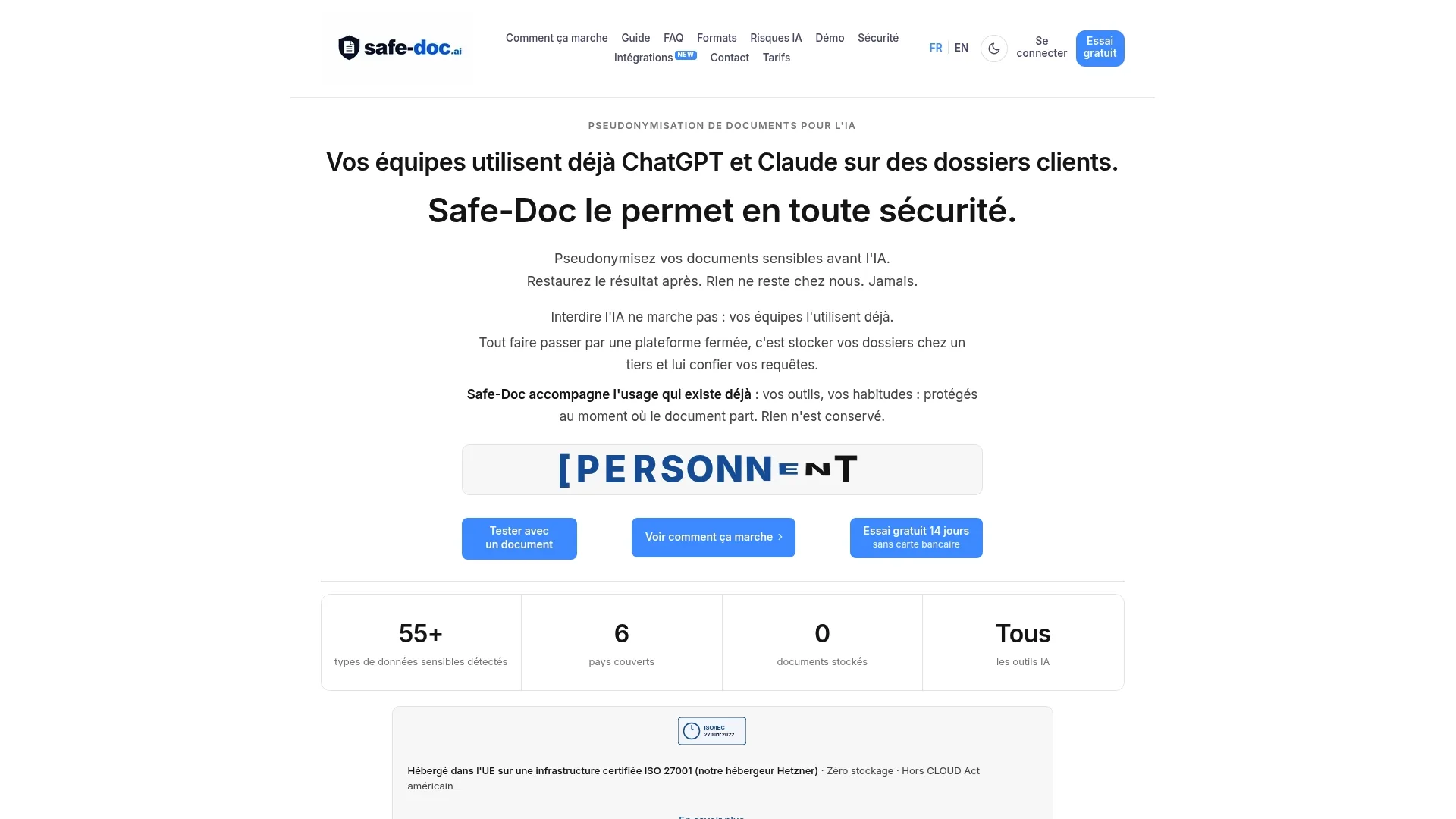
Concretely, Safe‑doc integrates via a REST API or direct web deployment, supports PDF and DOCX formats as well as full data rooms, and generates an encrypted mapping export when you need controlled re-identification. Each operation produces an exportable audit report, which directly meets the traceability requirements mentioned earlier in this article. Stateless mode guarantees that no trace of the plaintext document remains after processing.
This approach is particularly suitable for legal departments, IT departments, and HR teams who want to continue using ChatGPT or Claude without exposing sensitive data, without waiting for an internal project lasting several months. If you manage confidential documents and your teams are already using generative AI, the Safe‑doc DPO page details how to start a demonstration and evaluate the solution on your own flows.
Sources
To delve deeper into the legal framework, technical analyses, and methods cited in this article, several references are worth keeping close at hand.
- Pseudonymization and GDPR: the real conditions for exiting or not exiting the scope of personal data
- Anonymization of personal data - CNIL
- Anonymization and pseudonymization - UCL guidance
This article provides general information and is not a substitute for personalized legal advice. For any decisions affecting your organization's GDPR compliance, consult your Data Protection Officer or a qualified professional.