


The priority contractual clause is simple: require in the DPA (Article 28 GDPR) that the processor systematically pseudonymize sensitive data before any transmission, and provide a secure mapping export enabling controlled restoration by the data controller. Failure to include this obligation exposes the organization to administrative sanctions, regardless of the processor's conduct.
Three essential points:
- Mandatory clauses: Complete DPA per Article 28 GDPR, with explicit pseudonymization obligation, completed annexes, and formalized audit rights.
- Technical controls: stateless solution (zero storage), automatic PII detection across 90+ data types, encryption in transit, and mapping export for controlled restoration.
- Audit evidence: access logs, PDF reports, secure mapping exports, and DPIA where applicable, retained and accessible to the CNIL upon request.
Table of contents
- Why the contract is central to personal data protection
- Practical checklist: which clauses are mandatory in your DPA?
- Pseudonymization or anonymization: which obligation to include in the contract?
- How to draft operational pseudonymization clauses?
- Which technical measures should you contract for pseudonymizing your documents?
- Public procurement: what additional precautions does the CNIL recommend?
- Implementation plan: steps, timeline, and resources
- How to prove your compliance during a CNIL audit?
- What recommendation should you act on now?
- Key points
- What the stateless approach truly changes in practice
- Safe-doc: stateless pseudonymization ready to integrate into your DPA
- Sources and references for further reading
Why the contract is central to personal data protection
Article 28 GDPR mandates a written contract between every data controller and processor, covering nine mandatory clauses. An incomplete or missing DPA renders the controller directly liable for sanctions, even if the processor has committed no fault.
The distinction between controller and processor is not mere legal formality. It determines who sets the processing purposes, who receives documented instructions, and who bears the burden of proof during an audit. A service provider who independently determines how data is processed becomes a joint controller, with major contractual consequences for indemnification and notification obligations.
CNIL doctrine: "The qualification of actors must be analyzed when drafting the contract. Incorrect qualification leads to unsuitable clauses and an inoperative allocation of responsibilities."
Source: [CNIL Guide - responsibility of actors in public procurement](https://cnil.fr/sites/default/files/2024-03/guide_responsabilite_des_acteurs_dans_le_cadre_de_la_commande_publique.pdf)
The privacy policy is distinct from the DPA: it informs data subjects about how their data is managed, while the DPA governs obligations between professionals. Confusing the two can leave contractual blind spots.

Practical checklist: which clauses are mandatory in your DPA?
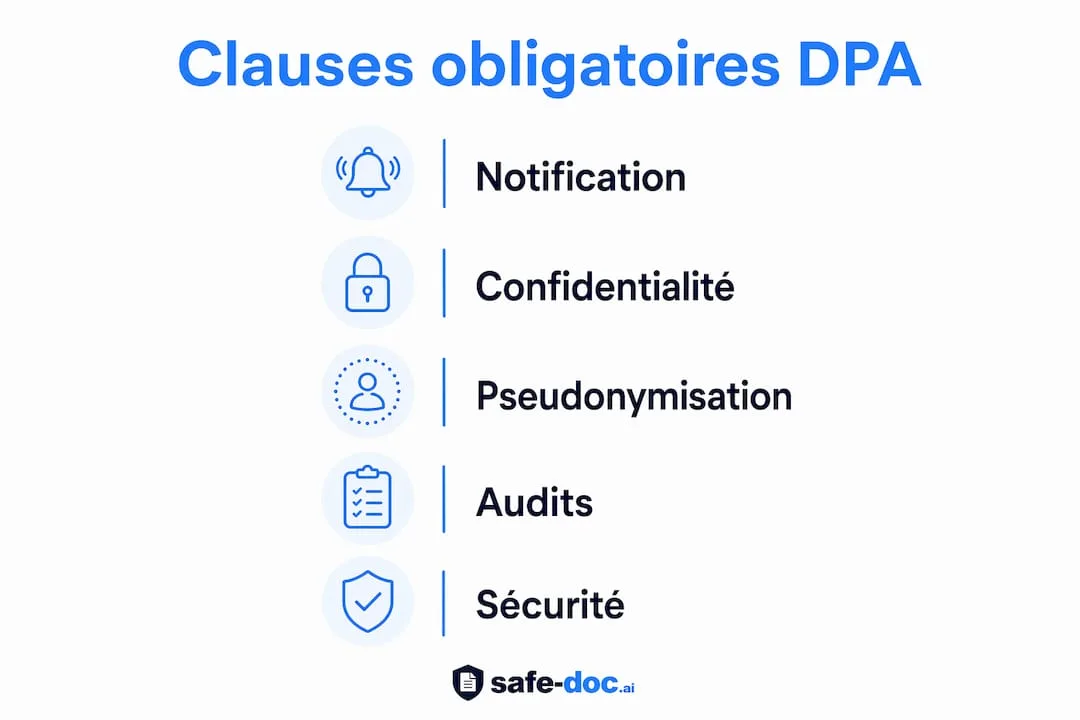
Article 28(3) GDPR imposes nine clauses. Here is their status and operational priority:
1. Subject matter, duration, and nature of processing - Essential (mandatory). Define precisely what is processed, for how long, and for what purpose.
2. Purposes of processing - Essential (mandatory). The processor may only process data for purposes documented by the controller.
3. Types of data and categories of data subjects - Essential (mandatory). Annex 1 must be completed; a DPA without complete annexes is legally unusable.
4. Obligations and rights of the controller - Essential (mandatory). Documented instructions, right of oversight, audit rights.
5. Personnel confidentiality - Essential (mandatory). Written commitment from each person authorized to access the data.
6. Security measures (Article 32 GDPR) - Essential (mandatory). Pseudonymization, encryption, access control, logging.
7. Conditions for sub-processing - Essential (mandatory). List of authorized sub-processors, back-to-back clauses, prior controller authorization.
8. Assistance with data subject rights - Essential (mandatory). Response deadlines, procedures for handling access, rectification, and erasure requests.
9. Return and deletion of data at contract termination - Essential (mandatory). Mapping export modalities, deletion deadlines, proof of destruction.
Recommended additions: incident notification clause (maximum notification time to controller without undue delay, and within 24 hours per contractual best practices), penalty clause, and separate NDA for strategic information not covered by GDPR alone.
Pseudonymization or anonymization: which obligation to include in the contract?
Pseudonymization is defined in Article 4(5) GDPR as processing personal data such that it can no longer be attributed to a specific data subject without additional information kept separately. Pseudonymized data remains personal data: GDPR continues to apply. This is precisely why pseudonymization is preferable to anonymization in a contractual context.
Anonymization irreversibly removes all links to the individual. Consequence: the data falls outside GDPR scope, but the controller also loses all restoration capability. For service contracts or data rooms, this loss of reversibility is often unacceptable.
Key point: Pseudonymization performed upstream, before sending to third-party services, limits the quantity of personal data transmitted and reduces the controller's contractual liability exposure. It also simplifies DPA negotiations and can lighten the frameworks required for international transfers, provided reversibility is strictly controlled and documented.
Concretely, the contract must specify: the pseudonymization method used, the conditions for mapping retention (restricted access, encryption), the modalities for restoring original data, and who holds the re-identification key.
How to draft operational pseudonymization clauses?
Here are directly usable formulations for a DPA or service contract.
Pseudonymization obligation clause:
"The processor undertakes to pseudonymize all personal data contained in transmitted documents, prior to any processing or communication to third parties, using a method compliant with Article 4(5) GDPR. The pseudonymization mapping is stored separately, under the exclusive control of the controller, and may only be reconstituted with prior written authorization."
Auditability clause:
"The processor shall make available to the controller, upon request and within five business days, access logs, audit reports in PDF format, and secure mapping exports. The controller has the right to an annual audit, with ten business days' notice, covering the technical and organizational measures implemented."
Professional tip: Systematically pair an NDA with the DPA for strategic information not covered by GDPR alone. According to Me Valentin Simonnet, penalty clauses forfeit damages in advance and simplify sanctions for unauthorized disclosure, without the injured party having to prove the extent of harm. Have these clauses validated by counsel before signing.
Which technical measures should you contract for pseudonymizing your documents?
Measures to be contractually imposed on the processor, in accordance with Article 32 GDPR, cover two levels.
Technical measures:
- Automatic PII detection across 90+ data types (names, IBANs, social security numbers, health data, etc.)
- Real-time pseudonymization, without intermediate storage of original documents (stateless mode)
- Encryption in transit (TLS 1.2 minimum) and at rest (AES-256)
- Strict access control with least-privilege principle and strong authentication
- Complete logging of access and pseudonymization operations
- Secure mapping export, stored separately and accessible only to the controller
Organizational measures:
- Mandatory training of authorized personnel, with traceability of authorizations
- Back-to-back clauses imposed on each sub-processor
- Incident management plan with contractual notification deadlines
- Breach notification SLA (maximum delay to controller, then to CNIL within 72 hours)
For common document formats (PDF, DOCX, data rooms), verify that the selected solution natively supports these formats and offers REST or MCP API integrations to fit into existing workflows without processing interruptions.
Public procurement: what additional precautions does the CNIL recommend?
In public procurement, actor qualification is often more complex than in private contexts. A service provider may be a processor for certain operations and a controller for others, depending on the purposes pursued.
CNIL recommendation: The agreement must clearly and pragmatically determine the respective obligations of the parties, particularly for exercising data subject rights. The list of authorized sub-processors must be contractually imposed at contract award.
Source: CNIL Guide - public procurement
Operationally, form DC4 (sub-processor list) must be kept current and annexed to the contract. Any modification to the sub-processing chain requires prior authorization from the contracting authority. Also include a clause validating security measures before service commencement, and a termination right if technical guarantees become insufficient during execution.
Implementation plan: steps, timeline, and resources
| Phase | Estimated duration | Responsible | Deliverable |
|---|---|---|---|
| Audit existing processing | - | DPO / CISO | Flow mapping, identification of missing DPAs |
| DPA drafting and validation | 1-3 months | Legal / DPO | Signed DPA, complete annexes |
| Technical solution selection and validation | 1 month | CISO / IT | Technical evaluation report |
| Pilot (data room or document sample) | 1 month | CISO / business team | Pilot report, test mapping export |
| API deployment and integration | 1-2 months | IT / integrator | Production deployment, logs activated |
| Periodic review | Annual | DPO | Audit report, DPA update |
Contractual and technical validation stages can proceed in parallel to reduce overall timeline. A pilot on restricted scope (an M&A data room or batch of HR contracts) validates the solution before full-scale deployment.
On costs: a pseudonymization SaaS license is billed per user seat and per volume of pages processed, with optional add-on packs. Add API integration costs (variable depending on flow complexity) and, where applicable, an annual external audit. A limited pilot controls initial expenses before committing to larger volumes.
How to prove your compliance during a CNIL audit?
Evidence expected by the CNIL and auditors falls into three categories.
Contractual documents:
- Signed DPA with all annexes completed (processing description, sub-processor list, security measures)
- Supplementary NDA for strategic information
- DPIA (impact assessment) for high-risk processing
Technical evidence:
- Timestamped and complete access logs
- Solution-generated audit reports in PDF format
- Secure mapping export, proof of data deletion or restoration
Metrics to track:
- Number of accesses to pseudonymized data per period
- Average incident notification time to controller
- Successful pseudonymization rate on processed documents
- Average mapping return time upon request
Maintain an incident register, even for minor incidents, and contractually provide for audit rights with notice, defined scope, and confidentiality clause on results. Undocumented data breaches are systematically aggravating factors during audits.
What recommendation should you act on now?
Contractually mandate pseudonymization in the DPA, require mapping export, and formalize audit rights. Then launch a technical pilot on a restricted perimeter to validate the solution before deployment.
Immediate actions:
1. Verify that each active DPA contains the nine mandatory clauses and complete annexes.
2. Add a pseudonymization clause and an auditability clause to each new contract or renewal.
3. Evaluate a stateless document pseudonymization solution and plan a one-month pilot.
Key points
Contractually mandated pseudonymization in the DPA, coupled with a stateless solution and formalized audit rights, constitutes the most effective protection of party privacy in GDPR-governed contracts.
| Point | Details |
|---|---|
| Contractual obligation (Art. 28 GDPR) | The DPA must cover all nine mandatory clauses with complete annexes, or face sanctionable non-compliance. |
| Pseudonymization priority | Requiring pseudonymization before any transmission reduces contractual liability scope and simplifies DPAs. |
| Formalized auditability | Requiring logs, PDF reports, and mapping exports in the contract guarantees proof of compliance during CNIL audits. |
| Public procurement | Adapt clauses according to CNIL actor qualification and maintain form DC4 current upon contract award. |
| Safe-doc | Stateless document pseudonymization solution with 90+ PII type detection, secure mapping export, and PDF audit reports. |
What the stateless approach truly changes in practice
Most guides on privacy protection in contracts stop at clauses. This is necessary, but insufficient: a pseudonymization obligation clause without a verifiable technical solution is merely a declaration of intent.
What changes with a stateless architecture is the very nature of residual liability. When no original document is stored on the processor side, the DPA scope is mechanically reduced. Negotiations are shorter, annexes less complex, and the risk of Shadow AI leakage disappears from the contractual perimeter. Teams continue using their usual AI tools, but sensitive data never reaches them in identifiable form.
Mapping export is another often underestimated element. Without it, pseudonymization becomes a one-way operation: data is protected, but the controller loses restoration capability. With secure mapping under exclusive controller control, reversibility remains possible, GDPR compliance is maintained, and the contract can specify precise and verifiable restoration obligations.
Safe-doc: stateless pseudonymization ready to integrate into your DPA
Your contracts now require verifiable document pseudonymization. Safe-doc meets this requirement with a zero-storage architecture: documents are processed in real time, original data never transits our servers, and each operation generates a PDF audit report usable during CNIL audits.
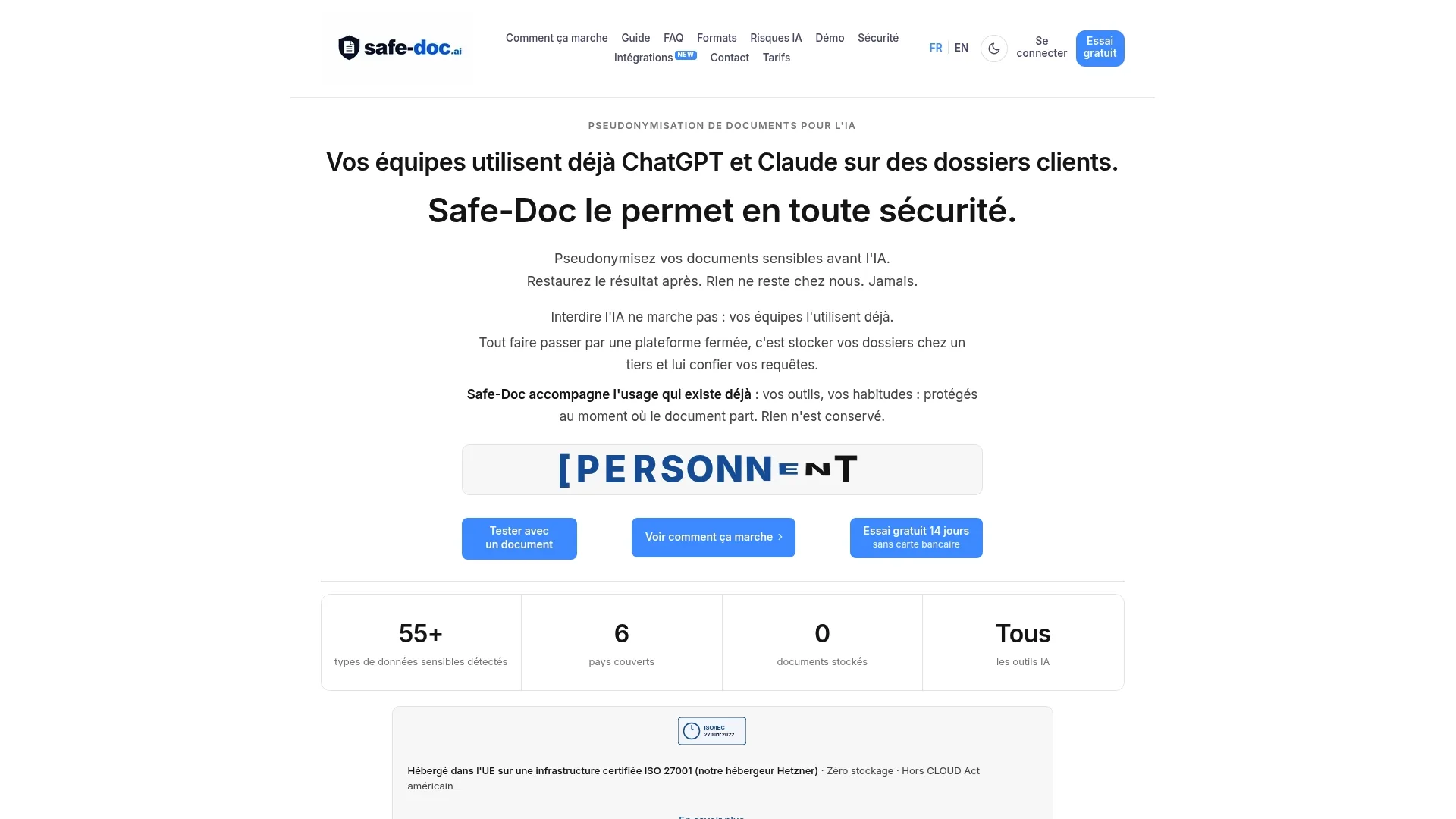
Detection covers 90+ data types (PII, financial data, health information), with native support for PDF and DOCX formats and REST API integrations to fit into your existing document workflows. The secure mapping export remains under your exclusive control, directly simplifying the drafting of restoration clauses in your DPA.
To evaluate integration with your existing DPA and launch a pilot on your document perimeter, request a demonstration or consult Safe-doc's GDPR compliance page.
This article provides general information. For your specific situation, consult qualified legal counsel and verify current requirements with the CNIL.
Sources and references for further reading
- [GDPR text - Article 28](https://eur-lex.europa.eu/legal-content/FR/TXT/?uri=CELEX%3A32016R0679): legal basis for processor contractual obligations and the nine mandatory DPA clauses.
- CNIL Guide - responsibility of actors in public procurement: doctrine on actor qualification, adapted clauses, and precautions specific to public procurement.
- DPA Article 28 GDPR model - Legiscope: template and analysis of mandatory clauses, importance of annexes.
- GDPR and contracts - Yousign: summary of six essential clauses and operational best practices.
- Confidentiality agreement (NDA) - Me Valentin Simonnet: legal analysis of penalty clauses and obligations of result in NDAs.
- Confidentiality agreement - LegalPlace: practical guide on drafting an NDA, duration, scope, and sanctions.
- GDPR pseudonymization Art. 4(5) - Safe-doc: guide to GDPR-compliant pseudonymization and DPA integration.
- [Confidentiality and AI contracts - Safe-doc](https://safe-doc.ai/blog/confidentialite-contrats-intelligence-artificielle-guide.html): relationship between DPA, AI clauses, and document pseudonymization.