



Pseudonymizing employee files means replacing an employee's direct identifiers (name, social security number, employee ID, address) with aliases, while keeping a separate mapping table that lets you recover the real identity when needed. Article 4(5) of the GDPR defines it precisely, and it has become the baseline measure for any HR team that wants to use AI without exposing its staff.
HR documents are among the most sensitive a company handles. A payslip contains a social security number and bank details. A disciplinary file names colleagues and witnesses. A sick note touches on health. And these are exactly the documents HR teams want to hand to an AI: summarize a file, prepare a reply, check a payroll run, draft a letter.
This guide covers the four situations where pseudonymizing employee files matters most (payslips, health data, disciplinary files, access requests), the technical methods, a step-by-step rollout and the mistakes to avoid. The examples come from French and European law; the logic carries over to any company with employees in the EU.
The golden rule: no HR document should reach an outside AI tool with identities in clear text. Pseudonymize first, process second, and keep the final decision in a person's hands.
Key takeaways
| Point | Details |
|---|---|
| Pseudonymizing is not anonymizing | Pseudonymized data is still personal data: the GDPR continues to apply in full. |
| Health and union membership are a separate case | This data falls under article 9 of the GDPR: prohibited in principle, with narrow exceptions and stronger protection. |
| The mapping table is the weak point | It must be stored on a separate system, encrypted, with limited and logged access. |
| The decision stays human | AI can structure a file; it does not decide on a sanction (article 22 of the GDPR). |
| Evidence matters as much as technique | Records, an impact assessment where needed, contracts, access logs: that is what regulators check during an inspection. |
Table of contents
- Pseudonymization vs. anonymization: what's the difference for HR files?
- Mapping an employee file before pseudonymizing
- The key steps of secure pseudonymization
- Case 1: pseudonymizing payslips
- Case 2: sick leave and employee health data
- Case 3: disciplinary files
- Case 4: responding to an employee access request
- Which methods and tools for pseudonymizing HR documents?
- Rolling out pseudonymization in six steps
- How to choose a pseudonymization solution for HR
- The most common mistakes
- What to do if HR data is breached
- Safe-doc for pseudonymizing your employee files
- Frequently asked questions
- Further reading
- Sources
- Recommended reading
Pseudonymization vs. anonymization: what's the difference for HR files?
Pseudonymization replaces direct identifiers with aliases: "Martin Dupont" becomes "EMPLOYEE-4872". A mapping table, kept separately and protected, lets you recover the real identity when necessary.
Anonymization permanently removes any link between the data and the person. No table, no key: re-identification must be impossible, including by cross-matching.
This distinction is not just technical: it decides whether the GDPR applies. Anonymized data falls outside its scope. Pseudonymized data stays fully inside it, with everything that implies: legal basis, informing employees, individual rights, retention periods and security.
For the company that holds the mapping table, pseudonymized data is therefore still personal data. The Court of Justice of the European Union confirmed this in its ruling of September 4, 2025 (EDPS v SRB, C-413/23 P): everything depends on the holder's actual ability to re-identify the people concerned.
| Criterion | Pseudonymization | Anonymization |
|---|---|---|
| Re-identification | Possible, via the mapping table | Impossible, irreversible |
| GDPR applies | Yes, in full | No |
| Typical HR use | Active files, AI processing, audits, responding to an inspection | Statistics, internal studies, permanent archives |
| Protection level | High, provided the table is well protected | Maximum if done properly |
| Residual risk | Re-identification by cross-matching data | Near zero if cross-matching is impossible |
The decision rule for HR
Ask yourself one question: will you need to find the person again?
If the answer is yes (a payroll dispute, a social security audit, an employment tribunal case, an access request, a file that is still active), pseudonymize. If it is no (aggregate statistics, an overall pay study, an archive whose retention period has expired), anonymize.
One example of legitimate anonymization: résumés of unsuccessful candidates. The CNIL, France's data protection authority, recommends deleting or anonymizing them no later than two years after the last contact with the candidate. The reference framework is summarized in our guide to the CNIL and EDPB recommendations.
Never call a processing operation "anonymized" if you keep a mapping table, even an encrypted one. That is not anonymization, and if the regulator reclassifies it, you are back under every GDPR obligation you thought you had avoided.
To go further on this distinction: Pseudonymization vs. anonymization: what the GDPR says.
Mapping an employee file before pseudonymizing
The first step is not technical. Before choosing a tool, you need to know what a file contains and what level of protection each category needs. Good practice also means excluding from the file any data with no direct link to the employment relationship. To rank these categories, see our guide to sensitive data classification.
| Category | Examples | Protection level |
|---|---|---|
| Identification | Name, address, date of birth, social security number, employee ID | Systematic pseudonymization before any AI |
| Contract and payroll | Salary, bonuses, IBAN, contributions | Pseudonymization; access limited to the payroll team |
| Performance and career | Annual reviews, objectives, promotions | Pseudonymization; access limited to the manager and HR |
| Disciplinary | Alleged facts, witness statements, sanctions | Reinforced pseudonymization, including any third parties named |
| GDPR article 9 | Medical reasons, fitness for work, union membership or dues | Separate procedure, very restricted access, specific legal basis |
Article 9 data deserves particular attention. Processing it is prohibited in principle, with exceptions set out in the text, such as the employer meeting its obligations under employment law. A system that detects names and IBANs well but lets a reason for absence or a union dues line through lets slip exactly what regulators penalize most.
Indirect identifiers, the most common blind spot

Masking the name is not enough. In a small organization, the combination of a job title, a department and a hire date is often enough to recognize someone. File metadata (author, revision history, comments), headers, footers and attachments, and email signatures must therefore be handled just like names.
The same goes for badge timestamps, screenshots and extension numbers, and above all for mentions of third parties: colleagues, witnesses, managers, customers.
Before pseudonymizing, map your HR data flows on paper. Identify every point where an identity could be rebuilt by cross-matching. Only then choose your tools.
The key steps of secure pseudonymization
A compliant setup rests on solid organization, even before you choose a tool.
First, identify the fields to pseudonymize: last names, first names, social security numbers, addresses, IBANs, employee IDs and internal identifiers linked to the person. Aliases must be stable: the same employee always gets the same alias within a given system, so internal cross-referencing still works.
The mapping table is isolated on a separate system, with rights limited to authorized people only: the DPO, the legal department, the HR manager in charge. Access is role-based: authorized HR staff see active files, managers only what falls within their scope.
Every access is logged (who opened which file, when and in what context), and each document type has its own retention period, at the end of which it is deleted or anonymized.
Pro tip: The mapping table is the most vulnerable link in the setup. Treat it as a critical asset: encryption, logged access, regular review of permissions. A table stored in the same shared folder as the pseudonymized files cancels out most of the protection.
A strict separation between active and archived data also reduces the risk of cross-leaks. It is one of the first things a regulator's inspector looks at.
Case 1: pseudonymizing payslips
The legal basis
Payroll processing relies on performance of the employment contract (GDPR article 6(1)(b)) or a legal obligation (article 6(1)(c)). Employee consent is almost never a valid basis: the employment relationship prevents it from being truly free. Firms that run payroll for clients will find a setup dedicated to accounting firms.
Retention periods
In France, the employer must keep a copy of payslips for five years (article L3243-4 of the French Labor Code). Beyond that, payslips kept for studies must be anonymized.
What to mask before any AI
On a payslip, mask the employee's identity (name, address, social security number, employee ID) and bank details. Watch out for lines that reveal article 9 data too, such as an absence for illness or a union dues deduction. If the document leaves the company, the employer's identifiers should be masked as well.
The right method

For payslips processed by AI, tokenization with a mapping table is the best fit. It keeps the document's structure: amounts stay readable and can be calculated, only the identities are replaced. An AI can then check a payroll run, spot an anomaly or compare pay without ever seeing who is who.
Permanent redaction suits exports shared outside the company or aggregate reports, when nobody will ever need to find the person again.
When anonymization becomes the only option: if no rule requires you to find the person again and the data will be used for a published study, a widely shared aggregate report or training a model, anonymize. In every other case, and especially for any payslip that could be disputed or audited, reversible pseudonymization remains the standard.
The most serious mistake
Exporting a payroll CSV file and pasting it into a consumer AI assistant. A payroll table brings together, in a few lines, direct identifiers, bank data and sometimes health data. If that happens, it is a personal data breach under the GDPR: it must be assessed and, where required, notified to the regulator.
For a first trial, start with the payroll staff who handle the largest volumes and the most complex collective agreements. A method validated on the hard cases then extends easily to the simple ones.
Case 2: sick leave and employee health data
What the employer is allowed to hold

In France, for a sick note, the employer only receives the copy intended for it, with no medical information. It needs the start date and length of the leave, not the diagnosis. For a workplace adjustment, it needs the restrictions communicated by the occupational physician, not their medical cause.
That is the principle of minimization: collect only what is strictly necessary to manage the employment contract.
Medical confidentiality is absolute on the employer's side. Only the occupational physician holds medical information. If an HR document nonetheless contains health data (a certificate sent by mistake, a mention in an email), it must be treated as article 9 data: restricted access, pseudonymization before any processing, deletion as soon as it is no longer needed.
Hosting health data
In France, any provider that hosts health data on behalf of a third party must hold the Health Data Hosting (HDS) certification, under article L1111-8 of the French Public Health Code (in French). Before signing, check that certification, and require a clause for returning the data with no copy retained. The contract defines access profiles and purposes, and requires encryption at rest and in transit, including during maintenance operations.
The security measures expected
The CNIL has restated the security measures expected for access to health data (in French): strong authentication, access logging and regular analysis of those logs. Logging that nobody reviews is not enough.
Sending a sick note securely
Transmission is the most vulnerable moment. A sick note is never sent by unencrypted email or instant messaging, and it does not go into a shared folder the whole team can open. Access is limited to the people in charge of payroll and absence management. And before any AI processing, even a simple summary, it is always pseudonymized.
Pro tip: Many health data incidents come from a mundane error rather than an attack: a certificate sent by unencrypted email, an absence tracker on an open share. According to the CNIL's review of five years of GDPR, one notified breach in five comes from internal human error. A policy listing approved tools and regular awareness training for HR teams prevents a good share of these leaks.
Case 3: disciplinary files
A disciplinary file combines three difficulties: it must remain identifiable (the procedure targets a specific person), it contains data about other people (witnesses, colleagues, possible victims), and any procedural error can get the sanction overturned.
Why a leak is costly

The first risk is the sanction being overturned: an unlogged access, a file shared without protection or a missed deadline can be enough to bring it down before an employment tribunal. Then there is the breach of professional secrecy by the people bound by it, a criminal offense in France under article 226-13 of the Criminal Code. And a leak damages trust within the teams, often more lastingly than the sanction itself.
What to pseudonymize
The employee concerned, but also every third party named, as well as indirect identifiers: badge timestamps, screenshots, email signatures, job references.
Choosing the right method
| Method | Reversible | Human oversight | Recommended use |
|---|---|---|---|
| Assisted manual redaction | No | High | Small volumes, one-off checks |
| Tokenization | Yes, via the table | Medium | Automated HR flows |
| Reversible pseudonymization by encryption | Yes, via a separate key | High | Ongoing disciplinary files |
| Irreversible anonymization | No | Low | Statistical registers, permanent archives |
The role of AI: structure, not decide
AI can help organize a large file, build a timeline of events or spot inconsistencies. It must not assess the facts or decide on the sanction.
Before an employment tribunal, it is the employer who answers for the decision, not the algorithm. Article 22 of the GDPR strictly regulates decisions with legal effects based solely on automated processing. An automatic summary can miss a mitigating circumstance or misweigh a prior incident.
A typical sequence, from the first report to archiving
| Step | What happens |
|---|---|
| First report | The manager writes a dated, factual report: facts, place, circumstances |
| Gathering evidence | Statements and evidence are collected in a secure space, with a timestamped list |
| Pseudonymization | The identities of the employee and third parties are replaced before any AI-assisted analysis; the table is kept separately |
| Review | The HR manager or legal counsel checks the pseudonymization and reviews the analysis |
| Sharing with the employee | The file is sent through a secure channel, with proof of delivery, respecting the right to respond |
| Decision | Made by an authorized person, on the re-identified file |
| Archiving | The file is kept for a defined period, then purged when it expires |
Pro tip: Over-pseudonymizing can also be a problem: if the AI can no longer see who did what, its analysis loses all value. Replace identities with consistent aliases (EMPLOYEE-A, WITNESS-1, MANAGER-1) rather than blanks.
Case 4: responding to an employee access request
Any employee, former employee or candidate can ask their employer what data it holds about them and get a copy (GDPR article 15). This is one of the situations where pseudonymization helps most, because the response must include the requester's data but exclude everyone else's.
What the response must contain

The response first confirms that processing exists, then provides a copy of the personal data concerned: payslips, reviews, administrative correspondence and, depending on the case, disciplinary material. It sets out the purposes of the processing, the categories of data and their recipients, internal or external, and the retention period or the criteria used to set it. If there is an automated decision, it explains the logic.
Deadline and cost
The employer has one month from receipt, which can be extended by two months for a complex or large request, provided the person is informed within the first month (GDPR article 12(3)). A request covering fifteen years of files spread across several systems can justify that extension; a request for the last three payslips cannot.
Exercising the right of access is free. Only additional copies can be subject to a reasonable fee.
The limits: third parties, emails and trade secrets
The right of access covers personal data, not handing over entire documents. A work email that mentions the requester can also contain data about colleagues, customers or information covered by trade secrets. Those elements must be removed or masked before sending. The CNIL explains this point for work emails (in French).
That does not make the right unlimited: an employer can challenge a manifestly excessive request, but the burden of proof is on the employer. Each limitation must therefore rest on concrete facts (identified third parties, a demonstrated secret), not on a general reason.
Pro tip: Avoid systematically asking for a copy of an ID card. An employee writing from their usual work address generally has nothing more to prove. Requiring ID for every request is disproportionate data collection, and can be seen as an obstacle to exercising the right.
A seven-step internal procedure
Acknowledge receipt promptly, stating the date the one-month deadline starts, and verify the requester's identity proportionately. Then list the systems involved (HRIS, payroll, email, disciplinary files, archives) and extract only the relevant data, without copying whole files out of convenience.
Before sending, mask third-party data and anything covered by a legal secret, and get the DPO's sign-off. The response goes out through a secure channel. Archive every step (receipt, extraction, approval, sending): that is your proof of diligence.
Also prepare three letter templates: an acknowledgment of receipt, an extension notice explaining why the request is complex, and a reasoned partial refusal listing exactly which data was excluded and why.
Why pseudonymization speeds up the response
On a file with several years of email, manually masking third parties quickly becomes unrealistic and error-prone. The efficient flow is: extract the documents, automatically pseudonymize mentions of third parties, run a targeted human check, then deliver securely. Each operation can be logged, which serves as evidence in an inspection.
Which methods and tools for pseudonymizing HR documents?
| Technique | Principle | Reversible | When to use it |
|---|---|---|---|
| Redaction | Permanent removal of the data from the document | No | Document shared externally, third parties in an access request response |
| Tokenization | Replacement with a token, mapping table kept separately | Yes | Payroll, active files, AI processing |
| Encryption | Identifiers encrypted, key kept outside the system | Yes | Archives that must be kept for a long time |
| Generalization | Value made less precise (age → age bracket) | No | Statistics, internal studies |
| Automatic detection (NER) | A model spots names, addresses and numbers | Depends on the method applied next | Large volumes, unstructured documents |
Automatic detection by AI
Named entity recognition (NER) models automatically spot names, places, dates of birth and numbers in long documents. They often catch indirect identifiers that the human eye misses, and handle volumes no one could review by hand. They do not replace the DPO's or HR manager's judgment on the legal characterization of the processing. To process volumes, see our guide to the document pseudonymization API.
Attribute-based access control

Attribute-based access control (ABAC) makes each access to a file depend on precise criteria: role, department, seniority, context of the request. It is the finest-grained way to stop a user, or an AI tool, from reaching files that do not concern them.
AI also amplifies design errors. If your access architecture is poorly thought out, the AI will process data it should not see, faster and at greater scale. Sort out access rights before plugging in the tool.
Rolling out pseudonymization in six steps
The rollout starts with mapping: the types of HR documents, the sensitive fields they contain, the volumes and who accesses them. Then define the rules, field by field (tokenization or redaction), with an explicit list of article 9 data. Test on a small scope, ideally the most complex cases, and measure detection quality on a representative sample (see the table below).
After the test comes integration: pseudonymization sits upstream of every AI use and inside the HRIS, with automatic triggers when retention periods expire (end of contract, close of a recruitment). You also need to train the teams: since February 2025, article 4 of the EU AI Act requires companies that use AI systems to ensure a sufficient level of AI literacy among their users. Document the training.
Measuring quality before going live
| Indicator | What it measures | Target |
|---|---|---|
| Data detected | Share of personal data correctly masked | Threshold to set with the DPO |
| Data missed | Personal data that went through in clear text | Zero tolerance for article 9 data |
| False masking | Non-personal data masked unnecessarily | Monitor so the analysis is not degraded |
| Segregation | Data from one entity visible from another | Zero tolerance |
The documentation to prepare for regulators
The file includes the record of processing activities, which states the purpose of the AI processing, and a data protection impact assessment (DPIA) if the processing is high-risk. Add the data processing agreements with each provider (AI, pseudonymization, hosting), the pseudonymization policy (methods, data covered, table management) and the access logs, timestamped and exportable.
How to choose a pseudonymization solution for HR
On the technical side, the solution must offer controlled reversibility, with a mapping table that stays with you, and detect article 9 data, not just names and numbers. It handles common formats (PDF, Word, spreadsheets, email), does not store documents at the provider for any length of time, and produces exportable logs for inspections.
On the contractual side, require a data processing agreement compliant with article 28 of the GDPR that explicitly covers HR data, a written commitment not to retain documents, and processing located in the European Union. Also ask for a security certification (ISO 27001 or equivalent) and, if the provider hosts health data in France, HDS certification.
The most common mistakes
The most common mistake is sending an HR document in clear text to a consumer AI assistant, even "just for a summary". Oversights are almost as frequent: third parties, because a file can be perfectly pseudonymized for the employee concerned while leaving three colleagues' names in clear text, and indirect identifiers (metadata, headers, attachments, screenshots). Day to day, the Safe-Doc Chrome extension pseudonymizes the document right in ChatGPT or Claude.
Other mistakes come from misreading the framework: confusing pseudonymization with anonymization and thinking you are outside the GDPR, storing the mapping table alongside the pseudonymized data, or not informing employees, when pseudonymization does not remove the transparency obligation. Not documenting is a mistake too: during an inspection, the absence of records or a formal policy is a breach in itself.
Blocking AI without offering an alternative only moves usage outside any control: that is Shadow AI.
Pseudonymization does not release the employer from its obligations. Transparency toward employees, legal basis, respect for individual rights and limited retention periods all still apply in full, even when the data is pseudonymized.
What to do if HR data is breached
The first priority is to contain: cut off access to the affected system or tool, and revoke compromised access. Then assess the incident: which data, how many people, what risk to them. If the breach poses a risk to people's rights, the regulator is notified within 72 hours (GDPR article 33), and the employees concerned are informed if the risk is high (article 34). In every case, the incident and the measures taken are documented, even without notification.
Administrative fines can reach 20 million euros or 4% of worldwide annual turnover. For concrete examples of incidents: HR data breaches and the GDPR: 8 concrete examples.
Safe-doc for pseudonymizing your employee files
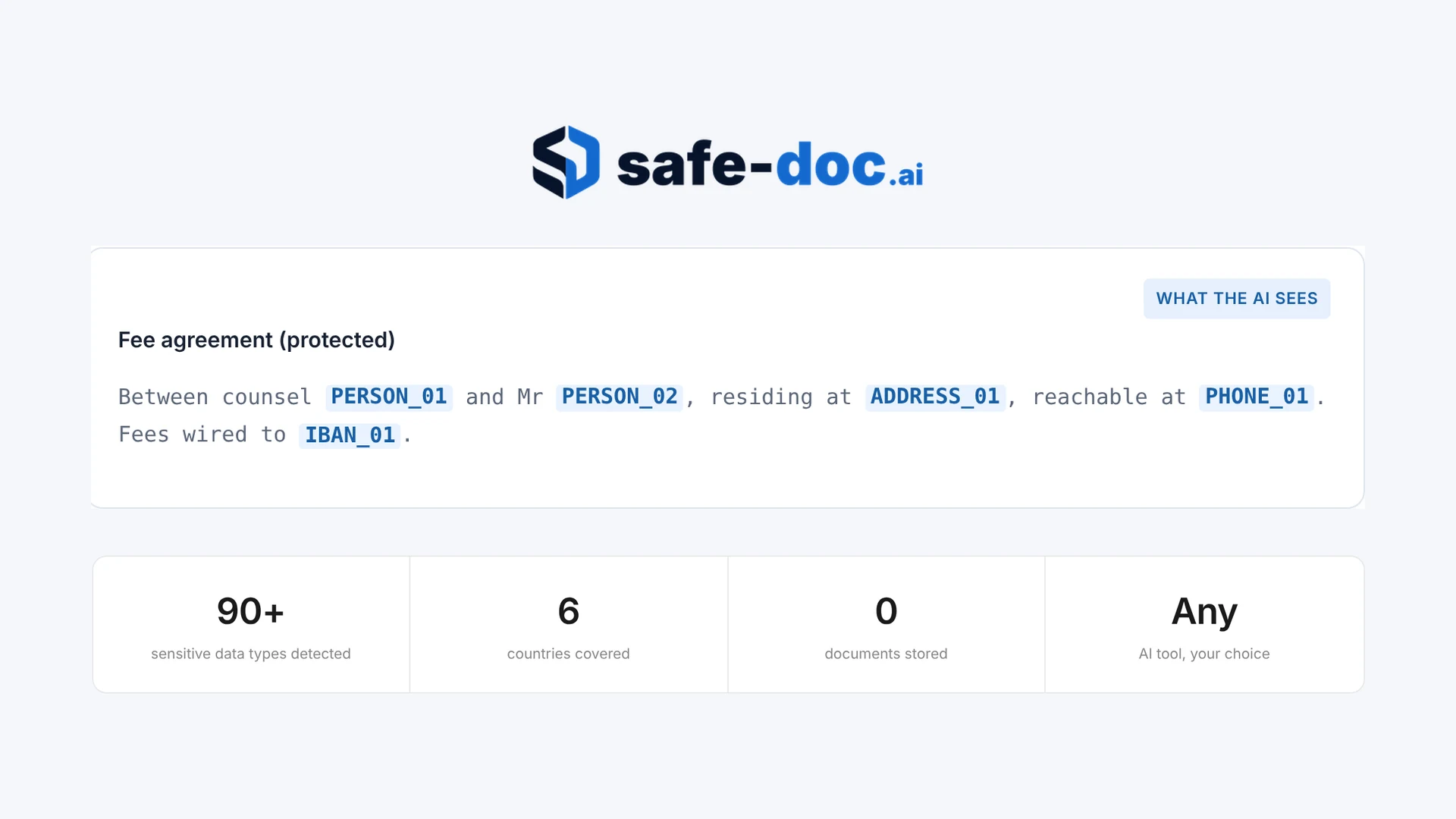
HR files mix identities, pay and sometimes health. Safe-doc focuses on one task, pseudonymizing them properly: more than 90 types of data detected, the same alias for the same employee throughout the file, and colleagues' or witnesses' names handled like everything else.
The HR manager drops in the payslip, sick note or meeting report (PDF, Word, spreadsheet, text), checks what will be masked, then works with their usual assistant. No file is kept after processing. See the page for HR teams and the guarantees for DPOs.
Frequently asked questions
What is employee file pseudonymization?
It is replacing an employee's direct identifiers (name, social security number, employee ID) with aliases, with a mapping table kept separately. It is defined in article 4(5) of the GDPR. Pseudonymized data is still personal data.
Can you use ChatGPT or Claude on HR files?
Yes, provided the documents are pseudonymized before sending and the use is properly framed: records, informing employees, tools approved by the company. Sending an HR file in clear text to an outside AI assistant exposes personal data without sufficient safeguards.
What is the difference between pseudonymization and anonymization for HR?
Pseudonymization lets you find the person again using the mapping table: the GDPR still applies. Anonymization makes re-identification impossible: the data leaves the GDPR's scope, but the process is irreversible and unsuitable for active files.
How long should payslips be kept?
In France, the employer must keep a copy of payslips for five years (article L3243-4 of the Labor Code). Other countries set their own periods.
Can the employer know the reason for sick leave?
In France, no. The employer only receives the part of the sick note intended for it, with no medical information. Only the occupational physician has access to medical data.
How long do you have to respond to an employee access request?
One month, extendable by two months for a complex request, provided the employee is told within the first month.
Can AI decide on a disciplinary sanction?
No. It can help organize a file, but the decision must be made by a person. Article 22 of the GDPR strictly regulates decisions based solely on automated processing.
How do you document pseudonymization for a regulatory inspection?
The record of processing activities should list the categories of pseudonymized data, the methods, the retention periods and the access rights. A formal internal policy and the access logs for the mapping table are the evidence expected.
Further reading
- HR data breaches and the GDPR: 8 concrete examples
- Pseudonymization vs. anonymization: what actually changes before you use AI
- GDPR compliance for consulting firms: protecting your clients' data
Sources
- CNIL: employees' right of access to their data and to work emails (in French)
- CNIL: responding to a right of access request (in French)
- CNIL: health data, security and confidentiality measures (in French)
- CNIL: anonymizing personal data (in French)
- EDPB: Guidelines 01/2022 on data subject rights, right of access
- Légifrance: article L1111-8 of the French Public Health Code (in French)
- CNIL: personal data breaches, a review of five years of GDPR (in French)
This article is general information and does not replace advice from a qualified lawyer. Consult a legal professional about your situation before acting on this content.