

In 2026, a defensible GDPR audit rests on three pillars: compliance with the twelve foundational security measures of Article 32, a current register of processing activities (Article 30), and robust documentation of technical decisions, including DPIAs. These are precisely what the CNIL now prioritizes in its stepped-up enforcement, which increasingly targets SMEs.
To build a defensible case, you must assemble concrete, dated evidence: a current register, usable access logs, restoration test reports, signed Article 28 processor agreements, and validated DPIAs for every high-risk processing operation.
Three legislative instruments frame this year's exercise and deserve explicit citation in your report:
- Decree No. 2026-272 of 14 April 2026, which governs cloud hosting of sensitive data.
- Regulation (EU) 2023/1543, known as EPOC, on European production orders for electronic evidence.
- The European Data Act, whose implementation deadlines fall progressively throughout 2026.
Key takeaway: without verifiable technical proof, declarative compliance no longer suffices before a CNIL inspector in 2026.
Key points
A defensible GDPR audit in 2026 rests on three verifiable pillars: the twelve foundational measures of Article 32, a current Article 30 register, and documented DPIAs for each high-risk processing operation.
| Point | Details |
|---|---|
| - | - |
| Prioritize Article 32 | Check MFA, encryption, and logging first-the CNIL's preferred audit terrain. |
| Update the register | Cross-reference business interviews with technical scans to avoid the 30 to 50% of undocumented processing operations. |
| Cite the correct texts | Reference Decree No. 2026-272, Regulation 2023/1543, and the RECYF framework explicitly in your report. |
| Prepare for inspection response | Centralize evidence and designate a single point of contact; respect the 72-hour breach notification deadline. |
| Reduce exposure with Safe-doc | Pseudonymize sensitive documents in real time and export mapping to support your audit trail. |
Table of contents
- Data protection regulations for auditors 2026: what has changed
- How to conduct a GDPR audit in 5 to 6 steps
- What are the 12 security measures required by Article 32?
- What evidence to collect and what pitfalls to avoid in the report
- How to respond to a CNIL inspection in 2026
- Sources
Data protection regulations for auditors 2026: what has changed
The regulatory landscape has not exploded in 2026, but it has grown denser on specific points every auditor must now master. Decree No. 2026-272 establishes a framework for particularly sensitive data hosted via a private cloud service: it imposes requirements on internal organization, the subcontracting chain, hosting location, and data portability. It enters into force between April and July 2026 depending on the articles concerned.

In parallel, the RECYF version 2.5 framework from ANSSI offers security objectives and acceptable means of compliance, a useful baseline for justifying your technical choices to an inspector. Regulation (EU) 2023/1543 becomes directly applicable on 18 August 2026: it creates European production and preservation orders that apply regardless of data location, a point cloud providers must anticipate. The Data Act continues to deploy access and portability obligations for manufacturers of connected devices and cloud service providers.
| Text | Scope | 2026 deadline |
|---|---|---|
| - | - | - |
| Decree No. 2026-272 | Private cloud, sensitive data | April to July 2026 |
| RECYF v2.5 (ANSSI) | NIS 2 security framework | Published March 2026 |
| Regulation (EU) 2023/1543 (EPOC) | European production orders | Applicable 18 August 2026 |
| Data Act | Data access, portability | Progressive deadlines 2026 |
On the ground, the CNIL has hardened its enforcement doctrine: it now targets SMEs more frequently, and recent sanctions focus primarily on violations of Articles 25 (data protection by design) and 32 (security of processing). The message is clear: documenting a technical choice often carries more weight than the choice itself.
How to conduct a GDPR audit in 5 to 6 steps
A rigorous GDPR audit follows a recognized structure, notably adopted in specialized firm methodologies, which clearly distinguishes governance, technical security, and risk management.
1. Planning and scope. Define the processing operations, entities, and systems covered, as well as the type of audit (compliance, maturity, or security).
2. Processing mapping. Update the Article 30 register by cross-referencing business interviews with technical scans (SaaS, cloud shares, spreadsheets).
3. Legal assessment. Verify lawful bases, retention periods, and transparency notices for each processing operation identified.
4. Technical security audit. Verify concrete implementation of Article 32: access controls, encryption, logging, backups.
5. DPIA for high-risk processing. Formalize a data protection impact assessment whenever a processing operation presents a high risk to data subjects.
6. Action plan and follow-up. Prioritize gaps, assign responsible parties, and set verifiable deadlines.
Each step must produce a tangible deliverable: matrix of lawful bases, control checklist, DPIA report, prioritized action plan. For business interviews, prepare targeted questions: what tools do they use daily, where do they store customer files, who has access to accounting exports?
- An internal audit led by the DPO suits a limited scope and a mature organization.
- External support is justified for complex processing, cross-border issues, or initial compliance efforts.
- Costs range from zero euros for self-assessment to several tens of thousands of euros for a specialized firm's intervention across a broad scope.
Audit duration typically spans a few weeks for an SME scope, longer for a multi-entity group.
What are the 12 security measures required by Article 32?
The CNIL expects an operational baseline of approximately twelve technical and organizational measures to consider a controller in compliance with its security obligations. Absence of these measures may be sanctioned even without a proven breach: the security obligation is an obligation of means, not of result.
| Measure | Expected proof | Priority |
|---|---|---|
| - | - | - |
| Individual accounts | List of accounts, no generic accounts | Critical |
| Password policy | Signed policy, technical configuration | Critical |
| Multi-factor authentication | MFA configuration on remote and privileged access | Critical |
| Encryption in transit and at rest | Certificates, server configuration | Critical |
| Access logging | Timestamped and retained logs | High |
| Tested backups | Restoration test reports | High |
| Regular updates | Patch application history | High |
| Secure development | Code reviews, separate environments | Medium |
| Physical security | Access control to server premises | Medium |
| Staff training | Training certificates | Medium |
| Processor oversight | Signed Article 28 contracts | Critical |
| Breach management | Documented procedure, incident register | High |
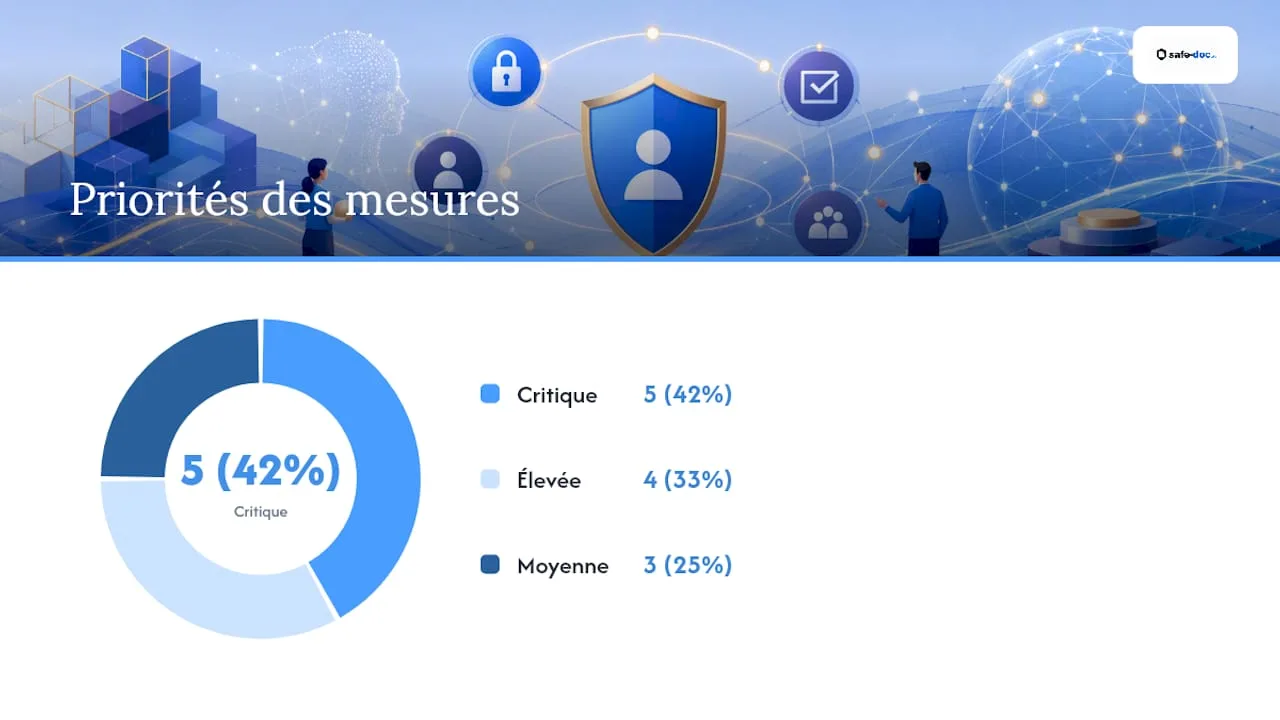
Absence of MFA on remote access frequently appears as an aggravating factor in CNIL sanctions, making it a priority point to verify in any technical security audit.
Pro tip: On a 90-day action plan, tackle MFA and encryption first-the inspectors' preferred terrain: these produce quick evidence, often within days, and immediately reduce sanction risk.
What evidence to collect and what pitfalls to avoid in the report
A credible audit report relies on dated documentation, not statements of intent. Systematically gather the current Article 30 register, DPIA file, access logs, restoration test reports, Article 28 contracts, your signed information systems security policy, and update application history.
Structure the report in five blocks:
1. Executive summary for senior management.
2. Detailed findings by theme (governance, security, subcontracting).
3. Evidence supporting each finding.
4. Prioritized action plan with responsible parties and deadlines.
5. Technical annexes (architecture diagrams, log extracts).
The most frequent pitfall occurs during mapping: between 30% and 50% of processing operations are often missing from the initial register, notably marketing tools, HR files, and shared spreadsheets. Second common error: confusion between compliance audit, maturity audit, and security audit, which nonetheless serve different objectives and deliverables. Finally, many organizations document their processing but fail to justify their technical choices, which significantly weakens the case before an inspector.
How to respond to a CNIL inspection in 2026
A CNIL inspection leaves no time to improvise. In the event of a personal data breach, notification to the CNIL must occur within 72 hours when risk to data subjects is established. For a standard information request, prepare your priority evidence even before receiving the inspection notice.
1. Designate a single point of contact to centralize communication with the CNIL.
2. Assemble the register, Article 28 contracts, and latest DPIAs within seven days.
3. Verify consistency between what your register declares and what the inspector will observe on site.
4. Within 30 days, formalize an action plan if gaps are identified during the engagement.
- Document any exemption linked to a project predating Decree No. 2026-272, a scenario explicitly provided for by the text.
- Verify DPO governance rules: the CNIL has clarified that a DPO must not be both judge and party on files they personally supervise.
- Keep a written record of every exchange with the supervisory authority.
Editorial point of view: what a well-conducted audit reveals
The true signal from 2026 is the demand for verifiable technical evidence, not sworn declarations. Combining compliance audit and maturity audit transforms compliance into genuine operational risk reduction. Automating evidence collection-for example, via pseudonymization with mapping export to restore data-substantially lightens this documentary burden.
Pseudonymization, technical support for your audit evidence
Whenever a firm processes sensitive documents with AI, opens a data room, or regularly shares files externally, the question of pseudonymization arises concretely, not just theoretically.
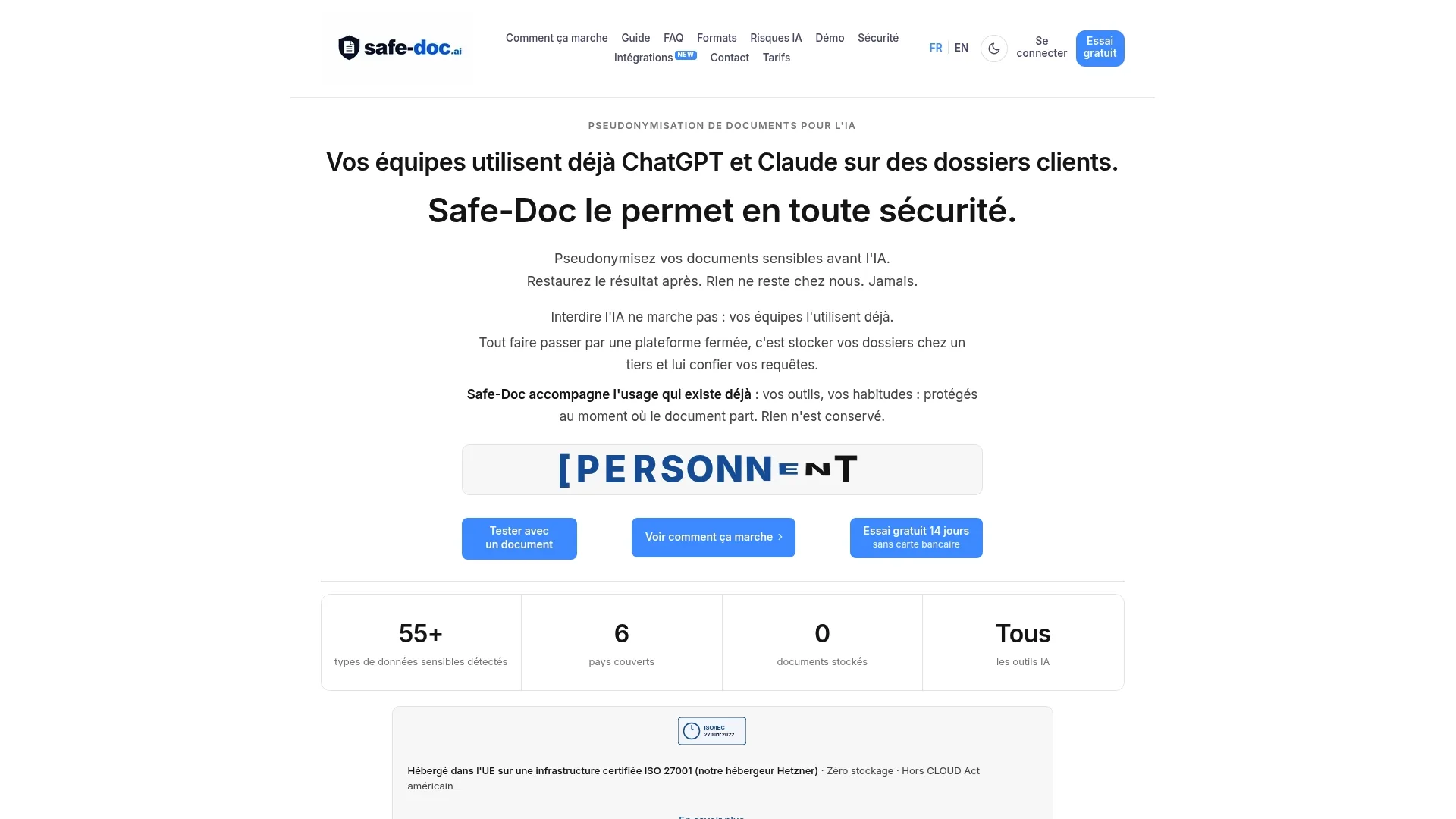
Safe-doc detects more than 90 types of personal and confidential data in your PDF and Word documents, pseudonymizes them in real time without storing them, then generates an exportable mapping to restore information once processing is complete. For an auditor, this means an audit report ready to attach to the file and exposure of sensitive data reduced to the strict minimum, even when your teams use ChatGPT or Claude daily. Pseudonymization does not replace the Article 30 register, DPIAs, or Article 28 contracts: it complements these legal obligations, not substitutes for them. To see how to integrate it into your audit and advisory practice, consult the page dedicated to legal departments and DPOs.
Sources
An audit report gains credibility when each finding rests on an identifiable, dated, and reader-verifiable text.
- Decree No. 2026-272 of 14 April 2026 (Légifrance)
- Priority enforcement 2026 - CNIL
- RECYF v2.5 - ANSSI
Append relevant extracts from each cited text, including supervisory authority decisions when they justify an organizational choice, for example on the question of DPO conflicts of interest. Systematically specify the consultation date, the framework version used, and the exact number of the decree or order cited: an audit report without this rigor loses much of its probative value.
This article constitutes general information and does not replace the advice of a qualified lawyer. Consult a qualified legal professional regarding your individual case before acting on this content.