

Encryption renders your financial documents unreadable to anyone without the authorized key. It is the core technical measure mandated by Article 32 of the GDPR, and its role in protecting confidential data extends far beyond simple secure storage. Before sending any document to an AI tool, the priority is clear: pseudonymize locally, then maintain control of your own keys via FIPS 140-3 compliant hardware security modules. The CNIL, ANSSI, and solutions like Safe-doc provide the frameworks and tools to furnish proof of compliance during inspections.
Table of contents
- Why traditional encryption is no longer sufficient against Shadow AI
- What regulatory obligations apply to your financial documents?
- Which technical controls should you deploy to protect your financial data?
- How to establish an operational roadmap before using AI
- Checklist, stakeholders, and cost estimates for SMEs and mid-size companies
- How Safe-doc concretely addresses these requirements
- Key takeaways
- What audits actually reveal about financial document security
- Safe-doc supports you from audit to deployment
- Sources and regulatory references
Why traditional encryption is no longer sufficient against Shadow AI
Encryption at rest protects your files on disk. Encryption in transit secures their transfer. But when an employee pastes a forecast balance sheet into ChatGPT or sends a tax schedule via a consumer file-sharing service, the data flows in cleartext to the AI provider, outside any controlled perimeter. This is precisely where the risk lies, and traditional approaches fail to address it.
The Shadow AI phenomenon amplifies this problem. Finance teams routinely use external assistants without informing their CISO, exposing customer names, transaction amounts, and cash-flow projections. Metadata and filenames represent an often-overlooked leakage vector: a file named `Previsionnel_Tresorerie_Janvier2026_ProjetX.xlsx` reveals strategic information before it is even opened.
- Office/PDF password protection: insufficient under Article 32 GDPR-these safeguards can be circumvented in seconds.
- Transfers via WeTransfer or non-contracted messaging: non-compliant with GDPR for financial documents, due to the absence of a signed data processing agreement.
- Exposed metadata: filenames, document properties, and network paths must be pseudonymized before any external transmission.
CNIL enforcement actions in 2024-2025 explicitly targeted HR and financial document flows, with formal notices issued for lack of end-to-end encryption and use of non-contracted tools.
What regulatory obligations apply to your financial documents?
The framework is precise and binding. Article 32 of the GDPR requires technical measures commensurate with the level of risk: encryption, traceability, strong authentication, and hosting within the European Union. For financial documents, this is not optional.
- Article 28 GDPR (DPA): any processor handling data on your behalf must sign a compliant data processing agreement. Without a DPA, use of an external AI tool is illegal under GDPR, regardless of encryption quality in transit.
- CNIL recommendations: the 2024 personal data security guide mandates a classification policy, encryption of workstations and mobile media, and secure transfer protocols (SFTP, modern HTTPS).
- ANSSI: guidance for sensitive information systems recommends strict segregation of data volumes and encryption at the file-system or data level.
- eIDAS: for financial documents with evidentiary value, qualified PKI certificates guarantee integrity and provide legally enforceable proof in case of dispute.
The DPO plays a central role: they must be able to produce the Article 30 register, access logs, signed DPAs, and proof of pseudonymization during an inspection. These elements constitute your compliance dossier.
Which technical controls should you deploy to protect your financial data?
Local pseudonymization before transmission is the cornerstone of any secure AI architecture. It consists of replacing sensitive identifiers (names, company registration numbers, nominal amounts) with reversible tokens-exclusively within your perimeter-before the document reaches an external service. The AI tool receives an analytically useful document, but without exploitable personal data.
- CNIL-recommended algorithms: AES-GCM, ChaCha20-Poly1305 for symmetric encryption; SHA-2/3 for hashing; Argon2 for passwords.
- Customer-controlled keys: generate and store your keys in FIPS 140-3 compliant HSMs, separated from encrypted data. Regular key rotation and access audits are non-negotiable.
- Encryption in transit: TLS 1.3 minimum, SFTP for file transfers. Retire obsolete protocols (TLS 1.0/1.1, unencrypted FTP).
- PKI signatures (eIDAS): for financial documents with evidentiary value, a PKI-based signature with a qualified certificate guarantees integrity and non-repudiation, unlike a simple electronic signature.
- Strong authentication (MFA) and comprehensive logging of every access, modification, or export.
Pro tip: Pseudonymize metadata as well: rename files with neutral identifiers before transmission, and strip document properties (author, company, network path) using a dedicated tool.

How to establish an operational roadmap before using AI
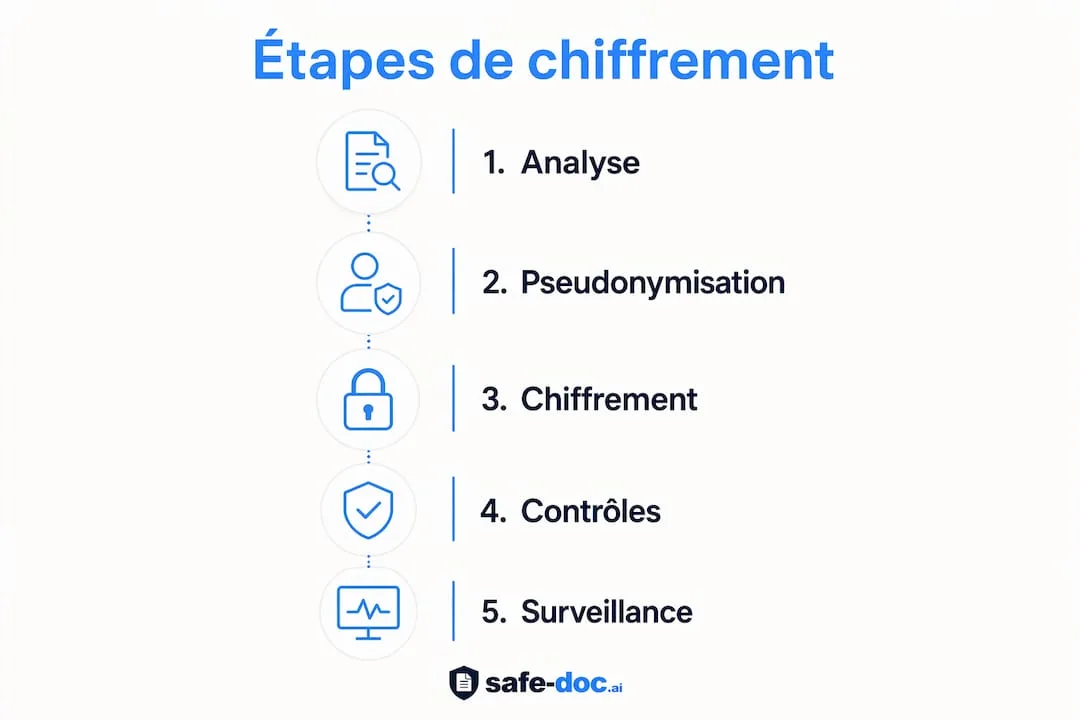
The approach unfolds in six sequential steps, each with a deliverable assigned to a specific role.
1. Sensitive document mapping (CISO + CFO): identify affected financial flows, their classification, and sensitivity level.
2. Classification and processing policy (DPO): define which documents may be processed by AI, under what conditions, and with which controls.
3. Local pseudonymization (CISO + integrator): deploy tokenization locally, log each transformation, and permit de-pseudonymization only within the controlled perimeter.
4. Key control and HSM (CISO): generate keys in a FIPS 140-3 HSM, configure rotation, and schedule access audits.
5. Secure transfer and DPA (legal counsel + DPO): verify that each AI provider has signed an Article 28-compliant DPA, with data localization in the EU/France.
6. Logging, audit, and incident playbook (CISO + DPO): activate immutable logs, schedule annual penetration tests, and document processing of sensitive documents without storage.
Minimum technical criteria to validate at each stage: AES-256, FIPS 140-3 HSM, MFA, EU/France hosting, signed DPA, proof of zero storage.
Checklist, stakeholders, and cost estimates for SMEs and mid-size companies
| Phase | Typical duration | Indicative cost (SME/mid-size) | Key stakeholders |
|---|---|---|---|
| Initial audit and mapping | Variable | Variable cost (context-dependent) | CISO, DPO, CFO |
| Pseudonymization pilot | Variable | Variable cost (context-dependent) | CISO, security integrator |
| Full deployment | Variable | Variable cost (context-dependent) | CISO, cloud provider, legal counsel |
| Team training | Variable | Variable cost (context-dependent) | DPO, finance management |
These ranges vary according to information-system complexity, the number of document flows, and existing maturity level. A hybrid HSM (hardware + cloud) reduces infrastructure costs while maintaining FIPS 140-3 compliance.
- Technical: AES-256 encryption, FIPS 140-3 HSM, MFA, local pseudonymization, zero storage.
- Contractual: DPA signed with each AI provider, Article 30 register up to date.
- Training: awareness of Shadow AI risks, procedures for handling encrypted documents, incident management.
- Audit: annual penetration tests, log reviews, verification of key rotation.
How Safe-doc concretely addresses these requirements
Safe-doc implements pseudonymization directly in the browser, without durably storing documents on its servers. Financial data is tokenized locally before transmission to the chosen AI tool (ChatGPT, Claude, etc.), meaning the AI provider never receives raw personal information.
- Zero persistent storage: no document transits Safe-doc servers, eliminating provider-side breach risk and simplifying proof of compliance.
- Immutable logging: each pseudonymization transformation is traced and exportable for CNIL or ANSSI audits.
- DPO support: Safe-doc provides the necessary evidence (logs, DPA, zero-storage architecture) to populate the Article 30 register and respond to inspections.
- Financial use cases: exchanges with accountants, AI analysis of management reports, due-diligence reviews without exposing counterparties' personal data.
For teams wishing to explore the distinction between pseudonymization and anonymization further, Safe-doc offers detailed technical documentation on its architecture and guarantees.
Key takeaways
Encryption protects confidential financial documents, but only local pseudonymization before AI processing addresses the real risk in 2026.
| Point | Details |
|---|---|
| Pseudonymization before AI | Tokenize financial data locally before any transmission to an external AI tool. |
| Customer-controlled keys | Generate and store keys in FIPS 140-3 compliant HSMs, separated from data. |
| Mandatory DPA | Sign an Article 28-compliant data processing agreement with each AI provider. |
| CNIL-compliant algorithms | Use AES-GCM or ChaCha20-Poly1305; retire Office/PDF password protections. |
| Safe-doc | Local pseudonymization, zero storage, and exportable logging for proof of CNIL compliance. |
What audits actually reveal about financial document security
The most common errors observed during audits are not technical-they are organizational. Finance teams sending forecast balance sheets via personal email, Excel files protected by four-character passwords, filenames exposing the client name and fiscal period before the file is even opened. Strong encryption is available, often free, yet underutilized.
What strikes me more is the persistent confusion between pseudonymization and anonymization. Many DPOs believe that masking a name is sufficient to anonymize. Yet pseudonymized data remains personal data under GDPR: it is re-identifiable. This is precisely why pseudonymization is the correct approach for AI, not irreversible anonymization, which would destroy the document's analytical utility.
My recommendation for 2026: start with a limited scope-for example, exchanges with your accountant. Pseudonymize those documents, verify your DPA is signed, export your logs. This proof of concept takes two to four weeks and provides a solid foundation to convince management and extend the system. Documented HR and financial data breaches demonstrate that sanctions fall on organizations that had the means to protect themselves but had not yet acted.
Safe-doc supports you from audit to deployment
Your finance teams are already using AI tools. The question is no longer whether you must secure these uses, but how to do so without blocking productivity. Safe-doc offers real-time local pseudonymization, without storing your documents, with proof of compliance your DPO can present to the CNIL the day of an inspection.
Three concrete steps to get started: a rapid audit of your financial document flows, a proof of concept on a restricted perimeter, then gradual deployment with team training. Consult the dedicated DPO page to launch your compliance audit, or discover integration with Claude to pseudonymize your documents directly in your working environment.
Sources and regulatory references
- Personal data security guide 2024 (CNIL): technical checklists, classification, secure transfer protocols.
- Encryption, hashing, signature (CNIL): recommended algorithms, key sizes, secrets management.
- Recommendations for architectures of sensitive information systems (ANSSI): technical framework for sensitive systems and restricted distribution.
- Regulation (EU) 2016/679 - GDPR: official text, Articles 28 and 32.
- Customer-controlled encryption keys in the banking sector: HSM practical guide and customer control of keys.
- Digitally signing financial documents: PKI, eIDAS qualified certificates, and document integrity.
- Pseudonymize confidential accounting data (Safe-doc): implementation guide and proof-of-concept examples.
- GDPR compliance and financial statements (Safe-doc): obligations specific to financial data and evidence expected by the CNIL.