

Systematically pseudonymize your pay slips before any AI processing, in stateless and tenant-scoped mode, before sending any file to a language model. This is the most urgent measure, and it conditions all the others. Here are the three actions to carry out without delay:
Immediate actions:
- Block the sending of CSV, PDF or DOCX payroll files to public models (ChatGPT, Claude without corporate DPA) until a pseudonymization layer is activated.
- Launch a minimal inventory of sensitive fields present in your bulletins: last name, first name, SIRET, IBAN, social security number, reasons for absence, union dues.
- Activate automatic pseudonymization on incoming flows before any AI processing.
Deliverable to be produced within 24 hours:
1. Operation certificate per job (SHA-256 hash + tenant ID) for each batch processed.
2. Proof of DPA signature with the AI service provider or pseudonymization.
3. Documented test plan: expected detection rate, accepted false positive threshold, controlled recovery procedure.
Table of contents
- Reversible pseudonymization or irreversible anonymization: how to choose for your newsletters?
- What GDPR obligations actually apply to pay slips in France?
- What technical methods should you choose to protect your salary data?
- How to deploy pseudonymization on a production scale?
- How to integrate pseudonymized bulletins into your AI workflows without risk of leaks?
- How to test, validate and produce audit evidence for the CNIL?
- What target architecture for stateless pseudonymization of pay slips?
- When does irreversible anonymization become the only acceptable option?
- What technical and contractual criteria should be required during a call for tenders?
- What mistakes should you absolutely avoid when hiding pay slips?
- Key Points
- What teams systematically underestimate in these projects
- Safe-doc: operational pseudonymization for DSI, HR and DPO
- Useful sources and recommended reading
Reversible pseudonymization or irreversible anonymization: how to choose for your newsletters?
The answer depends on just one question: will you need to find the original data again?
If the processing aims at an aggregated statistical analysis or the training of a model on historical data without individual restitution, irreversible anonymization is possible. On the other hand, as soon as the bulletin can be subject to a URSSAF control, a salary dispute or a legal retention obligation, reversible pseudonymization with separate keys per tenant is required.
Operational criteria to evaluate before deciding:
- Need restoration: tax audit, industrial tribunal dispute, internal audit.
- Presence of article 9 data: illness reasons, union dues - priority treatment and mandatory separate procedure.
- Volume and multi-tenant: beyond a few hundred bulletins per month, key management per tenant becomes an architectural prerequisite.
- Auditability requirement: access logs, PDF export of operations, SHA-256 certificates.
Pro tip: When your AIPD concludes that there is a high risk or a legal obligation imposes controlled re-identification (litigation, CNIL control), opt for pseudonymization with separate keys per tenant and complete logging. Irreversible anonymization definitively closes the door to any restoration: first check that your legal framework allows it.
What GDPR obligations actually apply to pay slips in France?
La applicable legal basis pour le traitement des données de paie est, dans la grande majorité des cas, l'obligation légale (article 6.1.c du RGPD) ou l'exécution du contrat de travail (article 6.1.b). The employee's consent is almost never valid here: the link of subordination vitiates any free expression of consent, and the CNIL regularly recalls this during its inspections.

Article 9 data - medical reasons for absence, union dues - require an additional legal basis and reinforced security measures. They must be explicitly marked and processed via a separate procedure, with restricted access.
Documents to be provided during a CNIL audit:
- Up-to-date processing register, mentioning the purpose of the AI processing.
- AIPD completes if the processing presents a high risk (crossing of sensitive data, large volume, use of AI).
- DPA signed with each AI or pseudonymization service provider.
- Redaction certificates per job (SHA-256 hash + tenant ID).
- Time-stamped and exportable access logs.
Point of vigilance: according to the AI Act (article 4), AI literacy training of HR users is a legal requirement for high-risk systems, and is a frequent audit point. Document training sessions and retain certifications.
pseudonymization in accordance with article 4(5) of the GDPR is the technical measure that the CNIL recommends to reduce the risk linked to the use of AI on sensitive HR documents.
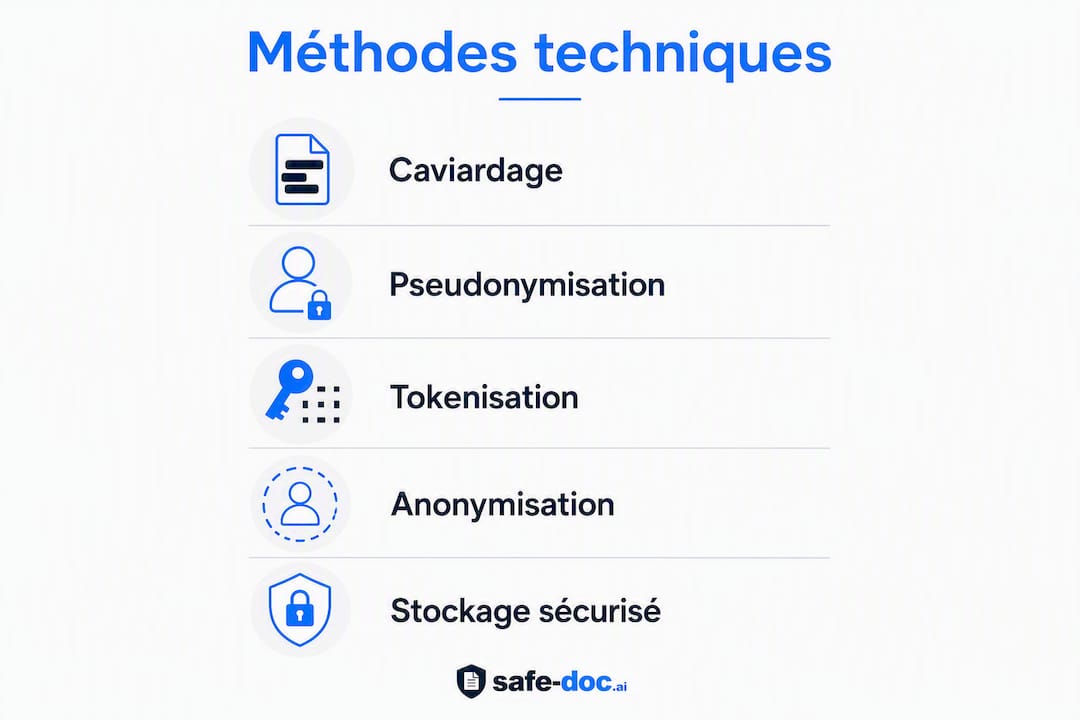
What technical methods should you choose to protect your salary data?
Four approaches coexist, each adapted to a different context.
| Method | Reversibility | PII Coverage | API Integration | Storage mode |
|---|---|---|---|---|
| Redaction (redaction) | No | High if NER driven | Native PDF/DOCX | Stateless possible |
| Reversible tokenization / mapping | Yes (separate key) | Very high | REST API, CSV | Encrypted export mapping |
| End-to-end encryption | Yes (symmetric key) | Total (entire file) | Limited | Encrypted storage required |
| Statistical anonymization | No | Partial (aggregates) | Batch only | Stateless |
For pay slips processed by AI, tokenization with reversible mapping is the most suitable method: it preserves the structure of the document, allows controlled restoration and is natively integrated via REST API on PDF, DOCX or CSV flows. Redaction is suitable for final exports or aggregated reports.
Non-negotiable technical criteria: multilingual PII detection and article 9-aware, export of the mapping in a box separate from the AI model, strict separation of keys by tenant. To learn more about the methods applied to financial data, guide on the pseudonymization of accounting data details similar use cases.
How to deploy pseudonymization on a production scale?
A successful deployment follows six sequential phases. Each step produces a verifiable deliverable.
1. Inventory and mapping: list all PII fields by type of bulletin (DSN, PDF, spreadsheet), identify the article 9 fields, note the monthly volumes by payroll manager.
2. Definition of masking rules: column by column, decide tokenization or redaction, define the tenant-scoped dictionary.
3. POC on three high-volume managers: prioritize the managers with the most complex conventions to generalize the discipline quickly and produce audit certificates per tenant in one quarter.
4. Detection tests: measure true positive (TP), false positive (FP) and false negative (FN) rates on a representative sample; validate the acceptable threshold with the DPO.
5. Staging and API integration: connect the pseudonymization layer to the payroll ERP and the AI workflow via REST API; check latency and scalability (pages/minute).
6. Training and progressive production: train HR users, document the controlled restoration procedure, activate logs and automatic PDF reports.
Output metrics to be validated before going into production: detection rate above the threshold set with the DPO, processing time per page in compliance with the SLA, zero cross-tenant leaks on partitioning tests.
How to integrate pseudonymized bulletins into your AI workflows without risk of leak?
The principle is simple: no bulletin must reach an AI model before having passed through the pseudonymization layer. CNIL recommends pseudonymization as a technical measure to lift the ban on the use of AI on sensitive documents, provided that the separation between identity and processing is effective.
The recommended architecture places a stateless masking API in front of any AI call. The restoration mapping is stored in a separate vault, inaccessible to the model. The keys never pass through in requests sent to the LLM. For SaaS models (ChatGPT Enterprise, Claude for Work), check the existence of a DPA covering your HR data and favor hosting in the EU for Article 9 data. EU-US transfers remain regulated by the Data Privacy Framework, but do not exempt from pseudonymization upstream.
Shadow AI continues in parallel as long as users do not have a simple solution at hand. Blocking without tools does not work.
Pro tip: Configure a tenant-aware scope on each pseudonymization job to avoid any cross-tenant leaks. Combine it with an AI usage charter signed by the HR and IT teams, and document the training sessions: article 4 of the AI Act makes this an obligation for high-risk systems.
How to test, validate and produce audit evidence for the CNIL?
Four tests are essential before any production launch and at regular intervals thereafter.
| Metric | Definition | Recommended threshold |
|---|---|---|
| True positive rate (TP) | PII correctly detected and hidden | To be defined with the DPO according to criticality |
| False Negative Rate (FN) | PII missed by the system | Zero tolerance on data article 9 |
| False positive rate (FP) | Non-PII data wrongly masked | Monitor impact on data quality |
| Latency per page | Unit processing time | Compliant with contractual SLA |
| Cross-tenant leak testing | Data from one tenant visible to another | Zero tolerance |
Audit artifacts to produce and keep: complete AIPD if the processing is high risk, PDF export of time-stamped access logs, SHA-256 certificates per job, metric report covering coverage rate and errors. These documents constitute proof of technical and organizational mastery required during a CNIL inspection.
Reminder: the use of AI in payroll can be secure if we combine contractual DPA, systematic pseudonymization and complete documentation (AIPD, register, certificates). None of these three elements can compensate for the absence of the other two.
What target architecture for stateless pseudonymization of pay slips?
Architectural principle: “No nominative data must reach the AI model. The stateless pseudonymization layer is the only authorized crossing point between your bulletins and any external processing. The recovery mapping lives in a separate, encrypted vault, accessible only with traced DPO authorization. »
The key components of the flow:
Ingestion (PDF, DOCX, CSV, DSN) → NER/OCR article 9-aware (multilingual detection of PII and sensitive data) → Stateless pseudonymization layer (tenant-scoped tokenization, no storage at the provider) → Encrypted export mapping (separate vault, keys not accessible to the model) → Logs and PDF report (certificate SHA-256 per job, timestamped logs).
Integration points to plan: ERP/payroll software connector, webhook to AI workflow, export to data lake or compliant archiving, controlled restoration procedure upon DPO authorization. Stateless architecture with strict key traceability reduces operational risk and facilitates compliance during audits.
When does irreversible anonymization become the only acceptable option?
Pseudonymization presents a structural limit: as long as the restoration mapping exists, the data technically remains personal data within the meaning of the GDPR. The risk of re-identification through cross-referencing increases with the volume and richness of the data retained.
Decision rule: if you have no legal obligation to restore individual data AND the dataset will be used for public training or an aggregated report distributed without restitution, irreversible anonymization is the only compliant option.
Cases justifying irreversible anonymization: creation of a widely distributed AI training dataset, publication of aggregated statistical reports without the possibility of individual restitution, transfers outside the EU to environments without sufficient DPA. In all other cases - and in particular for any bulletin likely to be contested or controlled - reversible pseudonymization remains the norm.
Decision flow: purpose of processing → legal risk of reidentification → need for restoration → reversible pseudonymization or irreversible anonymization.
What technical and contractual criteria should be required during a call for tenders?
Any pseudonymization solution for pay slips must satisfy these dimensions before signature.
Technical dimensions:
- Controlled reversibility with secure mapping export.
- PII detection coverage: 90+ data types, article 9-aware, multilingual.
- Native REST API integration, PDF/DOCX/CSV/DSN formats supported.
- Stateless mode confirmed by architecture and third-party audit.
- Auditability: exportable logs, PDF report per job, SHA-256 certificates.
Contractual clauses to be required:
- GDPR compliant DPA, explicitly covering HR and Article 9 data.
- Latency and scalability SLA (guaranteed pages/minute).
- Contractual obligation not to store documents and mappings with the service provider.
- Authorized restoration procedure documented and audited.
- ISO 27001 certification or equivalent third-party audit.
GDPR compliance for AI in payroll is based on three inseparable pillars: contractual DPA, systematic pseudonymization and complete documentation.
What mistakes should you absolutely avoid when hiding pay slips?
The most common and serious error: sending a non-pseudonymized payroll CSV file to a public LLM. Payrolls combine direct PII and sensitive Article 9 data, often without the user realizing the risk. Such a violation exposes the company to a mandatory CNIL notification.
Other common errors and their fixes:
- Log mappings without encryption: systematically encrypt mapping exports and store them in a vault separate from the AI model.
- Do not scope-tenant detection: a global configuration without partitioning per tenant creates a risk of cross-tenant leakage that is difficult to detect and prove.
- Omit article 9 data: a system that detects names and IBANs but misses medical reasons or union dues misses the most sensitive data.
In the event of a proven incident: immediately block access to the model concerned, revoke the compromised keys, run a leak test, inform the DPO and prepare the CNIL notification if the criteria are met. Keep the complete audit trail of the reaction: this is what the CNIL examines as a priority.
Pro tip: For POC, prioritize payroll managers managing the most complex collective agreements and the highest volumes. Generalizing discipline from these difficult cases is much more effective than starting with simple cases.
Key points
Stateless, tenant-scoped and traceable pseudonymization is the essential technical measure for using AI on pay slips in compliance with the French GDPR.
| Point | Details |
|---|---|
| GDPR legal basis | Legal obligation or performance of contract; employee consent is invalid for payroll data. |
| Article 9 data | Medical reasons and union dues require a separate procedure and restricted access. |
| Stateless architecture | No document or mapping stored with the service provider; SHA-256 certificate per job required. |
| Audit evidence | AIPD if high risk, signed DPA, time-stamped logs, SHA-256 certificates and metric reports to keep. |
| Safe-doc | Detection of 90+ types of PII, stateless mode, secure export mapping and PDF audit reports for CIO, HR and DPO. |
What teams systematically underestimate in these projects
Most pay slip pseudonymization projects fail not on technique, but on governance. We deploy a tool, we train someone, and Shadow AI continues in parallel because HR users do not have a simple solution at hand.
What I observe most often: IT teams configure the pseudonymization layer correctly, but forget to scope the dictionaries. As a result, a payroll manager can theoretically access the tokens of another tenant. This is not a flaw in the tool, it is a configuration error that only a cross-tenant leak test reveals. And no one does this test before the audit.
The other blind spot: article 9 data. A system which perfectly detects names, IBANs and social security numbers but misses the reasons for absence or union dues misses exactly what the CNIL sanctions most heavily. Check that your solution is explicitly Article 9-aware, not just “GDPR compliant” in the generic sense.
Finally, reversibility is not a luxury: it is a legal obligation in most payroll contexts. Choosing irreversible anonymization to simplify the project means exposing yourself to the impossibility of responding to a URSSAF inspection or industrial tribunal dispute. Reversible pseudonymization with separate keys per tenant is the norm, not the exception.
Safe-doc: operational pseudonymization for DSI, HR and DPO
Your payslips contain data that you cannot send as is to an AI model. Safe-doc solves this problem without changing your tools or your work habits.
The platform automatically detects more than 90 types of sensitive data, including Article 9 fields, and pseudonymizes your PDF, DOCX and CSV documents in stateless mode: no document or mapping is stored at Safe-doc. Each job produces an SHA-256 certificate and an exportable PDF report, which can be used directly by your DPO during a CNIL audit. Integration is done via REST API or via the web interface, without overhauling your infrastructure.
For HR departments and IT departments who want to move forward quickly, Safe-doc offers a POC on your three high-volume payroll managers. Expected result: audit certificates per tenant and detection metrics validated in a few weeks. Also consult page dedicated to HR teams for use cases and contractual guarantees.
Useful sources and recommended reading
- CNIL reference - Human resources management: compliance framework for HR processing, reference for the AIPD and the register.
- Anonymization of personal data - CNIL: official definitions and techniques of anonymization and pseudonymization.
- GDPR pseudonymization art. 4(5) - Safe-doc: legal and technical explanation of compliant pseudonymization.
- Confidentiality and AI contracts - Safe-doc: legal framework for the use of AI on sensitive documents.
- Anonymize HR data - Safe-doc: compliant practices for pseudonymizing data in pay slips.
- DPA / GDPR / AI Act - Safe-doc: contractual documentation and DPA models for legal teams.