


Legal data encryption is defined as the transformation of sensitive documents into unreadable code, accessible only via an authorized cryptographic key. This technique forms the foundation of legal data security for any legal professional subject to GDPR and attorney-client privilege. In 2026, AES-256 and TLS 1.3 standards, along with CNIL recommendations, define the minimum acceptable level. Understanding how legal data encryption works is no longer a technical option reserved for IT specialists. It is a direct professional responsibility for lawyers, notaries, and data protection officers.
What encryption algorithms and systems protect legal data?
Symmetric encryption and asymmetric encryption constitute the two main families of cryptography used in the legal sector. Each addresses distinct needs depending on whether you are protecting a stored file or data in transit.
Symmetric encryption with AES-256 is the gold standard for data at rest. AES-256 applies 14 successive rounds of transformation on 128-bit blocks, rendering any brute-force attack ineffective with current technology. A confidential contract stored on a firm's server must be encrypted with AES-256 at minimum.

Asymmetric encryption relies on a key pair: a public key for encryption and a private key for decryption. This mechanism is used for secure exchanges between parties, particularly when transmitting documents between lawyers or to courts.
For data in transit, the TLS 1.3 protocol is now the standard. The CNIL requires TLS 1.2+ as the minimum baseline for regulated professions, with TLS 1.3 recommended for new deployments. The absence of this protocol constitutes a direct violation of Article 32 of GDPR.
- AES-256: encryption of files at rest, client files, databases
- RSA / ECC: key exchange and digital signatures
- TLS 1.3: protection of network communications and access to cloud platforms
- SHA-256 hashing: verification of document integrity without decryption
Pro tip: Don't confuse hashing with encryption. Hashing is irreversible and serves to verify that a document has not been modified. Encryption is reversible with the correct key. Both are complementary in a secure legal architecture.
What regulatory requirements govern legal encryption?
The regulatory framework for legal data encryption rests on two pillars: GDPR and attorney-client privilege. These two obligations mutually reinforce each other and create dual technical and criminal liability for legal professionals.
Article 32 of GDPR requires technical measures proportionate to the risks. In practice, for a law firm or corporate legal department, the minimum obligations in 2026 are as follows:
1. Encryption at rest with AES-256 for all files containing personal data or covered by attorney-client privilege.
2. Encryption in transit via TLS 1.2+ for all network transmission, with migration to TLS 1.3 for new infrastructures.
3. Robust hashing of passwords and document fingerprints with SHA-256 or bcrypt.
4. Multi-factor authentication (MFA) mandatory for access to systems containing sensitive data.
5. Data Protection Impact Assessment (DPIA) before any deployment of AI tools processing data covered by attorney-client privilege.
A DPIA is mandatory whenever AI processing involves high-risk data. This obligation applies directly to firms using automated file analysis tools.
For data transfers outside the European Union, the EDPB recommends encryption with key management by the exporter. This measure prevents any access to data, even under foreign court order. An international firm that stores files on a US server without this measure exposes its clients to real risks of compelled disclosure.
How to manage encryption keys to guarantee data sovereignty?
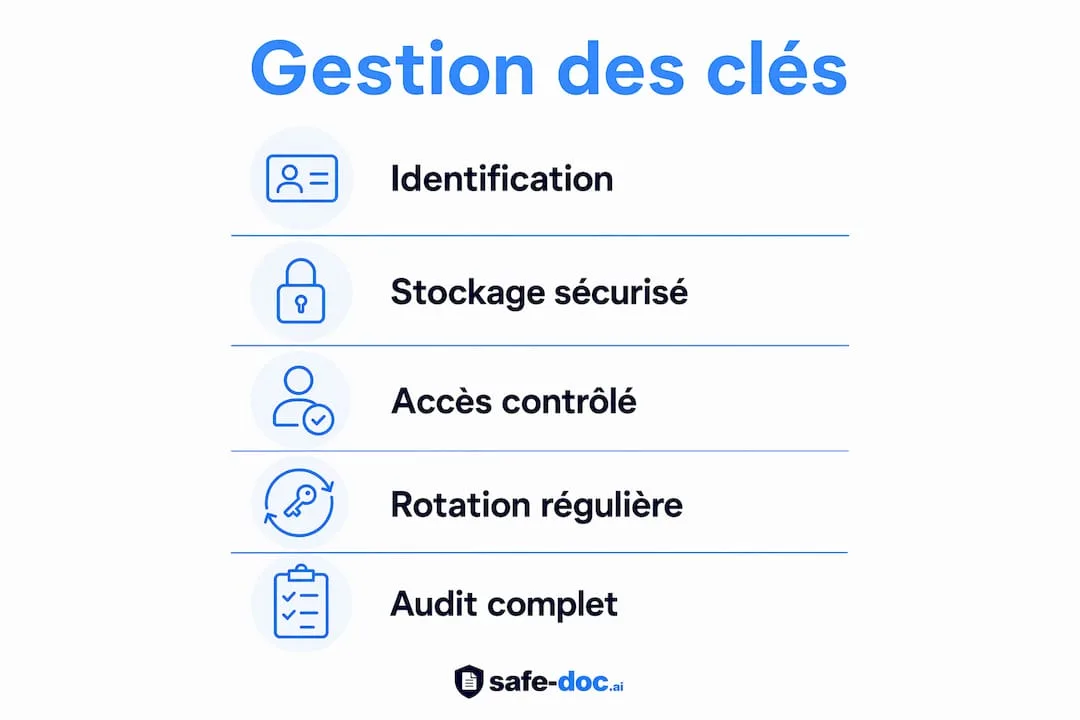
Encryption key management is the most frequently overlooked point in legal architectures. Yet, encryption protects nothing if the cloud provider itself retains the decryption keys. In this case, a court order addressed to the provider is sufficient to expose all the data.
The solution is customer-managed keys, known as Customer Managed Keys (CMK). The firm generates and maintains its own keys. The provider hosts the encrypted data without ever being able to read it. This architecture guarantees true sovereignty over information.
Best practices to implement:
- MFA and Privileged Access Management (PAM): multi-factor authentication limits the risk of key compromise, even in case of password theft.
- Immutable audit logs: time-stamped logging with user identifiers allows you to prove compliance and identify any abnormal access.
- Rigorous offboarding procedures: an employee who leaves the firm must have their access revoked immediately. Insufficient offboarding allows unrevoked access to persist, a major factor in breaches despite encryption in place.
- Regular key rotation: encryption keys must be renewed according to a defined schedule, at minimum annually.
Pro tip: [Firms that precisely document their access](https://query-informatique.com/securiser-les-donnees-juridiques-sensibles/) are better equipped during CNIL audits. A structured access log is worth more than a security policy written but never applied.
What tools are recommended for encrypting legal documents?
The choice of tools directly determines the actual level of data protection. Available solutions fall into three categories according to their level of compliance and architecture.
| Tool category | Encryption | Key management | GDPR compliance |
|---|---|---|---|
| Legal digital vault | Client-side AES-256 | Client | High |
| Professional cloud platform | AES-256 + TLS 1.3 | Client or shared | High if CMK |
| Consumer messaging | Variable or absent | Provider | Insufficient |
| Consumer storage | Variable | Provider | Insufficient |
A client-side encrypted digital vault is the most secure solution for sensitive exchanges between lawyers and clients. The RPVA includes encryption for official procedures, but does not cover out-of-procedure exchanges. Consumer tools such as non-professional messaging do not meet attorney-client privilege requirements.
Professional cloud platforms with AES-256 encryption and client key management constitute a viable alternative for firms that wish to maintain an outsourced infrastructure. The non-negotiable condition remains control of the keys by the firm itself. For multi-site firms, deployment must allow data residency by case and by jurisdiction, not only by physical location of the firm.
Pseudonymization of documents before their processing by AI tools represents an additional layer of protection. Safe-doc allows you to pseudonymize sensitive data before submitting them to tools like ChatGPT or Claude, without storing any documents. This approach directly addresses the problem of Shadow AI in firms.
What are the concrete challenges in implementing legal encryption?
Implementing encryption raises practical difficulties that theoretical security policies are insufficient to resolve. The first pitfall is blind trust in backups. 43% of organizations discover during an incident that their backups are unreliable. Testing restoration at least once a month is the only way to ensure that encrypted data is truly recoverable.
The second challenge is managing access over time. A firm that correctly encrypts its data but does not revoke access from former employees creates a structural flaw. Offboarding must be treated as a security procedure in its own right, with a checklist and validation by the IT manager or DPO.
- Test restorations monthly in an isolated environment
- Audit access quarterly to identify inactive accounts
- Document incidents even minor ones to feed the processing register
- Train employees on the risks linked to unauthorized tools, particularly Shadow AI
Pro tip: Data security has become a differentiator for firms that know how to demonstrate it to their clients. An annual audit report shared with institutional clients builds trust well beyond any contractual clause.
Key points
Legal data encryption requires AES-256 at rest, TLS 1.3 in transit, and customer-managed keys to guarantee true sovereignty and seamless GDPR compliance.
| Point | Details |
|---|---|
| 2026 encryption standard | AES-256 at rest and TLS 1.3 in transit are the minimum levels required by the CNIL. |
| Customer-managed keys | Only control of keys by the firm guarantees inaccessibility of data under foreign court order. |
| Regulatory obligations | Article 32 of GDPR requires encryption, MFA, and DPIA before any deployment of AI on sensitive data. |
| Audit logs | Time-stamped access logging is essential to prove compliance during a CNIL inspection. |
| Restoration testing | 43% of organizations discover during an incident that their backups are failing; monthly testing is mandatory. |
Legal encryption, a professional liability issue
What strikes me most in discussions about legal data security is the persistent confusion between encryption and compliance. Many firms believe that deploying AES-256 is sufficient to satisfy GDPR. This is not the case. Encryption is a necessary condition, not a sufficient one.
The real question is not "is our data encrypted?" but "who holds the keys, who can access them, and under what conditions?" I have seen perfectly encrypted firms run into difficulty during an audit because their access logs were non-existent or not time-stamped. Proof of compliance is as important as compliance itself.
The pressure of extraterritorial legislation, particularly the US Cloud Act, makes data sovereignty more urgent than ever for firms handling international cases. Encryption with customer-managed keys is no longer a luxury for large firms. It is a basic requirement for any professional advising clients on cross-border transactions.
Finally, the rise of Shadow AI in firms creates a new risk vector that encryption alone cannot contain. Employees who use ChatGPT or other unauthorized tools with case documents bypass the entire security architecture in place. The answer is not to ban AI, but to channel it with tools that pseudonymize data before processing. This is precisely what Safe-doc allows you to do, without changing work habits.
- Jacques
Safe-doc: pseudonymization and compliance for legal professionals
Legal professionals who want to use AI without compromising the confidentiality of their cases need a layer of protection between their documents and analysis tools.
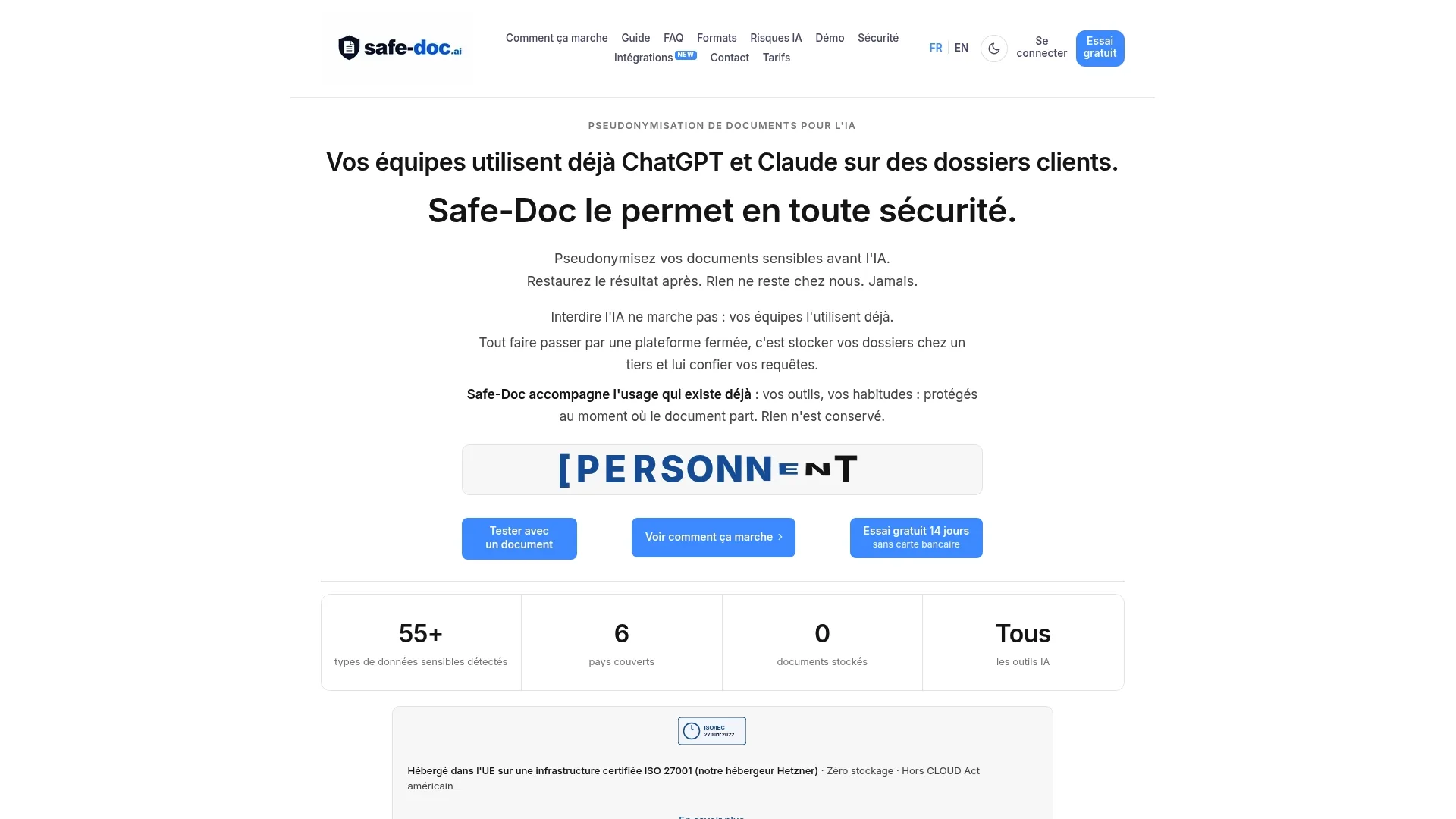
Safe-doc pseudonymizes sensitive data in real time before transmission to tools like ChatGPT or Claude. No documents are stored on Safe-doc servers. The solution is GDPR compliant and meets attorney-client privilege requirements. The pseudonymization and audit features allow DPOs and legal managers to document each processing operation and prove their compliance during an inspection. To understand the detailed operation of the solution, the how it works page presents Safe-doc's zero-storage architecture.
Frequently asked questions
What is AES-256 encryption for legal data?
AES-256 is a symmetric encryption algorithm that applies 14 rounds of transformation on 128-bit blocks. It is the recommended standard in 2026 to protect legal files at rest against unauthorized access.
What is the difference between encryption at rest and in transit?
Encryption at rest protects files stored on a server or disk. Encryption in transit, via TLS 1.3, protects data during network transmission. Both are mandatory to comply with Article 32 of GDPR.
Why is customer-managed key management essential?
If the cloud provider retains the encryption keys, it can decrypt the data under foreign court order. Customer-managed keys ensure that only the firm can access its own data, even under compulsion.
Is encryption sufficient to ensure GDPR compliance?
No. GDPR also requires multi-factor authentication, audit logs, a DPIA for high-risk processing, and offboarding procedures. Encryption is one measure among a set of technical and organizational obligations.
How to protect legal data when using AI tools?
Pseudonymizing documents before processing by an AI tool is the recommended method. Safe-doc applies this protection in real time, without storing documents, which allows the use of tools like ChatGPT while respecting attorney-client privilege.