

The Model Context Protocol lets you insert a pseudonymization step between your sensitive data and a large language model before the LLM ever sees it. Today, this is the most robust approach for connecting enterprise systems to generative AI platforms like ChatGPT or Claude without directly exposing the personal information they handle.
But beware of a common confusion: pseudonymizing does not mean anonymizing. Once data has passed through an MCP pseudonymization server, it remains personal data under Article 4(5) of the GDPR. The mapping table that enables reversibility changes the nature of the risk; it does not eliminate it.
Concretely, here's what this approach means for your organization:
- MCP standardizes how an AI agent calls external tools, making it possible to insert a pseudonymization filter without rewriting each integration.
- Pseudonymization reduces the risk of leaks, but it maintains GDPR obligations: processing register, impact assessment, data subject rights.
- For teams that want to move fast without building their own masking infrastructure, Safe-doc offers a ready-to-use MCP integration with no document storage.
If you're looking for a quick answer, there it is. The rest of this article details the architecture, technical integration patterns, and roadmap for implementation.
Key points
Pseudonymization via MCP reduces the exposure risk for personal data sent to an LLM, but it never exempts you from GDPR obligations.
| Point | Details |
|---|---|
| - | - |
| MCP structures data access | The tools, resources, and prompts primitives let you insert a pseudonymization filter at the protocol level rather than per application. |
| Pseudonymization ≠ anonymization | Pseudonymized data remains personal data under Article 4(5) of the GDPR, as long as the mapping table exists. |
| Place masking server-side in MCP | Centralizing pseudonymization in the server or a dedicated proxy prevents accidental bypass by client applications. |
| Secure the mapping table | Encryption at rest, per-session salt, and automatic deletion limit re-identification risk in the event of a breach. |
| Safe-doc as an acceleration path | The platform detects over 90 data types, stores no documents, and integrates via REST API or MCP for rapid deployment. |
Table of contents
- What is MCP and how does it structure AI integration?
- Why pseudonymize data before sending it to an LLM?
- Where should the pseudonymization layer sit in an MCP architecture?
- Which technical integration patterns should you choose to mask data?
- How do you actually deploy pseudonymization in an MCP pipeline?
- How do you concretely reduce the risk of re-identification?
- What open source tools exist for prototyping an MCP integration?
- MCP integration from a SaaS pseudonymization solution's perspective
- Should you choose MCP and pseudonymization, or another approach?
- From technical guide to implementation with Safe-doc
- Sources
What is MCP and how does it structure AI integration?
The Model Context Protocol is an open standard that defines how a language model accesses tools, data, and instructions outside its training set. Before its adoption, every integration between an LLM and a business system (database, CRM, document management tool) required a custom connector. MCP replaces this proliferation of proprietary bridges with a common interface, which dramatically simplifies how LLMs access external services.
The protocol rests on three distinct primitives, each with a specific role:
1. Tools: functions the model can call directly, for example "search for a customer in the database" or "pseudonymize this text." The model decides when to invoke them based on the conversation context.
2. Resources: data exposed by the host application that the model can read but does not trigger itself. They remain under the application's control, not the LLM's.
3. Prompts: predefined request templates that the human user chooses to activate, keeping some control on the person side rather than the machine side.
This separation is a game-changer for data security. A pseudonymization tool exposed as an MCP tool can systematically intercept text before it reaches the model, without each developer having to hand-code that step into their application. For an IT department managing several AI assistants in parallel-marketing, legal, customer support-it's the difference between a security policy enforced once at the protocol level and a policy applied (or forgotten) team by team.
Why pseudonymize data before sending it to an LLM?
Sending a contract, HR file, or raw audit report to a third-party model means moving personal data outside your control perimeter, often to servers located outside the European Union. Pseudonymization breaks the direct link between content and real identity, reducing exposure in the event of a leak or misconfiguration on the AI provider's side.
The legal distinction deserves to be stated clearly. Anonymization permanently removes the possibility of re-identifying a person, which takes the data out of the GDPR's scope. Pseudonymization, by contrast, replaces identifiers with tokens while retaining-separately-the table that enables reversibility to the original values. The Article 29 Working Party, in Opinion WP216, emphasizes precisely this frequent confusion: pseudonymized data remains personal data as long as the mapping table exists somewhere.
A figure that changes how you read the risk: according to Opinion WP216 of the Article 29 Working Party, pseudonymization reduces the link between a dataset and a person's identity, but it never removes the data's status as personal data under the GDPR. It is the reversibility key, not the masking technique itself, that determines the actual level of risk.
This nuance has direct practical consequences for your obligations:
- The processing register, impact assessment (DPIA), and data subject rights continue to apply, even after pseudonymization.
- On the other hand, pseudonymization remains a security measure explicitly recommended by Article 32 of the GDPR, which can reduce your exposure in the event of an inspection or incident.
- Use cases where it is essential: sending contractual documents to an AI assistant, analyzing HR files via a third-party tool, or transferring data to an AI cloud provider located outside the EU.
The main residual risk is not pseudonymization itself but poor management of it: a poorly protected mapping table, or a possible correlation between several pseudonymized datasets that, when cross-referenced, allow re-identification.
Where should the pseudonymization layer sit in an MCP architecture?
An MCP architecture rests on three components that communicate with each other, and the central question for a security officer is simple: at what level should you intercept data before it reaches the model?
The MCP host is the application the end user interacts with-an AI-augmented email client, desktop assistant, or internal business interface. The MCP client is the software component embedded in that host that manages the connection with one or more servers. The MCP server exposes the available tools, resources, and prompts, and this is typically where it connects to your real systems: databases, document managers, business APIs.
Two transport modes structure these exchanges: stdio mode, suited to local deployment where client and server run on the same machine, and streamable HTTP mode, used for distributed architectures where the MCP server runs on separate infrastructure. This second mode imposes non-negotiable network precautions:
- End-to-end TLS encryption on all communications between client and server.
- A reverse proxy in front to handle authentication, rate limiting, and access logging.
- Network isolation of the MCP server from the production databases it queries.
The question that comes up systematically in integration projects: should you mask data on the application side (before the MCP call) or on the MCP server side itself? The second option is essential in the majority of enterprise cases. Placing pseudonymization directly in the MCP server, or in a dedicated proxy placed right in front of it, guarantees that no client application can bypass the protection through configuration error. The model never receives raw data, regardless of which client queried it.
Pro tip: Don't duplicate pseudonymization logic in each client application. Centralize it in a single MCP server or proxy, tested once and for all, rather than reimplementing it with each new AI project.
Which technical integration patterns should you choose to mask data?
1. The anonymizer proxy. This pattern places an MCP server between the AI agent and the source database. The dnjfr/mcp-db-results-anonymizer project illustrates this well: the query executes on the real database, columns containing personal information are automatically detected via a multi-layer pipeline, then values are replaced with pseudonyms before the result goes back to the agent. The AI agent never sees the raw data, which dramatically simplifies compliance for transfers to third-party LLMs. This pattern is particularly suitable for cases where the AI directly queries a business database (PostgreSQL, MySQL, MongoDB).
2. The mask-then-unmask workflow. Here, raw text is first masked by a dedicated tool, transmitted to the model for processing (summarization, analysis, drafting), then unmasked upon receipt of the response. The pseudonym-mcp package available on npm exposes exactly this type of tooling-`mask_text` and `unmask_text`-with a mapping kept in memory and tied to a session identifier. This pattern suits document workflows: assisted drafting, contract summaries, responses to sensitive emails.
3. The session store for controlled reversibility. The common element between the two preceding approaches is managing the mapping table. The woladi/pseudonym-mcp project recommends storage strictly limited to the current session, with a unique salt per session to generate deterministic pseudonyms without long-term persistence. Without this discipline, the mapping table itself becomes data to protect at the same level as the originals.
The choice between these patterns depends primarily on your entry point. If the AI queries a structured database, the anonymizer proxy avoids any rewrite of business logic. If your users are pasting free text into an assistant, such as email or contract content, the mask/unmask workflow offers more flexibility. Many organizations end up combining the two: a proxy for database access and a mask/unmask tool for free-text exchanges with the AI assistant.
How do you actually deploy pseudonymization in an MCP pipeline?
Moving from theory to production follows a fairly stable sequence, regardless of sector. Here are the four steps that structure a solid deployment.
1. Inventory and classify sensitive fields. Before writing a line of code, map the categories of personal data that actually pass through your AI flows: names, social security numbers, banking details, health data, confidential contractual information. This step often reveals surprises-free-text fields containing identifiers that no database schema explicitly flags.
2. Choose the pseudonymization method appropriate to each field type. Tokenization suits structured identifiers (customer numbers, file references). Salted hashing works well for values you want to compare without revealing them. Reversible encryption is required when exact restitution of the original value is necessary downstream. Hybrid approaches, combining regular expressions for structured identifiers and entity recognition via a local model for names and organizations, often offer the best coverage compromise.
3. Structure mapping storage with strict separation of access. The mapping table must be encrypted at rest, limited to the session duration, and accessible only to components with a real functional need for it. Operational recommendations from IT audit feedback emphasize this point: encrypting the mapping table and limiting access concretely reduces the attack surface in the event a pipeline component is compromised.
4. Test before production, then formalize the impact assessment. Tests should include linkage attacks and frequency attacks, where an attacker attempts to re-identify a person by cross-referencing several pseudonymized datasets. Once these tests pass, the DPIA documents the processing for your data protection officer and serves as proof of due diligence in the event of an audit.
Pro tip: Build in a policy from day one for automatic rotation and deletion of session mappings. A mapping kept indefinitely "just in case" is the first weak link a security audit will identify, and the first risk in the event of a breach.
For legal teams managing this type of project, our guide on pseudonymizing contractual documents details a checklist tailored to contracts and legal documents, a particularly common use case in enterprise MCP deployments.
How do you concretely reduce the risk of re-identification?
Pseudonymization protects all the better when it rests on strict governance of the reversibility key. Without this discipline, the mechanism loses much of its value.
Several concrete measures make a real difference in practice:
- Salt each session independently. A unique salt per session, combined with the original value before hashing, prevents the same identifier from always producing the same pseudonym from one session to the next. This breaks attempts to correlate multiple conversations with the AI assistant.
- Limit mapping lifetime. A mapping stored only during the active session, then deleted, reduces the exposure window in the event of a server compromise.
- Separate roles between DPO and CISO. The person who decides on re-identification (typically the data protection officer, based on business justification) should not be the same as the person who technically administers the mapping storage infrastructure.
- Log re-identification operations without logging the data themselves. An audit must be able to show who requested a lifting of pseudonymization and when, without that log itself becoming a new reservoir of sensitive data.
Correlation leak tests are essential before any production deployment: they must include linkage attacks, frequency attacks, and statistical validation of the residual risk of re-identification, a point explicitly emphasized in Opinion WP216 of the Article 29 Working Party.
These good practices are not static. Recommendations from the CNIL and the European Data Protection Board evolve with the uses of generative AI, which requires periodic review of your internal procedures, not one-off compliance that gets archived once and for all.
What open source tools exist for prototyping an MCP integration?
Three projects come up regularly in technical discussions on pseudonymization coupled with MCP, and each addresses a different need.
- dnjfr/mcp-db-results-anonymizer implements the proxy pattern described above: automatic detection of sensitive columns in a database and replacement with pseudonyms before the AI agent sees the query result. Useful if your main use case involves querying a structured database via an AI assistant.
- pseudonym-mcp, published on npm and supported by the woladi/pseudonym-mcp repository on GitHub, targets free text instead: `mask_text` and `unmask_text` tools, in-memory mapping limited to the session, and three detection modes (regex, local language model, or hybrid combining the two).
- Both projects share a common practical limitation: their detection coverage of unstructured entities (names, organizations, addresses) depends heavily on the language and the recognition model used. French, with its variations of compound names and titles of civility, remains harder to cover exhaustively than English.
To compensate for these blind spots, many teams add a layer of human verification on a sample of pseudonymized outputs before full production, rather than blindly trusting automatic detection from the first deployment.
MCP integration from a SaaS pseudonymization solution's perspective
These open source projects demonstrate that the technical pattern works. What they don't solve, however, is the engineering time required to adapt them to a real enterprise environment, with its diversity of document formats, audit constraints, and access governance requirements.
This is precisely the space Safe-doc covers. The platform detects more than 90 types of personal and confidential data, processes documents in real time without durably storing them, and exposes this capability both via a web interface and via REST and MCP API integration that plugs directly into your existing flows. For an IT team that already has an MCP pipeline in place, this translates to an additional pseudonymization server in the architecture, rather than an engineering project to build from scratch.
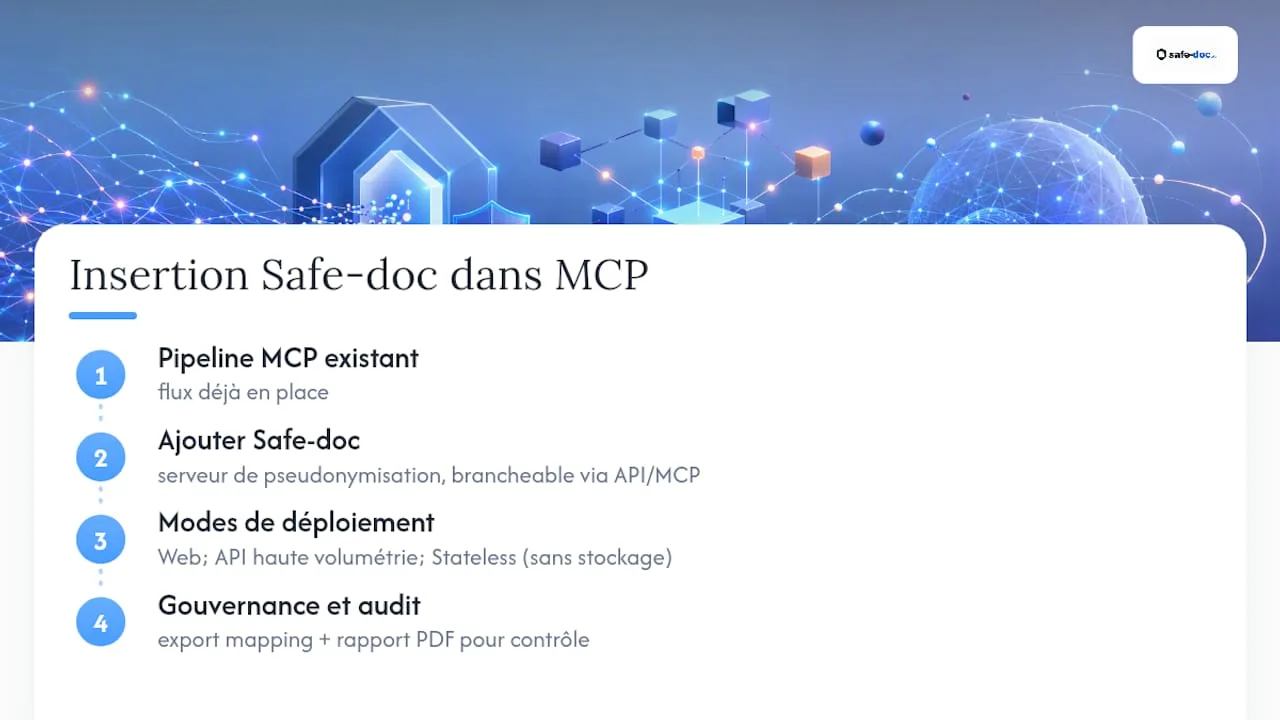
Three deployment scenarios come up most often among teams evaluating this approach: web use for the occasional needs of a legal or HR department, API integration for high-volume automated flows, and stateless mode for organizations that categorically refuse any persistence of data, even temporary, in their AI pipeline.
For the governance and audit side, which remains the main point of friction in most pseudonymization projects, the platform generates an export of the mapping to enable controlled restoration of the data, as well as a PDF report documenting the processing and residual risk analysis. These are exactly the documents a data protection officer must be able to produce in the event of an audit, without having to manually reconstruct the history of processing carried out by a technical team six months earlier.
Should you choose MCP and pseudonymization, or another approach?
The debate around AI pseudonymization often revolves around a false alternative: "pseudonymize" versus "do nothing and hope the AI provider honors its contractual commitments." This framing underestimates a third option, far more common in companies than technical discussions suggest: Shadow AI-employees who paste extracts from contracts, HR files, or financial reports into ChatGPT without any filter, simply because it's faster than waiting for IT approval.
This is where the technical argument of this article meets an organizational reality. An MCP pseudonymization server, no matter how well designed, only protects the flows that actually pass through it. If an employee can still open a tab and paste plain text elsewhere, the most rigorous architecture in the world is useless. The real question is therefore not only "which integration pattern to choose," but "how to make the secure path simpler than the bypass."
This is a point few technical guides address head-on, because it shifts the problem from the engineering realm to that of adoption. An elegant MCP integration, but limited to three developers who configured it, does not reduce enterprise-wide risk. The real gain comes when pseudonymization becomes the quickest route, not just the most compliant, for everyone-from the lawyer drafting a memo to the HR manager preparing a disciplinary file.
From technical guide to implementation with Safe-doc
Building an in-house MCP pseudonymization server means managing personal data detection, session mapping, correspondence encryption, and auditability, often by combining several open source projects to cover each scenario. Safe-doc brings these building blocks together in a single platform, without durably storing your documents, which saves your IT team from maintaining the correspondence and security infrastructure required by projects like dnjfr or woladi.
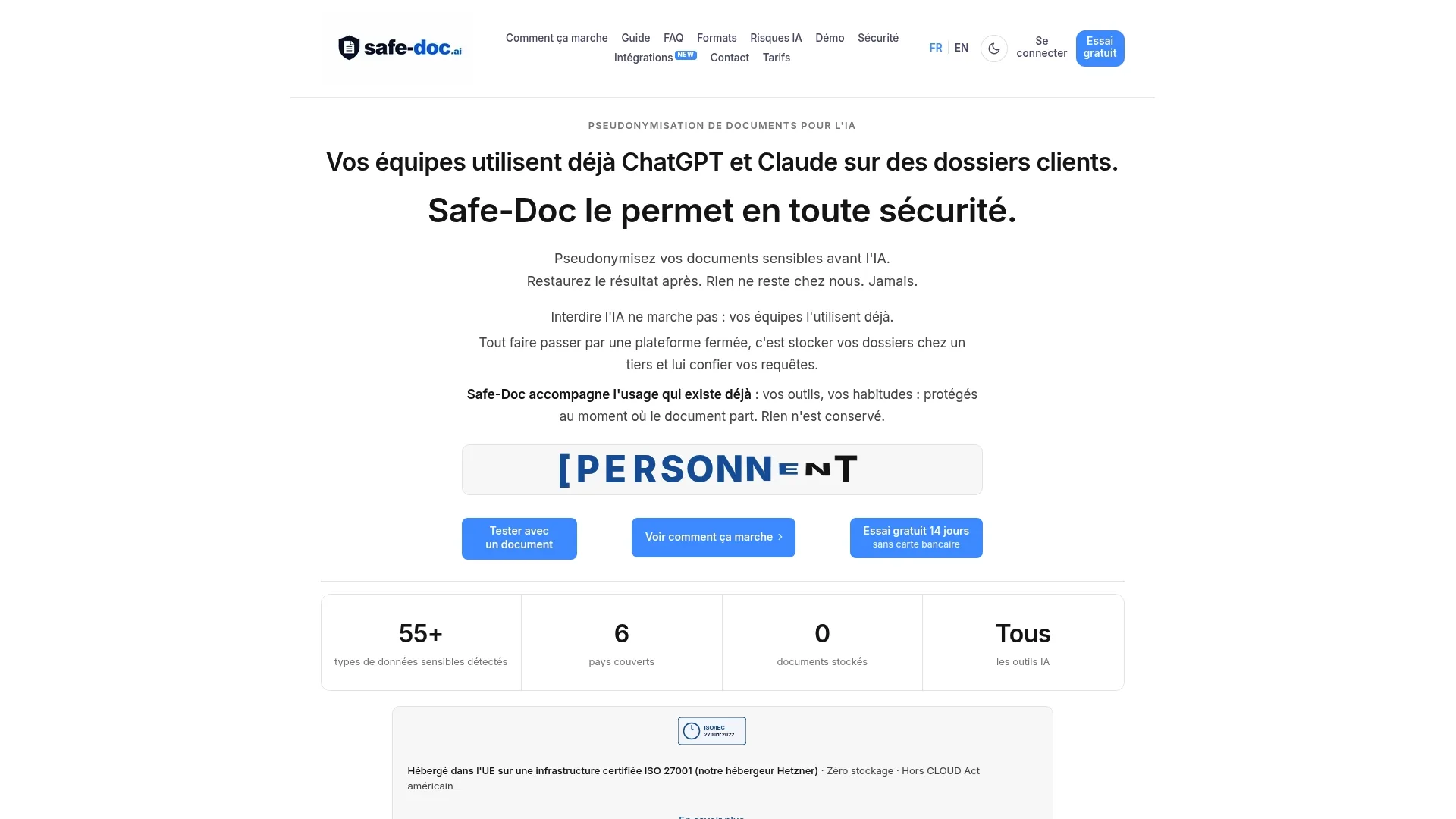
The platform is particularly suited to legal departments, IT departments, and audit firms that handle contracts, HR files, or financial reports and want to continue using ChatGPT or Claude without exposing confidential information. Automatic detection of over 90 data types, coupled with native MCP integration for technical teams, gets you started without rewriting your existing workflows.
If your organization is looking to quickly secure its uses of generative AI without months of engineering, the best next step is to test the platform on a real document and examine the residual risk report it generates.
Sources
To delve deeper into compliance and technical implementation, consult directly the documents and projects cited in this article: