


Protecting an industry benchmark based on customer data requires combining four levers: strict classification of the data being compared, stateless pseudonymization at the point of sharing, locked-down contractual clauses, and documented re-identification testing before any distribution. None of these elements is sufficient alone. Perfect encryption will not prevent cross-referencing with public files from revealing the identity of a customer cited anonymously in a table of industry margins.
Here are the actions to launch today to secure a benchmark currently under construction:
- Map the datasets being used and note their level of sensitivity (low, medium, high).
- Pseudonymize upstream any data transmitted to an analysis or AI tool, without durably storing the source document.
- Lock down exchanges with NDAs and non-reuse clauses before any external sharing.
- Have re-identification tested on a representative sample before publication or distribution.
- Log each access to the benchmark to maintain proof in the event of an audit or incident.
- Train business teams who handle this data to recognize risky use, particularly via consumer AI tools.
The benefit is measurable: reduced exposure surface in the event of a leak, and demonstrable GDPR compliance before the CNIL if an audit occurs.
Key Points
Protecting an industry benchmark requires combining rigorous classification, stateless pseudonymization, contractual lockdown, and documented re-identification testing before any distribution.
| Point | Details |
|---|---|
| - | - |
| Classify before protecting | Establish a criticality table that associates each benchmark variable with its actual risk level. |
| Choose the right method | Use reversible pseudonymization to return individualized results, anonymization for external distribution. |
| Lock down contracts | Integrate NDA, non-reuse clause, and audit rights before any sharing with an external partner. |
| Test re-identification | Simulate cross-referencing with public sources before publication to validate the k-anonymity threshold. |
| Adopt stateless processing | Safe-Doc pseudonymizes sensitive documents in real time without durably storing them, with exportable mapping under internal control. |
Table of Contents
- Mapping and classifying benchmark data: what to protect and why
- What technical measures actually secure a benchmark?
- Pseudonymization and anonymization adapted to benchmarks: which method to choose?
- Governance, contracts, and legal obligations: what should your legal framework cover?
- How to test re-identification before releasing a benchmark
- Sources
Mapping and classifying benchmark data: what to protect and why
An industry benchmark is never a simple table of neutral figures. It often aggregates pricing practices, margin rates by customer segment, purchasing volumes, and sometimes anonymized contract extracts. These elements may fall under trade secrets, in the same way as a raw customer file, insofar as they reveal a commercial strategy or competitive advantage.
The difficulty is that this benchmark data often escapes traditional security policies, which are designed for personal data or contractual documents. Cigref warns of this blind spot: a company must define its own business sensitivity grid rather than waiting for an external standard that will not come.
Here is a classification procedure that works for most IT departments:
1. List each benchmark variable (price, margin, volume, customer segment, geographic area).
2. Assess the impact of disclosure for each variable: low, medium, or high.
3. Cross this assessment with the number of third parties having access to the source file.
4. Produce a criticality table that associates each variable with its risk level and the required protection measure.
5. Have this table validated by the DPO and the legal department before any sharing.
Let's take a concrete case. A consulting firm compiles a pricing benchmark for ten clients in the same industry. Annual volumes and negotiated discounts are classified as "high impact" because they allow a specific customer to be identified by deduction. Industry averages aggregated across more than thirty companies fall into "low impact": pooling dilutes the risk of individual identification.
Pro tip: never classify a benchmark just once for its entire lifespan. Data aggregated across five customers changes status if the panel drops to three: reclassify each time the scope is updated.
What technical measures actually secure a benchmark?
A criticality table is useless without the technical controls that flow from it. IT management must verify, line by line, that each identified sensitivity level corresponds to a concrete measure, not to an intention.
The technical foundation rests on a few non-negotiable pillars:
- Encryption in transit and at rest: every benchmark file, including intermediate versions stored on a workstation, must be encrypted with centralized key management separate from the teams handling the data.
- Data sovereignty: if the benchmark concerns customers subject to strict sectoral requirements (health, finance, defense), verify where encryption keys and backup copies are hosted.
- Identity and access management: apply an RBAC or ABAC model coupled with multifactor authentication, limiting access to the benchmark to only those with a genuine business need.
- Endpoint monitoring: a detection and response tool (EDR/XDR) reduces the risk that a benchmark file leaves the company via a compromised workstation or an unauthorized USB key.
- Immutable backup: apply logic close to the 3-2-1-1-0 model, with at least one offline copy and one immutable copy, to prevent ransomware from also encrypting your backups.
- Tamper-proof logging: each access, export, or modification of the benchmark must generate a timestamped trace, maintained in a system separate from the one hosting the data.
These building blocks are not theoretical. IBM notes that a robust data protection strategy systematically combines enhanced authentication, secure backup, and regulatory compliance-the three operating in silos have little effect.
A figure to remember: the Wavestone cyber 2026 benchmark indicates that organizations' cyber maturity is average, and that monitoring and audit constitute major levers for progress. For an industry benchmark, this translates concretely: without an exploitable access log, it is impossible to prove who viewed what, nor to react quickly in the event of a compromise.

Pseudonymization and anonymization adapted to benchmarks: which method to choose?
The confusion between pseudonymization and anonymization is costly for IT teams. Pseudonymization replaces identifying data with a technical identifier but remains reversible via a correspondence table maintained separately. Anonymization irreversibly destroys the link: no key allows you to return to the original data.
For an industry benchmark, the choice depends on the intended use. If you need to return individualized results to each participating client, reversible pseudonymization is required: it allows you to reconstruct who is who, under strict control. If the benchmark is intended for external publication or sharing with a partner, anonymization becomes the target, because it eliminates any risk of uncontrolled reversal.
The stateless workflow is a game-changer for teams using AI or BI tools to analyze these datasets. Concretely, the sensitive document is processed in real time, pseudonymized on the fly, then transmitted to the analysis tool without ever being stored on an intermediate server. This approach minimizes the exposure surface when third-party tools, including mainstream generative AI, are used to accelerate a benchmark analysis.
Three practical requirements accompany this choice:
- The correspondence mapping between real data and pseudonyms must remain under internal control, never with an external service provider without a specific clause.
- Reversibility must be tested regularly: a corrupted or poorly secured mapping cancels the entire pseudonymization effort.
- Exporting the mapping, when necessary to restore the original data, must follow an authorization procedure distinct from the one that grants access to the pseudonymized benchmark.
Pro tip: never confuse pseudonymization with absolute security. A pseudonymized file accompanied by overly precise context variables (company size, region, contract date) remains re-identifiable by cross-referencing. Pseudonymization reduces risk; it does not eliminate it.
Governance, contracts, and legal obligations: what should your legal framework cover?
Technical security protects the file. Contractual governance protects the company when the file circulates between several parties, which is almost always the case for an industry benchmark built with partners or external firms.
Here are the points to lock down before any signature:
1. Confidentiality clauses and NDAs explicitly covering benchmark data, not just "confidential information" in the broad sense.
2. Non-reuse clause prohibiting a partner from reusing aggregated data for another client or another project without written authorization.
3. Return or destruction clause setting a precise deadline at the end of the engagement, with proof of effective deletion.
4. Right of audit allowing your company to verify that the partner applies the promised technical measures.
5. Processing location specified in the contract, particularly if a subcontractor hosts or processes the data outside the European Union.
On the regulatory front, a Data Protection Impact Assessment (DPIA) becomes necessary as soon as the benchmark processes a significant volume of personal data or sensitive data within the meaning of the GDPR. The CNIL recommends documenting this analysis and applying measures proportionate to the identified risk, including legal basis and retention period. A contractual confidentiality guide details the specific clauses to integrate when AI tools are involved in processing.
Trade secrets complete this legal framework. To be enforceable in the event of a dispute, they require demonstrable protection measures: access register, named authorizations, documented circulation policy. Without material proof of these measures, a court may consider that the information was not treated as secret, and therefore not protectable as such.

How to test re-identification before releasing a benchmark
A benchmark can respect all classification and pseudonymization rules and still remain re-identifiable. The risk rarely comes from the file itself, but from its cross-referencing with public sources: annual reports, press releases, open industry data.
The testing procedure follows simulated-attack logic:
- Formulate a realistic attacker hypothesis: a competitor, a journalist, or a curious customer seeking to identify themselves in the benchmark.
- Measure the level of k-anonymity of the dataset-that is, the minimum number of individuals sharing the same visible attributes.
- Check the diversity of sensitive values within each group (l-diversity principle), to prevent a homogeneous group from revealing information by deduction.
- Simulate cross-referencing with public data available on the industry concerned, to assess whether the aggregation withstands this test.
Recent analyses on data protection in the AI era confirm that cross-referencing with public sources and overly small samples are among the leading causes of accidental re-identification.
| Threshold observed | Recommended corrective measure |
|---|---|
| - | - |
| k-anonymity below 5 | Aggregate more participants before publication |
| Homogeneous group on a sensitive variable | Introduce controlled randomization of values |
| Geographic granularity too fine | Move up to regional rather than local level |
| Sample below ten entities | Suspend external distribution of the segment concerned |
Each test must be documented in a report, annexed to the DPIA or to the benchmark criticality sheet. This document serves as concrete proof in the event of an audit or challenge by a customer appearing, even indirectly, in the compared data.
Evidence and method: what resources to consult to go further
A stateless pseudonymization system concretely reduces the number of sensitive documents passing through third-party servers-a critical point when a team uses ChatGPT or Claude to accelerate analysis of a benchmark. Automatic detection of several dozen types of sensitive data before any transmission limits human oversights, often the source of the costliest leaks.
To explore the method in greater depth, several authoritative references on this subject:
- The CNIL guide to personal data security details the technical and organizational measures expected by the regulator.
- The MEDEF guide on sensitive data specifies what constitutes trade secrets in a commercial benchmark context.
- The Cigref analysis on non-personal data proposes a classification method adaptable internally.
- The Wavestone cyber 2026 benchmark situates your maturity level relative to the market.
What Jacques takes away on protecting benchmarks
The operational priority is not technical; it is organizational: mobilize the DPO, the CISO, and the business teams from the design phase of the benchmark, not after its distribution. The classic trap is to overinvest in encryption and network monitoring while leaving sharing contracts without a non-reuse clause. A company can have the best infrastructure on the market and still lose a trade-secret dispute because it failed to formalize who had the right to do what with this data.
- Jacques
How Safe-Doc concretely secures your industry benchmarks
An industry benchmark almost always involves a risky tipping point: the moment when data leaves your perimeter to be analyzed, compared, or shared with an external partner. Safe-Doc addresses this precise moment without durably storing your documents, pseudonymizing more than 90 types of sensitive data in real time before they reach an AI tool or third-party platform.
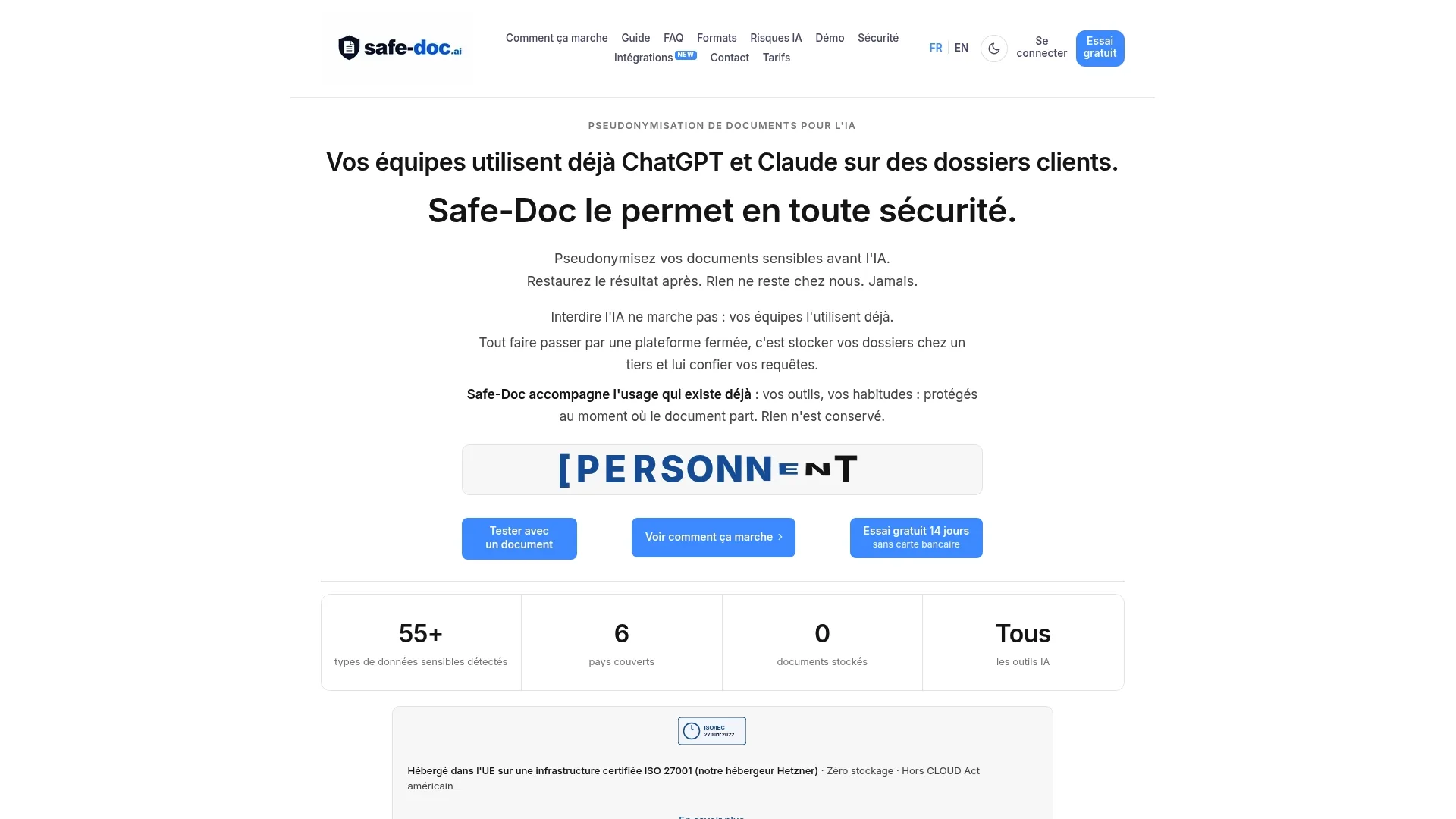
Concretely, before transmitting a benchmark file to an external partner for comparative analysis, you pass the document through Safe-Doc: customer identifiers, prices, and sensitive volumes are pseudonymized on the fly, and an exportable mapping remains under your control to restore the data if needed. API integrations allow you to automate this processing directly into your existing workflows, without changing your usual analysis tools. For a DPO who must demonstrate GDPR Article 4(5) compliance during an audit, the auditability function generates a detailed report of each processing operation performed.
Discover how the dedicated DPO page details this approach, or directly test how stateless processing works on an actual benchmark document.
Sources
To explore each aspect covered in greater depth, these references remain the most reliable: the CNIL guide for the regulatory method, the MEDEF guide for the legal qualification of sensitive data, the Cigref analysis for internal classification, the Lacour firm for trade secrets, and the ministry guide for the operational criticality grid.
- Sensitive data guide - MEDEF
- Guide to personal data security - CNIL
- Cigref - Protection of sensitive non-personal data
- Trade secrets, AI, and protection of intangible assets - Cabinet Lacour